
Caltech SAT Requirements: Why a 780 Reads the Same as an 800
On this page
- Caltech SAT Requirements for Fall 2027: What Is Actually Required
- Caltech SAT Score Buckets: What Each Range Actually Means
- What Caltech Looks at Beyond Your SAT Score
- How to Build a Caltech-Ready SAT or ACT Score
- FAQ: Caltech SAT Requirements and Score Buckets
- Is a 1450 SAT or 33 ACT better for Caltech?
- Does Caltech do interviews?
- What SAT score do I need to get into Caltech?
- What is the minimum SAT score required to get into Caltech?
Caltech requires the SAT or ACT from applicants for fall 2027 entry, with no preferred exam and no cutoff score. Caltech's bucket system is how it reads each section score: an SAT section of 780-800 or an ACT subscore of 35-36 reaches the committee only as "Bucket A," with the exact number hidden. Caltech superscores both tests and reads ACT subscores individually.
Those policies come from Caltech's standardized tests page. The harder question is whether your current score already clears the top bucket, because that answer decides where your remaining prep hours go before Caltech's testing deadlines.
Caltech SAT Requirements for Fall 2027: What Is Actually Required
Caltech requires first-year applicants for fall 2027 entry to submit the SAT or the ACT, and it prefers neither. Caltech reinstated the requirement in April 2024, starting with students entering in fall 2025, after pausing it in 2020.
No hard cutoff. Caltech publishes no minimum SAT or ACT score and reads each section through its bucket system alongside the rest of the file.
Caltech superscores both exams, taking your best section results across sittings. For the ACT, Caltech sets aside the composite and considers each individual subscore instead: Math, English, Reading, and the optional Science and Writing. For fall 2027 applicants, Caltech does not require the ACT writing or science subscores.
Caltech also asks applicants to report all AP and IB exams taken, regardless of score or whether they want them considered. Only enrolling students send official AP or IB scores later.
| Policy area | SAT | ACT |
| Accepted for fall 2027 (one required) | Yes | Yes |
| Preferred exam | Neither | Neither |
| Hard score cutoff | None | None |
| Superscored | Yes | Yes |
| How scores read | Section scores | Each subscore, not composite |
| Subscores not required | n/a | Writing, Science |
Caltech's Restrictive Early Action deadline is November 1, 2026, with materials accepted until November 6, but REA testing must be completed before November 30; for Regular Decision, due January 4, 2027, testing must be completed before December 31, 2026 (Caltech deadlines). QuestBridge applicants had to submit scores before October 31, 2026. Those testing dates, not the application deadline, set the limit on any retake. A section one bucket below the top forces the hardest call, so settle whether a retake fits that timeline before committing another month to prep.
Caltech SAT Score Buckets: What Each Range Actually Means
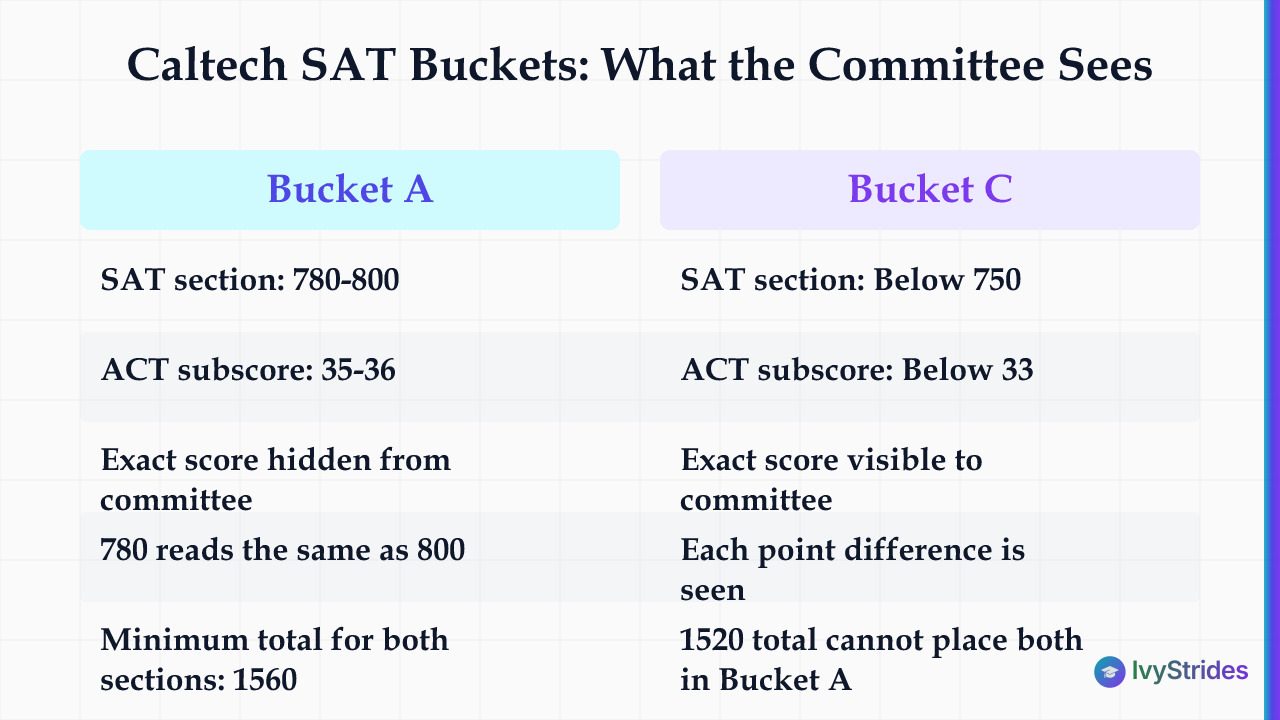
Caltech's standardized testing buckets sort each SAT section and ACT subscore into a range, and in Buckets A and B the committee sees only the bucket, not the number (Caltech's bucket explainer). A 780 Math and an 800 Math both reach review as "Bucket A," so a 780 does not read as worse than an 800.
Bucket A covers SAT section scores of 780-800 and ACT subscores of 35-36, a range in which Caltech's faculty research found only a small difference in students' grades at Caltech. Bucket B covers SAT 750-770 and ACT 33-34, where that difference was "larger, but still relatively small." A section below 750 SAT or 33 ACT falls in Bucket C, and the committee sees the exact score.
| Bucket | SAT Math | SAT R&W | ACT subscore | What the committee sees |
| A | 780-800 | 780-800 | 35-36 | "Bucket A," exact score hidden |
| B | 750-770 | 750-770 | 33-34 | "Bucket B," exact score hidden |
| C | Below 750 | Below 750 | Below 33 | The exact score |
Get your Daily IV Dose on Instagram: quick study tips and test-day advice for high school students. Follow @ivy.strides.
IvyStrides' analysis of Caltech's bucket table against the College Board's 200-800 section scale puts the lowest total with both sections in Bucket A at exactly 1560, 780 plus 780. A 1520 total cannot place both sections in Bucket A, so at Caltech what a 1520 SAT means depends on which section falls short and by how much.
One factor of five. Reaching Bucket A removes score as a differentiator, but it does not finish the application. Caltech's Common Data Set rates standardized test scores "Very Important" alongside rigor of secondary school record, the application essay, recommendations, and character and personal qualities (Caltech CDS 2025-26). Because Caltech reads each section separately, understanding how the Digital SAT section scores are calculated matters for targeting the right bucket.
What Caltech Looks at Beyond Your SAT Score

Photo by Poddar Group of Institutions on Pexels
Beyond the SAT or ACT, Caltech's holistic review looks for three central qualities, Capacity for Caltech Rigor, Scholarly Character, and Scientific Drive, and requires academic preparation to be established first. Caltech says that once that preparation is shown, admission is not determined simply by "small differences" in test scores, which is why the last few points inside Bucket A are not worth chasing. Caltech calls these qualities "not a checklist."
Capacity for Caltech Rigor means a strong math and science foundation, including demonstrated mastery of calculus, chemistry, and physics, judged against the courses available to you. Caltech states plainly that "limited access to opportunities does not equate to limited capacity" (what we look for). Scholarly Character covers integrity, resilience, and generosity in learning. Scientific Drive is depth of engagement, not a count of STEM activities.
More than 20 faculty do full reads of the most competitive files, and every admitted student receives a positive review from a professor (Caltech faculty process). Caltech's Common Data Set rates the interview "Not Considered," and its first-year application requirements include none. Students apply through the Common App or QuestBridge.
| Item | Caltech requirement |
| Standardized test | SAT or ACT, required for fall 2027 |
| Course rigor | Calculus, chemistry, physics |
| Application essay | Very Important factor |
| Recommendations | Two subject-specific teacher letters |
| Supplemental essays | STEM interest, Scholarly Character, two Scientific Drive, one community question, plus an optional academic short answer |
| Interview | Not Considered |
| AP/IB exams | Report all taken |
For fall 2027, Caltech asks for a 150-200 word answer on why you chose your STEM area of interest, one Scholarly Character essay of up to 200 words, two Scientific Drive essays of up to 200 words each, and a 100-150 word answer on what you would contribute to the Caltech community (Caltech supplemental essays).
When reviewing these drafts, IvyStrides essay coaches push for one specific question or problem as the topic rather than a survey of activities, matching Caltech's own language about depth of engagement. Caltech's examples of Scientific Drive include repairing devices and rebuilding a tractor on a farm, so an ordinary topic can carry a compelling essay when it shows how you think.
MIT also requires the SAT or ACT from applicants for fall 2027 entry, but Caltech's dean of admissions, Ashley Pallie, says that to Caltech's knowledge no other school uses a bucket system, one of several ways the two schools weigh applicants differently. Meeting Caltech's academic readiness standard does not guarantee admission.
How to Build a Caltech-Ready SAT or ACT Score
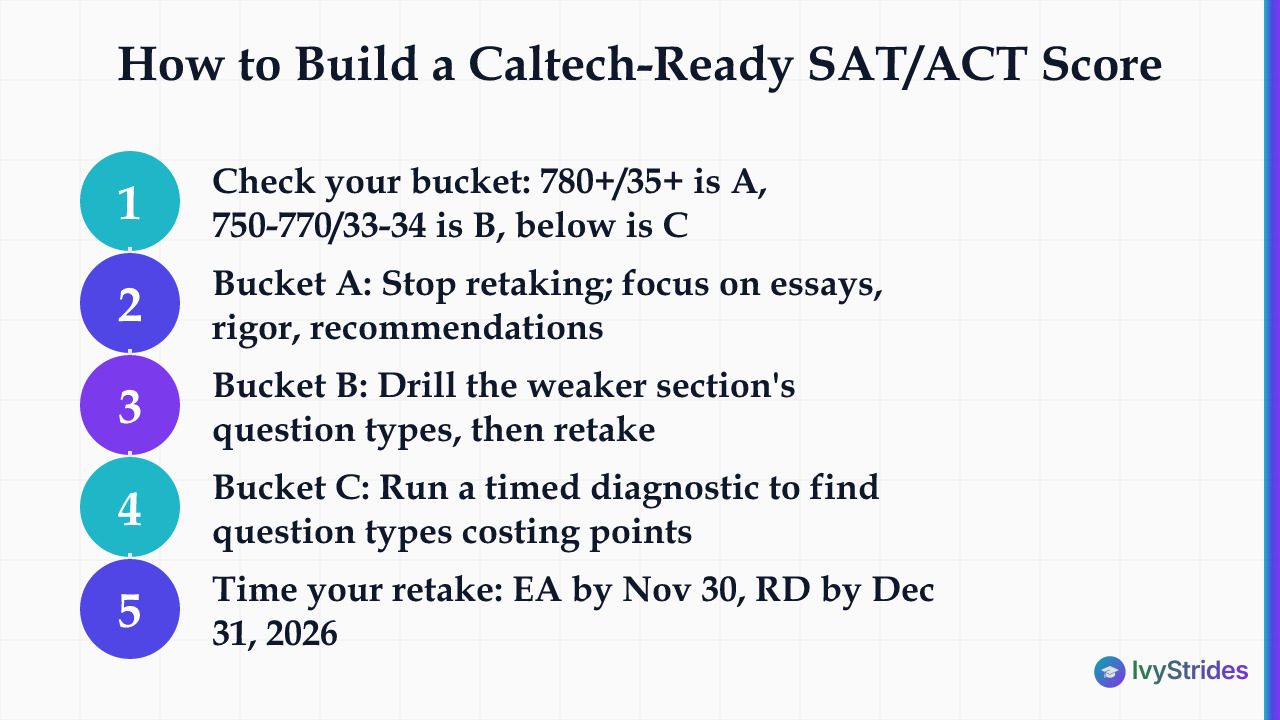
Your Caltech prep next step depends on which bucket each section occupies, because the bucket decides whether score is still a usable lever. With both sections in Bucket A, another retake changes nothing the committee sees; a Bucket B section has a defined gap to the top tier.
Bucket A already? Stop chasing points; Caltech itself says retaking for a perfect score "is not a good use of your time." Redirect your hours to course rigor, the supplemental essays, and recommendation relationships, where the remaining Very Important factors live.
For students in Bucket B who want to reach Bucket A, the path runs through targeted work on whichever of Reading and Writing or Math sits below 780. A retake makes sense only when that section sits close enough to 780 to close before the testing deadline for your round.
The Digital SAT gives 44 Math questions in 70 minutes and 54 Reading and Writing questions in 64 minutes, and in each section your first module decides whether the second is harder or easier (College Board). Your misses on official Bluebook practice tests show which SAT Math domains and question types hold a section below 780, and those are the ones to drill.
This video ranks five SAT Math topics by difficulty, showing which domains like quadratics and geometry most often hold scores below target.
More videos like this one: follow IvyStrides on YouTube for daily SAT and ACT preparation tips.
For the ACT, Caltech reads each subscore on its own and superscores, so Math and English can be raised at separate sittings: ACT Math is 45 questions in 50 minutes, English 50 in 35, Reading 36 in 40 (ACT).
| Your current section score | Bucket | Recommended next step | What the committee sees |
| 780+ SAT or 35+ ACT | A | Essays, rigor, recommendations | "Bucket A" only |
| 750-770 SAT or 33-34 ACT | B | Target the weaker section's question types | "Bucket B" only |
| Below 750 SAT or 33 ACT | C | Diagnostic first, then a retake plan | The exact score |
At IvyStrides, students aiming for Caltech's Bucket A work with section-specialist SAT coaches who find the question types holding a Math or Reading and Writing score below 780, so practice goes to those types instead of more full-length tests that only confirm the gap. That work is the core of our one-on-one SAT prep for a specific section gap. For a Bucket C section, start with a timed diagnostic, because an SAT retake plan works from the question types that cost you points.
A retake that misses November 30 can still count for a Regular Decision application if completed before December 31, 2026.
FAQ: Caltech SAT Requirements and Score Buckets
Is a 1450 SAT or 33 ACT better for Caltech?
Neither, because Caltech buckets each section, not the total or the composite. A 1450 SAT total cannot have both sections at 750 or above (that would require at least 1,500), so at least one section falls below 750 and lands in Bucket C. Caltech sets aside the ACT composite, so check the subscores: 33-34 is Bucket B, 35-36 is Bucket A. Put retake time into the section closest to the next bucket.
Does Caltech do interviews?
No. Caltech lists no interview among its first-year application requirements, and its 2025-26 Common Data Set marks the interview "Not Considered." Applications arrive through the Common App or QuestBridge, and the review draws on supplemental essays, two teacher recommendations, and, for the most competitive files, faculty reads.
What SAT score do I need to get into Caltech?
Caltech sets no minimum SAT score and no cutoff. Its bucket system shows SAT section scores of 780-800 to the committee only as Bucket A, so 780 per section is the clearest prep goal. Caltech also says successful applicants have traditionally scored 700 or higher on each SAT section. Test scores are one of five factors its Common Data Set rates Very Important.
What is the minimum SAT score required to get into Caltech?
Caltech publishes no minimum SAT score; its faculty "very intentionally" chose not to set one, though a score is required for fall 2027 entry. A section below 750 falls in Bucket C and is shown at its exact value, and Omer Tamuz, chair of Caltech's undergraduate admissions committee, says Caltech has typically admitted a handful of students with scores below 750 each year.

Hemant is a seasoned entrepreneur, investor, and growth strategist with deep ground in education and technology-driven learning. His core training is in Mathematics and Physics — he authored Physics for IB Diploma: Ultimate Revision Guide, recognized as a top student resource.