
Caltech vs MIT: Both Admit Under 5%, but Read Applicants Differently
On this page
- Caltech vs MIT: Selectivity, Size, and What Each School Actually Weighs
- What Caltech Looks for: Rigor, Scholarly Character, and Scientific Drive
- What MIT Looks for Beyond Grades and Test Scores
- Caltech vs MIT Application Process: Portals, Deadlines, and What Each School Requires
- FAQ: Caltech vs MIT Admissions
- Is Caltech or MIT harder to get into?
- Is Caltech or MIT more prestigious?
- Does applying REA to Caltech prevent applying Early Action to MIT?
- Is Caltech or MIT better for computer science?
Caltech and MIT both require the SAT or ACT for the 2026-27 cycle (fall 2027 entry), and both admitted under 5% of first-year applicants for fall 2025. Caltech is far smaller; faculty read its most competitive applications, and every student it admits has a positive review from a professor. MIT is larger and runs its own application portal.
The harder question is not which school is harder to get into but which application you can honestly build, because the two name different qualities as decisive.
Caltech vs MIT: Selectivity, Size, and What Each School Actually Weighs
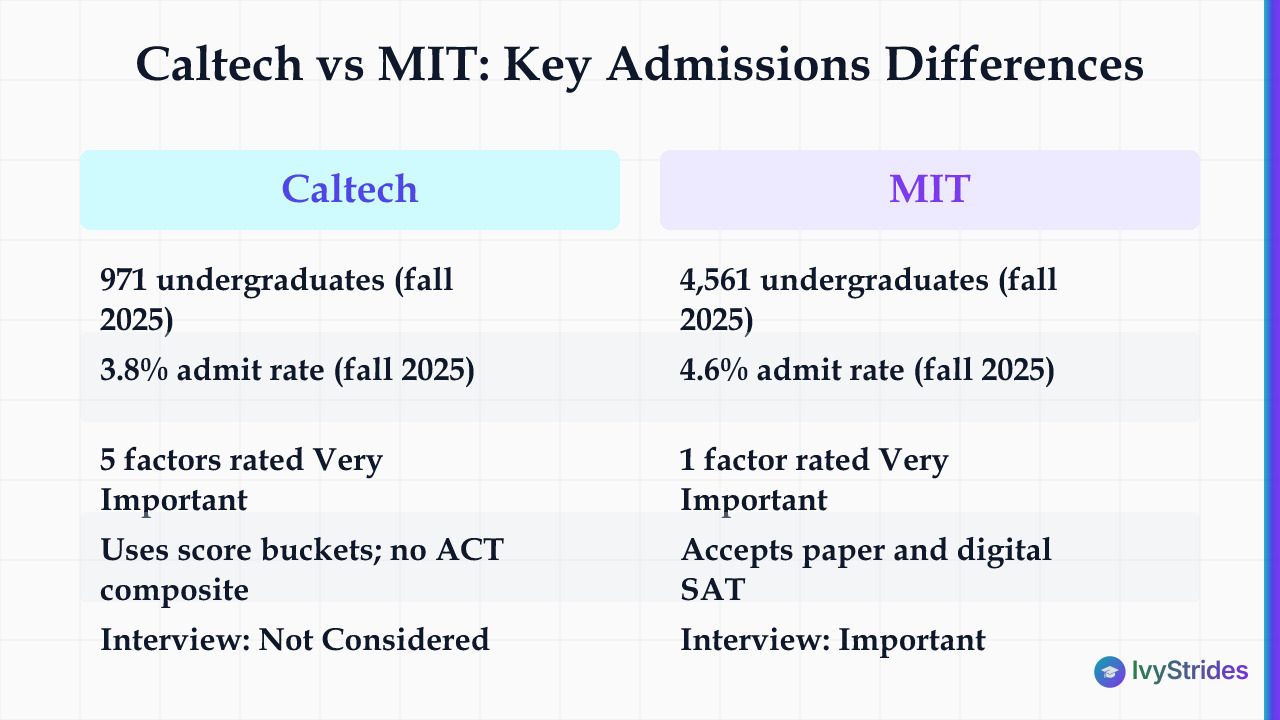
Caltech and MIT are both test-required STEM universities for the 2026-27 cycle (fall 2027 entry), and both use holistic review once academic preparation is established. The sharpest difference is scale: Caltech had 971 undergraduates in fall 2025 to MIT's 4,561, per each school's 2025-26 Common Data Set.
Test policy differs in the detail. For fall 2027 entry, Caltech requires the SAT or the ACT and prefers neither. It sets aside the ACT composite, considers each ACT subsection score instead, and does not require the ACT writing or science subscores. MIT also requires the SAT or the ACT from all first-year applicants for fall 2027, accepts the paper and digital SAT, and does not require the ACT writing or science sections or the SAT essay.
Caltech also groups scores by section. Reviewers see an SAT section of 780 to 800 or an ACT subscore of 35 to 36 only as Bucket A, and 750 to 770 or 33 to 34 only as Bucket B; below 750 or 33, the exact score is shown. A lopsided ACT therefore reads differently at Caltech than at a composite-averaging school, so build your prep around your weakest section.
What each school says it weighs comes from section C7 of that Common Data Set (CDS). Caltech lists five Very Important factors; MIT lists one.
| Factor | Caltech | MIT |
| Rigor of secondary record | Very Important | Important |
| Standardized test scores | Very Important | Important |
| Application essay | Very Important | Important |
| Recommendations | Very Important | Important |
| Character/personal qualities | Very Important | Very Important |
| Interview | Not Considered | Important |
Source: Caltech CDS 2025-2026, posted August 2026, and MIT CDS 2025-2026.
Character is where the two agree: both rate it Very Important, and MIT places character above every other factor it weighs.
IvyStrides' analysis of Caltech's 2025-26 CDS, 428 admits from 11,285 first-year applicants for fall 2025, puts that year's admit rate at 3.8%, and Caltech says it admits under 5% in both early and regular rounds. MIT reports admitting 1,334 of 29,281 applicants (4.6%) for the Class of 2029, which entered in fall 2025. Rates move every year, and admission depends on the full file, never on scores alone.
What Caltech Looks for: Rigor, Scholarly Character, and Scientific Drive
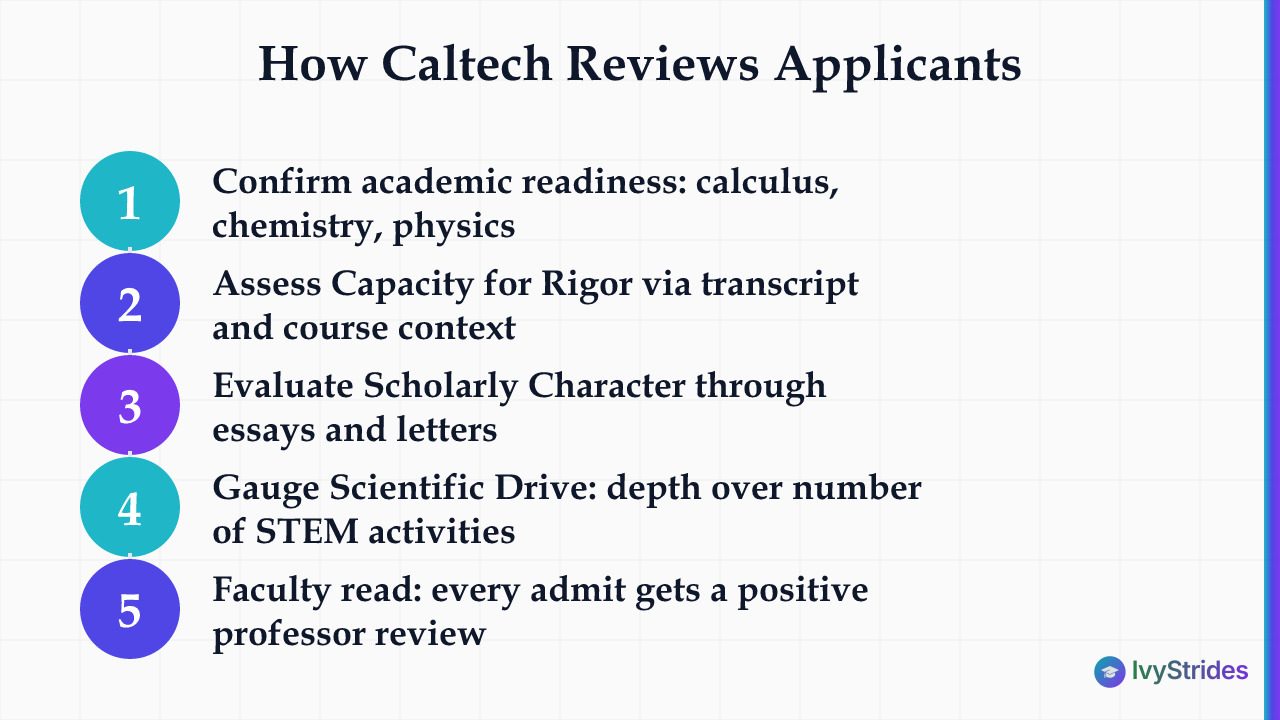
Caltech names three central qualities it reads applicants against: Capacity for Caltech Rigor, Scholarly Character, and Scientific Drive. It is explicit that these are not a checklist. Academic readiness comes first: once preparation including calculus, chemistry, and physics is established, reviewers look at how a student handles hard work, setbacks, and collaboration.
Rigor means mastery, judged in context. Caltech requires four years of math including one year of calculus, one year of physics, one year of chemistry, four years of English, and two years of history or social science. Caltech says limited access to opportunities does not equate to limited capacity, yet the calculus prerequisite stands; a student with no access to the course can substitute set AP or IB scores or an approved online course challenge.
| Quality | What Caltech Looks For | Where It Shows |
| Capacity for Caltech Rigor | Mastery of calculus, chemistry, physics in context | Transcript, course rigor, subscores |
| Scholarly Character | Integrity, resilience, generosity in learning | Scholarly Character essay, letters |
| Scientific Drive | Depth of engagement, returning to questions | Scientific Drive essays, portfolio |
The gap to check for is an essay that describes STEM participation rather than the depth Caltech's Scientific Drive quality asks for. Caltech is explicit that depth of engagement matters, not the number of STEM activities. Students often benefit from a counselor who tests each essay draft against the quality it is meant to show.
The faculty read is the structural difference. After staff review, more than 20 faculty do full reads of the most competitive applications, and every admitted student receives a positive review from a professor.
Supplementals are short and specific. For fall 2027, Caltech's required STEM academic interest essay runs 150-200 words, the Scholarly Character essay (one of two prompts) and each of the two Scientific Drive prompts you choose from three top out at 200 words, and a fun question about what you would contribute to the Caltech community takes 100-150. Caltech also requires two subject-specific teacher letters, one STEM and one humanities or social science.
Two optional submissions can add evidence of Scientific Drive: a STEM portfolio and a research paper. A submission counts as research if you worked with a university or research-affiliated lab, reported to a senior researcher, and produced a paper published, submitted, or in preparation. Knowing how long a serious high school research project takes helps you judge whether it's realistic before deadlines.
AP results are visible at both schools. Both schools ask you to self-report your AP and IB exams, and neither needs official scores until a student enrolls, so which AP exams you sit becomes a visible part of the file at either school. AP credit and placement policies vary by college, so confirm each school's current policy before assuming a 5 earns anything.
What MIT Looks for Beyond Grades and Test Scores

Photo by Andy Barbour on Pexels
MIT frames selection around fit: where Caltech names three qualities, MIT lists eight components of the match between applicant and Institute. MIT states it's really the match that drives selection, not grades alone. Where Caltech front-loads scientific depth, MIT front-loads fit with its mission and its collaborative culture.
| Quality | What MIT Says | Where It Shows |
| Mission alignment | Using scholarship to make the world better | "Impact on community" essay |
| Collaborative spirit | Group problem sets, cross-department labs | Teacher letters, activities |
| Initiative | Pursuing opportunities and hard coursework | Activities, short responses |
| Risk-taking, resilience | Not afraid to fail; builds support | Essays, recommendations |
| Hands-on creativity | Mind and Hand: do, don't just think | Maker work, portfolio |
| Intensity, curiosity | Quality over quantity | Four-activity list |
| Balance | Fulfillment outside academics | "Just for fun" response |
| Community character | Feeling responsible to your communities | Essays, recommendations |
Source: MIT Admissions: What We Look For. MIT is blunt that impact can be small in scale. Tutoring a single kid in math, it says, changes the world. Students who always prefer working alone may not be happy there.
The application enforces the philosophy. MIT runs its own portal, not the Common App. You write four short-answer essays of about 100-200 words each and four short responses of 40-50 words each, and you can list only four activities, not a full resume.
Don't carry your Caltech Scientific Drive narrative straight to MIT, whose 40-50 word short responses probe personality instead: what you do just for fun, someone you admire, a topic you could talk about for hours, and whether you are a generalist or a specialist. The same essay rarely serves both.
MIT also accepts optional SlideRoom portfolios: a Research Supplement plus music and theater arts, visual art and architecture, and maker portfolios. Maker Portfolio reviewers say they care more about your build process than your end result. An alumni Educational Counselor interview is offered where available and waived with no penalty where it isn't; MIT's CDS rates the interview Important, not decisive.
Caltech vs MIT Application Process: Portals, Deadlines, and What Each School Requires
Caltech and MIT run different portals, essay structures, and early rounds. Caltech uses Restrictive Early Action (REA), due Nov 1, 2026, with materials accepted until Nov 6 and decisions by mid-December, then Regular Decision, due Jan 4, 2027, with decisions by mid-March. MIT uses non-restrictive Early Action, due Nov 1 with decisions in mid-December, and Regular Action due Jan 4 with decisions in mid-March.
| Requirement | Caltech | MIT |
| Portal | Common App or QuestBridge | MIT's own portal |
| Early round | Restrictive Early Action, Nov 1 | Early Action (non-restrictive), Nov 1 |
| Regular deadline | Regular Decision, Jan 4 (materials to Jan 10) | Regular Action, Jan 4 |
| Essays | STEM interest (150-200), Scholarly Character (one of two) and two of three Scientific Drive (max 200 each), fun question (100-150) | Four short-answer (~100-200), four short (40-50) |
| Activities | Common App activities | Four-activity limit |
| Teacher letters | Two: STEM + humanities/social science | Two; suggested math/science + humanities/social science/language |
| Interview | Not Considered (CDS C7) | Important; alumni EC where available |
| Optional extras | STEM portfolio, research paper | Research Supplement; maker and arts portfolios |
The two early rounds do not combine: Caltech's REA bars Early Action and Early Decision applications elsewhere, and its narrow exceptions, such as schools outside the US and non-binding public universities, do not include MIT. A Caltech REA applicant can apply to MIT only in Regular Action; an MIT Early Action applicant can still apply to Caltech in Regular Decision. Because only one of the two can get your early application, settle how Early Decision, Early Action, and Regular Decision rounds compare before choosing.
The C7 factor ratings are the most reliable published view of what each office weighs, and reading the Common Data Set sections that matter for applicants keeps you honest about it. Before Nov 1, check your weakest SAT section or ACT subscore against Caltech's ranges, list every AP and IB exam you have taken, draft the Caltech and MIT essays as different stories, and decide which school gets your one early application.
FAQ: Caltech vs MIT Admissions
Is Caltech or MIT harder to get into?
Both admitted under 5% of first-year applicants for fall 2025: 3.8% at Caltech and 4.6% at MIT, per each school's published counts. Caltech's class is far smaller, so it has fewer seats. A direct difficulty comparison matters less than whether your file shows the qualities each school names.
Is Caltech or MIT more prestigious?
Both are widely regarded as peers among the world's leading science and technology universities, and rankings vary by source. Caltech calls itself an unapologetic STEM institution; MIT's Latin motto means Mind and Hand. The useful question is which environment fits your goals.
Does applying REA to Caltech prevent applying Early Action to MIT?
Yes. Caltech's Restrictive Early Action bars Early Action and Early Decision applications elsewhere, and its narrow exceptions, such as schools outside the US and non-binding public universities, do not include MIT. Apply to MIT in Regular Action by Jan 4, or pair MIT Early Action (Nov 1) with Caltech Regular Decision (Jan 4, 2027).
Is Caltech or MIT better for computer science?
Computer science was the second most common intended option in Caltech's Class of 2030 profile, but Caltech's whole undergraduate body is about a fifth the size of MIT's, so the choice is between a small, tight-knit program and a large ecosystem.

Hemant is a seasoned entrepreneur, investor, and growth strategist with deep ground in education and technology-driven learning. His core training is in Mathematics and Physics — he authored Physics for IB Diploma: Ultimate Revision Guide, recognized as a top student resource.