
How to Write the Extracurricular Essay in 2026: A Step-by-Step Guide That Actually Works
On this page
- What the Extracurricular Essay Is Really Asking You to Do
- How to Choose the Right Extracurricular Activity to Write About
- How to Structure Your Extracurricular Essay Narrative
- How to Hit 150 or 250 Words Without Losing Your Story
- FAQ: Writing the Extracurricular Essay
- How do I write an extracurricular activity essay?
- How to write about extracurriculars?
- Is ChatGPT good for college essays?
- How do I start off a 250 word essay?
- Your Next Step on the Extracurricular Essay
To write the extracurricular essay, pick one activity where you showed real commitment, open with a specific scene instead of a general statement, describe your personal role and the problem you faced, then close with the impact that followed. The extracurricular essay is a short supplemental prompt about one activity.
Most target schools cap this prompt at 150 or 250 words, so every sentence has to earn its place. The framework below covers activity selection, narrative structure, and word-count execution, in the order you actually need them.
What the Extracurricular Essay Is Really Asking You to Do
The extracurricular essay is a short-form supplemental essay that asks you to expand on one activity from your application, usually in 150 or 250 words. It works as an elaboration prompt: the school already sees your title and hours in the activities list, so this space exists to reveal character and growth, not to restate what you did.
What the admissions reader wants. Character, values, growth, and contribution. An admissions reader scanning fifty files a day looks for the person behind the entry, not a second resume. The strongest drafts show a decision you made, a problem you solved, or a way you changed, and they do it through one specific scene.
The activities list gives you 150 characters per entry to state what you did; the extracurricular essay is where you show why it mattered, so the two documents should complement each other, not repeat the same information. If you need help with those short entries, our guide to how to write strong activities list descriptions covers that document separately.
Here is how the three main writing documents differ, per Common App official limits.
| Document | Word Limit | What It Shows | Common Mistake |
| Personal statement | 650 words | Your core identity or story | Trying to cover everything |
| Extracurricular essay | 150 or 250 words | Depth in one activity | Restating the activities list |
| Activities list | 150 characters | What you did, briefly | Vague, verb-free phrasing |
The Common App essay prompts for 2025-2026 stay unchanged from the prior year, per Common App's official announcement, so the personal statement remains a separate 650-word document. Students working with a college counselor on their full application strategy will want to confirm which schools on their list require this prompt before drafting. Supplemental requirements vary by school, so verify each one on the school's own supplement page.
Most students applying to eight to twelve schools write somewhere between fifteen and thirty supplemental essays in total, and you can see how many supplemental essays you will write school by school. The extracurricular prompt is one of them.
How to Choose the Right Extracurricular Activity to Write About
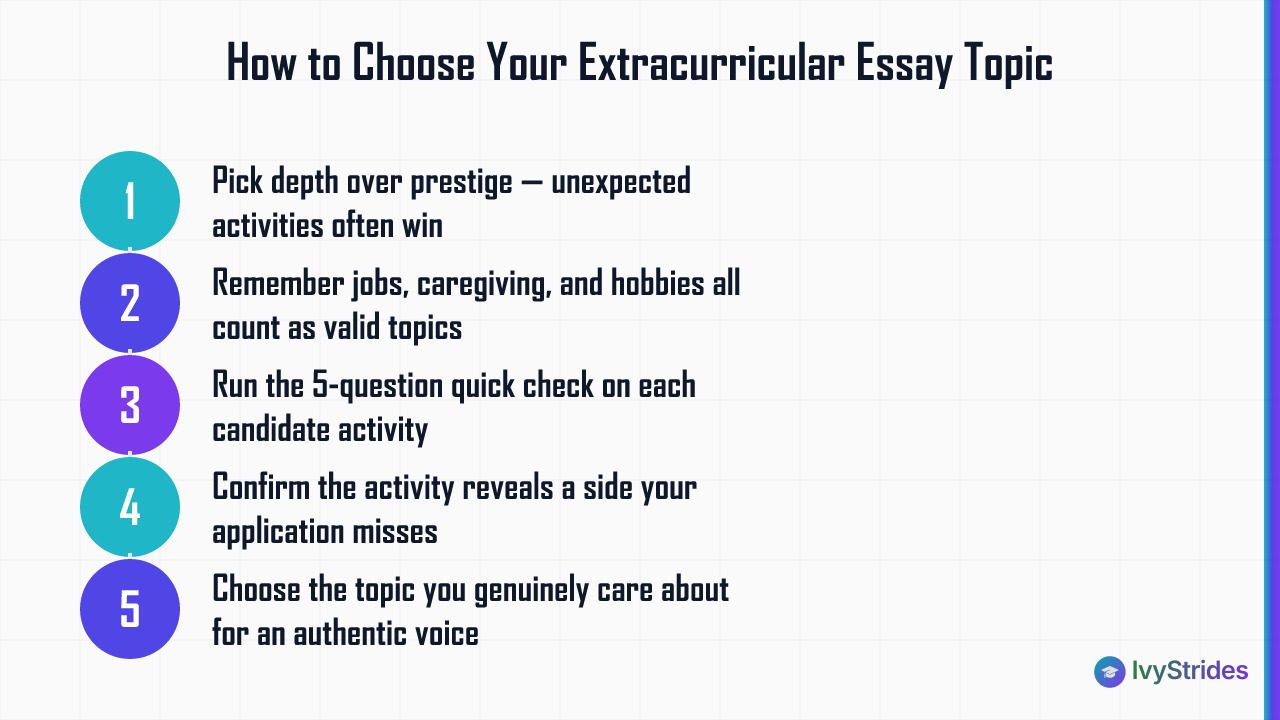
Choose the activity where you showed the most depth, initiative, or personal meaning, not the one with the most prestigious title. Depth beats prestige every time in the extracurricular essay. A part-time job, a family responsibility, or a niche hobby can carry a stronger essay than model UN if it reveals a real dimension of who you are.
Paid work and family duties count. Common App guidance treats a job, caregiving, or an informal passion as fully valid activity topics. No leadership title required. In our coaching with students drafting supplemental essays, the ones who write about an unexpected activity often produce a more memorable essay than those who default to the most impressive line on the list.
Run each candidate activity through this quick check before you commit a draft to it.
- Did I show real commitment or initiative here? A yes means there is a story, not just attendance.
- Does this reveal a side of me the rest of my application misses? A yes means it earns its own essay.
- Can I name one specific moment inside it? A yes means you have an opening scene.
- Am I about to repeat my personal statement topic? A yes means pick something else.
- Do I actually care about this? A yes means your voice will sound like a person.
That last question matters more than it looks. Genuine interest keeps a 150-word essay from reading like a form response. If you are still stuck between options, our guide to college essay ideas that work walks through the wider brainstorming process.
How to Structure Your Extracurricular Essay Narrative
Two structures carry almost every extracurricular essay: the narrative arc and the montage approach. The narrative arc moves through problem, stakes, action, and impact, and it fits any activity with a single defining story. The montage approach threads three facets of a multi-sided activity through one unifying insight, and it fits students whose role spanned several distinct tasks.
Open with a specific scene, never a summary. In our coaching, the single most common structural error is opening with a general statement rather than an inciting incident. Watch the difference:
- Weak opener: "I have been involved in robotics for three years."
- Strong opener: "At 11 p.m. the night before regionals, our robot's arm snapped."
The second sentence sets stakes, names a scene, and pulls the reader in. That is show, don't tell in one line. Our guide to show, don't tell in college essays breaks the technique down with more before-and-after examples.
Clarify your role. Write what you personally did, not what the team accomplished. "We won the district title" tells the reader nothing about you. "I rewired the arm servo in the pit at 6 a.m." puts you on the page. Then land the impact: on yourself, your team, your community, or the field.
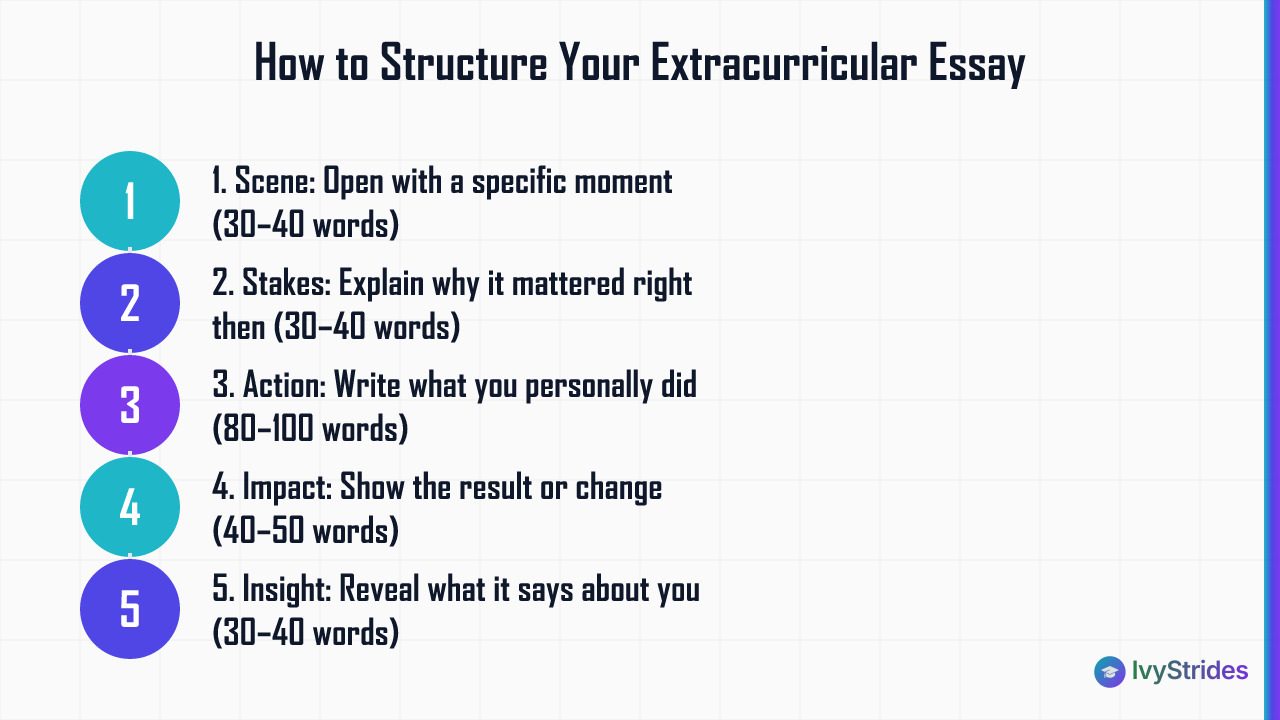
Here is the arc mapped to a 250-word budget.
| Step | What to Write | Word Budget (250) |
| 1. Scene | The specific opening moment | 30-40 |
| 2. Stakes | Why it mattered right then | 30-40 |
| 3. Action | What you personally did | 80-100 |
| 4. Impact | The result or change | 40-50 |
| 5. Insight | What it revealed about you | 30-40 |
The extracurricular essay is one type of supplemental prompt, so the framework here applies across most of the fifteen to thirty supplements a typical applicant writes. Understanding the arc is the easy part. Executing it in your own voice, without slipping back into resume mode, is where most drafts stall. An essay coach reads your draft, names the one structural gap, and guides the revision without overwriting your voice, which is what college essay coaching exists to do.
How to Hit 150 or 250 Words Without Losing Your Story
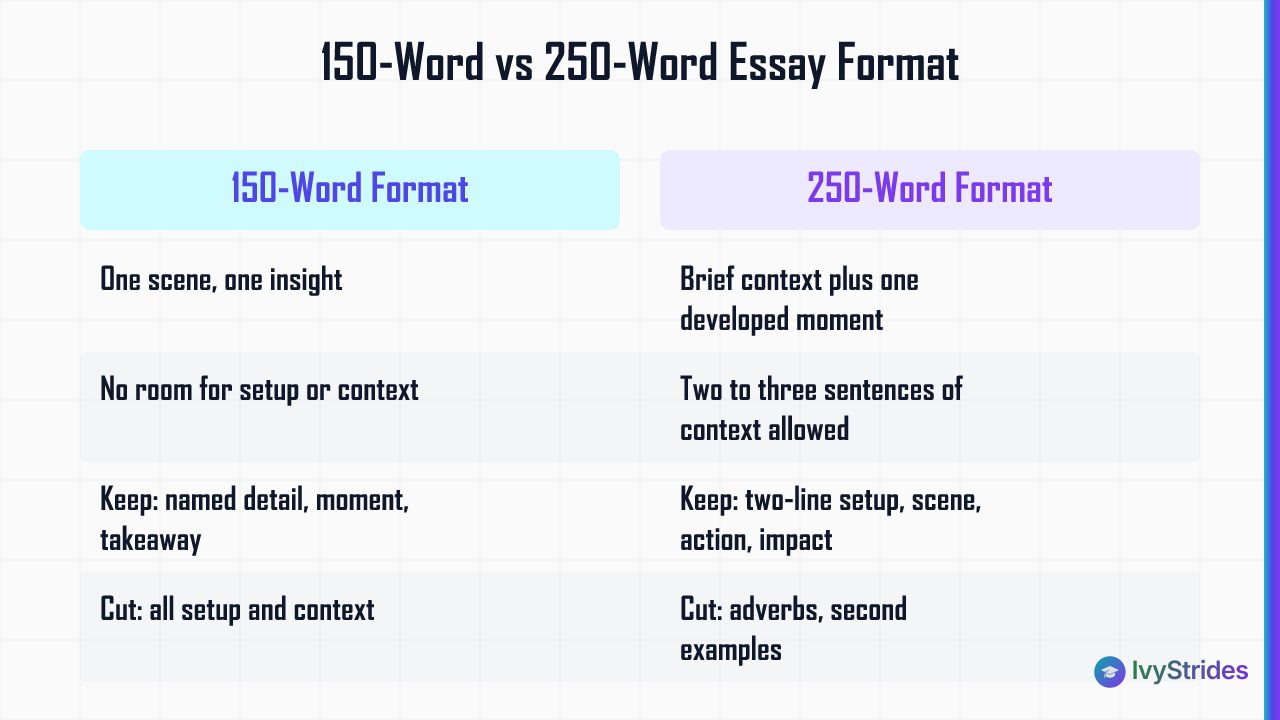
The 150-word and 250-word formats need different compression strategies, and mixing them up is why drafts either overflow or feel thin. The 150-word extracurricular essay holds one scene and one insight, with no room for setup. The 250-word version allows two or three sentences of context plus one developed moment. Same story, different depth.
Cut these first. Adverbs, throat-clearing openers, and any closing sentence that just restates your first. In our coaching with students revising supplements, those three cuts alone usually recover thirty to forty words without touching a single real detail.
Keep these. The named detail, the specific number, and the one moment of change. If you have to choose between a sentence of reflection and a concrete image, keep the image. Specificity is what an admissions reader remembers.
| Format | Structure | What to Include | What to Cut |
| 150 words | One scene, one insight | Named detail, the moment, the takeaway | All setup and context |
| 250 words | Brief context plus one developed moment | Two-line setup, scene, action, impact | Adverbs, second examples |
Check it before you submit. Read the essay aloud, count the words, and confirm the opening sentence could stand on its own. If the first line only makes sense after the second, rewrite it.
A focused revision pass, checking for passive voice, vague claims, and word-count overruns, is what separates a good draft from a submission-ready one. Our guide to college essay editing walks through that full process. Once the draft is clean you will want to know whether the story lands, which is where college essay feedback helps.
One caveat on numbers: Common App supplemental word limits vary by school, so always verify the exact ceiling on the school's own supplement page before you compress. And remember that admissions outcomes depend on the full application, not any single essay.
FAQ: Writing the Extracurricular Essay
How do I write an extracurricular activity essay?
Choose one activity where you showed real commitment, open with a specific scene rather than a general statement, describe your personal role and the challenge you faced, and close with the impact or insight that followed. Keep every sentence tied to what the activity reveals about your character, not just what you accomplished. That focus on character over accomplishment turns a resume line into an essay.
How to write about extracurriculars?
Go deep on one activity instead of skimming several. Name a moment, a problem, a decision, or a change rather than summarizing your involvement across three years. The goal is to show a side of yourself the rest of the application does not already cover, so pick the activity that reveals something new.
Is ChatGPT good for college essays?
AI tools can help you brainstorm angles or spot structural gaps, but the essay has to sound like you. Admissions readers notice prose that reads generic or over-polished, and many schools explicitly restrict AI-generated submissions, though policies vary, so check each school's stated rule. Treat AI as a thinking partner, never a ghostwriter.
How do I start off a 250 word essay?
Open with a specific scene or moment, not a general statement about the activity. One concrete sentence, such as "At 11 p.m. the night before the regional competition, our robot's arm snapped," does more work than two sentences of background. The first sentence sets the stakes; everything else follows from it.
Your Next Step on the Extracurricular Essay
You now have the full sequence: pick the right activity, build the narrative arc or montage, and compress to the word count your school sets. The essay reveals character through one specific story, and it stays distinct from both your activities list and your personal statement.
Here is what to do next:
- Run your top two or three activities through the five-question selection checklist and pick one.
- Draft the narrative arc without watching the word count yet.
- Cut to 150 or 250 words using the compression checklist, keeping the named detail and the moment of change.
- Read it aloud and confirm the opening sentence can stand alone.

Hemant is a seasoned entrepreneur, investor, and growth strategist with deep ground in education and technology-driven learning. His core training is in Mathematics and Physics — he authored Physics for IB Diploma: Ultimate Revision Guide, recognized as a top student resource.