
PSAT vs SAT: How They Compare: The Real Difference and Which One Is Right for You
On this page
- PSAT vs SAT at a Glance: The Five Differences That Actually Matter
- PSAT vs SAT Format Side by Side: Sections, Timing, and Adaptive Structure
- Is the SAT Harder Than the PSAT? What the Difficulty Gap Actually Looks Like
- The One Reason the PSAT Has Real Stakes: National Merit and What It Requires
- Not Sure Whether to Prep for the PSAT, the SAT, or Both?
- PSAT vs SAT Score Conversion: What a 1300 PSAT Means for Your SAT Target
- Should You Prep for the PSAT, the SAT, or Both? A Decision Framework by Grade
- PSAT vs SAT vs ACT: How All Three Tests Fit Into One Admissions Strategy
- FAQ: PSAT vs SAT
- How comparable is the PSAT to the SAT?
- What does a 1300 on the PSAT equal on the SAT?
- Is a 740 a bad PSAT score?
- Do the PSAT and SAT have the same questions?
- What does PSAT stand for?
- Do colleges see PSAT scores?
- Is a 1100 a good PSAT score?
- How much harder is SAT Math than PSAT Math?
- Ready to Turn Your PSAT Score Into an SAT Target and a Real Prep Plan?
The PSAT/NMSQT and the Digital SAT share the same question types and adaptive structure, but they differ on three points: purpose, score scale, and stakes. The PSAT tops out at 1520 and works as a practice tool and National Merit qualifier; colleges never see it. The SAT tops out at 1600, gets sent to colleges for admissions decisions, and can be retaken on your own schedule. Both are now fully digital and section-adaptive.
The score-scale and format figures below come from College Board, cited throughout. The harder question is what your PSAT score actually predicts for the SAT, and whether the gap is big enough to change how you prep. The next section starts there.
PSAT vs SAT at a Glance: The Five Differences That Actually Matter
The PSAT/NMSQT and the Digital SAT differ on five points that change how you should treat each one: purpose, score scale, who sees the result, how you sign up, and whether National Merit is on the line. Everything else about the two tests is close to identical.
| Difference | PSAT/NMSQT | Digital SAT |
| Purpose | Practice test and scholarship qualifier | College admissions credential |
| Score scale | 320 to 1520 | 400 to 1600 |
| Who sees the score | Student and high school only | Colleges you send it to |
| How it's given | Once a year, in October, at your school | Multiple dates, at test centers, your choice |
| National Merit | The 11th-grade PSAT/NMSQT qualifies | Does not qualify |
Here's the part most students miss: the PSAT isn't a warmup with no consequences. Per College Board, the PSAT/NMSQT taken in junior year is the single qualifying exam for the National Merit Scholarship Program. For students near a state cutoff, that one October morning carries real money. For everyone else, the PSAT's value is diagnostic: it tells you where your SAT prep should start.
The SAT does the heavy lifting on your application. It's the score a college sees, weighs, and factors into an admissions decision. For a fuller side-by-side, see our breakdown of the difference between SAT and PSAT.
PSAT vs SAT Format Side by Side: Sections, Timing, and Adaptive Structure
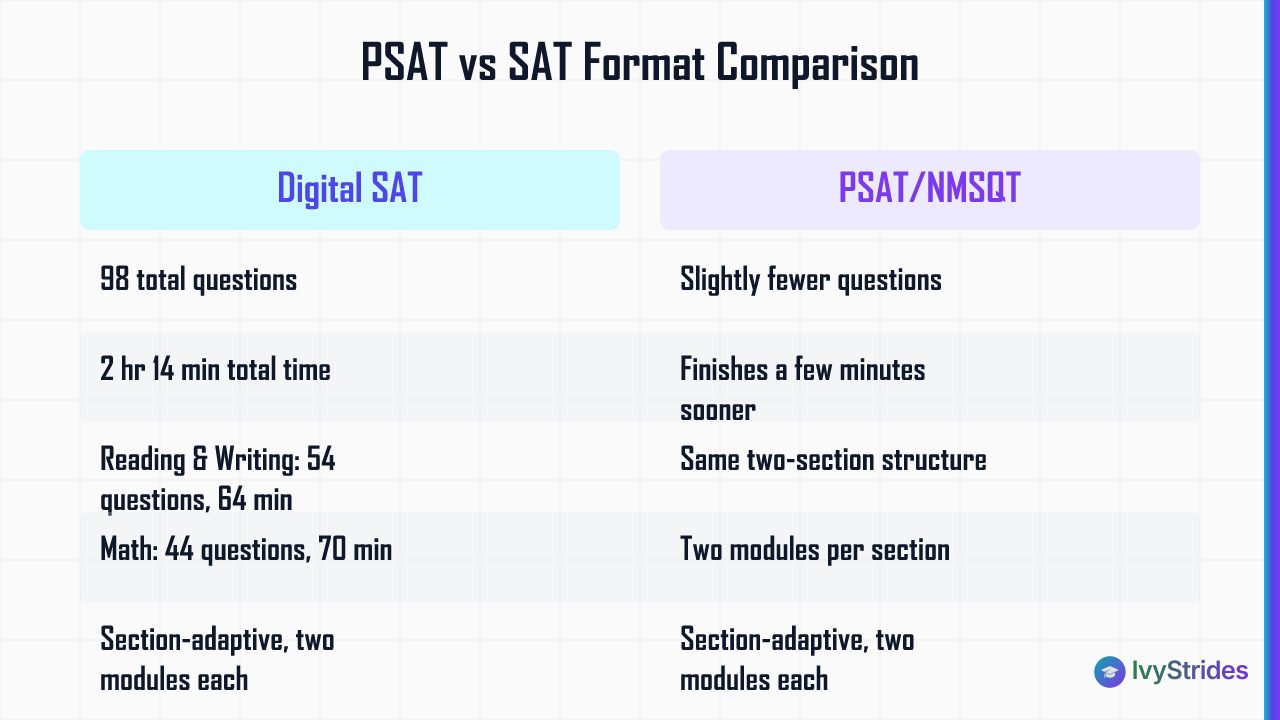
The Digital SAT runs 98 questions across two sections in 2 hours 14 minutes of testing time, and the PSAT/NMSQT uses the same two-section shape with slightly fewer questions and a shorter clock. Both split each section into two modules, and both run on the Bluebook app. That shared architecture is why prep transfers so cleanly between them.
Here is the Digital SAT in full, per College Board:
| Section | Questions | Time |
| Reading and Writing | 54 (two 27-question modules) | 64 minutes |
| Math | 44 (two modules) | 70 minutes |
| Total | 98 | 2 hr 14 min |
That works out to roughly 82 seconds per question on average. The PSAT/NMSQT mirrors this structure with two sections, two modules each, and a marginally lighter question load, which is why it finishes a few minutes sooner. For the complete section-by-section timing breakdown, see our guide to the PSAT format and sections.
Both tests are section-adaptive, and this is the piece that trips up newcomers. Your performance on Module 1 of a section sets the difficulty of Module 2. Do well on the first Reading and Writing module, and the second one serves harder questions worth more scoring headroom. Struggle, and Module 2 stays easier, capping how high that section can score.
Do the PSAT and SAT have the same questions? No. They pull from the same question types across the same domains, but the actual items differ on each test. College Board doesn't recycle questions between them; it calibrates them to measure the same skills at slightly different ceilings. To see how those modules translate into a number, read our explainer on how the Digital SAT is scored.
Is the SAT Harder Than the PSAT? What the Difficulty Gap Actually Looks Like
The SAT is slightly harder than the PSAT/NMSQT, not dramatically harder. The gap comes from two places: the SAT's adaptive Module 2 reaches a higher difficulty ceiling, and the SAT Math section includes a small band of advanced topics that show up rarely or not at all on the PSAT. Reading and Writing? Essentially the same on both tests.
Both exams draw Reading and Writing questions from the same four domains: Information and Ideas, Craft and Structure, Expression of Ideas, and Standard English Conventions. A student who can handle inference questions and transition-word logic on the PSAT is handling the same skill on the SAT. No new question type appears.
Math is where the daylight shows. The SAT stretches a bit further into advanced algebra and precalculus content, including certain trigonometry and advanced function problems. The PSAT is calibrated for 10th and 11th graders; the SAT is calibrated for college-readiness. That difference is real, but it's a narrow band of content, not a wholesale jump.
In our coaching, students who score 1200 on the PSAT typically score in the 1240 to 1300 range on a first SAT attempt without any additional prep. The gap is bridgeable, and it's bridgeable with targeted work rather than a full restart. For a deeper look at how question difficulty compares section by section, see our full breakdown of whether the PSAT is harder than the SAT.
The One Reason the PSAT Has Real Stakes: National Merit and What It Requires
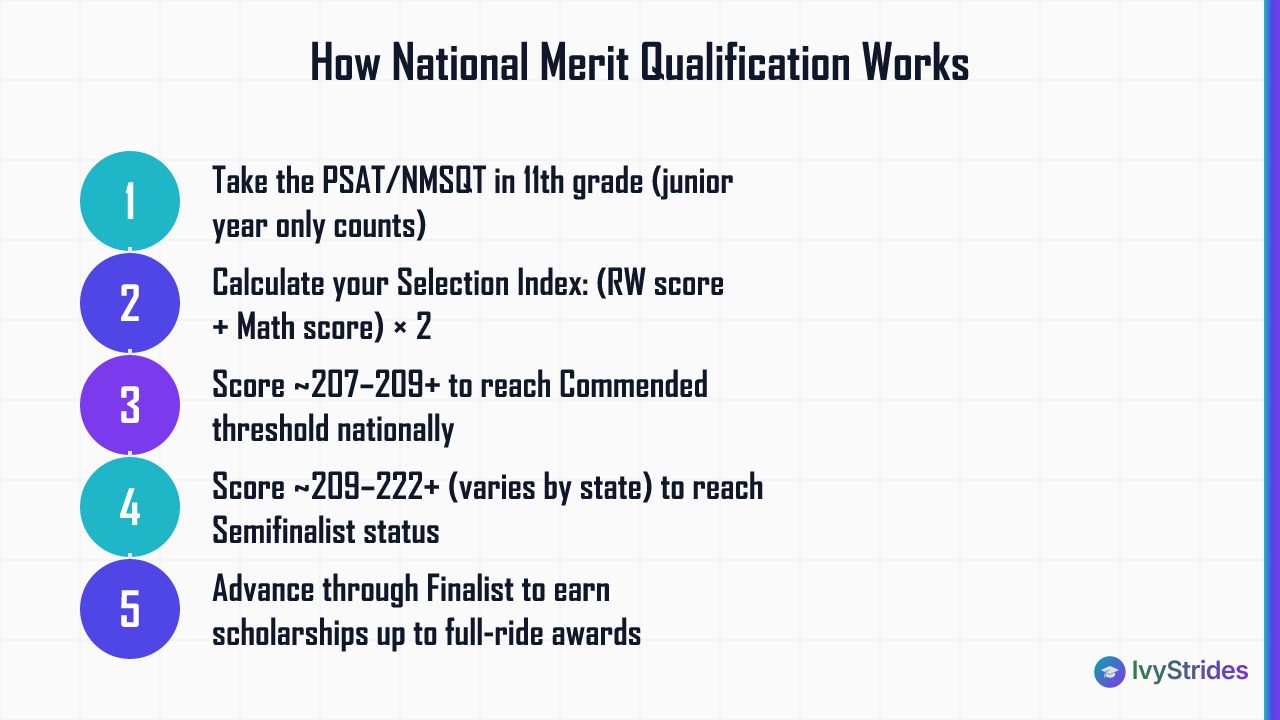
The National Merit Scholarship Program uses the PSAT/NMSQT taken in 11th grade as its sole qualifying exam, per College Board. Not the 10th-grade sitting, not the PSAT 8/9, not the PSAT 10. Only junior-year performance counts, which makes that one October test the highest-stakes PSAT a student ever takes.
Qualification runs on the Selection Index, a number built from your two section scores. You take your Reading and Writing section score and your Math section score, add them, then multiply by two. A perfect 760 in each section gives a Selection Index of 228, the maximum. This is a separate metric from your 320-to-1520 composite, and it's the number that matters for National Merit.
Recognition comes in tiers, from Commended Students up through Semifinalists, Finalists, and Scholars. State cutoffs for Semifinalist status vary each cycle and by state; recent cycles have landed roughly between 209 and 222 on the Selection Index, with the national Commended threshold typically sitting around 207 to 209. These figures shift year to year, so check the current cycle's official numbers rather than treating any single figure as fixed.
Awards range from a one-time National Merit Scholarship of around $2,500 up to full-ride, corporate-sponsored packages, though not every high scorer receives a monetary award. If your PSAT score puts you near your state's cutoff, read our step-by-step guide on how National Merit works in 2026 before deciding how much PSAT prep to invest. It's also worth reviewing the National Merit scholarship benefits so you know what recognition actually unlocks.
If you've decided the PSAT deserves dedicated prep time, our PSAT prep coaching walks through a structured plan aimed at National Merit range.
Not Sure Whether to Prep for the PSAT, the SAT, or Both?
In a free 15-minute call, an IvyStrides coach will look at your current score, your grade, and your target schools, then tell you exactly which test to prioritize and what a realistic prep timeline looks like.
PSAT vs SAT Score Conversion: What a 1300 PSAT Means for Your SAT Target
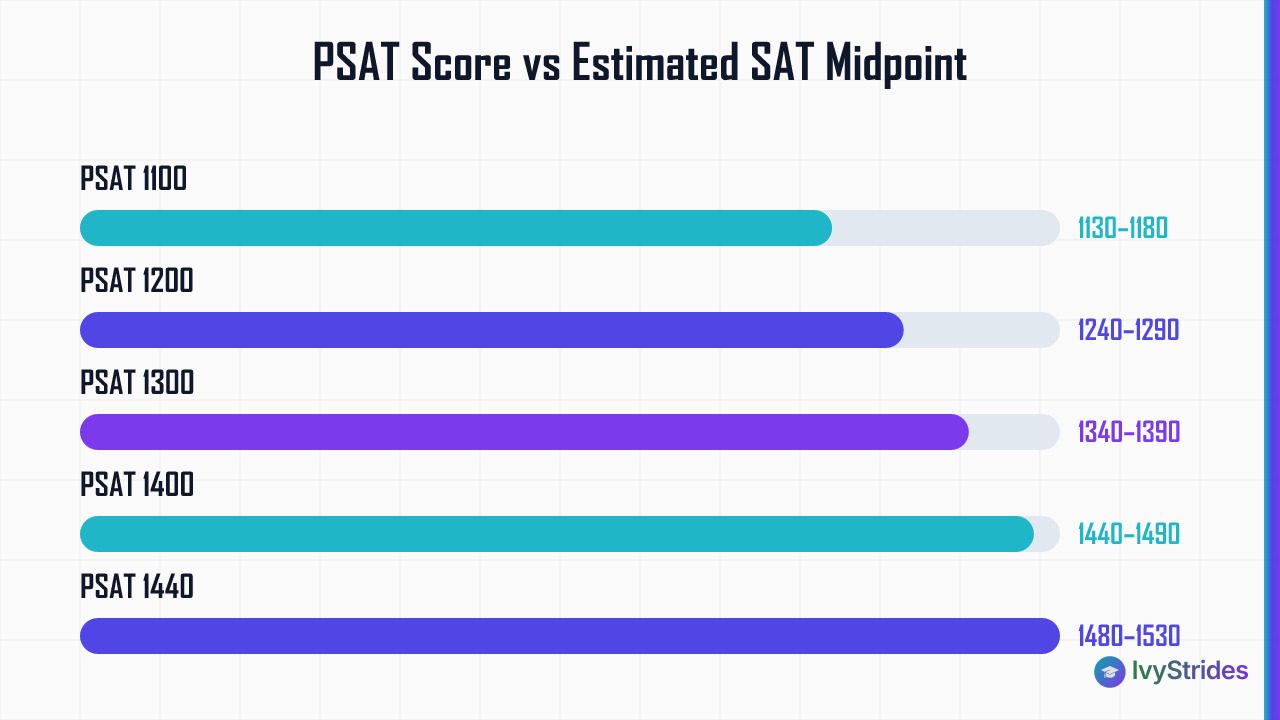
A 1300 PSAT score maps to an estimated SAT range of roughly 1340 to 1390, based on College Board concordance data. The PSAT tops out at 1520 and the SAT at 1600, so the conversion isn't one-to-one; it shifts a composite up by roughly 40 to 80 points to account for the different scales and the SAT's slightly higher ceiling.
Here are the common landing points, all approximate and drawn from concordance data:
| PSAT composite | Estimated SAT range |
| 1100 | 1130 to 1180 |
| 1200 | 1240 to 1290 |
| 1300 | 1340 to 1390 |
| 1400 | 1440 to 1490 |
| 1440 | 1480 to 1530 |
Treat every one of these as an estimate, not a promise. Your actual SAT score depends on prep effort, the time between tests, and which specific skills you sharpen. The scales are related but not identical, which is why the conversion produces a range rather than a single number.
Here's the mindset that matters: your PSAT score is a diagnostic baseline, not a ceiling. It's a floor you build from. In our coaching, students who treat their PSAT as a floor rather than a cap and complete a diagnostic-driven SAT plan typically close the gap to their target within roughly 8 to 12 weeks. You can also convert at the section level, mapping your Reading and Writing and your Math separately, which shows exactly where your prep hours should go.
Once you have your PSAT composite, use our PSAT to SAT score conversion guide to map it to a realistic SAT target range. Not sure whether your PSAT score is on track in the first place? Our guide to what is a good PSAT score breaks down benchmarks by grade and percentile. When you're ready to build a baseline, start with our PSAT practice tests.
Should You Prep for the PSAT, the SAT, or Both? A Decision Framework by Grade
The right answer depends on your grade and whether National Merit is realistically in play. For most students, SAT prep is the primary investment, because the SAT is the score colleges actually see. But PSAT prep is never wasted; the question types and strategies overlap so heavily that preparing for one builds the other.
Here's the grade-by-grade logic:
| Grade | Test in play | What to do with it |
| 9 | PSAT 8/9 | Low-stakes baseline; note weak areas, no heavy prep |
| 10 | PSAT 10 | Identify weaknesses, preview the SAT format |
| 11 | PSAT/NMSQT | National Merit qualifier; prep hard if near a cutoff |
| 11 to 12 | SAT | Primary admissions credential; the main prep investment |
The PSAT 8/9 serves 8th and 9th graders and the PSAT 10 serves 10th graders, and neither qualifies for National Merit. Only the junior-year PSAT/NMSQT does. So if National Merit motivates your prep, the clock that matters is the fall of 11th grade.
The overlap is the good news: same four Reading and Writing domains, same adaptive module structure, same Math content foundation. In our coaching, students who complete a full diagnostic-driven PSAT prep cycle in 10th grade typically enter 11th-grade SAT prep roughly 6 to 8 weeks ahead of peers who skipped PSAT prep. The work compounds.
So when is PSAT-specific coaching worth it? Our rule of thumb: if a student's PSAT score sits within about 10 to 15 points of their state's National Merit cutoff, dedicated PSAT prep earns its keep, because that scholarship pathway is winnable. For students well outside cutoff range, SAT prep is the higher-return use of the same hours.
For timing your start, see our guide on how early to start PSAT prep. When you're ready to build a study plan, our how to study for the PSAT walkthrough lays out the structure. And if you're unsure which version applies to your grade, read our breakdown of PSAT versions: 8/9, 10, and NMSQT differences.
PSAT vs SAT vs ACT: How All Three Tests Fit Into One Admissions Strategy
The PSAT, SAT, and ACT play three distinct roles. The PSAT/NMSQT is College Board's internal practice-and-scholarship tool. The SAT is one of the two major admissions tests. The ACT is the alternative admissions credential, accepted equally at every US college that takes the SAT. Neither the SAT nor the ACT is preferred; colleges have no favorite.
Your PSAT score can actually hint at which admissions test fits you better. A student who scores well in PSAT Math but keeps hitting the wall on PSAT Reading and Writing pacing sometimes finds the ACT's Reading and Science format a better match. The ACT runs faster and structures its passages differently, which suits some readers and frustrates others. The only way to know is a full-length diagnostic of each.
In our coaching, students who take a full-length diagnostic of both the SAT and ACT before committing to one test avoid wasting prep hours on the wrong exam. That single afternoon of diagnostic testing saves weeks of misdirected effort.
One caveat worth stating plainly: test-optional policies vary by school and by year, and they change often. Per FairTest, the policy landscape shifts constantly. A strong SAT or ACT score can still strengthen an application even at a test-optional school, so "test-optional" does not mean "scores don't matter." It means you get to choose whether a score helps you.
If you're weighing the SAT against the ACT rather than the PSAT, our ACT vs SAT: which test is right for you comparison covers the format, scoring, and decision framework in full. To decide whether to submit a score at all, read what is test-optional and should you submit SAT scores.
FAQ: PSAT vs SAT
How comparable is the PSAT to the SAT?
Very comparable. Both are digital, both are section-adaptive, and both test the same Reading and Writing domains and Math foundation. The differences are the score ceiling of 1520 versus 1600, the slight difficulty gap in Module 2, and the SAT running a few minutes longer. Serious PSAT prep builds the exact skills the SAT rewards.
What does a 1300 on the PSAT equal on the SAT?
A 1300 PSAT lines up with an estimated SAT range of roughly 1340 to 1390, based on College Board concordance data. That's an estimate, not a guarantee. Your real SAT result turns on prep effort, the gap between test dates, and which skills you actually improve. Read 1300 as a starting line, not a finish line.
Is a 740 a bad PSAT score?
It depends entirely on whether 740 is a section score or a composite. A 740 section score out of 760 is excellent, landing near the 99th percentile. A 740 composite out of 1520 sits below the national average of around 930 for 11th graders and signals that structured prep would pay off before you sit the SAT.
Do the PSAT and SAT have the same questions?
No. The two tests use the same question types across the same domains, but the actual questions differ on each one. College Board designs them to measure identical skills at slightly different difficulty ceilings. Practicing for one builds directly transferable skills for the other, which is why the two prep tracks overlap so much.
What does PSAT stand for?
PSAT stands for Preliminary SAT. The full official name of the version that qualifies for National Merit is PSAT/NMSQT, where NMSQT stands for National Merit Scholarship Qualifying Test. College Board also runs the PSAT 8/9 for 8th and 9th graders and the PSAT 10 for 10th graders. Neither of those qualifies for National Merit.
Do colleges see PSAT scores?
No. PSAT scores are never sent to colleges and don't appear on any application. Only you and your high school get the score report. The one external consequence is National Merit recognition, which comes from the 11th-grade PSAT/NMSQT and can be listed on an application as an honor.
Is a 1100 a good PSAT score?
A 1100 PSAT sits above the national average of around 930 and is a reasonable baseline for a 10th grader. For an 11th grader chasing National Merit, though, 1100 falls well short of the typical Selection Index cutoff. For admissions purposes it maps to an estimated SAT range of roughly 1130 to 1180, a solid platform to build SAT prep on. For more benchmarks, see whether 1280 is a good PSAT score or 1050 is a good PSAT score.
How much harder is SAT Math than PSAT Math?
Slightly harder. Both cover algebra, problem-solving, and data analysis. The SAT's adaptive Module 2 reaches more advanced questions, and the SAT includes a narrow set of topics, such as certain trigonometry and advanced functions, that appear rarely or not at all on the PSAT. In our coaching, students who reach a 700-plus PSAT Math section are well-positioned to target 720 to 750 on SAT Math with focused prep. For the mechanics, see how the PSAT is scored.
Understanding how these two tests relate is the first real decision in a testing timeline, and it changes what you should be doing this month. A PSAT score is a diagnostic baseline that points straight at an SAT target and tells you whether National Merit is worth chasing. The next move is turning that number into a plan built by section specialists who coach the exact skills your score gaps demand. You can read the approach we use on our About page. To see who would coach you, meet the team on our tutors page.
Ready to Turn Your PSAT Score Into an SAT Target and a Real Prep Plan?
Book a free 15-minute strategy call. We will map your PSAT score to an SAT target range, check whether National Merit is in play, and recommend the right IvyStrides service for your timeline.

Award-winning author (South Asian Book Award) and graduate of BITS Pilani and UCLA Luskin School of Public Affairs. Brings a published writer's eye to Common App essays and grammatical precision to SAT and ACT R&W instruction.