
What Is AP Classroom, and Can You Use It Without a Join Code?
On this page
- What Is AP Classroom and How Do You Access It
- How AP Classroom Access Works for Students vs. Teachers
- What AP Classroom Resources Are Available Without a Join Code
- How to Get the Most Out of AP Classroom Before Your AP Exam
- FAQ: AP Classroom Access and Resources
- How do I sign in to AP Classroom?
- What is an AP Classroom join code and where do I get one?
- How do you use AP Classroom as a study tool?
- Can I access AP Classroom without being enrolled in an AP class?
- Your Next Step With AP Classroom
AP Classroom is College Board's free online platform for AP course resources, including practice questions, AP daily videos, and free-response question (FRQ) sets. You sign in at myap.collegeboard.org with a College Board account. A teacher-issued join code links you to your class section.
Those platform details come from College Board's own AP Central and AP Students pages, cited throughout. The distinction that trips up most students: myap.collegeboard.org is where you log in to do the work, while apstudents.collegeboard.org is the public-facing site anyone can read without a join code.
What Is AP Classroom and How Do You Access It

Photo by RDNE Stock project on Pexels
AP Classroom is College Board's official online instructional platform for AP courses. College Board describes it as providing instructional resources for each AP course to support student learning of all course content and skills. You reach it at myap.collegeboard.org, and a free College Board account is the only hard requirement to get in the door.
One account, several College Board tools. The same login connects you to AP Classroom, your AP exam registration, and your score reports. AP Classroom is where the teaching and practice live; it is not where you take the exam.
The exam itself runs somewhere else. College Board delivers AP exams as fully digital or hybrid digital exams through Bluebook, its testing app. So think of AP Classroom as the practice room and Bluebook as the exam hall. Separate tools, same ecosystem. Every AP exam is then scored on a 1 to 5 scale, which is the number all that practice points toward.
If you are enrolled in or planning AP classes online, AP Classroom is the layer your coursework sits on top of. Once you know the platform, the next logistical step is how to register for AP exams through your school or an authorized coordinator.
| Platform | URL | Who Uses It | Requires Join Code |
| AP Classroom | myap.collegeboard.org | Enrolled students, teachers | For class-specific work, yes |
| AP Students portal | apstudents.collegeboard.org | Any student, any parent | No |
| Bluebook | separate app | Students on exam day | No |
How AP Classroom Access Works for Students vs. Teachers
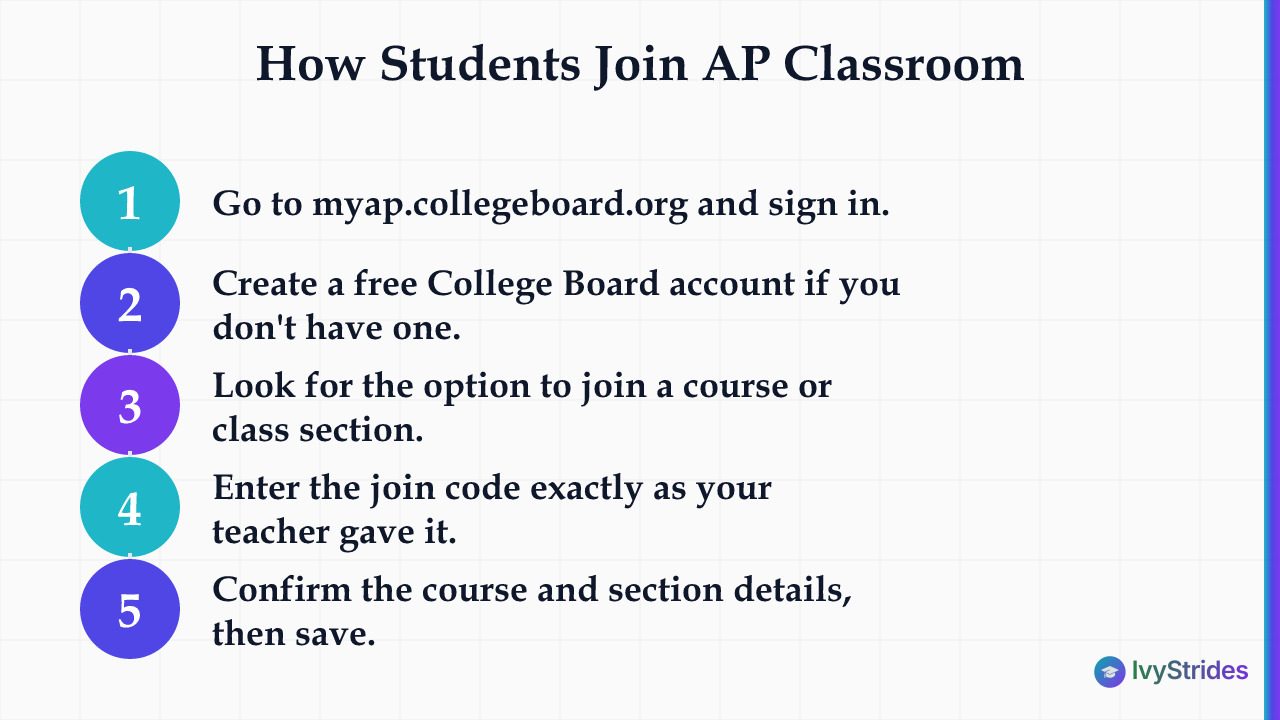
AP Classroom access splits cleanly by role: students sign in at myap.collegeboard.org and enter a teacher-issued join code to reach their class section, while teachers need an approved AP Course Audit before they can build and assign anything. The join code is the hinge the whole platform turns on for students.
Because that code controls class-specific work, understanding it matters before you type it in. A join code is a short alphanumeric string your AP teacher generates inside AP Classroom and shares with the class. It links your College Board account to one class section. You cannot create it yourself, and College Board does not publish a fixed format for it, so if your teacher has not handed one out yet, ask them directly.
On the teacher side, the gate is the AP Course Audit. A teacher needs a College Board professional account and an approved AP Course Audit form before gaining educator access. If you are a teacher or counselor working through that process, how to become an AP teacher walks through it in full.
-
Go to myap.collegeboard.org and sign in with your College Board account.
-
If you do not have an account, create a free one first.
-
Once in, look for the option to join a course or class section.
-
Enter the join code exactly as your teacher gave it to you.
-
Confirm the course and section details, then save.
Self-study students sit outside this flow, and that is fine. International and homeschool students who register for AP exams independently can still reach the AP Students portal and many resources; the join code step simply requires coordinating with a local test center or AP coordinator. If that describes you, how international students study AP online covers the registration path in detail.
What AP Classroom Resources Are Available Without a Join Code
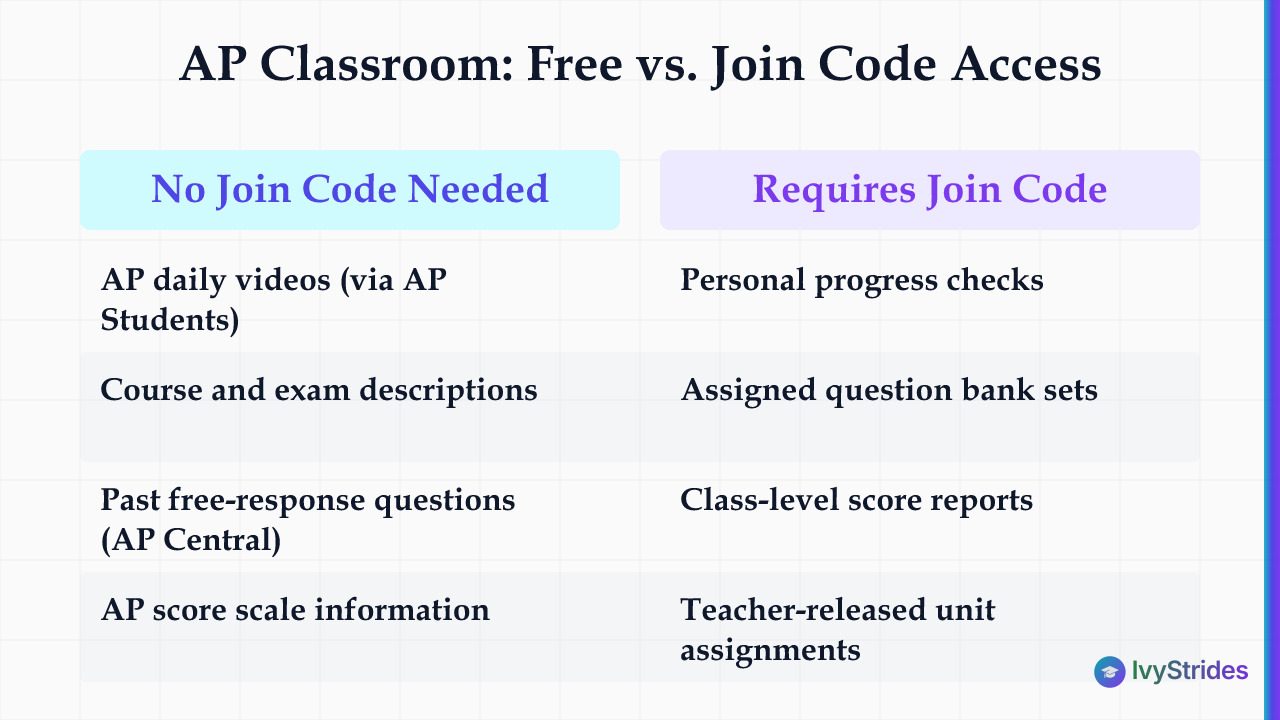
Without a join code, you still get a real layer of AP Classroom and AP Students content: AP daily videos, course and exam descriptions, and past free-response questions published on College Board's site. What the code unlocks is the teacher-assigned layer, the personal progress checks and specific question bank sets your teacher releases, plus class-level score visibility.
Because the join code gates the assigned work, it helps to know exactly what each resource is. Personal progress checks are formative question sets, mixing multiple-choice and FRQs, that your teacher assigns unit by unit. The question bank is College Board's searchable store of practice questions. Neither one is an answer key to the live exam, and the platform never contains AP Classroom answers to real test items.
Every AP exam is scored on a 1 to 5 scale, and College Board treats 3 as the lowest qualifying score, so the progress checks are calibrated to show whether your current mastery is on track for that threshold. The descriptors matter when you read a result.
| Resource | Available Without Join Code | Requires Join Code / Teacher Assignment |
| AP daily videos | Yes, via AP Students | Also viewable inside a class |
| Course and exam descriptions | Yes | , |
| Past free-response questions | Yes, on AP Central | , |
| Personal progress checks | No | Yes |
| Assigned question bank sets | No | Yes |
| Class-level score reports | No | Yes |
| AP score scale information | Yes | , |
College Board's score descriptors give those progress checks a target. A score of 3 is 'qualified,' equivalent to a college grade of B-, C+, or C; a 4 is 'very well qualified,' equivalent to A-, B+, or B; a 5 is 'extremely well qualified,' equivalent to A+ or A. One caveat worth stating plainly: a 3 carries College Board's recommendation for college credit and placement, but each college sets its own threshold, so confirm with the school.
Recognition stacks on top of a single score. The AP Scholar Award goes to students who earn scores of 3 or higher on three or more AP exams, so you can use progress checks to gauge readiness across subjects before exam day. The AP Capstone Diploma goes to students who earn scores of 3 or higher in AP Seminar and AP Research and on four additional AP Exams of their choosing. For the full tiers, see AP Scholar awards.
So is AP Classroom enough on its own? For a motivated student in a well-taught class, the built-in resources carry a lot of the load. The gap shows up when nobody is reading the progress check data with you.
Completing personal progress checks unit by unit before the May window helps you arrive with a clearer picture of where your points are being lost. AP Classroom provides the official College Board practice layer; students who want live instruction and a structured plan around those resources can pair it with live per-subject AP instruction.
How to Get the Most Out of AP Classroom Before Your AP Exam
AP Classroom pays off most in the eight to ten weeks before the exam, used as a diagnostic engine rather than a video library. This figure is an IvyStrides calculation. The 2027 AP Exams run May 3 to 7 and May 10 to 14, with a late-testing window May 17 to 21, so count backward from your subject's date.
Because those dates are fixed, the sequence matters more than the hours. Start with personal progress checks to find your weak units, then use AP daily videos to rebuild those specific units, then practice FRQs against the published rubrics. A common pattern we see: students open AP Classroom for the first time in April and discover they skipped the progress checks for Units 3 through 5, which are often the highest-weight units on the exam.
College Board publishes the exam dates and unit frameworks; IvyStrides maps them into the eight-week checklist below.
-
Week 8: Take the diagnostic progress check for every unit; log which score band each returns.
-
Week 7: Rank units by weakness and by exam weight.
-
Week 6: Watch AP daily videos for your two weakest high-weight units.
-
Week 5: Redo those progress checks; compare bands.
-
Week 4: Start timed FRQ practice, scoring against published rubrics.
-
Week 3: Rotate to the next weakest units.
-
Week 2: Full mixed practice set; check your Bluebook setup.
-
Week 1: Light review, rubric re-read, exam-day logistics.
Exam-day logistics, briefly. Morning AP exams begin at 8 a.m. local time and afternoon exams at 12 p.m. local time, and you'll test in Bluebook, so download and run the app check before exam week. For subject-level tactics beyond the platform, AP exam prep by subject breaks it down per course.
When is AP Classroom enough, and when is it not? If your progress check bands are climbing and you can self-diagnose, the platform plus the rubrics may be all you need. The honest line is spelled out in whether free AP prep is enough to score a 5. Where it falls short is interpretation: turning a flat Unit 4 band into a plan takes a coach who knows the subject, which is the work our specialist coaching does inside the AP program.
FAQ: AP Classroom Access and Resources
How do I sign in to AP Classroom?
Head to myap.collegeboard.org and log in with your College Board account. If you don't have one, create a free account first. Once you're in, you'll see any class sections you've already joined, and you can add a new one with a join code from your teacher.
What is an AP Classroom join code and where do I get one?
It's a short alphanumeric string your AP teacher generates inside AP Classroom and shares with the class. The code links your College Board account to that specific class section and unlocks teacher-assigned progress checks and assignments. If your teacher hasn't shared one, ask them directly, because you cannot generate it yourself.
How do you use AP Classroom as a study tool?
Start with the personal progress checks to find the units that need the most work, then use AP daily videos for content review on those units. Practice FRQs using the question bank and score your responses against the published rubrics. Working through progress checks unit by unit helps you see where your points are slipping.
Can I access AP Classroom without being enrolled in an AP class?
Yes, partially. The AP Students portal at apstudents.collegeboard.org is public and holds daily videos, course descriptions, and past FRQs. The full question bank and personal progress checks require a teacher-issued join code, but self-study students can still build a strong foundation on the public resources and official College Board practice.
Your Next Step With AP Classroom
AP Classroom is free, official, and worth logging into today, whether or not a join code is waiting for you. The platform rewards a student who treats progress checks as a diagnostic and works backward from the May exam date.
- Sign in at myap.collegeboard.org and enter your join code if you have one.
- No code or no class? Open apstudents.collegeboard.org for daily videos and past FRQs.
- Take one progress check this week to see where your points are going.
- Confirm your subject's 2027 exam date and count back eight weeks.

Two decades teaching quantitative and verbal aptitude on standardized tests. Rare dual expertise across Math and Verbal — particularly effective for students with gaps on both sides. Senior AP Mentor for our Calculus and English tracks.