
Your Teen Was Deferred: What Parents Can Do and What to Leave Alone
On this page
- What a College Deferral Actually Means for Your Student
- Is Getting Deferred Good or Bad? What the Decision Signals
- What Your Student Should Do in the Two Weeks After a College Deferral
- How to Write a Letter of Continued Interest After a College Deferral
- What Parents Should Do and What to Leave Alone After a Deferral
- FAQ: College Deferrals and Next Steps
- What does "deferred" mean when getting into college?
- Is a deferral basically a rejection?
- Does deferred mean waitlisted?
- If you get deferred early decision, is the commitment still binding?
If your child got deferred from college, the school moved the application from the early round into the regular decision pool for a second review. It is not a rejection. Your student stays under consideration, so read the admissions portal for required next steps and keep senior grades strong.
Those instructions come from the college's own deferral letter and portal, so start there. The harder question is which one or two updates to send before that college's deadline. Early results usually arrive in December or January (College Board), so this plan starts whenever the news reaches your family.

What a College Deferral Actually Means for Your Student
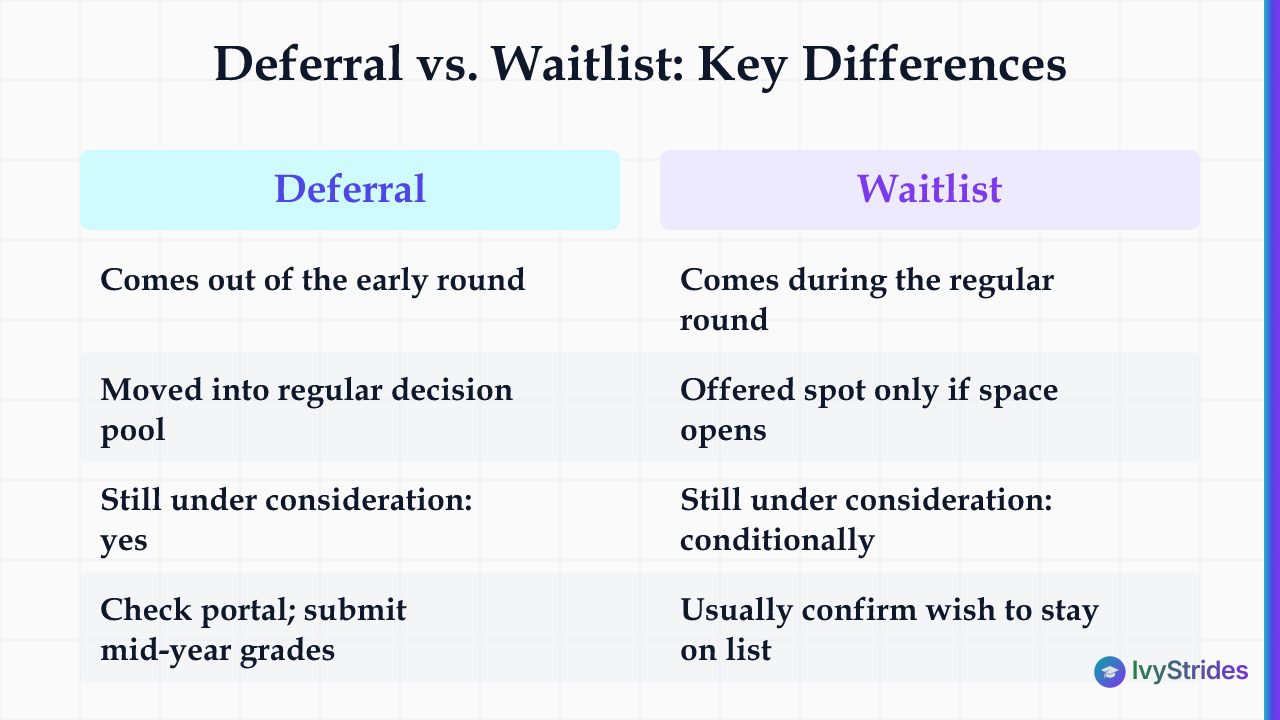
A college deferral is an admissions decision that postpones an early applicant's answer and moves the file into the regular decision pool, where it gets read again (ACT). Your student is neither admitted nor turned down. The college wants more context, often first-semester senior grades.
Deferral is not a waitlist. A deferral comes out of the early round, before the regular decision review. A waitlist placement comes during the regular round, and offers depend on admitted students declining and space opening up (ACT).
| Decision | What it means | Still under consideration? | Action required? |
| Deferred | Moved into the regular decision pool | Yes | Check portal; mid-year grades, sometimes a form |
| Waitlisted | Offered a spot only if space opens | Yes, conditionally | Usually confirm a wish to stay on the list |
| Denied | The college will not review further | No | None |
The binding commitment usually ends, on each college's terms. Early decision commits a student to enroll if admitted (Common App), and colleges word the deferral case differently. Cornell says postponing a student to regular decision releases the commitment (Cornell). Penn says an offer made later in the regular round is non-binding (Penn). Read your college's letter and agreement word for word before your student signs a second early decision agreement, because early decision and early action rounds differ in what they commit a family to.
The portal holds the real instructions. Some colleges ask deferred students to act: USC keeps a deferred early decision applicant in the regular round only if the student chooses to remain in consideration (USC). Others want nothing new. Skipping a required step can take a file out of review, so your student should open the admissions portal first.
Is Getting Deferred Good or Bad? What the Decision Signals
A deferral is neither good nor bad news: the college wants another look before it decides. ACT describes a deferral as a sign of potential that still calls for further review (ACT), so treat it as a real second read, not a promise.
Colleges that explain their deferrals tend to give two reasons. One is the pool: Lehigh says a deferral lets its committee weigh an applicant against the whole applicant pool, not just the early round. The other is more information, such as updated senior grades, new test results, and senior-year honors (Lehigh).
| Reason for deferral | What it means in regular decision | What can change it |
| Comparing against the full pool | File re-read with regular applicants | Strong new grades, real updates |
| Waiting on senior-year grades | Admissions wants more academic data | Strong first-semester senior grades |
| Waiting on other new information | File stays open for additions | A new test result, honor, or accomplishment |
No single rate carries across colleges. Deferral-to-acceptance rates vary by school and year, and some colleges publish theirs (ACT). MIT's Class of 2029 figures show 7,486 Early Action applicants deferred and 175 of them admitted in Regular Action (MIT). Lehigh gives no share and says it admits some deferred students nearly every year (Lehigh). Each figure belongs to that college and that cycle, and admissions outcomes depend on the full application. So a rate alone won't tell you what a deferral says about an application.
What Your Student Should Do in the Two Weeks After a College Deferral

Photo by cottonbro studio on Pexels
Start with the portal the day the news arrives, then work through grades and the optional pieces over the next two weeks. The sequence matters more than the volume, because colleges set their own update deadlines: MIT's update form for deferred applicants is due in mid-February (MIT).
Daily SAT and ACT prep on YouTube: short strategy videos from IvyStrides. Subscribe to IvyStrides on YouTube.
Mid-year grades are usually the most important update. The high school counselor submits the mid-year report, not the student (Common App). Lehigh says it must have that report from deferred applicants (Lehigh), and Tufts has told deferred applicants that mid-year grades are typically the most important new information (Tufts). Admissions officers read a transcript for rigor and grade trend, so strong first-semester senior grades can help a file. Your job here is logistics: confirm the counselor has the request and the deadline.
A new test score is worth sending when it is clearly stronger than any score on file, especially if it reaches the 25th to 75th percentile scores College Navigator lists for that college's enrolled first-time students (NCES College Navigator). The calendar is tight: after the December sittings, the next national dates are the ACT on February 27, 2027 (ACT) and the SAT on March 6, 2027 (College Board), so check whether the college will still read a score from those dates.
Testing policies vary by school and year, so whether a new SAT or ACT score helps after a deferral also depends on the college's current policy.
| Action | Who does it | Deadline |
| Open the portal, complete any opt-in | Student | First few days |
| Confirm early decision release status | Student | First few days |
| Request mid-year grade report | Student, then counselor | Before the college's deadline |
| Decide on a new test score | Student | Before the next registration deadline |
| Draft and send letter of continued interest | Student | Only if the college allows one |
| Note any new award or role | Student | Include in the college's update |
How to Write a Letter of Continued Interest After a College Deferral
A letter of continued interest, or LOCI, is a short note from the student that reaffirms interest in the college, adds one or two concrete updates, and names a specific reason the school still fits. Colleges differ on whether they want one. Barnard gives deferred applicants a chance to submit an expanded essay on their interest (Barnard), while MIT says deferred students need not email to say they remain interested (MIT). Send a letter only if the college permits additional materials, and follow its instructions on length and on where an application update goes.
The student writes it, not the parent. The LOCI is a short, high-stakes piece of writing, and the same principles that make a supplemental essay specific and genuine apply here. Colleges set their own limits where they set any, so keep it brief. The mistake to head off is writing a second personal statement rather than a brief update with one or two new facts.
So what belongs in it, and what to leave out:
| Include | Avoid |
| A clear statement of interest, and first choice only if true | Pleading or apologetic tone |
| One or two new facts since the application | Repeating the original essay or activities |
| A specific program, course, or opportunity | Generic praise any applicant could write |
| New grades, awards, or a leadership role | Parent-authored phrasing |
| A confident, concise close | A second full personal statement |
Parents help best by reading for clarity after the student drafts, not by writing sentences, and supporting the writing without taking it over takes practice. For families who want a specialist on a deferred student's letter, IvyStrides' essay coaches work the LOCI the way they work a supplemental, through college essay coaching for high-stakes short writing.
What Parents Should Do and What to Leave Alone After a Deferral

Photo by Julia M Cameron on Pexels
After a deferral, parents should run logistics and offer steady support, leaving the advocacy, the writing, and the admissions-office contact to the student. Lehigh, for one, asks that additions to the file come directly from the applicant (Lehigh).
Review the list, don't lobby the office. ACT recommends applying to other colleges after a deferral, since it does not promise admission (ACT), so go through the list together for target and likely schools. This is squarely a parent job, alongside tracking the remaining college application deadlines, because regular decision dates can fall soon after early results.
| Do | Do not |
| Confirm the counselor sends mid-year grades on time | Call or email the admissions office yourself |
| Review the college list for target and likely schools | Write or heavily edit the letter |
| Track remaining regular decision deadlines | Pressure your student to add reach schools |
| Offer calm emotional support | Forecast the odds or the outcome |
| Help gather new facts for the letter | Submit materials the portal did not request |
| Bring in outside strategy if the file is complex | Treat the deferral as a verdict |
For parents: IvyStrides shares admissions timelines and counseling guidance on LinkedIn. Follow along for the questions families ask most.
With a deferred student, IvyStrides' admissions counselors can start with mid-year transcript logistics and, where the college allows one, the letter of continued interest.
A counselor can help your student decide which materials to send and how to frame the letter for that specific school. That judgment sits at the center of grade-by-grade college counseling for 11th and 12th graders. Before you hand any of the work over, it helps to know what a college counselor actually does so you can keep your own role clean.
FAQ: College Deferrals and Next Steps
What does "deferred" mean when getting into college?
Deferred means the college moved the application from the early decision or early action round into the regular decision pool for a second review. The student is not admitted and not rejected. The file gets reconsidered alongside regular decision applicants, with a final answer by the college's published regular decision date.
Is a deferral basically a rejection?
No. A deferral keeps the application active. The college wants another look, often against the full regular decision pool, while a denial ends the review. Your student can add mid-year grades, a letter of continued interest where the college allows one, and a clearly stronger test score.
Does deferred mean waitlisted?
No. A deferral comes out of the early round and moves the student into regular decision review. A waitlist placement comes during the regular round and means the college may offer admission only if admitted students decline and space opens.
If you get deferred early decision, is the commitment still binding?
Usually not, though each college sets the wording. Cornell releases students it postpones to regular decision (Cornell). Penn calls an offer made later in the regular round non-binding (Penn), and Barnard says deferred students admitted in regular decision are no longer bound by the early decision agreement (Barnard). Read the deferral letter and your college's agreement before your student signs a second early decision agreement.

Rajesh is a technology leader, entrepreneur, and angel investor with 28+ years in Business & Technology Leadership and Product & Solution Engineering. He is passionate about education, mentoring, and driving digital transformation.