
UPenn Requirements: Wharton Wants Calculus, Nursing Wants Chemistry
On this page
- What UPenn Rates Very Important in Every Application
- What Each UPenn School Wants From Your High School Transcript
- Penn's Two Supplemental Essays and the School-Specific Short Answer
- UPenn Application Deadlines and the Early Decision Agreement
- FAQ: UPenn Requirements and School Fit
- What GPA is needed for UPenn?
- Is a 3.7 GPA good for UPenn?
- Is 1450 SAT enough for UPenn?
- What are the requirements to go to UPenn?
- Your Next Step on UPenn Requirements
The University of Pennsylvania requires the SAT or ACT for fall 2027 entry, with a hardship waiver for students who cannot test. You apply to one of four undergraduate schools (the College, Wharton, Engineering, or Nursing) or to a coordinated dual-degree program, and your academics are read against that school's guidance alongside five Very Important factors.
Those five factors, rated in Penn's Common Data Set, are transcript rigor, GPA, essays, recommendations, and character. UPenn's paperwork requirements are simpler: a Common App, Coalition, or QuestBridge application with your transcript, a counselor and a teacher recommendation, three Penn short answers, and SAT or ACT scores. The harder question is whether your transcript matches the specific school you chose, because Penn reads your file against that program, not against Penn in general.

What UPenn Rates Very Important in Every Application
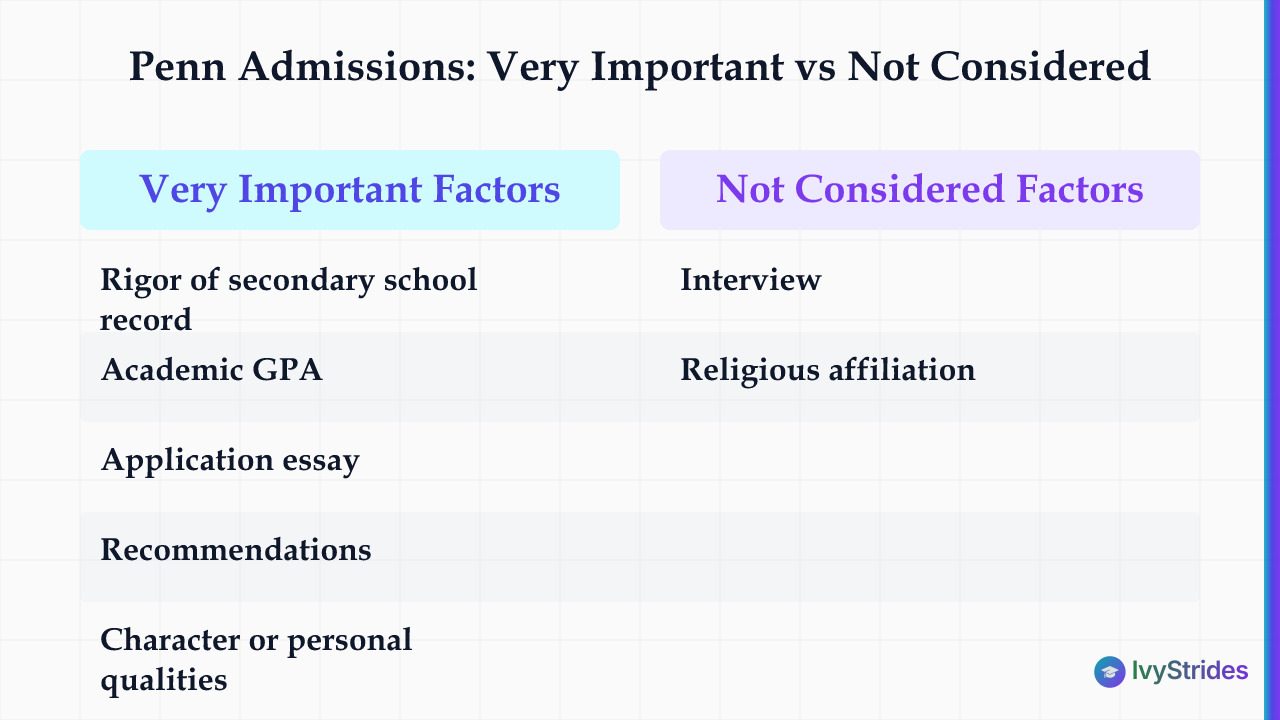
Penn rates the same five factors Very Important for every first-year applicant, regardless of which school you enter. Per Penn's 2025-26 Common Data Set, those factors are rigor of secondary school record, academic GPA, the application essay, recommendations, and character or personal qualities.
Whole-person review. Penn describes its process as a comprehensive, whole-person review in which no single component is favored, and admissions officers discuss applications in teams.
Readers also look for Benjamin Franklin-inspired character: open-minded and curious, inventive and practical, and focused on social good. Penn is test-required for fall 2027 entry (the 2026-27 cycle), and the rule covers all first-year, international, homeschooled, transfer, and QuestBridge applicants. A hardship waiver exists for applicants who have not taken the SAT or ACT and face a barrier such as no available test center, financial hardship, natural disaster, or civil unrest.
For the Class of 2030, enrolled students reported a middle 50% of 1440-1550 on the SAT and 33-35 on the ACT, per Penn's incoming class profile. Know the score range that puts an applicant in the competitive pool before you decide whether to retake, including how Penn treats superscoring.
| Factor | Penn's Rating (CDS 2025-26) | What It Means in Practice |
| Rigor of secondary school record | Very Important | Did you take your school's hardest courses? |
| Academic GPA | Very Important | Weighed against that rigor, not alone |
| Application essay | Very Important | Both supplements and the personal statement |
| Recommendations | Very Important | Counselor plus one core-subject teacher |
| Character/personal qualities | Very Important | The Franklin framework readers apply |
| Interview | Not Considered | Penn no longer offers them |
| Religious affiliation | Not Considered | No bearing on review |
One note on test scores. The same Common Data Set rates standardized test scores Considered, a tier below those five: for fall 2027 entry they are required to apply and weighed as one factor.
What Each UPenn School Wants From Your High School Transcript
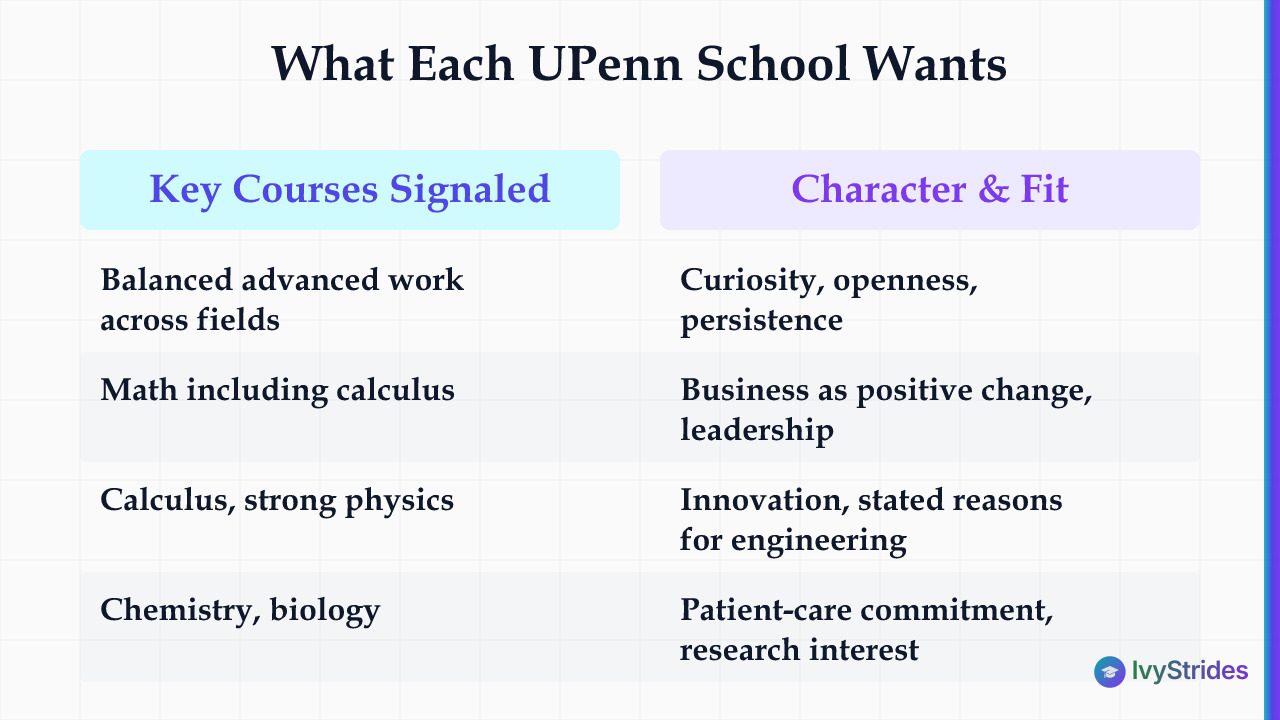
Wharton and Penn Engineering look for calculus, and Penn Nursing looks for chemistry and biology. Academic preparation is school-specific: each undergraduate school publishes its own guidance, and your transcript is read against the one you enter. Penn encourages every applicant to take English, social studies, math, science, and a foreign language throughout high school, and the same course rigor Penn readers check is read against your specific program. They ask whether you took the rigorous courses your school offered and whether your core-subject grades show readiness, using your school profile for context.
Wharton wants interest in business as a force for positive change, demonstrated leadership, and math including calculus. Penn Engineering wants the ability to innovate and apply science, stated reasons for choosing engineering, and strong physics and math, especially calculus. Penn Nursing wants commitment to patient care, interest in health-care issues and research, and strong chemistry and biology. The College of Arts and Sciences wants balanced, advanced preparation, curiosity, openness to dialogue, and persistence with hard questions.
| Penn School | Key Courses Signaled | Character or Fit Penn Looks For |
| College of Arts and Sciences | Balanced advanced work across fields | Curiosity, openness, persistence |
| Wharton | Math including calculus | Business as positive change, leadership |
| Penn Engineering | Calculus, strong physics | Innovation, stated reasons for engineering |
| Penn Nursing | Chemistry, biology | Patient-care commitment, research interest |
The practical check is calculus. Having it on your transcript before you apply to Wharton or Engineering covers the one course both schools name, and how many AP courses you took against what your school offered matters more than any fixed count. We see students apply to Wharton without calculus on their transcript, a gap against the math preparation Wharton names.
School-specific story. The students whose Penn files read as genuinely prepared are the ones who arrive with a clear one: Wharton applicants who can point to calculus and a leadership arc, or Nursing applicants whose transcript shows chemistry and biology alongside a patient-care activity. IvyStrides' admissions counselors do exactly this work, mapping a student's course list against each Penn school's academic guidance before the application goes in.
Penn's Two Supplemental Essays and the School-Specific Short Answer

Photo by https://kaboompics.com/ on Pexels
UPenn's writing requirements for fall 2027 entry are three short answers on top of your personal statement: two Penn-wide prompts and one school-specific prompt, each 50 to 200 words per Penn's 2026-27 writing page. The application essay is one of Penn's five Very Important factors.
Prompt 1 asks for a short thank-you note to someone you have not yet thanked and would like to acknowledge; Penn encourages you to share it with that person. Prompt 2 asks how you will explore community at Penn and how your experiences will help shape it.
Daily SAT and ACT prep on YouTube: short strategy videos from IvyStrides. Subscribe to IvyStrides on YouTube.
The school-specific prompt differs by school: the College asks what you are curious about and how you might pursue it there, Wharton asks about a current issue a Wharton education would help you explore, Engineering asks how you will pursue your engineering interests within your intended major, and Nursing asks why Nursing, where you see yourself professionally, and how you will contribute to its mission of promoting equity in healthcare.
Coordinated dual-degree applicants answer it for their single-degree school and add their program's own essays. Throughout, Penn asks you to be precise about why Penn and why that school, and suggests naming classes, research opportunities, or groups.
Penn no longer offers alumni conversations, and admissions officers do not hold on-campus interviews, so there's no Penn interview to prepare for.
| Writing Component | Word Limit | Status |
| Common App personal statement | 650 max | Required |
| Penn thank-you note | 50-200 | Required |
| Penn community prompt | 50-200 | Required |
| School-specific short answer | 50-200 | Required |
| Supplementary materials | Keep it brief | Optional; portfolios reviewed only for VIC applicants |
In our essay coaching, the students who write the strongest Penn short answers can name a specific Penn course, lab, or research group, not just a general interest in the field. Penn's short answer is essentially a focused prompt on why this college and why this school, built on named programs, and the same specificity rules apply. IvyStrides' essay coaches work through all three UPenn short answers alongside the personal statement so the four pieces read as one coherent file.
UPenn Application Deadlines and the Early Decision Agreement
Those essays and transcript signals arrive on a fixed calendar, and Penn runs two rounds: binding Early Decision with a November 1, 2026 deadline and decisions in December, and Regular Decision with a January 5, 2027 deadline. Penn offers no Early Action (CDS C22: No). For Early Decision, Penn accepts SAT scores from tests through November 2026 and ACT scores through October 2026; for Regular Decision, both through December 2026.
A binding commitment. The ED Agreement is signed by the student, a parent or guardian, and the counselor, and it commits you to enroll if admitted. Apply ED only if Penn is your clear first choice. IvyStrides' analysis of Penn's 2025-26 Common Data Set counts, 1,266 admitted from 9,503 Early Decision applicants, puts Penn's Early Decision admission rate for the Class of 2029 at 13.3%.
| Round | Deadline | Decision | Binding? | Notes |
| Early Decision | Nov 1, 2026 | December | Yes | ED Agreement signed by student, parent or guardian, counselor |
| Regular Decision | Jan 5, 2027 | Spring | No | No Early Action offered |
Recommendations. Penn requires one counselor or school official and one teacher in a core subject. You may add one optional letter from another teacher or a community supporter, such as a work supervisor, mentor, or coach. Penn asks you to be selective, so weigh whether an optional third recommendation letter would add a perspective your counselor and teacher letters cannot; skipping it does not count against you. Penn accepts the Common App, the Coalition Application, and QuestBridge, and asks you to use only one.
FAQ: UPenn Requirements and School Fit
What GPA is needed for UPenn?
Penn does not publish a minimum GPA. In its 2025-26 Common Data Set, enrolled first-years who reported a GPA averaged 3.9, and 59% had a 4.0. Academic GPA is one of five Very Important factors, but readers weigh it alongside course rigor. Penn uses school profiles to contextualize every transcript.
Is a 3.7 GPA good for UPenn?
A 3.7 sits below most of Penn's enrolled class: in the 2025-26 Common Data Set, 5% of enrolled first-years who reported a GPA fell between 3.50 and 3.74. It isn't disqualifying on its own, because Penn's whole-person review weighs course rigor, essays, and recommendations alongside GPA, and a 3.7 in the most demanding courses your school offers reads differently from a 3.9 in easier ones.
Is 1450 SAT enough for UPenn?
Penn's Class of 2030 profile puts the middle 50% SAT range of enrolled students at 1440-1550, so a 1450 falls inside it, near the low end. On the same profile, 22% of the SAT scores the class submitted fell between 1400 and 1490, and 63% between 1500 and 1600. Penn is test-required for fall 2027 entry and weighs scores as one factor in a whole-person review. Admission depends on the full application.
What are the requirements to go to UPenn?
For fall 2027 entry, Penn requires the SAT or ACT (or a hardship waiver), an official transcript and school report, three Penn short answers of 50 to 200 words each, one counselor recommendation, one core-subject teacher recommendation, and an application through the Common App, Coalition App, or QuestBridge.
Your Next Step on UPenn Requirements
Penn reads your application against the specific school you chose, so the work is to match your file to that program before the deadline. Start here:
- Confirm which of the four schools fits your transcript and planned courses.
- Check whether your SAT or ACT score reaches the competitive range, and file the hardship waiver only if you have not tested and face a real hardship.
- Draft the two Penn-wide short answers and your school's prompt, naming real Penn classes, labs, or groups.
- Decide between the November 1 ED deadline and the January 5 RD deadline, and line up your counselor and core-subject teacher recommendations early.
College admissions insights on LinkedIn: follow IvyStrides for application guidance and counseling updates.

Rajesh is a technology leader, entrepreneur, and angel investor with 28+ years in Business & Technology Leadership and Product & Solution Engineering. He is passionate about education, mentoring, and driving digital transformation.