
What Does a College Counselor Do? Services, Deliverables & Grade-by-Grade Timeline
On this page
- School Counselor vs. Private College Counselor: What the Difference Means for Your Student
- What a College Counselor Does Grade by Grade
- Is Hiring a College Counselor Worth the Cost?
- Not Sure Which Part of the Process Your Student Actually Needs Help With?
- What to Look for When Choosing a College Counselor
- You Know What Good Looks Like. Now Map the Plan.
- FAQ: College Counselor Services and Cost
- Is college counseling good?
- What are the duties of a student counselor?
- Are college counselors worth it?
- How much does a college counselor cost?
- Your Next Step on College Counseling
A college counselor helps a high school student build a college list, plan course rigor, prepare for the SAT or ACT, and write stronger admissions essays. A private, or independent, college counselor is a fee-based professional families hire to run that full strategy one-on-one. School counselors do this work too, but carry caseloads of 400 or more.
Those two roles look similar on paper and differ sharply in practice. The rest of this page breaks the work down by grade, names the concrete deliverables at each stage, and answers the question every family actually asks: is the private version worth paying for?
School Counselor vs. Private College Counselor: What the Difference Means for Your Student
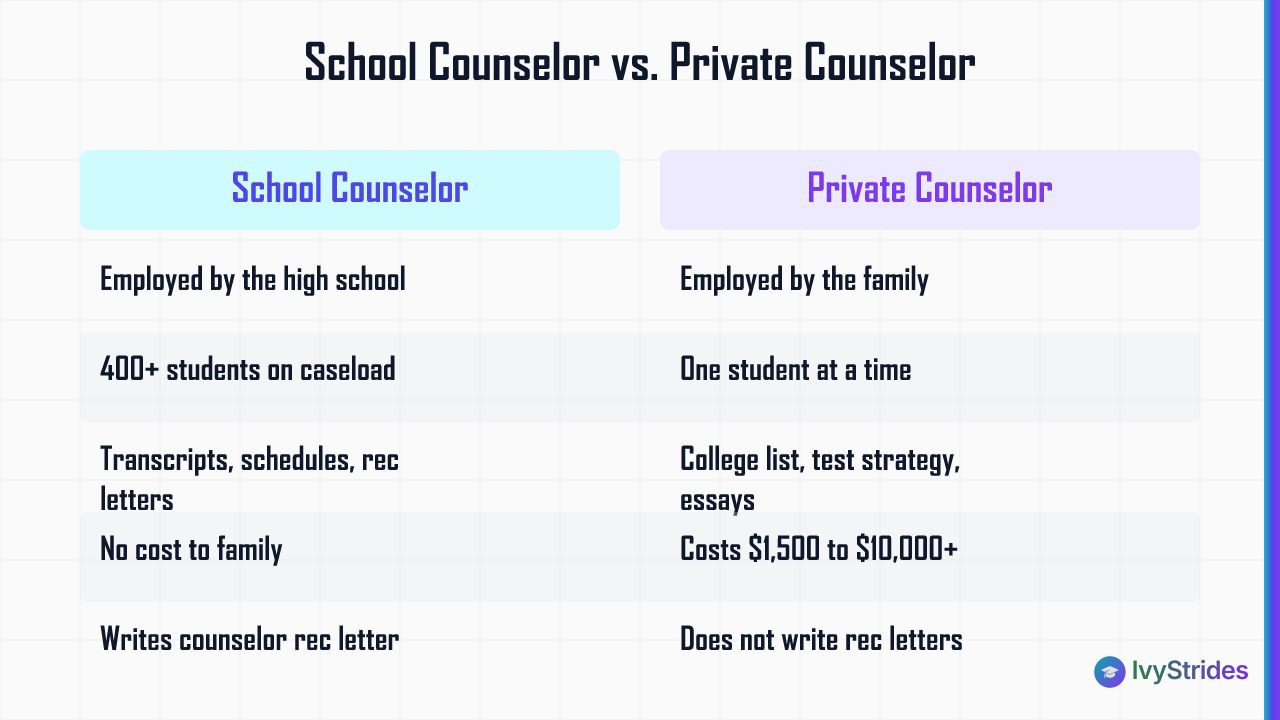
A school counselor and a private college counselor do different jobs. The school counselor works for the high school and serves every student in the building. The private, or independent, college counselor works for one family and one student.
Caseload is the real gap. The average public-school counselor-to-student ratio has run well above 400 students per counselor for years, per NCES data. Split a working year across roughly 400 seniors, juniors, and underclassmen, and the math leaves little room for individual admissions strategy. School counselors spend most of that time on transcripts, graduation requirements, recommendation letters, and scheduling.
An independent college counselor has no affiliation to any college or district. That person builds an individualized college list, sets test strategy, coaches essays, and manages application logistics for one student. The National Association for College Admission Counseling (NACAC) sets the ethical standards these professionals follow, including a ban on guaranteeing admission.
| Feature | School Counselor | Private College Counselor |
| Employer | The high school | The family |
| Typical caseload | 400+ students | One student at a time |
| Core duties | Transcripts, schedules, rec letters | College list, test strategy, essays |
| Cost to family | None | $1,500 to $10,000+ |
| Time per student | Limited | Dedicated |
| Writes rec letters | Yes | No |
Both matter. Your school counselor still writes the counselor recommendation and files the transcript, and a good brag sheet helps them write it well. The private counselor fills the individualized-strategy gap the caseload leaves open.
What a College Counselor Does Grade by Grade
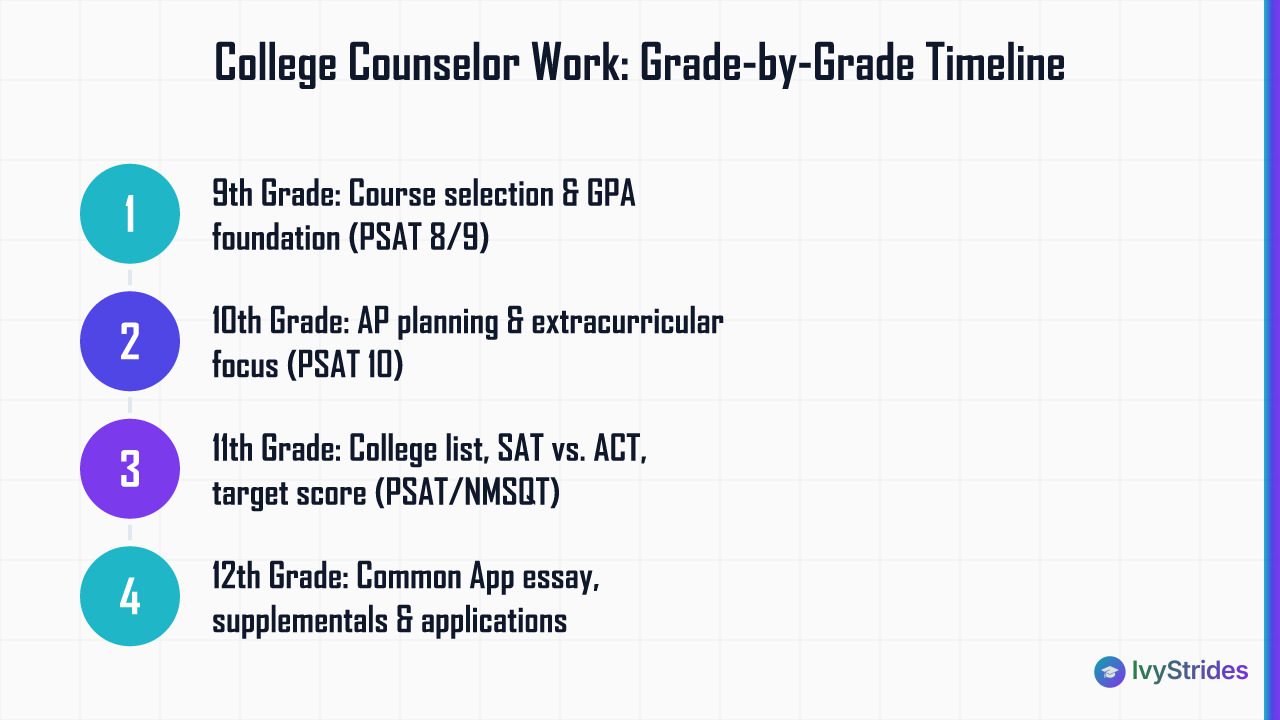
A college counselor's work runs as a four-year sequence, not a senior-year rescue. The tasks shift each year: foundation in 9th, planning in 10th, testing and list-building in 11th, applications and essays in 12th. Here is what a private counselor actually delivers at each stage.
| Grade | Key Counselor Tasks | Tests and Milestones |
| 9th | Course selection, GPA foundation | PSAT 8/9 baseline |
| 10th | AP planning, extracurricular focus | PSAT 10 |
| 11th | College list, SAT vs. ACT decision, target score | PSAT/NMSQT |
| 12th | Common App essay, supplementals, applications | Final SAT/ACT sittings |
9th grade: build the foundation. The counselor helps a freshman pick courses that keep advanced tracks open, and protects the GPA from the start, because early grades count. The PSAT 8/9 gives a first testing baseline, not a score that matters for admission.
10th grade: plan the rigor. This is where AP course selection starts. Counselors advise on how many AP courses to take and which subjects signal rigor to admissions readers at a student's target schools. The College Board treats AP course rigor as a core admissions signal, and a good plan matches how many AP classes to take to the student's realistic bandwidth.
11th grade: the highest-use year. One of the highest-use things a counselor does in 11th grade is help a student decide between the SAT and ACT, set a realistic target score, and build a prep timeline that fits the application calendar. The PSAT/NMSQT also lands here, and it doubles as the National Merit qualifying test, per the College Board.
In our coaching with students who start in 11th grade, the most common gap we see is an underdeveloped college list built around prestige rather than fit, which a counselor corrects early in the engagement. Test strategy is also where specialization matters. Advice on which test to sit should be coordinated with a section-specialist tutor for SAT R&W, SAT Math, or ACT sections, not handled generically by someone guessing across all four.
12th grade: applications and essays. Essay coaching is often the most time-intensive part of a counselor engagement in 12th grade, covering the Common App personal statement (650 words) and every school-specific supplemental essay, per Common App. The volume surprises families. A student applying to 10 schools with roughly three supplements each writes about 30 supplemental essays on top of the personal statement (IvyStrides estimate, based on Common App per-school requirements).
Across hundreds of supplemental essay drafts, the most common counselor intervention is helping students move from generic "why I want to attend" language to specific, school-referenced reasoning. A counselor's grade-by-grade plan maps directly onto the application calendar, where Early Decision deadlines typically fall in November and Regular Decision in January. Getting those college application deadlines for fall 2026 right. Managing which teachers submit how many recommendation letters each school wants, is a logistics job the counselor owns so the student can write.
Is Hiring a College Counselor Worth the Cost?
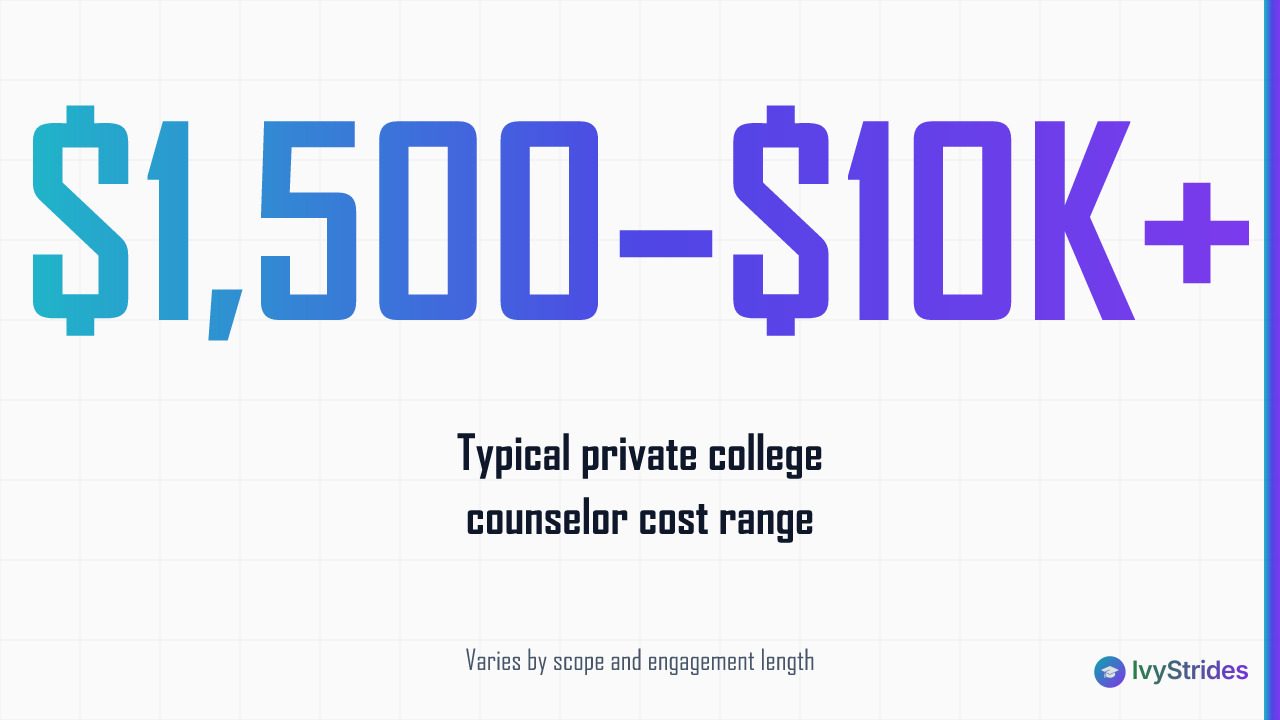
A private college counselor earns its cost when the work is specific and starts early; it is a weak investment when it repeats what a motivated student could find for free. Independent counselors typically charge $1,500 to $10,000 or more depending on scope and engagement length. Hourly rates usually run about $150 to $400 an hour, and full-service multi-year packages sit at the top of that range.
Where the money earns out. A counselor adds the most value in a handful of situations. Use this as a gut check:
- The student has a competitive or complex target-school list with heavy supplemental essays
- School counselor access is thin, which the 400-plus caseload usually means
- The application is essay-intensive and the student needs structured feedback
- Nobody in the family has navigated selective admissions before
- The student is capable but disorganized and needs deadline accountability
- The student is applying internationally to US colleges
A counselor matters less for a self-directed student with strong school support, applying to schools comfortably within their academic range.
What no counselor can do. No counselor can guarantee admission, and any claim otherwise is a red flag. Admissions outcomes depend on the full application, not any single component. On the r/ApplyingToCollege forum, students make a fair point: most of what it takes to get in is knowable. That is true, which is why the value of a counselor lives in execution and personalization, not access to secret information.
Whether to submit test scores at test-optional schools is one of the judgment calls a counselor makes based on a student's score relative to a school's middle-50 range. Test-optional policies vary by school and year, per FairTest, so this call gets remade every application cycle.
Here is the part most families miss: you don't have to buy the whole package. If the real gaps are essays and test scores, IvyStrides offers college essay coaching and 1-on-1 SAT or ACT prep as separate modules, so you invest only where the student needs help. That structure also lets a counselor advise on strategic levers like what is demonstrated interest without paying full-service rates for information.
Not Sure Which Part of the Process Your Student Actually Needs Help With?
You have a college list, a rough timeline, and a real question about where to focus. A free 15-minute call reviews your student's current profile, pinpoints the highest-leverage gaps in test scores or essays, and maps a concrete next step before the application window tightens.
What to Look for When Choosing a College Counselor
A strong college counselor shows three things: professional standing, real specialization, and a transparent method. Weigh those against the cost signals from the section above, because a $6,000 engagement earns its price only when all three are present.
Standing. Look for NACAC membership. NACAC sets the ethical code for admissions professionals, and its members agree not to promise outcomes they cannot control.
Specialization. Ask what the counselor actually does best. Some are essay-focused, some full-service, some coordinate testing. A strong engagement starts with a baseline diagnostic of the student's academic profile, test scores, and target schools before any strategy is set. That diagnostic-first approach is how IvyStrides structures prep, with a per-subject specialist coach rather than one generalist stretched across everything.
| Green Flag | Red Flag |
| NACAC member, honest about limits | Guarantees admission or a score |
| Starts with a diagnostic baseline | Same plan for every student |
| Names a clear methodology | Vague "we know people" claims |
| Specialists by section or subject | One tutor across all tests |
| Transparent, itemized pricing | Pressure to buy the full package |
When to start. Ideally 9th or 10th grade for full-service planning, so course selection and AP choices stay on track from the start. Starting in 11th grade is still viable for test and essay work, which is when many families come in.
Whoever you hire should explain the SAT-versus-ACT call in plain terms. If you want that framework yourself, our guide to ACT vs SAT: which test is right for you walks through it. Coordinating that decision with AP timing is its own small project, covered in our AP, SAT, and ACT testing plan.
You Know What Good Looks Like. Now Map the Plan.
You have the criteria, the grade-level timeline, and a clear picture of where the gaps are. Turning that into a specific prep and essay plan tied to your student's actual profile and target schools starts with one focused conversation. A free 15-minute strategy call does exactly that.
FAQ: College Counselor Services and Cost
Is college counseling good?
College counseling is most valuable when it is specific and starts early. A counselor who builds a personalized college list, sets a realistic test-score target, and gives structured essay feedback adds measurable value. Generic advice that mirrors what a student could find online does not justify the fee.
What are the duties of a student counselor?
A private college counselor's core duties include building a balanced college list, advising on course rigor and AP selection, setting a test-prep timeline, coaching the Common App personal statement and supplemental essays, managing application deadlines, and advising on Early Decision versus Regular Decision strategy.
Are college counselors worth it?
They are worth it when a student has a competitive target list, limited school counselor access, or essay-heavy applications. They matter less for a self-directed student with strong school support who is applying to schools well within their range. The honest answer depends on the specific student.
How much does a college counselor cost?
Private college counselors typically charge $1,500 to $10,000 or more, depending on whether the engagement is hourly, package-based, or full-service from 9th grade through submission. Hourly rates generally run about $150 to $400 per hour, and multi-year full-service packages sit at the higher end.
Your Next Step on College Counseling
You now know what a counselor delivers each year, how a private one differs from your school counselor, and where the cost earns out. The decision comes down to your student's specific gaps.
- Name the two or three places your student actually needs help: list, testing, or essays
- Decide whether full-service or a single module fits your budget
- If testing or essays is the gap, price those modules separately before committing to a full package
- Screen any counselor against the green-flag and red-flag list above

Award-winning author (South Asian Book Award) and graduate of BITS Pilani and UCLA Luskin School of Public Affairs. Brings a published writer's eye to Common App essays and grammatical precision to SAT and ACT R&W instruction.