
When Your Teen's SAT Score Stalls: What Parents Can Do and What to Leave Alone
On this page
- What a Real SAT Score Plateau Looks Like vs. a One-Off Bad Day
- Why More SAT Practice Tests Are Not Moving Your Teen's Score
- What Parents Can Actually Do When the SAT Score Stalls
- How to Have the SAT Score Conversation Without Making It Worse
- FAQ: A Stalled Teen SAT Score
- Can my parents see my SAT score?
- Can I proctor the SAT if my child is taking it?
- Why can I not see my teen's practice SAT score on Bluebook?
- Can someone who has graduated from high school still take the SAT?
- Your Next Step on a Stalled SAT Score
Treat a stalled SAT score as a pattern to diagnose, not a fixed ceiling. The SAT is a 2-hour-14-minute digital exam scored 400 to 1600, and when a teen's score stops moving, three causes are worth checking first: knowledge gaps in specific content domains, pacing errors, or practice without review.
For a parent, the harder question is who does what. Parents own logistics and accountability, while the content work belongs to the student, with a tutor's help if the cause proves hard to pin down.

What a Real SAT Score Plateau Looks Like vs. a One-Off Bad Day
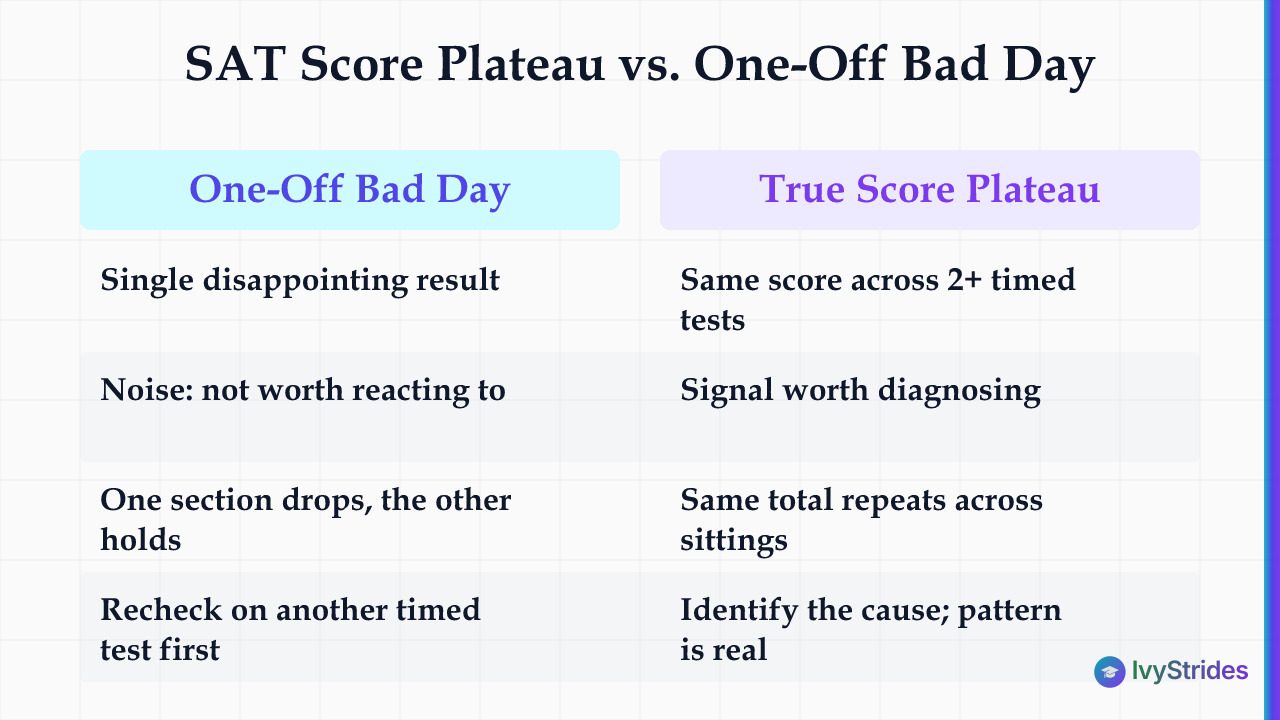
A score plateau is a score that does not move across two or more timed full-length practice tests or official sittings, not a single disappointing result. One low day is noise. A repeated number is a signal worth diagnosing.
Some movement between sittings is expected. The official score report shows a score range, which College Board describes as how much a score would likely vary on a different administration of the test under identical conditions (College Board).
The exam runs 98 questions in 2 hr 14 min of testing: Reading and Writing is 54 questions in 64 minutes across two modules, and Math is 44 questions in 70 minutes, also in two modules (College Board). Based on how a student performs on the first module of each section, the second module is either more or less difficult, so the way the adaptive modules feed the final score is worth understanding before you read too much into one result.
The distinction that matters. A plateau is a pattern you can take apart, not a fixed limit. Before you act on it, confirm the pattern is real.
| Situation | What It Looks Like | What It Means |
| One-off dip | One section drops, the other holds | Possibly a bad day; check it on another timed test before reacting |
| True plateau | Same total across two or more timed tests | Diagnosable; identify the cause |
| Section split | Math moves, Reading and Writing stalls | Domain-specific gap in one section |
| Late-module slump | Misses and blank answers pile up near the end of a module | Likely pacing; check timing before content |
Why More SAT Practice Tests Are Not Moving Your Teen's Score
More practice tests do not move an SAT score when the student never reviews the misses. A timed full-length practice test diagnoses the problem; it does not fix it. The fix is the review that follows, and it is the easiest step to skip.
Three causes are worth checking. A knowledge gap shows up as errors clustering in specific content domains. On Reading and Writing those domains are Information and Ideas, Craft and Structure, Expression of Ideas, and Standard English Conventions. On Math they are Algebra, Advanced Math, Problem-Solving and Data Analysis, and Geometry and Trigonometry (College Board).
Pacing is the second cause. A pacing gap shows up as rushed or unanswered questions late in a module. IvyStrides' analysis of College Board's published SAT format, 134 minutes across 98 questions, puts the average time per question at about 82 seconds. The sections differ, though: each Reading and Writing module gives 32 minutes for 27 questions, about 71 seconds a question, and each Math module 35 minutes for 22 questions, about 95 seconds. Compare your teen's practice timing with each section's average.
Practice quality is the quietest cause. After each full-length practice test in Bluebook, College Board's testing app, My Practice lists every question with the correct answer and the answer the student selected (College Board). A student who takes test after test without reading that review learns little between sittings. Reviewing every wrong answer by question type and content domain is what turns a flat result into a targeted plan, so which practice tests your teen uses, and how each one gets reviewed, matters more than how many get taken.
| Plateau Cause | Where It Shows Up | What to Do About It |
| Knowledge gap | Weak Knowledge and Skills results in one or two content domains | Targeted domain practice |
| Pacing gap | Rushed or blank questions near the end of a module | Timed drills against the section's average pace |
| Low-quality practice | Flat score across tests, no pattern tracked | Error log by type and cause |
The tool that makes the pattern visible is an error log that tracks question type and root cause. Record the question type, the content domain, and why the mistake happened: misread, didn't know the rule, ran out of time.
What Parents Can Actually Do When the SAT Score Stalls

Photo by Kaboompics.com on Pexels
The most useful thing a parent can do about a stalled SAT score is own the logistics and accountability, not the content. Content and strategy belong to the student and, where needed, a tutor.
For parents: IvyStrides shares admissions timelines and counseling guidance on LinkedIn. Follow along for the questions families ask most.
Once the plateau cause is identified, build the study plan around the specific weak domains rather than more unreviewed practice. Your job is to protect the conditions that plan needs: a quiet space, a consistent schedule, a working device for Bluebook, and a calendar built on real dates. The SAT weekend dates still ahead in 2026-27 are December 5, 2026 (registration deadline November 20), March 6, 2027 (February 19), May 1 (April 16) and June 5 (May 21) (College Board).
| Action | Who Owns It |
| Register with your teen and track the deadlines | Parent |
| Choose the test center at registration | Parent |
| Make sure Bluebook exam setup is done before test day | Parent |
| Confirm practice tests are timed and reviewed | Parent |
| Set up a quiet, consistent study space | Parent |
| Choose which content domains to drill | Student / coach |
| Decide question-level strategy and pacing | Student / coach |
| Agree on a target score together | Both |
What to leave alone. Do not sit beside your teen choosing answers, second-guessing their strategy, or dictating session pacing. That undermines ownership, and ownership is what carries a student through a plateau. Before you decide how hard to push a retake, check each college's score policy for fall 2027 entry, since College Board's advice is that each college has its own approach and policy on SAT scores (College Board). Scores are also one part of the application: admission officers weigh grades, courses, activities, essays and recommendation letters too.
If two sittings of self-study with a reviewed error log have not moved the score, outside help from a tutor who works from your teen's own results is worth considering. IvyStrides' 1-on-1 SAT tutoring starts with a diagnostic test and a custom roadmap that sets the baseline and the focus areas, re-evaluated weekly as data comes in, and each Bluebook-style mock is followed by a tutor review session.
How to Have the SAT Score Conversation Without Making It Worse

Photo by Julia M Cameron on Pexels
The SAT score conversation works when it starts from the score report data, not from effort or intelligence. A stalled score is a problem to solve together, not a verdict on your teen. Say so in your first sentence.
The same report that drives a prep plan gives this conversation a specific starting point. Its Knowledge and Skills section shows your teen's performance in each of the eight content areas the test measures, four in Reading and Writing and four in Math, and College Board suggests using it to identify the areas to focus on (College Board).
Pointing at one weak area and building the next few weeks of practice around it beats a vague instruction to study more. Knowing how the Digital SAT works from a parent's side, from its timing to its adaptive modules, makes that conversation easier to start.
Ask, don't prescribe. A diagnostic question keeps the student in ownership: "Which section felt rushed?" opens more than "You need to work on Math." If the plan you agree on means joining a course partway through, the same rule applies: a student who joins a digital SAT course late starts with the weakest domains and works toward the next test date.
Five steps for the conversation itself:
-
Open with the data: "Let's look at what the report shows."
-
Separate the score from the student: it measures a skill set, not worth.
-
Ask which parts felt hard rather than naming the fix.
-
Name one content domain to focus on first.
-
Agree on a concrete next step together, and a date to check in.
FAQ: A Stalled Teen SAT Score
Can my parents see my SAT score?
Yes, when you share them. SAT scores go to your own College Board account, where students aged 13 or older see their scores online and the score report PDF (College Board). A parent sees them when you share that report or open it together. College Board recommends that students create the account themselves or with a parent, because only one account can be tied to a student's official record (College Board).
Can I proctor the SAT if my child is taking it?
Not in your child's testing room. College Board's SAT Weekend Proctor Manual says staff should have "no immediate family member taking the test in the same testing room where the related staff member is working" (College Board). Your role on test day is logistics: drop-off, and checking that your teen has a physical photo ID, the admission ticket (printed or on a phone), and a fully charged device with Bluebook exam setup complete (College Board).
Why can I not see my teen's practice SAT score on Bluebook?
Practice scores are tied to the account your teen signs in with, not to a parent view. After a full-length practice test in Bluebook, scores appear in My Practice, which lists each question with the correct answer and the answer your teen selected (College Board). Ask your teen to open My Practice with you, or to download the score report and share it.
Can someone who has graduated from high school still take the SAT?
Yes. College Board's account setup includes an "I am no longer in high school/My school is not listed" option (College Board), and its ID rules cover older test takers: anyone 21 or older on test day must bring an official government-issued photo ID, such as a driver's license or passport (College Board).
Your Next Step on a Stalled SAT Score
A flat score is a diagnosis waiting to happen, not a limit. Confirm the plateau is real, find which of the three causes is driving it, and split the work so you carry logistics while your teen carries the content.
- Confirm the plateau across two timed full-length practice tests.
- Open the score report and read the Knowledge and Skills section together.
- Start an error log by question type and root cause.
- Name one weak domain to focus on first.
- If two sittings have not moved the score, consider a tutor who starts from a diagnostic test.
Watch the method, then try it: IvyStrides explains SAT and ACT question types on YouTube.

Hemant is a seasoned entrepreneur, investor, and growth strategist with deep ground in education and technology-driven learning. His core training is in Mathematics and Physics — he authored Physics for IB Diploma: Ultimate Revision Guide, recognized as a top student resource.