
How to Improve your SAT Score in 2026: A Step-by-Step Guide That Actually Works
On this page
- What Improving Your SAT Score Actually Requires (The Short Answer)
- Step 1: Set a Concrete Target Score Based on Your College List
- Step 2: Take a Full-Length Diagnostic Test and Read the Score Report
- Step 3: Build a Targeted Study Plan Around Your Weakest Areas
- How to Improve Your SAT Reading and Writing Score: Section-Specific Tactics
- How to Improve Your SAT Math Score: Section-Specific Tactics
- Step 4: Use Full-Length Practice Tests to Measure Real Progress
- Score Benchmarks: What Score Do You Actually Need?
- Can You Improve Your SAT Score by 200 Points? Realistic Timelines by Score Band
- Step 5: Decide Whether Self-Study or a Coach Will Get You There Faster
- Planning Your Retakes: How SAT Test Dates and Superscoring Affect Your Strategy
- FAQ
- Is a 1400 SAT score enough for Ivy League admission?
- Is a 1200 a good SAT score?
- Is a 1600 SAT score good?
- How realistic is a 200-point SAT improvement in 2 months?
- Can I improve my SAT score from 1100 to 1400 in 3 months?
- How do I improve my SAT score if I have only one week?
- Does free SAT prep actually work?
- Where to Go From Here
To raise your Digital SAT score, take a full-length official practice test in the College Board Bluebook app to establish your baseline, review the score report to find your weakest question types in Reading and Writing and in Math, then build a plan that targets those specific gaps. In our coaching, focused work of roughly 6-8 weeks typically produces around 100-point gains; 200-point improvements usually take about 3-4 months of consistent, targeted practice. The key: work on your actual weak spots, not what you already know.
Digital SAT format and scoring facts throughout this guide trace back to College Board's official documentation. The rest of the article expands the process into five sequenced steps, with score-band-specific timelines and section-specific tactics for R&W and Math.

What Improving Your SAT Score Actually Requires (The Short Answer)
The Digital SAT runs 2 hours and 14 minutes, is scored 400-1600, and has two sections: Reading and Writing (R&W) and Math, per the College Board. Each section splits into two adaptive modules. Your performance on Module 1 determines whether Module 2 routes to a harder or easier question set, and the harder Module 2 is what unlocks the top of the score range. All of it runs through the free Bluebook app, which hosts the official full-length adaptive practice tests you actually need.
Here's the framework we use with every student:
-
Set a target score based on your college list.
-
Take a Bluebook diagnostic and read the score report by domain.
-
Build a targeted study plan around your weakest question types.
-
Measure progress with full-length practice tests on a spaced cadence.
-
Decide honestly whether self-study or a section-specialist coach will get you there faster.
Random practice, "one more prep book," and drilling questions you already know how to answer are the three most common ways students burn eight weeks and gain around 30 points. Diagnostic-first work changes that. If you're new to the format, our primers on how long is the SAT and SAT adaptive testing explained fill in the mechanics.
Typical timelines, held honestly:
- Around 100 points in roughly 6-8 weeks at about 8-10 hours per week
- Around 200 points in roughly 3-4 months at about 10-15 hours per week
- Diminishing returns above 1500, where each additional 50 points takes disproportionately more hours
Step 1: Set a Concrete Target Score Based on Your College List
Before you study a single question, define what score you're actually chasing. "Higher" isn't a goal. 1450 by the October test date is a goal.
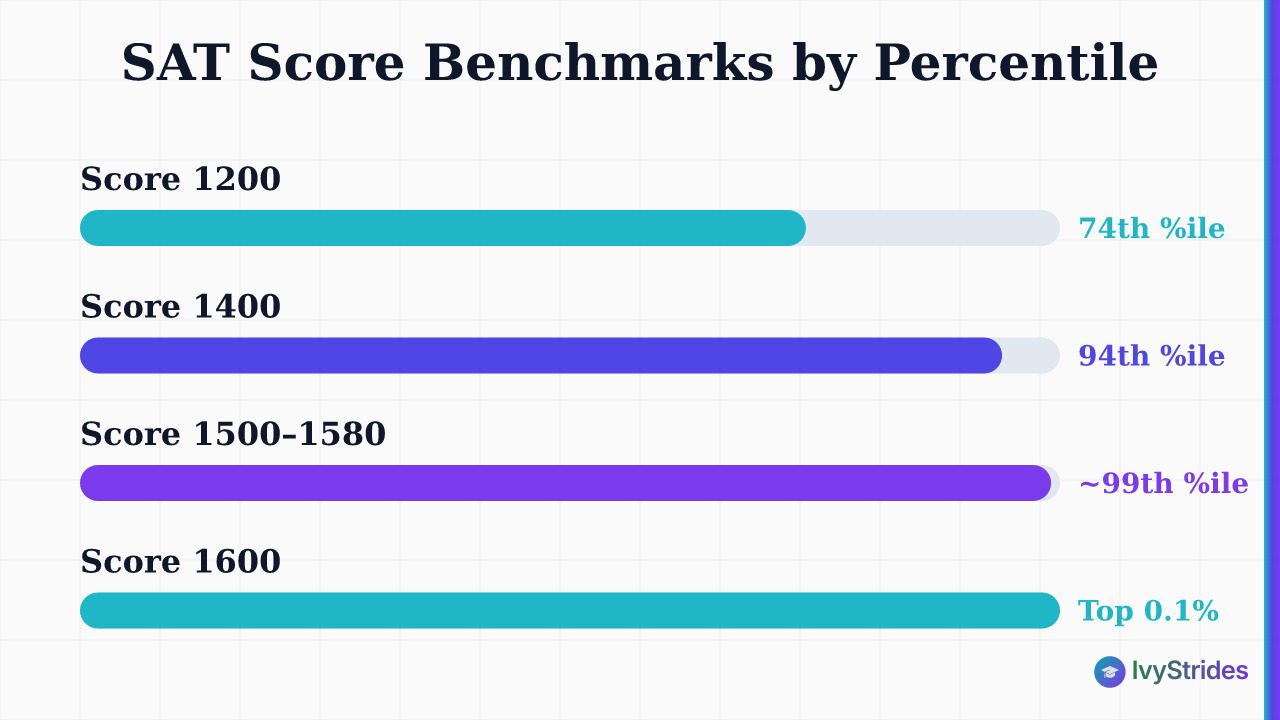
Anchor your target to your college list. A rough map of where scores sit on the current College Board percentile tables:
- 1200: around the 74th percentile. Solid for many state flagships and regional privates.
- 1400: around the 94th percentile. Competitive at most strong universities.
- 1450+: competitive for most highly selective schools.
- 1500-1580: the typical Ivy League middle-50% range. Verify each school's Common Data Set for its most recent published range.
- 1600: perfect. Roughly the top 0.1% of test-takers.
Knowing what score you actually need for your target colleges, not a vague "higher is better" goal, is what makes your prep plan specific and motivating. If you're sitting near 1300 and reading pages like is 1300 a good SAT score, your gap to a competitive Ivy-range application is roughly 150-200 points, a real and workable delta with about 3-4 months of targeted work. If you're already at 1500, is a 1500 a good SAT score for Ivy League helps you calibrate whether pushing higher is worth the marginal hours.
Two more variables shape your target.
Superscore. Many selective colleges take your highest R&W and highest Math scores across multiple test dates. Retaking with a focused section goal (say, only Math this time) is a legitimate strategy, not a hedge.
Test-optional policy. Even at test-optional schools, a strong score can strengthen a borderline application. Policies vary by school and by year; check FairTest and each college's admissions page before deciding whether to submit.
Once you have a target score and a target test date, work backwards. Choosing your target test date before you start studying gives your plan a real deadline and helps you decide how many retakes are realistic. Look at the official SAT test dates 2026 calendar and mark the last test date that still fits your application deadlines.
Step 2: Take a Full-Length Diagnostic Test and Read the Score Report
Most students skip this step. Don't.
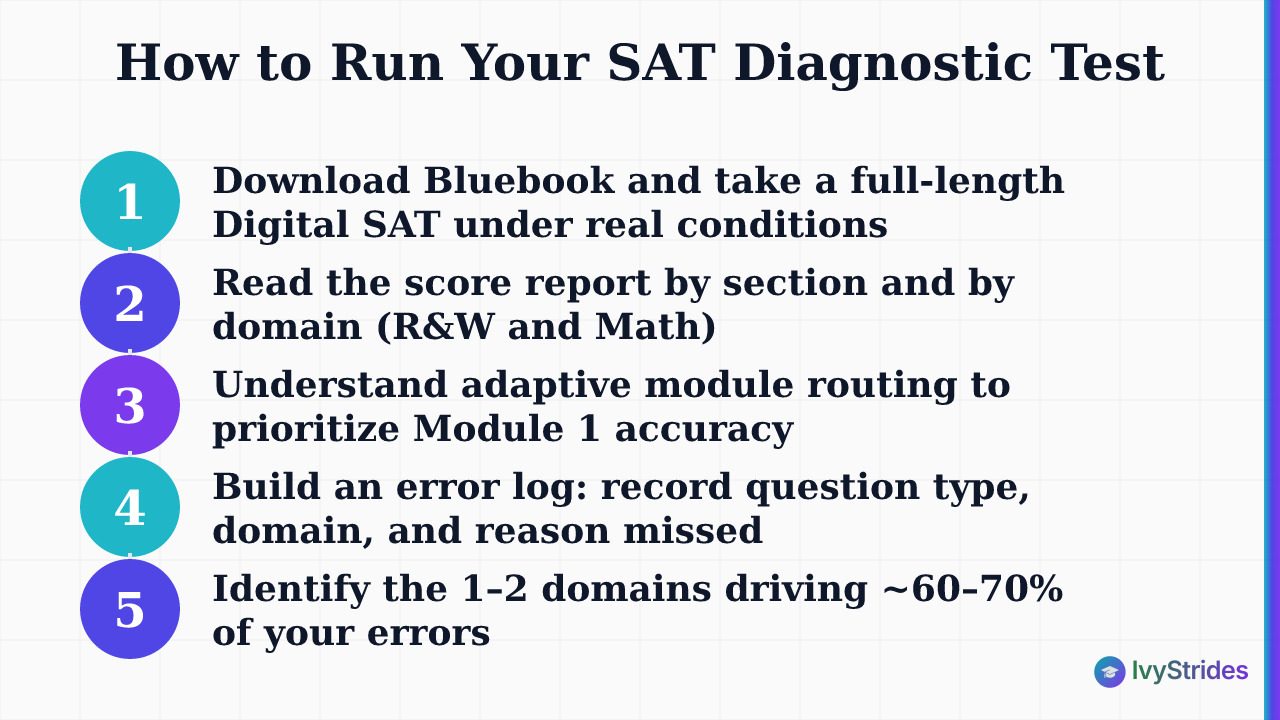
Download Bluebook from the College Board site, register for a free practice session, and take one full-length Digital SAT under real conditions: timed, phone away, only the official 10-minute break between sections. No pausing. No "let me just look this up." The diagnostic is only useful if it reflects your actual current ability under actual test pressure.
When the score report loads, read it by section and by domain. The Digital SAT breaks each section into named domains, and this is where your plan gets built.
R&W: 54 questions across two modules, 32 minutes per module, per the College Board. Four domains:
- Information and Ideas (main idea, evidence, inference)
- Craft and Structure (vocabulary in context, text structure, cross-text connections)
- Expression of Ideas (rhetorical synthesis, transitions)
- Standard English Conventions (grammar, punctuation, sentence structure)
Math: 44 questions across two modules, 35 minutes per module, per the College Board. Four domains:
- Algebra
- Advanced Math
- Problem-Solving and Data Analysis
- Geometry and Trigonometry
Understanding how the adaptive module routing works helps you prioritize accuracy in Module 1, where your performance determines whether you see harder or easier questions in Module 2. If Module 1 routes you to the easier Module 2, your section score is capped below the maximum, no matter how well you do afterward. Practical implication: early accuracy matters more than finishing fast.
Now build your error log. For every wrong answer, record three things: the question type, the domain, and the reason you missed it. Reasons cluster into a small set: content gap (didn't know the rule), misread (understood the material but misread the question), pacing (rushed), or careless (knew it, still bubbled wrong). In our coaching with students in the 900-1100 band, the most common barrier isn't a content gap; it's skipping the diagnostic entirely and going straight to random practice, which never surfaces the actual pattern. Our sat mistake tracker is a free download that gives you the exact log template we use with 1-on-1 students.
Once the log has around 20-30 entries, patterns show up. You'll usually see one or two domains driving roughly 60-70% of your errors. That's where the next step goes to work. For more full-length material at this stage, our SAT practice tests library expands on what Bluebook offers.
Step 3: Build a Targeted Study Plan Around Your Weakest Areas
Once you have your diagnostic score and a list of your weakest question types, the next step is building a week-by-week SAT study plan that allocates your hours where they'll move the needle fastest.
The rule is simple. Spend at least roughly 60-70% of your study time on the domains where you're missing the most questions. Don't spend more than about 30% of study time on already-strong domains. Reviewing what you already know feels productive; it isn't.
Hour-count estimates by target gain, based on what we typically see in our coaching:
- Around 100 points: roughly 6-8 weeks at about 8-10 hours per week. A consistent 8-10 hours per week across 8 weeks adds up to roughly 60-80 total study hours.
- Around 200 points: roughly 3-4 months at about 10-15 hours per week. That works out to somewhere near 130-200 total hours.
- 250-300 points from a starting score below 1200: typically 4-5 months at 12-15 hours per week rather than a 3-month sprint.
A weekly structure that tends to work:
- 2-3 sessions per week of domain drilling, roughly 60-90 minutes each, on your two or three weakest question types. Small batches, immediate review, error log updates.
- 1 session per week of mixed timed practice, typically a full module (roughly 32-35 minutes) followed by review.
- 1 full-length practice test every 2-3 weeks under real conditions, followed by a review session at least as long as the test itself.
That last piece is the spaced-retesting cadence. In our coaching, students who complete 4 or more full-length timed practice tests before their official test date score, on average, roughly 60-80 points higher than their first diagnostic. Skip the full-lengths and you're guessing whether your drills are working.
For a fully mapped-out template, our SAT study plan post lays out the exact weekly structure by score band. The main SAT prep overview shows how coached students layer this on top of section-specialist sessions.
How to Improve Your SAT Reading and Writing Score: Section-Specific Tactics
R&W is where students plateau most often, because it feels like reading practice when it isn't. The Digital SAT R&W section is a logic and grammar test dressed up in short passages. Each passage runs 1-5 sentences with one question attached, which changes the strategy entirely.
Read the question first. On short discrete passages, previewing the question tells you what to look for in the passage. Do it.
Tactics by domain:
Information and Ideas (main idea, evidence, inference). The trap: picking an answer that's true but doesn't answer the question. Force yourself to underline (mentally) the exact phrase in the passage that supports your choice. If you can't point to it, it's wrong.
Craft and Structure (vocabulary-in-context, text structure, cross-text connections). Vocabulary-in-context questions test how a word functions in the sentence, not its dictionary definition. A word you "know" can be the trap answer. In our coaching with R&W students scoring below 600, the most common error pattern is misreading the logical relationship between sentences in Craft and Structure questions, which cascades into wrong vocabulary and structure choices.
Expression of Ideas (transitions, rhetorical synthesis). Transition-word questions turn on logical relationships. Master six categories: contrast (however, in contrast), cause (therefore, so), addition (also, in addition), example (for instance), emphasis (indeed, in fact), and sequence (first, subsequently). If you can name the relationship between the two sentences, the transition is usually one option.
Standard English Conventions (grammar, punctuation). Look, the three grammar error types that account for the biggest share of missed conventions questions we see are comma splices, subject-verb agreement, and pronoun-antecedent agreement. Learn those three cold and you recover a real chunk of points. For question-type deep dives, our post on SAT main idea questions walks through the Information and Ideas patterns in detail.
How to Improve Your SAT Math Score: Section-Specific Tactics
Math on the Digital SAT is a calculator-permitted, formula-sheet-provided section with 44 questions split across two adaptive modules of 22 questions each, 35 minutes per module, per the College Board. Calculator use is allowed on all questions. Geometry formulas are given in the reference sheet.
That last fact reshapes strategy: memorizing formulas matters less than knowing when and how to apply them.
Tactics by domain:
Algebra (linear equations, systems, inequalities). This is the largest domain by question count on the Digital SAT Math section. Linear systems, especially word problems that translate into two equations, appear in nearly every test. If your Algebra subscore is below the section average, this is your first target. Our SAT algebra questions post drills the recurring patterns.
Advanced Math (quadratics, polynomials, functions). Factoring, the quadratic formula, and function transformations. In our coaching with Math students scoring below 550, students who lock down factoring patterns first tend to see the fastest domain-specific gains here.
Problem-Solving and Data Analysis (ratios, percentages, statistics, data interpretation). This is where careless errors live. Read the axis labels on every chart. Twice.
Geometry and Trigonometry (area, volume, right triangles, basic trig). Formulas are on the reference sheet. What isn't on the reference sheet: SOH-CAH-TOA, unit circle basics, and special right triangles (30-60-90, 45-45-90). Know those three cold. See SAT geometry formulas for the full applied list.
Student-produced response (SPR) questions. These have no answer choices, so back-solving isn't available. You have to set the problem up correctly. In our coaching with Math students scoring below 550, the most common error pattern isn't computation; it's misreading word problems, specifically failing to identify what the question is actually asking before writing a single equation. Force a habit: circle what the question wants before you start solving.
Calculator strategy: yes, use it. But don't reach for it on problems where the algebra is faster than typing. Reserve it for messy arithmetic, graphing checks, and statistical calculations. Students at 1450+ who want section-specialist support can look at our online SAT Math tutor service, which pairs students with a dedicated Math coach.
Step 4: Use Full-Length Practice Tests to Measure Real Progress
Full-length timed practice tests, taken under real test conditions, are the single most reliable way to measure whether your targeted drills are translating into actual score gains.
Rules for full-length tests:
- Real conditions. Timed, phone off, no interruptions, only the official 10-minute break between sections. Take it in the morning if your real test is in the morning.
- Cadence. One diagnostic to start, then roughly one every 2-3 weeks during prep. Four or more before your real test date is the target.
- Review is longer than the test. After each test, spend at least as much time reviewing wrong answers as you spent taking the test. Update the error log. Look for repeating patterns.
Pacing and test-day nerves are separate problems from content gaps, and students who address both tend to see more consistent score gains across retakes. If you get to a full-length and your practice-set accuracy doesn't hold up under timed conditions, the problem isn't content, it's execution. That's a different fix: more timed modules, not more untimed drilling.
What to do if scores plateau. Score plateaus almost always mean you've fixed the surface errors and there's a deeper conceptual gap in one domain, or a pacing pattern that hasn't been addressed. Look at your last three full-length score reports side by side. If the same domain is stuck while others move, that domain has a foundational gap, not a practice gap. Go back to the underlying concept.
The complete SAT checklist covers the logistical side of test day, which matters more than most students realize.
Score Benchmarks: What Score Do You Actually Need?
Direct answers to the questions students actually ask.
Is a 1200 a good SAT score? It puts you around the 74th percentile, per College Board percentile data. Solid for many colleges. Below the median at highly selective schools.
Is a 1400 a good SAT score? Yes. Around the 94th percentile. Competitive at most strong universities. Below the typical Ivy League middle-50% range.
Is a 1500 a good SAT score? Yes, and it sits at the low end of the typical Ivy League range of roughly 1500-1580. Verify each school's most recent Common Data Set for exact ranges. For context on where 1500+ scores fit, see is 1540 a good SAT score.
Is a 1600 a good SAT score? It's the highest possible score on the Digital SAT and puts you in roughly the top 0.1% of test-takers. Even so, admissions at highly selective colleges depends on the full application, not just the score. See what is the highest SAT score for the broader context.
Score-tier map (percentiles are approximate, based on College Board percentile tables):
| Score range | Approximate percentile | Typical college tier |
| 1200-1290 | ~74th-84th | Competitive at many state flagships and strong regional privates |
| 1300-1390 | ~85th-92nd | Competitive at strong national universities |
| 1400-1449 | ~94th | Competitive at most highly selective schools |
| 1450-1499 | ~96th-97th | Competitive at top-25 universities |
| 1500-1580 | ~98th-99th+ | Typical Ivy League middle-50% |
| 1590-1600 | 99th+ | Ceiling; roughly top 0.1% |
Even at test-optional schools, a strong SAT score can strengthen a borderline application, so it's worth checking each school's current policy via FairTest and the school's own admissions page before deciding whether to submit.
Can You Improve Your SAT Score by 200 Points? Realistic Timelines by Score Band
Yes, but the honest answer depends on your starting band.
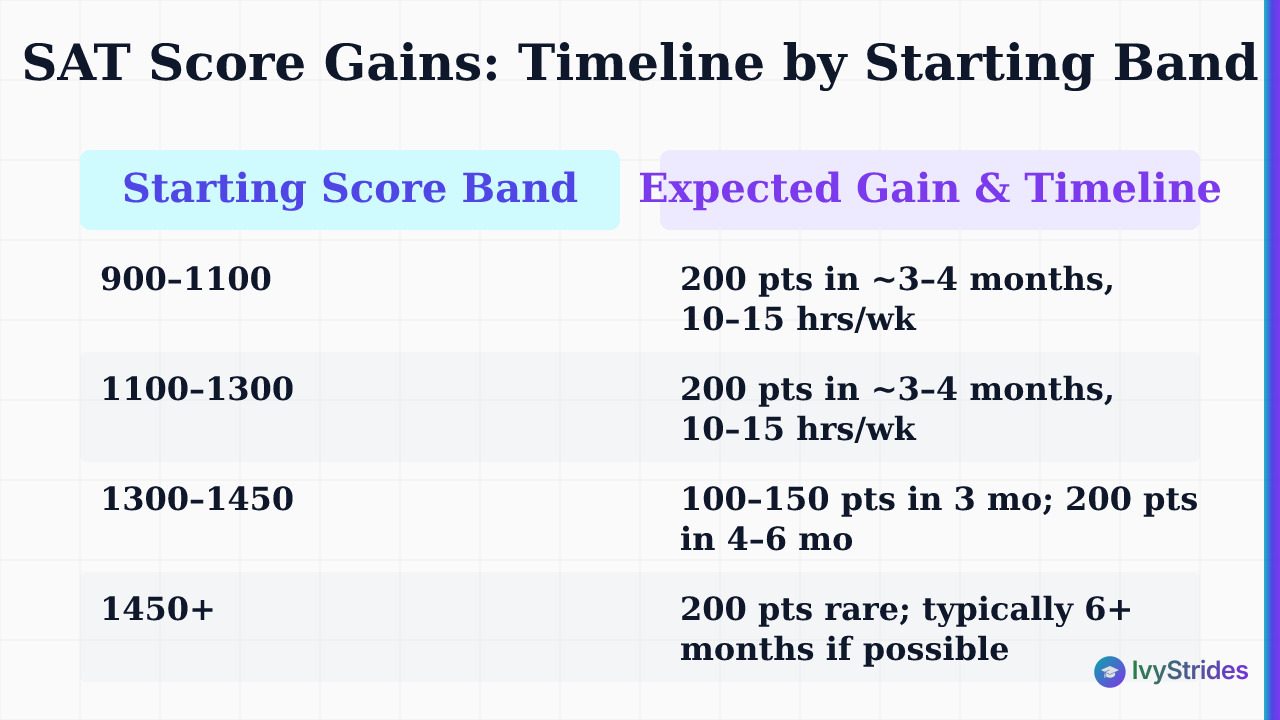
900-1100 starting band. 200-point gains in roughly 3-4 months are achievable for motivated students, because there are many addressable content gaps to fix. Typically about 10-15 hours per week of targeted work.
1100-1300 starting band. 200-point gains typically take roughly 3-4 months at about 10-15 hours per week. This is the band where a diagnostic-first plan matters most, because wrong-answer patterns split more evenly between content and execution.
1300-1450 starting band. In 3 months, 100-150 point gains are more typical. A full 200 points usually takes about 4-6 months, because the remaining errors are subtler and require more targeted work.
1450+ starting band. Each additional 50 points costs disproportionately more hours. 200-point gains from this band are rare and typically take roughly 6+ months, if they're possible at all given how close you are to the ceiling.
Can you gain 200 points in 2 months? Possible, but not typical. It requires a starting score below 1200, roughly 15+ hours per week, and a clear diagnostic showing addressable gaps. If you're above 1300 and someone promises you 200 points in 8 weeks, be skeptical.
In our coaching, students who start below 1200 and complete the full diagnostic-driven program show the largest absolute point gains. That's not marketing; it's a math fact about where the fixable errors live.
Planning retakes matters here. See how many times can you take the SAT for the College Board policy and our recommended retake cadence.
Step 5: Decide Whether Self-Study or a Coach Will Get You There Faster
Honest question. Honest answer.
Self-study is likely enough if: you have 3+ months before your test, a target below 1400, a clear diagnostic report, the discipline to work roughly 8-10 hours per week without external accountability, and you can honestly review your own errors and identify the pattern. Free official resources are real; the Bluebook practice tests are the same tests as the real exam.
Coached prep tends to move faster if: you're inside 2 months of your test date, targeting 1450+, hit a score plateau in self-study, can't figure out why you keep missing the same question type, or don't have the executive function to run a 15-hour-a-week solo plan.
The distinction that matters most: section-specialist vs. generalist tutoring. A section-specialist R&W coach and a section-specialist Math coach diagnose the specific question-type gaps in each section faster than one generalist tutor working across both. In our coaching, students who arrive with a clear diagnostic and a specific target score reach their goal in fewer sessions than students who start without a baseline.
For students who want a section-specialist coach to diagnose their exact gaps and build a personalized plan, 1-on-1 SAT prep accelerates the process compared to self-study alone, particularly for the 1450+ target band. Weighing options? Our posts on is free SAT prep enough and live online SAT prep vs. self-paced lay out the tradeoffs directly. A free SAT consultation is the fastest way to figure out which path fits.
Planning Your Retakes: How SAT Test Dates and Superscoring Affect Your Strategy
The SAT is offered multiple times per year, and per College Board policy, students can take it up to 12 times total. Most college counselors recommend 2-3 attempts. More than that tends to signal to admissions that you're chasing marginal points rather than building a case.
How superscoring changes the math. Many selective colleges take your highest Math and highest R&W scores across different test dates. A targeted retake with a section focus (say, only working on Math because your R&W already hit target) is a legitimate strategy. Not every school superscores; verify each school's policy before you plan.
Timing. Score release is typically about 2-3 weeks after the test date, per the College Board. Registration deadlines land roughly 4-5 weeks before the test. If you want your first score back before applying to the next test date, build in that buffer.
Map your target test date, your backup test date, and your absolute-last-chance test date onto the SAT dates 2026 calendar before you start studying. If you're planning intensive prep leading into a specific test date, our SAT winter batch covers the cohort schedule.
FAQ
Is a 1400 SAT score enough for Ivy League admission?
A 1400 is a strong score at roughly the 94th percentile, but it sits below the typical Ivy League middle-50% range of about 1500-1580. Most Ivies report middle-50% ranges that start around 1500. A 1400 is competitive at many excellent universities, so it's not a "bad" score by any measure. But for Harvard, Yale, Princeton, and peers, it's a gap worth closing. Admissions decisions depend on the full application, not just the SAT score.
Is a 1200 a good SAT score?
A 1200 places you at approximately the 74th percentile, which means you scored higher than about three-quarters of test-takers. It's a solid score for many colleges but falls short of the range at highly selective schools. If your target list has median SAT scores above 1400, a 1200 is a meaningful gap worth addressing through targeted prep, and one that responds well to a diagnostic-first plan.
Is a 1600 SAT score good?
A 1600 is a perfect Digital SAT score and puts you in roughly the top 0.1% of test-takers. It's the highest possible score. That said, admissions at highly selective colleges still depends on your GPA, essays, extracurriculars, and recommendations. A 1600 helps; it doesn't decide.
How realistic is a 200-point SAT improvement in 2 months?
Possible, but not typical. In our coaching, 200-point gains inside 2 months require a starting score below 1200, roughly 15+ hours per week of focused practice, and a diagnostic that shows clear, addressable content gaps. Students starting above 1300 typically need about 4-6 months for a 200-point gain, because the error patterns at higher score bands are subtler and require more targeted work.
Can I improve my SAT score from 1100 to 1400 in 3 months?
A 300-point gain in 3 months is ambitious but reachable if you start below 1200 and commit to roughly 12-15 hours of targeted practice per week. In our coaching with students in the 1100-1200 band, 200-250 point gains over 3 months are more typical; a full 300 usually takes closer to 4-5 months. The lever is diagnostic-first work: identify the specific question types driving the most errors, then drill those systematically.
How do I improve my SAT score if I have only one week?
One week isn't enough for large gains, but it's enough to recover points from avoidable errors. Focus on your highest-frequency error types from your most recent practice test. Review the grammar rules and math formulas you consistently miss. Take one full-length timed practice test mid-week to simulate conditions, then review it. Don't try to learn new content in the final week. Reduce careless mistakes and reinforce what you already know.
Does free SAT prep actually work?
Free official resources, especially the Bluebook full-length practice tests and College Board's Official SAT Practice, are legitimate and useful. They work best for students who are self-directed, have 3+ months before their test date, and are targeting gains below 200 points. For students targeting 1450+ or needing faster gains, the personalization of 1-on-1 section-specialist coaching typically produces more efficient results, because the error patterns at that band are harder to self-diagnose.
Where to Go From Here
The through-line is simple. Diagnostic first. Targeted work on your actual gaps. Spaced full-length tests to measure. Honest decisions about coaching. If you do the first step this week, take a Bluebook full-length under real conditions, you'll know more about your actual score gaps than most students who spend the same week reading prep blogs.

Award-winning author (South Asian Book Award) and graduate of BITS Pilani and UCLA Luskin School of Public Affairs. Brings a published writer's eye to Common App essays and grammatical precision to SAT and ACT R&W instruction.