
When Should Your Child Start SAT Prep? A Grade-by-Grade Plan for Parents

On this page
- The Short Answer: When to Start SAT Prep by Grade
- Freshman Year: Build the Foundation, Skip the Flashcards
- Sophomore Year: Run the Diagnostic and Take the PSAT 10
- How Many Hours Does SAT Prep Actually Take? A Score-Gap Framework
- Junior Year: The Primary Testing Window (and How to Protect It)
- What Grade Should Your Child Aim to Take the SAT for the First Time?
- Senior Year: One Retake Window, Then Essays Take Over
- Is Starting SAT Prep in 9th Grade Ever the Right Call?
- How to Build a Diagnostic-First SAT Prep Plan at Any Grade
- FAQ
- Is a 1400 SAT score good enough for Ivy League schools?
- How many months ahead is it best to start preparing for the SAT?
- Should my child take a SAT prep class or self-study?
- What is the best time of year to start SAT prep?
- How do I find my child's old or practice SAT scores to use as a baseline?
Most students should begin structured SAT prep in the spring of sophomore year or the summer before junior year, roughly 3 to 6 months before their first planned test date. Students facing a score gap of 200 points or more typically need 4 to 6 months of consistent work. Freshman year is for foundational math and reading habits, not formal prep. Junior year is the primary testing window. Senior year allows one retake, but essays and applications should take priority. Every plan should start with a full-length diagnostic practice test, not a calendar date.
These benchmarks pull from the current Digital SAT structure published by College Board and from patterns we see across diagnostic results in our 1-on-1 coaching. The harder question, and the one this article answers, is how a parent translates "sophomore spring" or "junior summer" into a concrete schedule that fits around AP exams, school workload, and the PSAT/NMSQT.
The Short Answer: When to Start SAT Prep by Grade
Here's the grade-by-grade framework in one pass:
- Grade 9 (Freshman): No formal SAT prep. Build math fluency through Algebra I and Geometry, and read 20-30 minutes of complex nonfiction daily. That's it.
- Grade 10 (Sophomore): Take the PSAT 10 in spring. Run a full-length Digital SAT diagnostic in April or May. Calculate the score gap to your target. Start light prep if the gap exceeds 200 points.
- Grade 11 (Junior): The primary testing window. Sit the PSAT/NMSQT in October. Target a March, May, or June SAT for the first official sitting, with a fall retake option in August, October, or November.
- Grade 12 (Senior): One retake window in August or October, then pivot to Common App essays and supplements.
The Digital SAT is scored on a 400-1600 scale across two sections, Reading and Writing and Math, delivered in adaptive modules over 2 hours and 14 minutes (College Board). Knowing the format matters less than knowing the gap. A student starting at 1050 with a 1400 target has a different timeline than a student starting at 1300 with the same goal. The diagnostic is the real starting line, not the calendar.
For a quick orientation to the test itself, here's how long is the SAT and what the sections look like.
Freshman Year: Build the Foundation, Skip the Flashcards

Photo by RDNE Stock project on Pexels
Should a 9th grader start SAT prep? For the vast majority of students, no. Formal SAT drilling before Algebra II forces content the student hasn't seen yet, and grinding vocabulary lists in isolation wastes effort that should go into the regular school year.
What freshman year IS for: building the substrate that makes junior-year prep work.
On math, that means staying on track with the standard sequence. SAT Math draws from algebra, advanced math (quadratics, exponents, nonlinear functions), problem-solving and data analysis, and geometry, per College Board's curriculum framework. Students who finish Algebra II before junior spring are positioned to handle the harder adaptive Math Module 2, which is where most top-band points live. If your freshman is struggling in Algebra I, that's the highest-use place to invest, not practice SAT questions. For a sense of what shows up later, see SAT algebra questions.
On Reading and Writing, the single best freshman habit is reading 20-30 minutes a day of dense, argument-driven nonfiction. The Atlantic, The Economist, longform science journalism, AP-style history textbooks. The Digital SAT R&W modules test command of evidence, inference, and rhetorical synthesis on short passages. Students who already read this kind of prose for fun handle those question types far more easily than students who only do school-assigned reading.
No flashcards. No timed sections. No prep books. Just the regular school year, done well.
Sophomore Year: Run the Diagnostic and Take the PSAT 10
Sophomore year is where prep officially enters the picture, but it enters as a diagnostic, not a course. Two events matter.
First, the PSAT 10. Offered in the spring, it's scored on a 320-1520 scale and mirrors the Digital SAT's structure (College Board PSAT page). It does not count for National Merit, which is why the stakes feel low. That's the point. Treat it as a scored preview.
Second, a full-length Digital SAT diagnostic in April or May, taken at home under timed conditions. The PSAT 10 gives your child a scored preview of SAT content and a baseline that shapes exactly how much prep time junior year will require. See our full breakdown of PSAT percentiles and what your child's score means for the National Merit pathway.
The diagnostic produces a baseline score and, more importantly, a score gap. Target score minus baseline equals gap. A sophomore with a 1080 diagnostic and a 1300 target has a 220-point gap. That's typically a 4-5 month structured prep block, ideally starting in June before junior year.
For context on what counts as a strong sophomore baseline, see is 1050 a good PSAT score. It depends entirely on the target school's mid-50% range and your child's growth runway.
The other event, which lands in October of junior year, is the PSAT/NMSQT, the actual National Merit qualifier. The National Merit Selection Index cutoff varies by state and typically ranges from 209 to 222 for semifinalist status. Sophomores cannot qualify no matter how high they score. But a strong PSAT 10 result tells you whether National Merit is realistic the following October.
How Many Hours Does SAT Prep Actually Take? A Score-Gap Framework
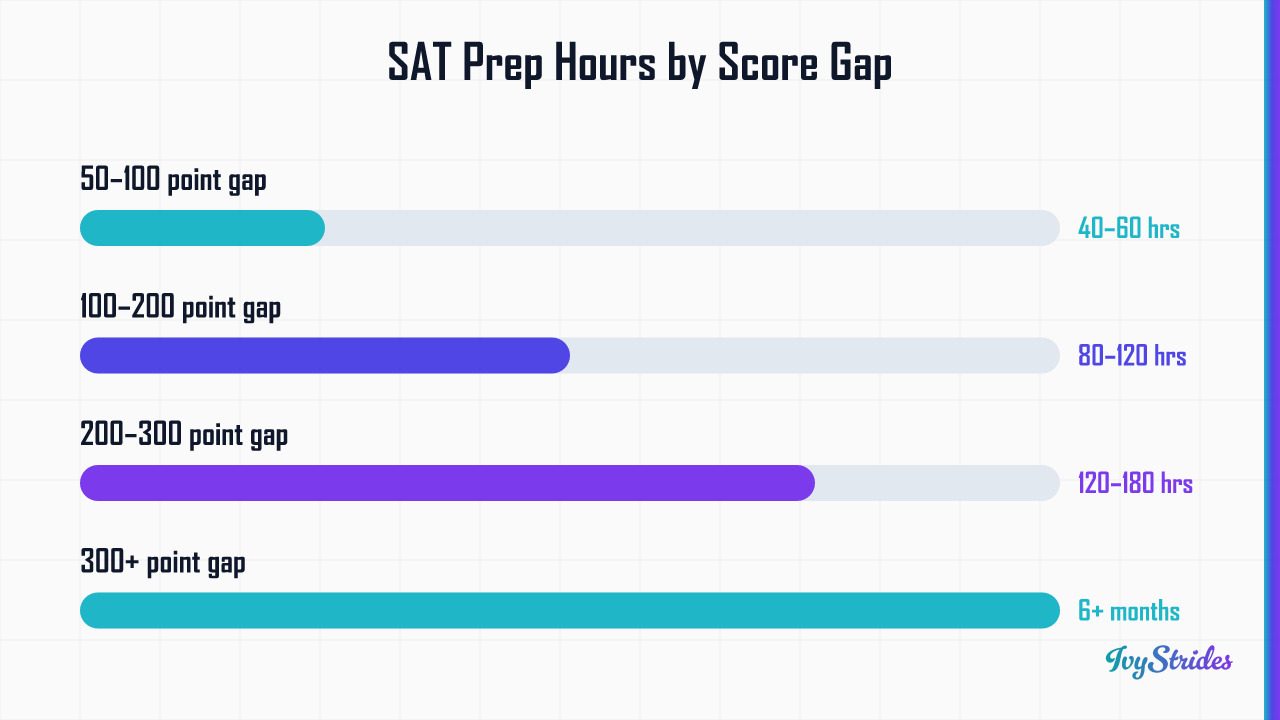
This is the question every parent asks, and the honest answer is: it depends on the gap, not the grade.
Here are the ranges we see across diagnostic cohorts:
- 50-100 point gap: typically 40-60 hours of focused prep over 6-8 weeks.
- 100-200 point gap: typically 80-120 hours over 10-14 weeks.
- 200-300 point gap: typically 120-180 hours over 4-6 months.
- 300+ point gap: 6+ months, usually starting sophomore spring.
For a junior carrying 3-4 AP courses, in our coaching a realistic weekly load typically runs 8-12 hours during peak prep season per College Board's recommended prep cadence. Push past 15 hours a week alongside school, and you typically hit diminishing returns. Most students burn out by week four.
Hours alone don't move scores. Methodology does. In our coaching, students completing the full diagnostic + targeted weakness work + spaced retesting program with section-specialist coaches see 200+ point improvements as a typical outcome. Section-specialist matters because the SAT R&W coach and the SAT Math coach are different people with different question-type expertise. A generalist tutor can review wrong answers. A specialist can predict, from a diagnostic, that a student will lose the most points on R&W inference and command-of-evidence questions and on Math Module 2 quadratics, then build the prep plan around those exact gaps.
Honestly, this is also where families ask whether 1-on-1 coaching is worth it versus a self-study plan. The answer depends on the score gap, the timeline, and the student's learning style. Self-study can work cleanly for gaps under 100 points. For 150+ point gaps, a structured plan tends to pay back the investment. For a fuller picture, see our SAT prep overview. Families wanting a baseline diagnostic first can book a free SAT consultation.
Junior Year: The Primary Testing Window (and How to Protect It)
Junior year is where the test gets real. Three calendar realities shape the whole year.
The SAT calendar. College Board offers SAT test dates in March, May, June, August, October, November, and December (verify the current cycle at satsuite.collegeboard.org). For most juniors, the prime first-sitting window is March, May, or June. That leaves a fall retake option if the first score lands short.
The AP calendar. AP exams run during the first two weeks of May, which collides directly with peak May SAT prep. Junior year AP exams fall in May, which overlaps directly with the spring SAT window. Students who plan their AP and SAT calendars together avoid the trap of cramming for both at once. If your child is adding AP courses this year, our guide to ap classes online walks through how to sequence the workload.
If your child is taking three or more AP exams, prioritize the March SAT to clear the deck before May. If they're taking one or two APs, the May or June SAT is workable, but build the prep plan backwards from those dates with the AP load factored in.
The PSAT/NMSQT in October. This is the National Merit qualifier. In our coaching, students who have typically done 2-3 months of SAT prep over the summer perform meaningfully better on the October PSAT/NMSQT than students who walk in cold per the National Merit Scholarship program cutoff patterns. If National Merit is a realistic target (a sophomore PSAT 10 in the 1300+ range is a reasonable signal), summer prep before junior fall is the highest-use block of the entire timeline.
Here's the part most parents miss: the first official SAT should be a real attempt, not a "let's see what happens" sitting. In our coaching with juniors, students who begin prep in June or July before junior year and test in October or March show the most consistent score gains compared to students who start in September. A cold first sitting locks in a low anchor and forces a longer retake cycle.
One more thing about retakes. Many selective colleges superscore, meaning the highest section scores across multiple sittings are combined into a composite. Policies vary by school, so verify each target school's policy through its Common Data Set. Superscoring is the reason a junior who scores 1380 (760 R&W, 620 Math) in March and 1380 (660 R&W, 720 Math) in June walks away with a 1480 superscore at the schools that combine them.
Two related reads worth bookmarking. Our piece on SAT adaptive testing explained covers why Module 2 difficulty shapes the top of the score range. For retake planning, our when do SAT results come out walkthrough helps you sequence decisions before they get rushed.
What Grade Should Your Child Aim to Take the SAT for the First Time?
Spring of junior year. That's the standard recommendation, and it holds for roughly 80% of students.
But two scenarios flex the standard answer.
The early tester. A sophomore who has finished Algebra II, scored above 1300 on the PSAT 10, and is targeting 1500+ may benefit from a fall junior or even spring sophomore SAT sitting. The logic is runway. If they can lock in a 1450 in May of sophomore year and a 1520 in October of junior year, they walk into senior year with a superscored 1520 and zero senior-year test pressure. That frees junior spring entirely for AP exams and essay brainstorming.
The late starter. A student who didn't engage with prep until late junior year, or who switched schools, or who needed extended time accommodations that pushed the timeline. For these students, a fall senior sitting in August or October is realistic, but it's the last viable window for most Early Decision deadlines, which fall November 1-15.
College Board allows students to take the SAT starting in 9th grade. Most should not. Sophomores who sit the official SAT without structured prep often score in the 900-1050 range, which can anchor low expectations and dent confidence going into junior year. In our coaching, students who take their first official SAT in March or May of junior year after 3-4 months of targeted prep score an average of 80-120 points higher than students who test cold.
The distinction worth holding: starting prep and sitting the exam are two different decisions. Most students should start prep the summer before junior year. Most students should sit the exam in junior spring. The gap between those two dates is where the score gets built.
For day-of logistics when the time comes, our complete SAT checklist for test day covers what to bring and what to skip.
Senior Year: One Retake Window, Then Essays Take Over
Senior year is not a prep year. It's a finishing year.
If your child needs to retake, the August and October SAT dates are the realistic windows. Most Early Decision deadlines fall November 1-15, which means the October sitting is the last sitting whose scores will reach an ED application on time. November scores generally arrive too late for ED, though they often work for Regular Decision deadlines in January.
When is a retake worth it? In our coaching, students who retake the SAT senior year with a specific section-targeted plan, not general review, are more likely to see meaningful gains than students who simply retest without changing their approach. The rough rule: if your child is sitting 60+ points below a meaningful threshold (the 25th percentile at their top-choice school, or a scholarship cutoff), a targeted retake makes sense. If they're already above the 50th percentile at their targets, the marginal score gain almost never beats the opportunity cost of essay time.
The opportunity cost is real. The Common App personal statement is capped at 650 words (Common App), and supplemental essays at selective schools often run 6-10 additional prompts per application. By the spring of junior year, students who have hit their score target can shift attention to brainstorming their Common App personal statement, giving essay coaching the time it deserves before senior fall deadlines. If essays are where your child needs the lift, our common app essay tutor service is built for exactly that handoff.
One caveat that matters. Test-optional policies vary by school and year, and as of the 2025-2026 cycle, many selective schools have either reinstated score requirements or strongly encourage submission (verify the current landscape at fairtest.org). "Test-optional" does not mean scores don't matter. A strong score still strengthens an application at most selective schools. A weak score can be withheld at genuinely test-optional schools, but the calculation depends on each target school's policy. For the current snapshot, see do colleges require SAT in 2026.
Admissions outcomes depend on the full application, not test scores alone. A senior with strong essays, rigorous coursework, and meaningful activities will outperform a senior with a higher score and a thin application. The senior-year calculus is always: where does another hour produce more admissions value, on the SAT or on the essays?
Is Starting SAT Prep in 9th Grade Ever the Right Call?
For most freshmen, no. For a small group, yes. The distinction matters.
The freshmen who benefit from early structured engagement fall into two categories.
Students who will need extended time accommodations. College Board accommodation requests for time and a half require documentation and school-submitted forms, and processing often takes 6-8 weeks. Families who anticipate needing accommodations should start the paperwork in 9th or early 10th grade, well ahead of any official test date. The prep itself can wait. The paperwork cannot. For more on what this looks like, see SAT with extended time accommodations.
Students with very large score gaps targeting top score bands. A 9th grader with a diagnostic below 1000 who targets 1400+ is looking at a 400+ point gap. That realistically needs 6+ months of structured work, which means a sophomore-year start is logical. In our coaching, 9th graders who benefit most from early engagement are those building math fluency in the pre-calculus and advanced algebra content that appears in SAT Math Module 2 adaptive routing. They're not drilling SAT questions. They're solidifying the underlying math. For context on what the ceiling looks like, see what is the highest SAT score.
For everyone else, early formal prep is counterproductive. Drilling SAT Math questions before Algebra II is reviewing material the student hasn't been taught. Memorizing vocabulary in isolation isn't how the Digital SAT R&W tests vocabulary, which is contextual and embedded in passages. And freshman burnout is real. A parent recently asked us about a son who'd been "preparing for the SAT" since September of 9th grade. By the time he reached junior year, he was exhausted by a test he hadn't yet taken.
Start early on the substrate (math fluency, reading habit, accommodation paperwork). Save the test prep for sophomore spring.
How to Build a Diagnostic-First SAT Prep Plan at Any Grade
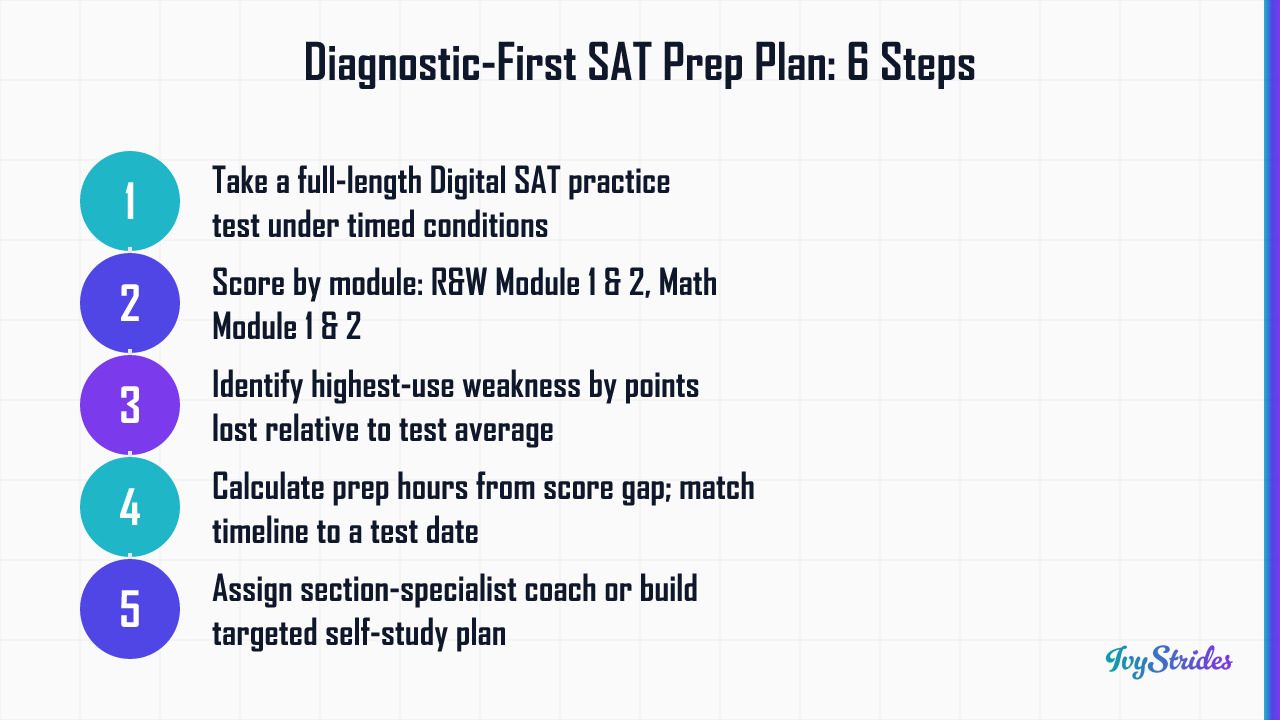
Whatever grade your child is in right now, the first step is the same: take a real Digital SAT practice test under timed conditions. Everything else follows from that score.
Here's the sequence we run with new families:
-
Take a full-length Digital SAT practice test. A free official practice test is available at satsuite.collegeboard.org. One sitting, official timing, no phone, no breaks beyond the official ones.
-
Score by module. The Digital SAT has two R&W modules of 27 questions each and two Math modules of 22 questions each, totaling 98 questions in 2 hours and 14 minutes. Look at where points are leaking: R&W Module 1, R&W Module 2, Math Module 1, or Math Module 2.
-
Identify the highest-use weakness. The section where the student loses the most points relative to test average. Not their weakest in absolute terms, their weakest in points-per-hour-of-prep terms.
-
Calculate hours from score gap. Use the framework above. A 150-point gap is 80-120 hours over 10-14 weeks. Match the timeline to a real test date.
-
Assign a section-specialist coach or build a targeted self-study plan. A generalist tutor reviewing wrong answers is not the same as a R&W specialist who knows the inference question pattern cold.
-
Retest every 6-8 weeks. Spaced retesting under timed conditions surfaces whether the gap is actually closing.
One technical note on the adaptive structure. Module 2 difficulty depends on Module 1 performance. A student who does well on Module 1 routes into a harder Module 2, and only the harder Module 2 unlocks the top of the score range. Low-effort Module 1 work caps the ceiling regardless of how well Module 2 goes. Section-specialist coaching pays particular attention to Module 1 accuracy for exactly this reason.
In our coaching, students who track errors by question type, not just by right or wrong, improve 30-50% faster than students who do untargeted review. An anonymized example: a sophomore came in with a 1080 diagnostic in April. After 5 months of targeted R&W and Math prep under section specialists, she scored 1290 on the October PSAT/NMSQT and 1340 on the March SAT. That trajectory is typical for the diagnostic + targeted weakness + spaced retesting methodology. Not guaranteed, typical.
For families who want to self-direct the early diagnostic phase, our SAT mistake tracker is a free download that walks through exactly how to log errors by question type. If your child is ready for a structured cohort, SAT winter batch enrollment covers the next intake. For what device and tool setup looks like for the Digital SAT, see the digital sat calculator guide.
SAT prep is a sequence: foundation in 9th, diagnostic in 10th, structured prep the summer before 11th, primary testing in junior spring, one retake window in senior fall, then essays. Grade determines the phase. Diagnostic determines the depth. Methodology determines whether the hours actually turn into points.
FAQ
Is a 1400 SAT score good enough for Ivy League schools?
A 1400 sits below the 25th percentile at most Ivy League schools, where the middle 50% range typically runs from 1500 to 1580. It's not a disqualifying score in a test-optional application, but submitting a 1400 to Harvard or Princeton is unlikely to strengthen the application. Students targeting Ivy-level schools should aim for at least the 25th percentile of their target school's reported range, which they can verify in each school's Common Data Set. A 1400 remains a strong score at many highly selective non-Ivy schools.
How many months ahead is it best to start preparing for the SAT?
In our coaching, for most students 3 to 6 months of structured prep before the first test date typically marks the right window per College Board's score-improvement guidance. Students with a score gap under 100 points can often close it in 6 to 10 weeks of focused work. Students with a 200-300 point gap typically need 4 to 6 months. The starting point should always be a full-length diagnostic, not a fixed calendar date, because the gap size determines the timeline, not the grade level alone.
Should my child take a SAT prep class or self-study?
Self-study works well for motivated students with a score gap under 100 points who can follow a structured plan consistently. For gaps of 150 points or more, or for students who have plateaued after self-study, 1-on-1 coaching with a section-specialist tutor produces faster and more reliable gains. Group classes fall in between but lack the personalization to target the specific question types where an individual student loses the most points. The diagnostic score and the student's self-discipline level are the two factors that determine which approach fits best.
What is the best time of year to start SAT prep?
In our coaching, the summer before junior year typically marks the single highest-use window for most students per College Board's recommended prep cadence. School is out, AP exams are over, and students typically have 8 to 10 weeks of focused time before fall classes resume. A student who begins prep in June and tests in October of junior year gets a full summer of preparation plus fall retake options. For sophomores with a large score gap, the summer before 10th grade is also productive, though for foundational content work rather than test-format drilling.
How do I find my child's old or practice SAT scores to use as a baseline?
If your child has taken a previous SAT, scores are accessible through their College Board account at collegeboard.org. Practice test scores from College Board's official materials can be self-scored using the answer keys and scoring tables published with each test. If your child took the SAT more than a year ago and the scores no longer appear in the portal, there's a formal retrieval process through College Board that may involve a fee.

Kunal writes about Digital SAT and ACT strategy for the IvyStrides blog.