
Joining a Digital SAT Course Late: What You Can Still Recover
On this page
- What the Digital SAT Score Scale Tells You About Your Recovery Gap
- Why Digital SAT Module 1 Is the Highest-use Target for Late Starters
- How to Build a Late-Start Digital SAT Prep Plan by Test Date
- Is Free Digital SAT Prep Enough When You Are Starting Late?
- FAQ: Digital SAT Prep Course Questions
- What is the best digital SAT prep course?
- Is 3 months enough for SAT?
- Is free SAT prep enough to score 1500?
- How do I prepare for the digital SAT?
- Your Next Step on a Late Digital SAT Start
The digital SAT is a 134-minute, 98-question exam split into Reading and Writing (54 questions, 64 minutes) and Math (44 questions, 70 minutes), each delivered in two adaptive modules. Starting a prep course late is recoverable if you triage by module.
Those format figures come from College Board's official structure page, cited again below. The harder question is not whether to prep but which two or three content domains to fix first, given the weeks you actually have before your test date.

What the Digital SAT Score Scale Tells You About Your Recovery Gap
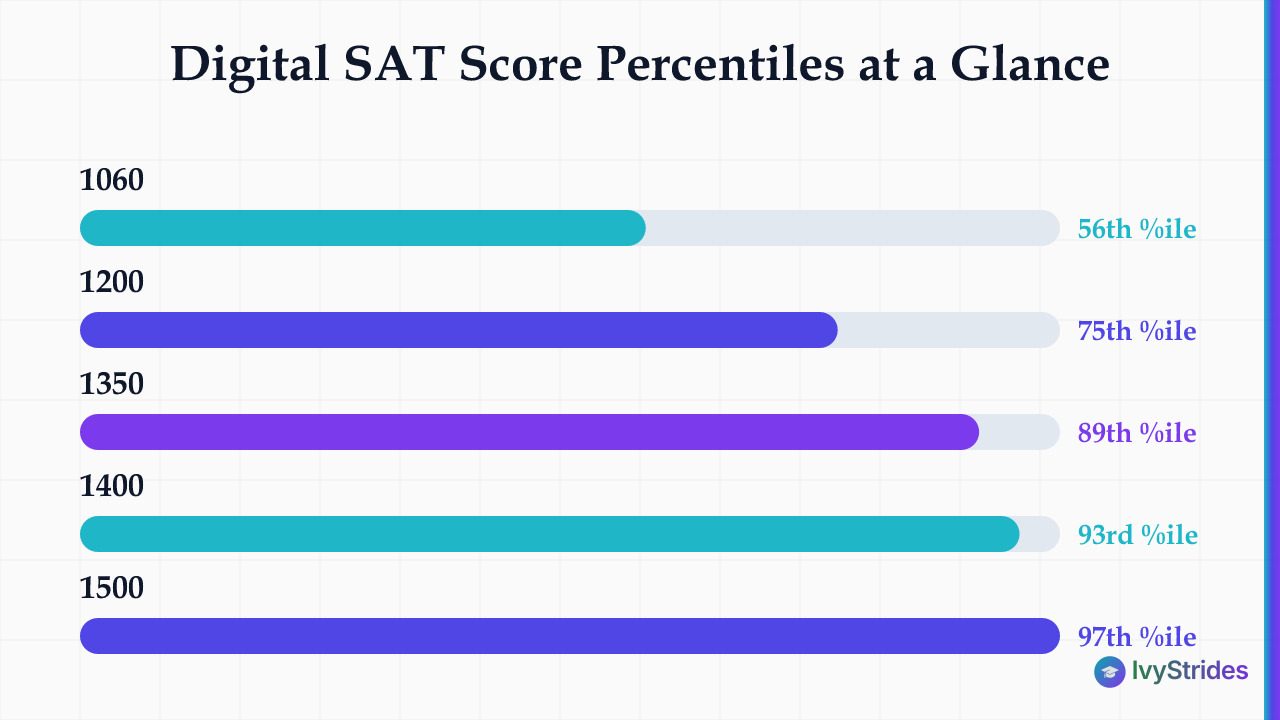
The digital SAT reports a total score on a 400 to 1600 scale, 200 to 800 per section. Your recovery gap is the distance between your current Bluebook practice score and the score your target colleges expect. Measure that gap first, because it decides how aggressive your triage has to be.
Reading and Writing runs 54 questions in 64 minutes across two 32-minute modules. Math runs 44 questions in 70 minutes across two 35-minute modules. A single 10-minute break separates them. The section-level College and Career Readiness benchmark for Reading and Writing is 480, a useful floor to clear before chasing a higher composite.
Where percentiles sit. Score points don't move at a constant rate. The jump from 1060 to 1200 covers far more of the test-taking population than the jump from 1400 to 1500, so a late starter at 1350 sits closer to the top than the raw number suggests.
| Total Score | Percentile (user group) | What It Signals |
| 1060 | 56th | Mid-pack; most state-school ranges |
| 1200 | 75th | Competitive for many publics |
| 1350 | 89th | Strong; selective-school floor |
| 1400 | 93rd | Highly selective range |
| 1500 | 97th | Top-tier target band |
Percentiles come from College Board's SAT score tables. Once you know your gap in points, how the digital SAT is scored shows how raw accuracy converts to the scaled number you need.
Why Digital SAT Module 1 Is the Highest-use Target for Late Starters
Digital SAT Module 1 is the fixed-difficulty first half of each section, identical for every test taker, and it is the single highest-use target for a late starter. Because Module 2 difficulty is set by your Module 1 performance, a student who fixes Module 1 accuracy first unlocks a harder, higher-ceiling Module 2 on test day, and that higher-ceiling module is where the top of the scale lives.
Each module carries 2 pretest questions that do not count toward your score, alongside the operational questions that do. You can't tell which is which, so treat every question as scored. That's exactly why clean Module 1 work matters: you have no way to spend a wrong answer "safely."
Pick your domains, don't review everything. Reading and Writing splits into four content domains: Information and Ideas, Craft and Structure, Expression of Ideas, and Standard English Conventions. For a late starter, Standard English Conventions and Expression of Ideas usually return points fastest, because they run on a finite set of rules rather than open interpretation. Math splits into Algebra, Advanced Math, Problem-Solving and Data Analysis, and Geometry and Trigonometry, and gains there come concept by concept, not from pattern recognition.
A common pattern we see in diagnostic results: students who have been doing untimed practice overestimate their Reading and Writing Module 1 accuracy under real 32-minute module conditions. Timed practice in Bluebook, the official free platform, is the only way to see your true Module 1 ceiling.
| Section | Module | Questions | Time | Late-Start Priority |
| Reading and Writing | Module 1 | 27 | 32 min | Highest |
| Reading and Writing | Module 2 | 27 | 32 min | Medium |
| Math | Module 1 | 22 | 35 min | Highest |
| Math | Module 2 | 22 | 35 min | Medium |
To see the ceiling mechanism in full, read whether Digital SAT Module 1 locks in your score ceiling. When you decide which questions to drill, the full map of every Reading and Writing question type by domain tells you where each one lives.
How to Build a Late-Start Digital SAT Prep Plan by Test Date
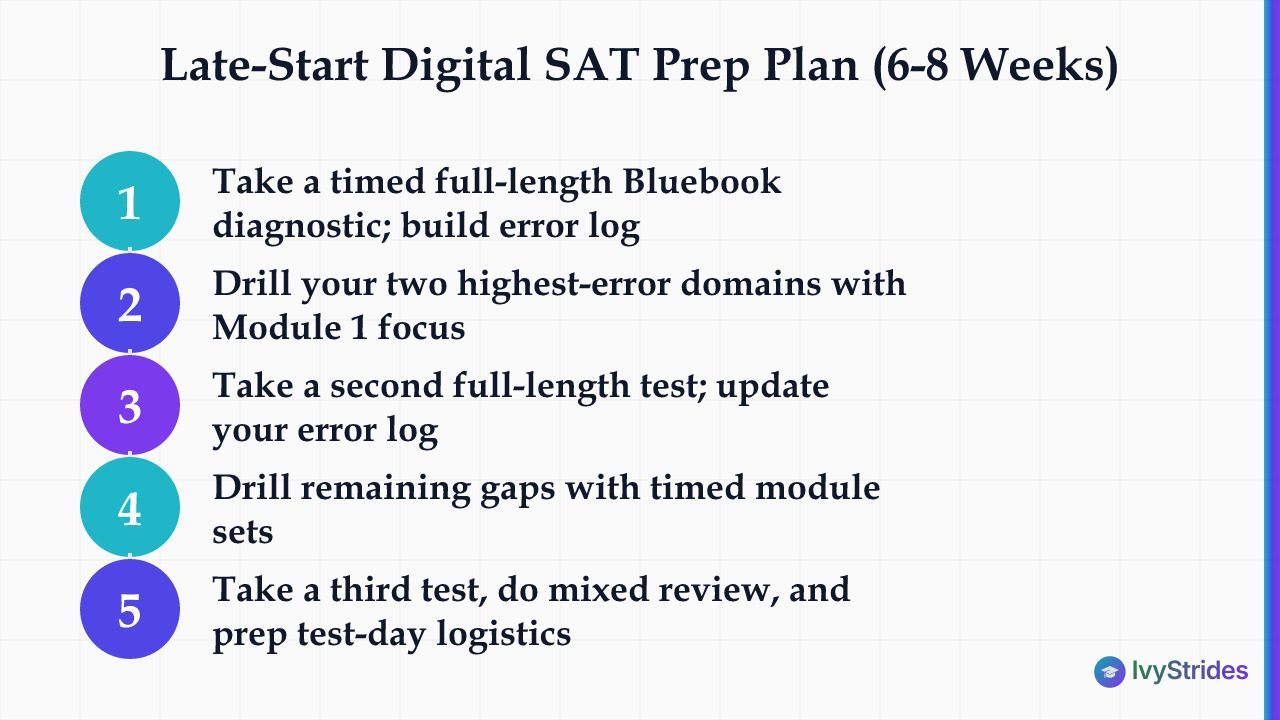
Your digital SAT prep plan is fixed the moment you check the calendar, because the next open test date sets the number of weeks you have. The next available SAT dates are November 7 and December 5, 2026, and March 6, May 1, June 5, 2027, per College Board's dates and deadlines page. Count backward from the one you can still register for.
In our coaching, every late-start plan begins with a timed Bluebook diagnostic so the student knows exactly which domains are costing the most points before a single hour of review is spent. Students who arrive with roughly 6 to 8 weeks and a 100-point gap typically have concentrated errors in two or three domains, not spread evenly across all eight. Your error log is the triage tool that finds them.
Count your practice tests honestly. In a 6 to 8 week window, two to three full-length Bluebook tests spaced about two weeks apart is realistic. More than that and you have no time left to fix what each one reveals. Official full-length practice in Bluebook is free and the most accurate simulation of the adaptive format, so start there whether or not you add paid coaching.
| Week | Action |
| Week 1 | Timed full-length Bluebook diagnostic; build error log |
| Week 2 | Drill the two highest-error domains, Module 1 focus |
| Week 3 | Second full-length test; update error log |
| Week 4 | Drill remaining gaps; timed module sets |
| Week 5 | Third full-length test; pacing work |
| Week 6 | Mixed review; test-day logistics |
Watch the registration math. Registering after the regular deadline adds a $38 late registration fee. Students testing outside the United States pay the $68 registration fee plus a $43 international fee. And scores are typically available online 2 to 4 weeks after the test, so a December date may land too late for an early application.
For free PDFs and schedules to fill your weeks, our sat study guide hub collects them in one place. Confirm the deadline for the date you want on the full SAT test dates calendar. The exact column-by-column method for the error log sits in our SAT mistake tracker walkthrough.
Is Free Digital SAT Prep Enough When You Are Starting Late?
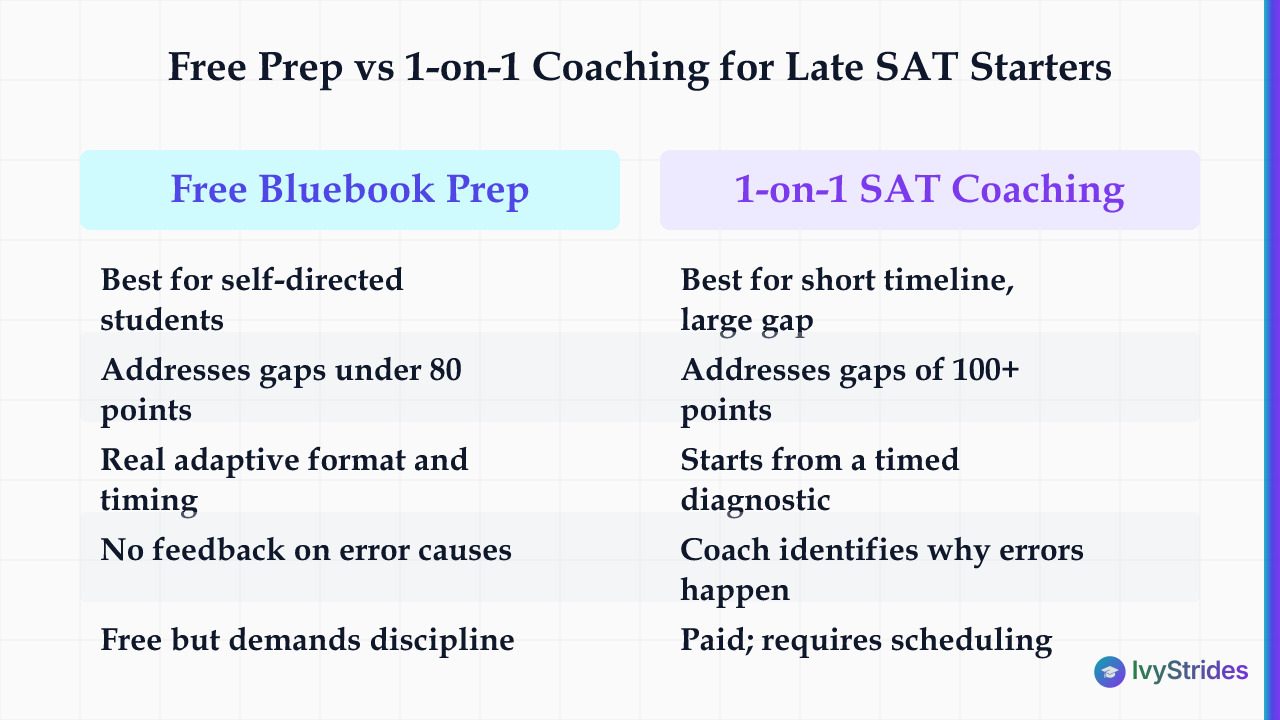
Free digital SAT prep is enough for some late starters and not for others, and the deciding factors are your score gap and your weeks remaining. Because your plan already runs on domain-level triage, the honest cut-off is roughly this: a gap under 80 points often closes on free official Bluebook practice alone, while a gap of 100 points or more in a short window usually needs feedback on why the errors keep happening.
What free prep does well. Bluebook delivers the real adaptive format, the real timing, and a domain-level score breakdown at no cost. For a self-directed student who can read an error log and act on it, that is a complete toolkit. As a SAT prep course online that charges nothing but demands discipline, the official source is hard to beat.
Where free prep hits a ceiling is diagnosis. A practice test tells you that you missed six Advanced Math questions; it doesn't tell you whether the cause was a setup error, an arithmetic slip, or a concept you never learned. IvyStrides' 1-on-1 SAT coaching fills that gap: it starts from a timed diagnostic and assigns a coach to your two weakest domains, so your limited hours go where they move the score.
| Prep Type | Best For | Score Gap It Addresses | Key Limitation |
| Free Bluebook practice | Self-directed students | Under 80 points | No feedback on error causes |
| Official tailored practice | Steady drillers | 80 to 120 points | You must diagnose yourself |
| 1-on-1 coaching | Short timeline, large gap | 100+ points | Paid; requires scheduling |
One caveat worth stating plainly: test-optional policies vary by school and year, so confirm each target college's current policy on its official admissions page before deciding how hard to push your score. A strong SAT still helps at test-optional schools, but admissions outcomes depend on the full application, not the score alone.
The official and third-party options you are weighing differ in how closely they simulate the real thing, which our ranking of the best SAT practice tests lays out test by test. If your gap sits past the free-prep ceiling with weeks ticking down, a coach who works your two weakest domains one-on-one is the faster path.
FAQ: Digital SAT Prep Course Questions
What is the best digital SAT prep course?
The best digital SAT prep course depends on your score gap and time remaining. For a gap under 80 points, free official Bluebook practice tests and College Board tailored practice are often enough. For a gap of 100 points or more with 6 to 8 weeks left, structured 1-on-1 coaching that starts from a timed diagnostic and targets your two weakest domains closes the gap faster than broad review.
Is 3 months enough for SAT?
Three months is a solid timeline for most students. A student who takes a diagnostic in week one, drills their two or three weakest domains, and completes three full-length Bluebook practice tests spaced about two to three weeks apart can make meaningful progress. The key is starting with a diagnostic rather than generic review.
Is free SAT prep enough to score 1500?
Free official practice via Bluebook is the right foundation for any student, and it is enough for some. Reaching 1500, the 97th percentile, typically means closing very specific gaps in both Reading and Writing and Math, which is hard without feedback on why errors happen. Students in the 1350 to 1450 range who want to push higher often benefit from targeted work on their remaining error patterns.
How do I prepare for the digital SAT?
Start with a timed full-length Bluebook practice test to get a baseline score and a domain-level error breakdown. Then prioritize the one or two content domains with the most errors, drill those with official practice questions, and retest every two to three weeks. The adaptive structure means Module 1 accuracy is the single highest-use target in any plan.
Your Next Step on a Late Digital SAT Start
A late start is a triage problem, not a lost cause. You have a fixed number of weeks, a measurable gap, and an adaptive test that rewards early-module accuracy over broad review. Work the gap, not the whole curriculum.
- Take one timed full-length Bluebook diagnostic this week and build an error log from it.
- Rank your eight content domains by error count; pick the top two or three.
- Prioritize Module 1 accuracy in both sections before anything else.
- Schedule two to three full-length tests, spaced about two weeks apart, between now and test day.
- Confirm your registration deadline and each target college's current testing policy.

Award-winning author (South Asian Book Award) and graduate of BITS Pilani and UCLA Luskin School of Public Affairs. Brings a published writer's eye to Common App essays and grammatical precision to SAT and ACT R&W instruction.