
A Parent's Guide to the Digital SAT: Timing, Cost, and How to Help (2026)
On this page
- What the Digital SAT Actually Looks Like in 2026
- When Should Your Teen Take the SAT: A Grade-by-Grade Timeline
- What the SAT Costs in 2026: Registration, Retakes, and Score Sends
- What SAT Score Does Your Teen Actually Need
- Why Your Teen's Score Is Not Moving and What to Do About It
- How to Support Your Teen's Prep Without Taking Over
- What to Expect on SAT Test Day: A Parent's Checklist
- How Many Times Can Your Teen Take the SAT, and Does Retaking Help
- Famous SAT Scores: What They Tell Us and What They Do Not
- FAQ
- At what age should a student start preparing for the SAT?
- Is a 1400 SAT score enough for Harvard?
- Is getting a 1200 on the SAT hard?
- Should my teen take the SAT if their target schools are test-optional?
- Can colleges see every SAT attempt my teen makes?
- How can my teen prepare for the SAT for free?
- What should I do if my teen is anxious about the SAT?
- Bringing It Together
The Digital SAT is a 2-hour-14-minute, fully adaptive exam scored 400 to 1600, delivered on a laptop or tablet through the Bluebook app at approved test centers. It has two sections: Reading and Writing (54 questions, 64 minutes) and Math (44 questions, 70 minutes), each split into two adaptive modules. US registration runs $68 for the 2025-26 cycle, per the College Board's SAT registration page. Most students take it first in the spring of junior year, with a retake option in the fall.
The harder question, and the one this article really answers, is how you turn those facts into a decision: when to register, what score your teen actually needs, and where your prep dollars will and won't pay off. The single most useful thing you can do this week is have your teen sit a full-length official practice test in Bluebook to establish a baseline. Everything downstream flows from that number.

What the Digital SAT Actually Looks Like in 2026
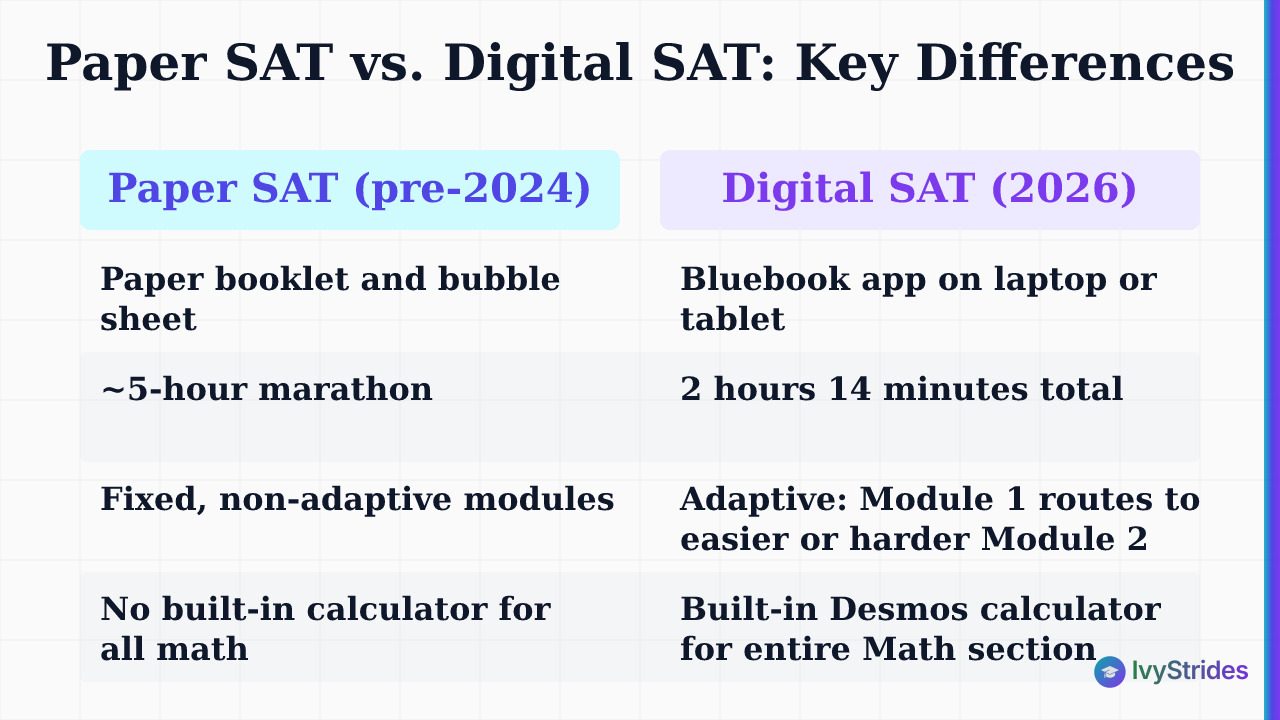
If you took the SAT before March 2024, the version your teen will sit looks almost nothing like yours. Since then, the SAT has been fully digital and adaptive, part of the College Board's SAT Suite of Assessments. No paper booklet. No bubble sheet. No five-hour marathon.
Here's the structure, per the College Board:
- Reading and Writing section: 54 questions across 2 modules, 64 minutes total. Short, single-passage questions covering craft and structure, information and ideas, standard English conventions, and expression of ideas.
- Math section: 44 questions across 2 modules, 70 minutes total. Algebra, advanced math, problem-solving and data analysis, and geometry and trigonometry. A built-in Desmos calculator is available for the entire Math section.
- Total test time: 2 hours 14 minutes.
- Score scale: 400 to 1600 total, with two section scores of 200 to 800 each.
The adaptive structure means Module 1 performance routes your teen into an easier or harder Module 2, which affects both the difficulty of questions seen and the ceiling of the final score. In practical terms: a strong Module 1 unlocks harder Module 2 questions that carry more scoring weight, and a weak Module 1 caps the maximum reachable score. That's why sloppy pacing at the start of a section is more expensive on the Digital SAT than it was on the paper version.
The test is delivered through the Bluebook app, which your teen downloads onto their own laptop or tablet, or uses on a school-provided device at the test center. Bluebook is also where official full-length practice tests live, and it's the app you want your teen practicing in. For a deeper walk-through of section timing, see our breakdown of how long is the SAT. For the mechanics of module routing, SAT adaptive testing explained.
When Should Your Teen Take the SAT: A Grade-by-Grade Timeline
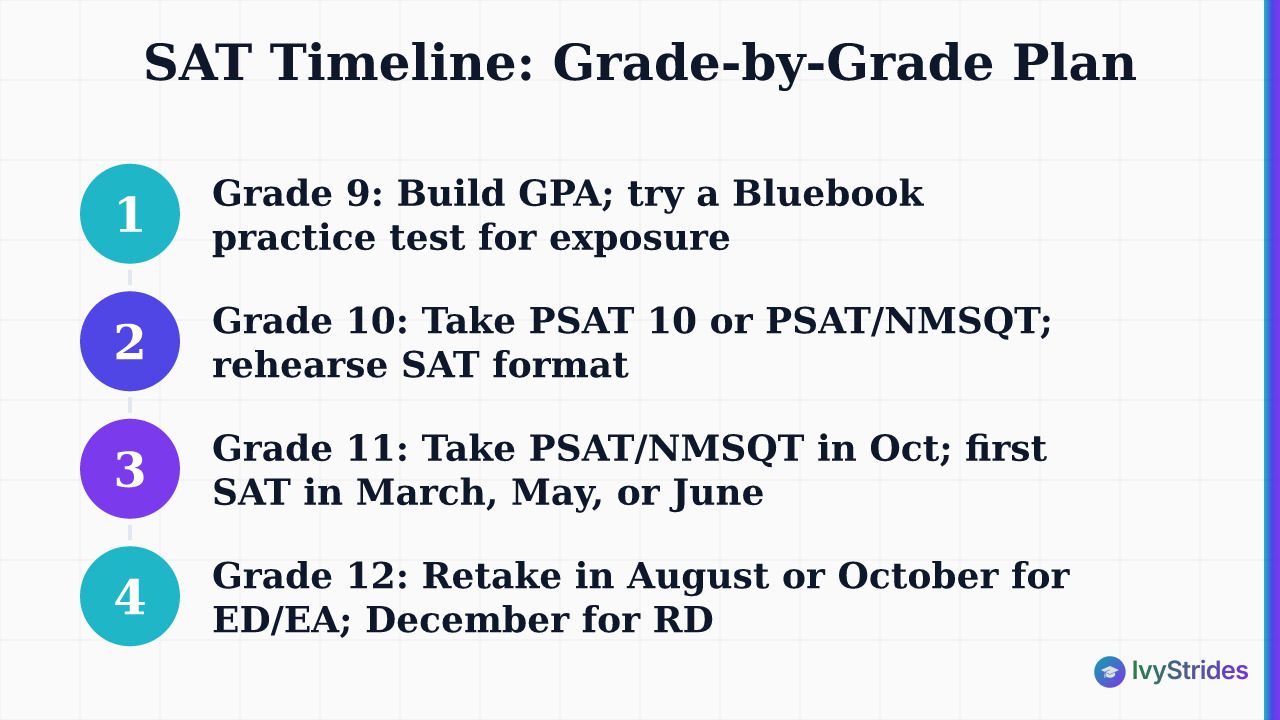
Honest answer: most students take the SAT for the first time in spring of junior year (March, May, or June), with a retake in August or October of senior year. That schedule still meets almost every Early Decision deadline. Everything else is a variation on that spine.
Here's what each grade looks like in practice:
Grade 9. Awareness, no urgency. Your freshman doesn't need SAT prep. What they do need is strong grades in rigorous coursework, because GPA and course rigor typically carry more weight in admissions than any single test score. If they're curious, a Bluebook practice test at the end of the year is a low-stakes way to see the format.
Grade 10. The year of the PSAT. Sophomores can take the PSAT 10 in the spring, and the PSAT/NMSQT is offered in October. If your teen is a sophomore or early junior, the PSAT/NMSQT is worth taking seriously: it's both a rehearsal for the SAT and the qualifying exam for the National Merit Scholarship Program. See what PSAT score do you need for National Merit for state-by-state Selection Index cutoffs, which shift each year.
Grade 11. The main event. Your teen sits the PSAT/NMSQT in October (this is the score that matters for National Merit), then targets a first SAT in March, May, or June after a real prep window. Junior spring is the sweet spot because grades are set, AP exams are close but not yet on top, and there's still a retake runway.
Grade 12. The retake window. August and October are the two SAT dates that align cleanly with Early Decision and Early Action deadlines in early November. December is a last-chance option for Regular Decision.
Choosing the right test date is the first concrete decision after a diagnostic, and the full 2026-2027 schedule with registration deadlines is covered in our SAT test dates 2026 guide. 2026 dates include August 22, October 3, November 7, and December 5, but verify against the College Board's official dates and deadlines page before you register, because dates and deadlines shift.
What the SAT Costs in 2026: Registration, Retakes, and Score Sends
Budget for more than the sticker price. The base US registration fee for the 2025-26 cycle is $68, per the College Board's SAT registration page. International students pay a higher fee that varies by country, typically an additional regional charge on top of the base. Late registration adds a further fee, and if your teen changes the test date or test center after registering, expect a change fee.
Score sends are the sneaky line item. When your teen registers, they get a small number of free score sends to colleges. After that, each additional score send costs $13. If your teen is applying to 12 colleges and forgets to use the free sends at registration, that's roughly $150 in send fees on top of the test itself.
Fee waivers are the important footnote. Eligible students can get SAT registration and up to four score sends covered through their school counselor, and waivers also unlock free access to certain prep resources. If your family qualifies, this is a real financial door your counselor can open in one meeting.
Retake math: if your teen tests twice with structured prep in between (which we generally recommend for students aiming above 1300), you're looking at roughly $150 to $200 in College Board fees plus prep costs. That's the floor before any tutoring, books, or practice tests. For a fuller breakdown, see our guide to how much does the SAT cost. For the mechanics of sending scores, how to send SAT scores.
What SAT Score Does Your Teen Actually Need
There's no universal "good" SAT score. There's only your teen's score relative to the middle 50% range at each college on their list.
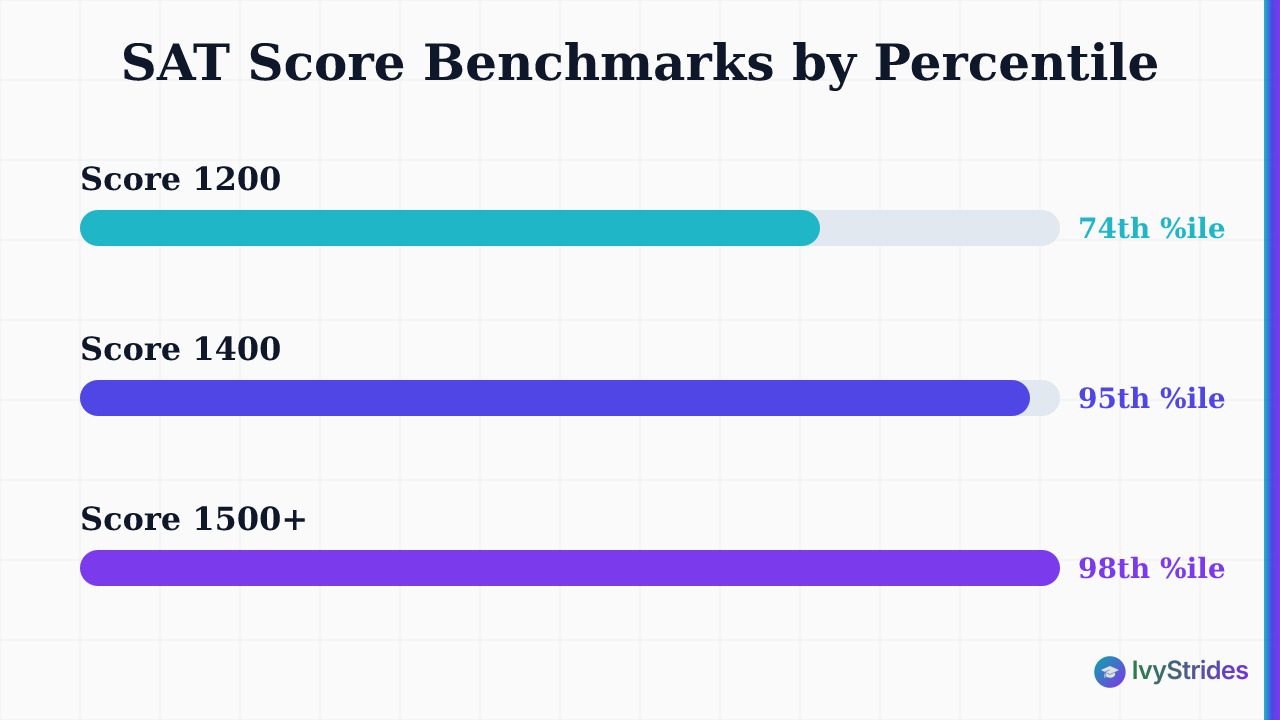
Some rough anchors from the College Board's annually updated percentile tables:
- 1200 sits at around the 74th percentile nationally. Solid score, competitive at many strong state flagships and mid-selective privates.
- 1400 sits at around the 95th percentile. Strong score, competitive at highly selective schools, but typically not at the very top of the range.
- 1500+ is the competitive zone for the most selective universities, roughly the 98th percentile and above.
Now the honest part about Harvard, because parents ask this constantly. Harvard's middle 50% SAT range for admitted students is approximately 1500-1580 (verify against Harvard's current Common Data Set before applying). A 1400 is below that middle 50%, which doesn't mean a 1400 can't be admitted, but it does mean the rest of the application has to do heavier lifting. For a deeper look at score bands at top schools, see is a 1500 SAT score good for Ivy League admission and our general guide to a good SAT score 2026.
Even at test-optional schools, a score above the 75th percentile for admitted students can strengthen an application, so the decision to submit is worth thinking through carefully. FairTest maintains a current tracker of test-optional schools, and policies do shift year over year. If your teen's projected score sits above a school's 75th percentile, submit. If it sits below the 25th percentile, generally don't. The zone in between requires judgment.
One more piece: superscore. Most selective colleges take the highest Math score and the highest Reading and Writing score across multiple sittings and combine them into a superscore. That policy fundamentally changes retake strategy, because a targeted second attempt aimed at the weaker section can lift the composite without requiring both sections to peak on the same day.
Why Your Teen's Score Is Not Moving and What to Do About It
Here's the part most parents miss. When a teen takes the SAT, gets a 1180, does another month of "prep," and comes back with a 1200, the problem is almost never that they need more hours. The problem is that the hours are unfocused.
In our coaching with students in the 1100 to 1250 band, the most common reason scores plateau is that prep is spread evenly across all question types instead of concentrated on the three or four question types where the student loses the most points. A student who consistently misses Command of Evidence questions in R&W Module 2 doesn't need more vocabulary review; they need a specific method for that question type, drilled to automaticity. A student who scores 580 R&W and 520 Math has a completely different prep plan than one who scores 520 R&W and 580 Math. Section-specialist coaching addresses this directly, because the tutor working on R&W isn't the same tutor working on Math, and each is deep in their section rather than shallow across both.
The adaptive structure amplifies this. If your teen is making early errors in Module 1, they get routed into an easier Module 2, and the score ceiling drops before they've really started. Understanding that changes how a student paces the opening questions, and it's one of the first things we address after reviewing a diagnostic.
For students completing a structured 1-on-1 SAT prep program, a 200+ point gain is typical. That's diagnostic-driven prep, targeted weakness work on the specific question types the student misses, spaced retesting to confirm retention, and section-specialist coaches for R&W and Math. It isn't a magic method. It's just focused. To see how the plan gets built once you have a diagnostic in hand, look at our SAT study plan framework, or the structure of our 1-on-1 SAT prep.
How to Support Your Teen's Prep Without Taking Over
Your job isn't to teach content. Your job is to hold the container.
Here's what that means concretely. Secure a quiet space in the house where your teen can sit a full 2-hour-14-minute practice test without interruption. Track registration deadlines so nothing slips (the deadline is typically about a month before each test date). Feed them well the night before test day. Don't quiz them on grammar rules over dinner.
On free resources: the College Board's official Digital SAT practice inside Bluebook is genuinely useful and, critically, uses real adaptive test forms. That's a legitimate starting point for any student with a 6+ month runway and a score gap under roughly 150 points. Once you have a diagnostic score and a target, a structured SAT study plan turns the gap into a week-by-week schedule your teen can actually follow.
For students with a 200+ point gap or a timeline under about 12 weeks, free tools are a strong starting point, but whether they're sufficient depends on your teen's score gap and timeline, a question we address directly in our article on whether free SAT prep is enough. In our coaching, students with that kind of gap and a tight timeline consistently make faster gains with targeted 1-on-1 work than with self-directed study alone. That's not a knock on free official resources; it's a reality of what a student can diagnose about their own weaknesses versus what a specialist can see.
A note on prep books. Any SAT book published before March 2024 covers the paper SAT, and much of it is now outdated. Look for 2024 or later editions, and make sure the practice tests are formatted for the adaptive digital exam. Better still, use our official SAT practice tests that mirror the current test structure, plus our library of free SAT resources for supplementary work.
What not to do: don't project your own test anxiety, don't compare your teen's score to a sibling's or a friend's, and don't renegotiate the prep plan every week. Consistency wins.
What to Expect on SAT Test Day: A Parent's Checklist
Test day logistics are simpler than they used to be, but the details matter. Here's what your teen brings:
- A charged, approved device (laptop or tablet) with Bluebook installed and tested. Alternatively, a school-provided device if the test center offers them.
- A backup power source or charger. Test centers may or may not have accessible outlets.
- A valid photo ID. The name on the ID must match the SAT registration exactly.
- The printed or digital admission ticket.
- An approved calculator is optional because Bluebook includes a built-in Desmos graphing calculator, but many students bring their own as backup.
- Snacks and water for the break.
What your teen doesn't need: a paper answer sheet, a pack of #2 pencils, or a stack of scratch paper (scratch paper is provided at the center). Arrival time is typically 30 to 45 minutes before the scheduled start; check the specific instructions on the admission ticket. Test centers can be searched at the College Board's SAT registration portal.
Score release comes about 2 to 4 weeks after the test date, published to your teen's College Board account. For the full pre-test-morning routine, see our SAT test day checklist and our specifics on what to bring to the SAT. If your teen is waiting on scores and getting antsy, when do SAT scores come out has the current release calendar.
Parents can't enter the testing room. Drop off, get coffee, come back. Resist the urge to interrogate them about specific questions afterward; they won't remember accurately, and dwelling on it only fuels anxiety before scores release.
How Many Times Can Your Teen Take the SAT, and Does Retaking Help
The College Board sets no official limit on how many times a student can take the SAT. In practice, two attempts is standard, three is common, and four or more usually signals that something in the prep plan isn't working.
The strategic case for retaking rests on two policies. First, Score Choice: most colleges let students select which test dates to send. Second, superscore: many selective colleges combine the highest Math and highest R&W scores across sittings into one composite. Together, these mean a targeted retake aimed at the weaker section can lift the reported composite without requiring both sections to peak on the same day.
But here's the catch. In our coaching, students who retake without changing their prep approach rarely improve more than roughly 20 to 30 points. Meaningful gains, the kind that move a score from 1250 to 1400, require identifying and fixing specific weak question types between attempts. Just sitting the test again in three months, without a different plan, is expensive practice.
A few colleges require all SAT scores from all test dates. Most don't, but check each school's specific policy. And even when all scores are visible, colleges that superscore focus on the highest sections, not the lower earlier attempts. For deeper mechanics and edge cases, see how many times can you take the SAT, or if your teen is planning a focused retake window, look at our SAT winter batch enrollment.
Famous SAT Scores: What They Tell Us and What They Do Not
Parents ask about celebrity scores, so briefly. Mark Zuckerberg is widely reported to have scored 1600 on the pre-2005 SAT, which used a different scale and format than today's Digital SAT. Bill Clinton is reported to have scored a 1032, again on a pre-recentering scale that doesn't translate cleanly to the current 400 to 1600 range.
These are trivia, not benchmarks. The SAT has been redesigned twice since Zuckerberg's era and once more since Clinton's, and the scoring bands have shifted with each version. A score from 1968 or 2000 can't be compared to a 2026 Digital SAT score in any useful way.
The real benchmark is the middle 50% SAT range for admitted students at each college on your teen's list, published in each school's Common Data Set. That's the number your teen needs to beat, not a decades-old celebrity score. For context on the maximum possible score and what a perfect 1600 looks like in the current era, see what is the highest SAT score.
FAQ
At what age should a student start preparing for the SAT?
Most students begin focused SAT prep in the second semester of sophomore year or the first semester of junior year, typically at age 15 or 16. Earlier is fine for motivated students, but prep is most efficient when it's close enough to the test date that skills are retained. A diagnostic practice test in Bluebook is the right starting point at any age, because it converts a vague sense of readiness into an actual number.
Is a 1400 SAT score enough for Harvard?
A 1400 is a strong score nationally, sitting around the 95th percentile, but it's below Harvard's typical admitted-student range, which is approximately 1500-1580 based on recent Common Data Set data. That doesn't make admission impossible; it does mean the rest of the application (GPA, course rigor, essays, extracurriculars) has to be exceptional. For most highly selective universities, a 1500+ score is more competitive.
Is getting a 1200 on the SAT hard?
A 1200 places a student at around the 74th percentile nationally, meaning roughly a quarter of test-takers score at or above that level. It's a solid score for many colleges and a reasonable first-attempt target for students starting from a 1000 to 1050 baseline. For students aiming at selective schools, a 1200 is typically a stepping stone rather than a final destination.
Should my teen take the SAT if their target schools are test-optional?
Test-optional means a score isn't required, not that a strong score doesn't help. At many test-optional schools, students who submit scores above the 75th percentile for admitted students tend to have a modest advantage. If your teen can realistically reach that threshold with prep, submitting is usually worth it. FairTest maintains a current list of test-optional schools, and policies do change year to year.
Can colleges see every SAT attempt my teen makes?
The College Board's Score Choice policy lets students select which test dates to send to most colleges. Some colleges require all scores from all sittings, so check each school's policy individually. Even when all scores are visible, colleges that superscore focus on the highest Math and highest R&W scores across dates, not on penalizing a lower earlier attempt.
How can my teen prepare for the SAT for free?
The College Board's official Digital SAT practice inside the Bluebook app is genuinely free and uses real adaptive test forms. That's a legitimate starting point, especially for students with a 6+ month runway and a score gap under roughly 150 points. For students with a larger gap or a tighter timeline, structured coaching with a section specialist typically produces faster and more reliable gains.
What should I do if my teen is anxious about the SAT?
Test anxiety is common and manageable. The most effective antidote is familiarity: students who sit multiple full-length timed practice tests under realistic conditions consistently report less anxiety on test day. Pacing strategies (knowing when to skip and return), understanding the adaptive module structure, and rehearsing the actual test-day routine all reduce uncertainty. The unknown is what fuels test anxiety; practice removes the unknown.
Bringing It Together
The Digital SAT is one component of a broader admissions strategy that also includes GPA, course rigor, AP scores, and essays. It matters, but it doesn't decide anything on its own. Your job as a parent is to give your teen the runway (time, quiet, honest information) and to make investment decisions with a clear picture of the actual score gap.
Start with a diagnostic. If you want a sense of who works with students at your teen's band, meet the tutors who coach each section. To learn more about how we build a plan around a baseline score, read about the IvyStrides approach.
Everything else flows from that first number.

Two decades teaching quantitative and verbal aptitude on standardized tests. Rare dual expertise across Math and Verbal — particularly effective for students with gaps on both sides. Senior AP Mentor for our Calculus and English tracks.