
The Best SAT Practice Tests in 2026 (and How to Use Them to Score Higher)
On this page
- The Short Answer: The Best SAT Practice Tests Available Right Now
- Which SAT Practice Tests Are the Most Accurate in 2026
- Free Official SAT Practice Tests: Where to Find Every One
- How to Actually Use SAT Practice Tests to Raise Your Score
- How Many Practice Tests Should You Take Before the Real SAT
- SAT Math Practice Tests: What to Focus On in Each Module
- Beyond Official Tests: Reliable Third-Party SAT Practice Resources
- Turning Practice Scores Into a Real Prep Plan
- FAQ
- Are the College Board Bluebook practice tests accurate predictors of my real SAT score?
- Should I take SAT practice tests without a time limit when I'm first starting out?
- How many official Digital SAT full-length practice tests are currently available?
- What is a good SAT score to aim for, and how do practice test scores map to that target?
- Is it worth buying SAT practice test books, or are the free official tests enough?
- Is there a consistent pattern in wrong answers on SAT practice tests, and how do I find it?
The best SAT practice tests in 2026 are the official full-length tests inside the College Board Bluebook app. There are currently 10 official tests (numbered 1 through 10); Tests 7 through 10 are the most current and best reflect today's difficulty. Bluebook is the only platform that replicates the Digital SAT's adaptive Module 2 routing, which is what makes its score predictions trustworthy. Third-party tests can add drilling volume, but they shouldn't replace official material as your primary scoring benchmark.
Every format and scoring claim below is sourced from College Board's Digital SAT suite. The harder question, the one this article actually solves, is what to do with a scored test once you have one.
Updated for the 2026 test cycle. Reflects the current Digital SAT format and the practice tests available in Bluebook as of early 2026.
The Short Answer: The Best SAT Practice Tests Available Right Now
Here's the ranked list, in order of accuracy for score prediction:
-
Official Bluebook practice tests (Tests 1-10). Free, delivered inside the Bluebook app on Mac, Windows, or iPad. Tests 7-10 are the most current and reflect the difficulty distribution students are seeing on real 2025-26 test dates. A new full-length test was added to Bluebook in early February 2026, bringing the total to 10.
-
Official paper PDF tests (linear, nonadaptive). Available at satsuite.collegeboard.org/practice/practice-tests/paper. These are the right tool for students approved for paper-based accommodations. For everyone else, they're a distant second choice because they can't replicate the adaptive routing.
-
Official free partner practice. The College Board's official free partner platform offers additional question-bank drilling calibrated to Digital SAT standards. Useful as a supplement, not a replacement for full-length Bluebook sittings.
-
IvyStrides Test Packs and other third-party practice. Useful for extra volume once you've exhausted official tests, or when you need targeted question-type drilling. Score reliability varies.
If you're just getting started, download Bluebook, take Official SAT practice tests 7 or 8 first, and treat the score you get as your real diagnostic baseline.
Which SAT Practice Tests Are the Most Accurate in 2026
Accuracy on the Digital SAT isn't about how "hard" the questions feel. It's about whether the test routes you the way the real one does.
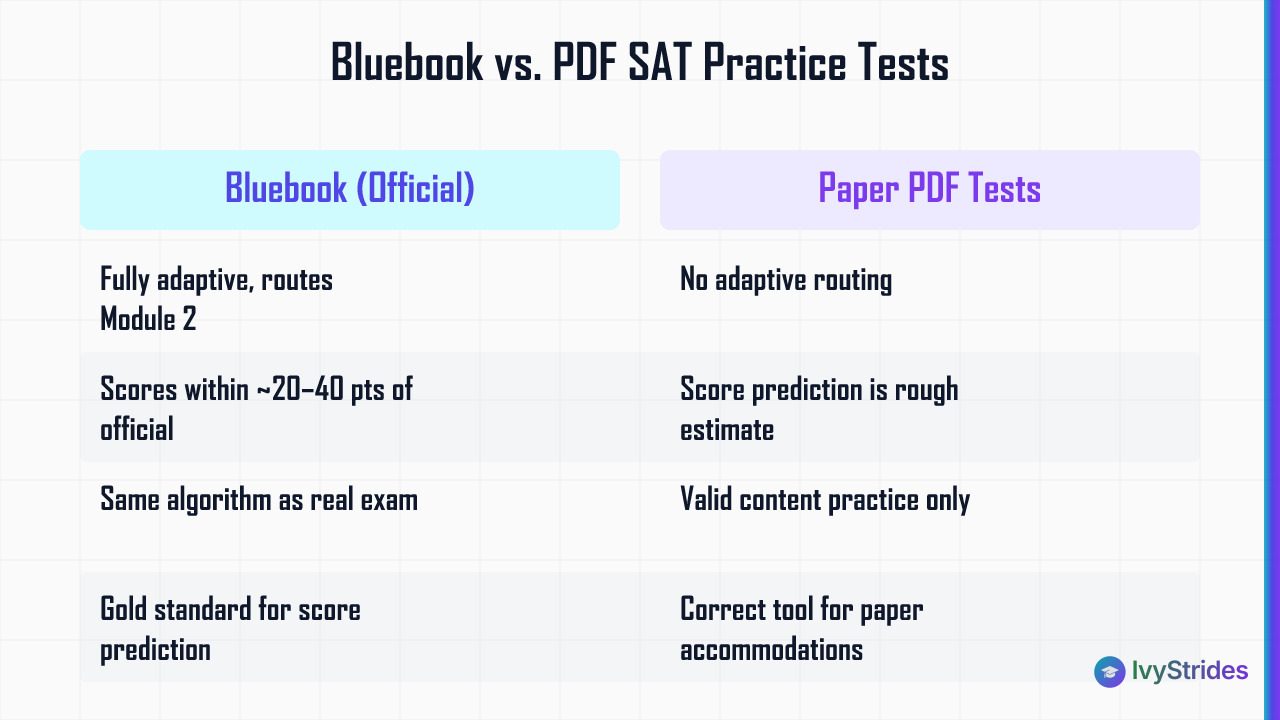
Here's the mechanism. The Digital SAT delivers two sections, Reading and Writing (R&W) and Math. Each section has two adaptive modules. Your performance on Module 1 determines whether Module 2 gives you the easier or harder question set, and that routing decision sets the ceiling on your possible score for that section. Because the Digital SAT routes you into a harder or easier Module 2 based on your Module 1 performance, only a fully adaptive test, like those in the Bluebook app, can accurately predict your real score range. This is how SAT adaptive test scoring actually works, and it's why a nonadaptive PDF, no matter how well-written, can't give you a defensible score prediction.
What does this mean in practice?
- Bluebook is the gold standard. Same app, same routing algorithm, same item calibration as the real exam. In our coaching, students' Bluebook scores typically fall within roughly 20-40 points of their eventual official score.
- Paper PDF tests are a fallback. They're valid content practice, and they're the correct tool for paper-based accommodations. But because they don't route, they can't tell you whether you'd be sent to a harder or easier Module 2 on test day, so their predicted score is a rough estimate at best.
- Third-party full-length tests vary widely. Difficulty calibration is often off. Some run roughly 50-100 points harder or easier than an equivalent Bluebook test. Use them for question-type drilling. Don't use their predicted scores to set admissions targets.
One useful side note. Students preparing for the PSAT/NMSQT will find that the same official Bluebook practice tests build the overlapping skills tested on both exams, since the PSAT and SAT share the same adaptive R&W and Math structure. If you're a sophomore or junior planning around National Merit, your SAT practice pulls double duty.
If you're wondering how many questions are on the SAT and how they split across modules, per College Board: 54 R&W questions across two modules, 44 Math questions across two modules, 98 total in a sitting of about 2 hours 14 minutes.
Free Official SAT Practice Tests: Where to Find Every One
All 10 official full-length Digital SAT practice tests are free. You don't need to pay for any of them.
Bluebook app (adaptive, most accurate): Download from satsuite.collegeboard.org. Available on Mac, Windows, and iPad. Once installed, you'll see all 10 practice tests under the "Test Preview" section. Each one runs about 2 hours 14 minutes and scores automatically with a section-level score report.
Paper PDFs (nonadaptive, for paper accommodations): satsuite.collegeboard.org/practice/practice-tests/paper. Downloadable answer sheets, scoring guides, and answer explanations included.
Official free partner practice: Digital SAT question bank with thousands of practice items calibrated to real test difficulty. Full-length tests are available, though the routing experience isn't identical to Bluebook.
Two quick notes on which tests to prioritize. First, Tests 7-10 are the most current calibration. Take these when you're closer to test day and want the most accurate score prediction. Second, Tests 1-6 (including SAT Practice Test 1 and SAT Practice Test 2) are still valid practice, especially for building familiarity with question types, but they were calibrated earlier and may run slightly softer than what you'll see in 2026.
For a broader map of everything free that's worth using, our sat resource sheet collects the material we hand our own students. And if you want the fuller picture of how we structure prep, our SAT prep overview walks through it.
How to Actually Use SAT Practice Tests to Raise Your Score
This is the section that matters most.
Taking a practice test without a structured review protocol is the single most common reason students plateau. The diagnostic-driven method we use at IvyStrides, starting from a scored Bluebook test and building a targeted error log, is what converts practice hours into the roughly 200+ point improvements we see in our coaching. If you take away one thing from this article, take away the protocol below.
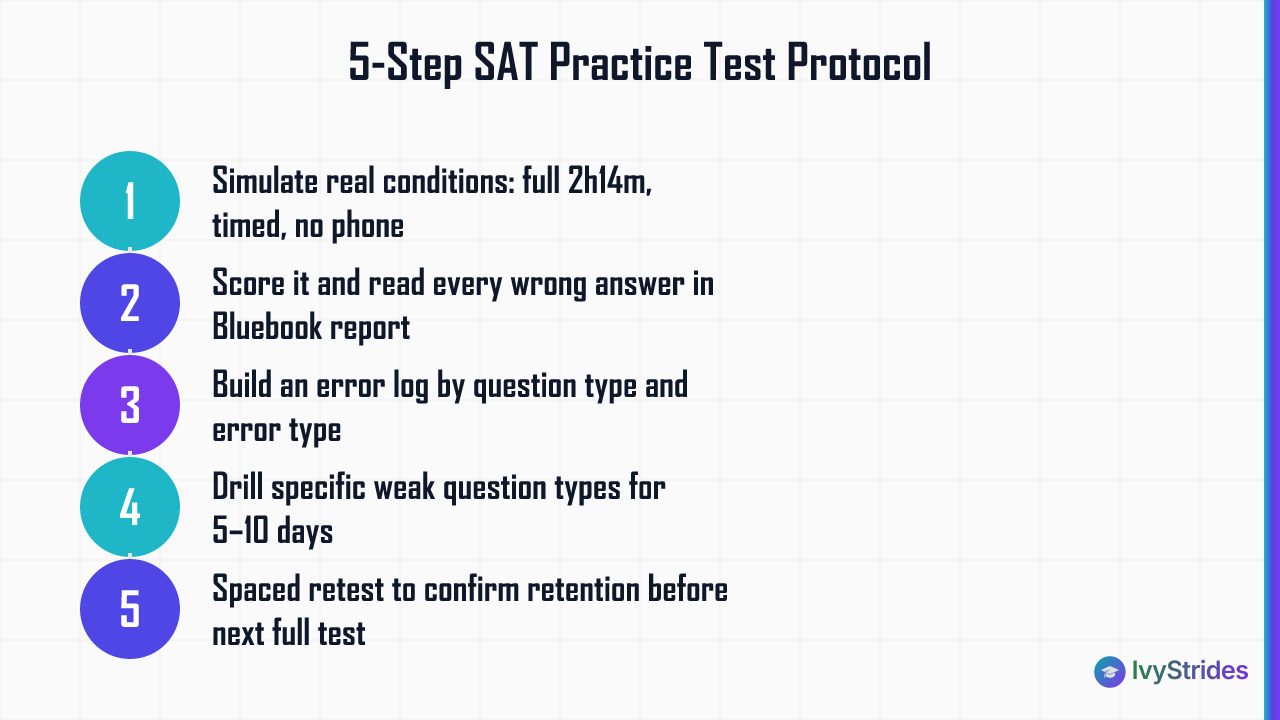
Step 1: Simulate real conditions. Full 2 hours 14 minutes. Timed modules. No phone. No pausing. One 10-minute break between sections. If you break the timing, you're not taking a practice test; you're doing untimed problem sets, which is a different exercise. Simulating real test conditions during practice, including the full 2-hour-14-minute sitting, timed breaks, and no phone access, is also one of the most effective ways to reduce test-day anxiety before the official exam.
Step 2: Score it and read the Bluebook score report closely. Bluebook gives you your section scores, total score, and a per-question breakdown showing which items you missed and the skill area each item tests. Don't skim this. Read every wrong answer.
Step 3: Build an error log by question type. Every mistake gets categorized on two axes. First, the question type (linear equations, systems of equations, transitions, rhetorical synthesis, main idea, data analysis, and so on). Second, the error type: careless error, concept gap, timing error, or question-type misread. Our sat mistake tracker template gives you the exact columns to fill in. In our coaching, students who complete a structured error log after every practice test show measurably faster score improvement than those who only review wrong answers casually.
Step 4: Targeted weakness work between tests. Don't just take the next practice test. For roughly 5-10 days, drill the specific question types your error log flagged. If you missed 4 questions on linear equations across R&W and Math, spend a session on linear equations, not on a general "SAT Math review."
Step 5: Spaced retesting. After roughly 7-10 days of targeted work, retest the same question types before moving to the next full-length test. This confirms retention. If you still miss the same items, the concept gap is real and needs coaching intervention, not more solo drilling. This is the loop that produces score gains. Our how to improve SAT score guide expands on how to sequence the targeted work between tests.
After two or three tests with this protocol, a pattern almost always emerges. In our coaching, the most common Math error pattern is in Algebra sub-types (systems of equations, linear functions), and the most common R&W error pattern is in transitions and rhetorical synthesis questions. Once you know your pattern, prep stops being random.
How Many Practice Tests Should You Take Before the Real SAT
The honest answer depends on your score gap and how much time you have. But here are concrete numbers.
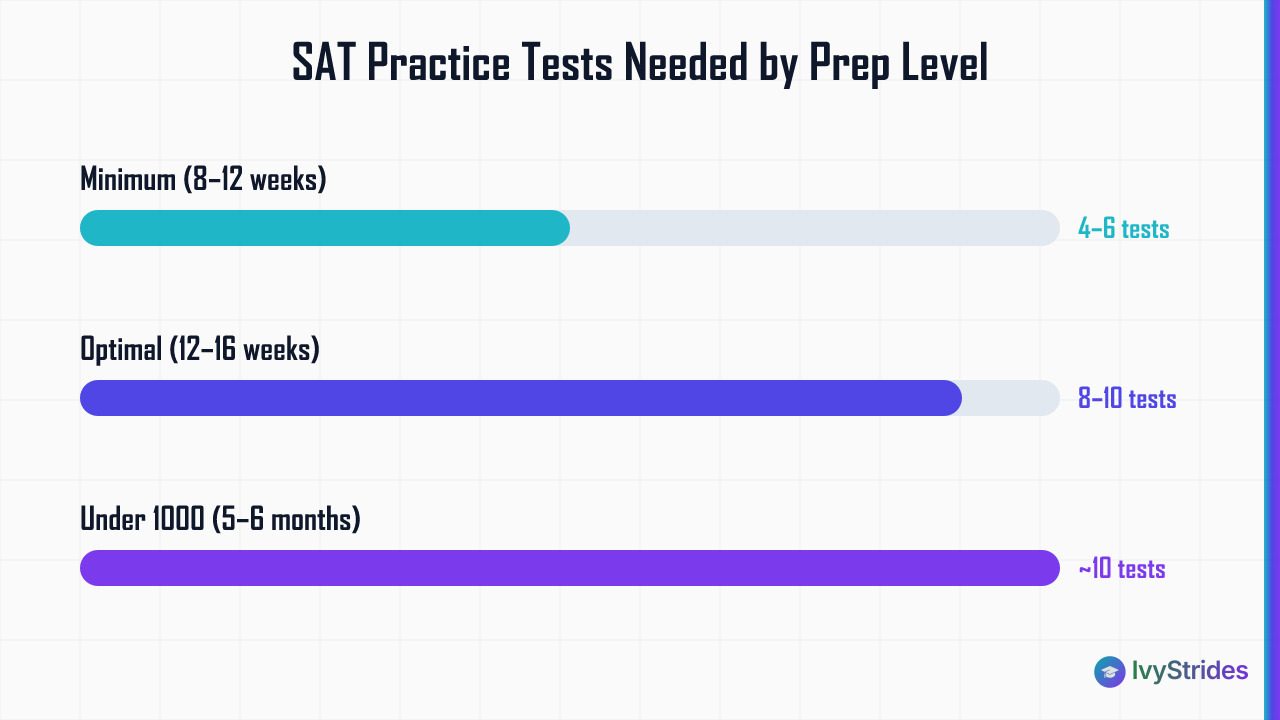
Minimum: roughly 4-6 full-length official tests for a student with about 8-12 weeks of prep. Fewer than that and you don't have enough data to spot patterns.
Optimal: about 8-10 full-length tests spread across roughly 12-16 weeks, one every 1-2 weeks, with targeted drilling in between. That's why 10 official tests is actually a reasonable ceiling. Using every one of them, well-reviewed, is more valuable than piling on lower-quality third-party tests.
Take the first one cold. No prep, no strategy videos, no cramming. A cold diagnostic gives you a true baseline. If you prep for two weeks and then take your first practice test, you've contaminated the data.
Your practice-test score is only useful if you know what target score your colleges expect. For context, the middle 50 percent SAT range at highly selective schools typically runs from roughly 1450 to 1570, which means a diagnostic score of 1250 tells you exactly how much ground to cover. Verify the exact range for each of your target schools by searching "Common Data Set [University Name]". Section C9 has the current admitted-student SAT distribution.
Percentile context for reference: 1200 is around the 74th percentile, 1400 is around the 94th to 95th percentile, and 1500 is around the 99th percentile. These are approximate and shift year to year with College Board's score distribution.
Realistic timelines from our coaching:
- A student scoring around 1150 on a cold diagnostic and targeting 1350 typically needs roughly 10-14 weeks of consistent work, about 8-10 hours per week.
- A student around 1300 targeting 1500 often needs about 12-16 weeks, with heavier emphasis on ceiling-level R&W and Math items.
- A student under 1000 typically needs foundational content work before test-taking strategy will pay off; timeline is closer to about 5-6 months.
For test-date logistics and how to time your official sitting around your prep, see our SAT test dates and complete prep guide. And if you're wondering where a specific number lands, is 1520 a good SAT score unpacks the percentile and admissions context.
SAT Math Practice Tests: What to Focus On in Each Module
Math on the Digital SAT is 44 questions across two adaptive modules, about 70 minutes total, per College Board. Calculator is permitted on every question, and the Desmos graphing calculator is built directly into Bluebook. If you're not using Desmos fluently, you're leaving points on the table.
Per College Board's content specifications, the Math section covers four domains: Algebra, Advanced Math, Problem-Solving and Data Analysis, and Geometry and Trigonometry. Algebra and Advanced Math together account for the majority of questions on any given test.
Here's the tactical piece most students miss. In our coaching, students who miss 3-4 Math questions in Module 1 are typically routed to the easier Module 2, which caps their Math score below 700. Module 1 accuracy is the gate. To score around 1500 total, you generally need to miss no more than about 2-3 Math questions across both modules combined, which means Module 1 has to be near-clean.
Module 2 hard questions, when you route into the harder set, cluster around multi-step Advanced Math (quadratics with unusual setups, exponential functions with variable coefficients) and Problem-Solving items with dense contextual language. Practice these under time pressure specifically.
On formulas: SAT geometry formulas are provided on the reference sheet at the start of the Math section, so your focus should be on applying them under time pressure, not memorizing them. Students working one-on-one with an Online SAT Math tutor typically make their biggest jumps in Module 1 accuracy first, then Module 2 ceiling items.
Beyond Official Tests: Reliable Third-Party SAT Practice Resources
You'll exhaust the 10 official tests eventually, especially if you're aiming for a top-percentile score. Here's how to think about supplements honestly.
Question-bank drilling. For volume on specific question types (say, you need 200 more linear-equations problems), a well-calibrated question bank is more useful than another mediocre full-length test. Focus on sources whose difficulty matches Bluebook.
Third-party full-length paper tests. Some third-party prep publishers release full-length nonadaptive paper tests. These can help students with paper-based accommodations or students who've genuinely run out of official material. Treat the scores as directional, not diagnostic. And know that no third-party test perfectly replicates the Bluebook adaptive routing algorithm. That's a technical reality, not a marketing claim.
Section drills and workouts. Focused sets of roughly 20-30 minutes on a single question type are excellent between full-length tests. They're not a substitute for a full sitting.
IvyStrides Test Packs. Our test packs are built for students who've used the official tests and need structured, score-band-calibrated full-length material with the same error-log framework baked in. If you've completed Tests 7-10 and want more of the same quality under the same review protocol, that's the natural next step. Getting comfortable with the digital sat calculator inside Bluebook is a separate skill worth investing in early. Students on a compressed timeline for spring test dates often join our SAT winter batch enrollment to work through the protocol with a section-specialist coach.
The rule of thumb: official Bluebook tests are your scoring benchmark. Everything else is drilling volume.
Turning Practice Scores Into a Real Prep Plan
A practice-test score by itself is a number. What turns it into points is the plan you build around it.
Every IvyStrides plan starts from a real scored Bluebook diagnostic, not a placement quiz or a self-reported score. From there, we do three things. First, section-specialist assignment: separate coaches for SAT R&W and SAT Math, because the skills are different and generalist tutoring dilutes both. Second, score-band analysis: a student scoring 1150 needs a completely different question-type priority than a student scoring 1350, even if both want to reach 1500. Third, an honest timeline. In our coaching, a roughly 200-point improvement typically requires about 10-16 weeks of consistent work, around 8-12 hours per week. For students completing the full IvyStrides 1-on-1 SAT program, 200+ point gains are typical, though individual results depend on starting score, hours invested, and consistency.
Here's the part most students miss. The score-band matters more than the total. Two students both starting at 1180 might need almost entirely different prep sequences depending on whether their weakness sits in R&W transitions or in Advanced Math.
A caveat worth stating clearly. Test-optional policies vary by school and by year. Check each of your target colleges' current policies directly, and cross-reference FairTest for the broader landscape. Even at test-optional schools, a strong score is a meaningful differentiator in a competitive applicant pool, not a requirement. And admissions outcomes depend on the full application, not on test scores alone.
If you're juggling multiple exams, our AP, SAT, and ACT testing plan walks through how to sequence them without burning out.
FAQ
Are the College Board Bluebook practice tests accurate predictors of my real SAT score?
Yes. Bluebook uses the same adaptive routing algorithm as the real exam, which is what makes it the most accurate predictor available. In our coaching, students' Bluebook scores typically fall within roughly 20-40 points of their official score. Paper PDFs and third-party tests can't match that accuracy because they don't replicate the Module 1 to Module 2 routing.
Should I take SAT practice tests without a time limit when I'm first starting out?
Only for the very first diagnostic session, and only if you're trying to identify which question types you struggle with conceptually. Every practice test after that should be fully timed. Pacing on the Digital SAT is a real skill, and untimed practice doesn't build it. Move to full timed conditions within your first week of prep.
How many official Digital SAT full-length practice tests are currently available?
As of 2026, College Board has released 10 official full-length practice tests (Tests 1 through 10) inside the Bluebook app. Tests 7 through 10 are the most current and best reflect current difficulty calibration; a new test was added to Bluebook in early February 2026. Older tests are still valid practice but may not perfectly mirror today's difficulty distribution. Verify the current count at satsuite.collegeboard.org before you plan your prep sequence.
What is a good SAT score to aim for, and how do practice test scores map to that target?
A 1200 is around the 74th percentile, a 1400 is around the 94th to 95th percentile, and a 1500 is around the 99th percentile. Your target should come from the middle 50 percent SAT range at your specific target colleges, which you can find in each school's Common Data Set (Section C9). Your Bluebook diagnostic tells you exactly how far you are from that target and how many weeks of prep to plan for.
Is it worth buying SAT practice test books, or are the free official tests enough?
For most students, the 10 official Bluebook tests plus an official question bank provide sufficient volume. Paid books can add drilling material for specific question types, but they should supplement, not replace, official tests as your scoring benchmark. If you've exhausted every official test, a structured Test Pack with built-in score-band analysis is a better investment than a generic prep book.
Is there a consistent pattern in wrong answers on SAT practice tests, and how do I find it?
Yes, and finding it is the most valuable thing you can do with a practice test. Categorize every wrong answer by question type (linear equations, transitions, main idea, and so on), by error type (concept gap, careless error, timing, misread), and by module. After two or three tests, a pattern almost always emerges. In our coaching, the most common patterns are Algebra sub-types on the Math side and transitions or rhetorical synthesis on the R&W side.
Take one Bluebook test this week. Score it. Build an error log by question type. You'll know more about your real SAT score in three hours than months of unfocused prep can tell you.

Two decades teaching quantitative and verbal aptitude on standardized tests. Rare dual expertise across Math and Verbal — particularly effective for students with gaps on both sides. Senior AP Mentor for our Calculus and English tracks.