
What Is the ACT STEM Score, Explained: Everything You Need to Know for 2026-27
On this page
- What the ACT STEM Score Is and How It Appears on Your Report
- How the ACT STEM Score Is Calculated from Your Section Scores
- How to Calculate Your ACT STEM Score in Three Steps
- What Is a Good ACT STEM Score for College and Scholarships?
- Should You Take the Optional ACT Science Section to Get a STEM Score?
- Should You Add ACT Science? A Quick Decision Checklist
- FAQ: ACT STEM Score Questions
- What is my ACT STEM score?
- How is the ACT STEM score calculated?
- What is a good ACT STEM score?
- Does the ACT STEM score matter?
- Your Next Step With the STEM Score
The ACT STEM score is the average of your Math and Science section scores, reported on the same 1 to 36 scale as the Composite and the multiple-choice sections. It appears on your score report as a separate score and does not affect your Composite. Because Science is optional, you only get a STEM score if you sit that section.
That averaging rule comes straight from ACT's understanding-your-scores page. The distinction worth holding onto from the start: STEM is a reported signal, not a required one, and your Composite is built from English, Math, and Reading alone.

What the ACT STEM Score Is and How It Appears on Your Report
The ACT STEM score is a supplementary score that averages your Math and Science section scores on the 1 to 36 scale. On ACT's sample student report, it sits on page one beside the Math and Science scores it comes from, with the Composite, English, Reading, Writing, and ELA scores on the same page. It is not the Composite, and it is not a subscore inside one section. It is its own line.
Why it matters as a separate number. The ACT Composite is the average of English, Math, and Reading only; Science is excluded from it. That makes the STEM score the one reported figure that pairs quantitative reasoning (Math) with scientific reasoning (Science). Because the ACT Composite is calculated from three sections and leaves Science out, a strong Science result shows up in your Science and STEM scores, not in your Composite.
Two other scores share that part of the report. The ELA score combines English, Reading, and Writing; ACT reports it on the 1 to 36 scale, like STEM, and produces no ELA score without a Writing score. The Writing score itself sits on a 2 to 12 scale and does not touch the Composite or the STEM score. None of these three change your Composite.
| Score | Sections Averaged | Scale | Requires Optional Section? |
| Composite | English, Math, Reading | 1-36 | No |
| STEM | Math, Science | 1-36 | Yes (Science) |
| ELA | English, Reading, Writing | 1-36 | Yes (Writing) |
| Writing | Writing essay only | 2-12 | Yes (Writing) |
So if your report shows no STEM score, check whether Science was part of your test. ACT produces no STEM score when either input is missing, so nothing went wrong with the scoring.
Sources: ACT, Understanding Your Scores; ACT sample student score report; Using Your ACT Results 2026-27.
How the ACT STEM Score Is Calculated from Your Section Scores
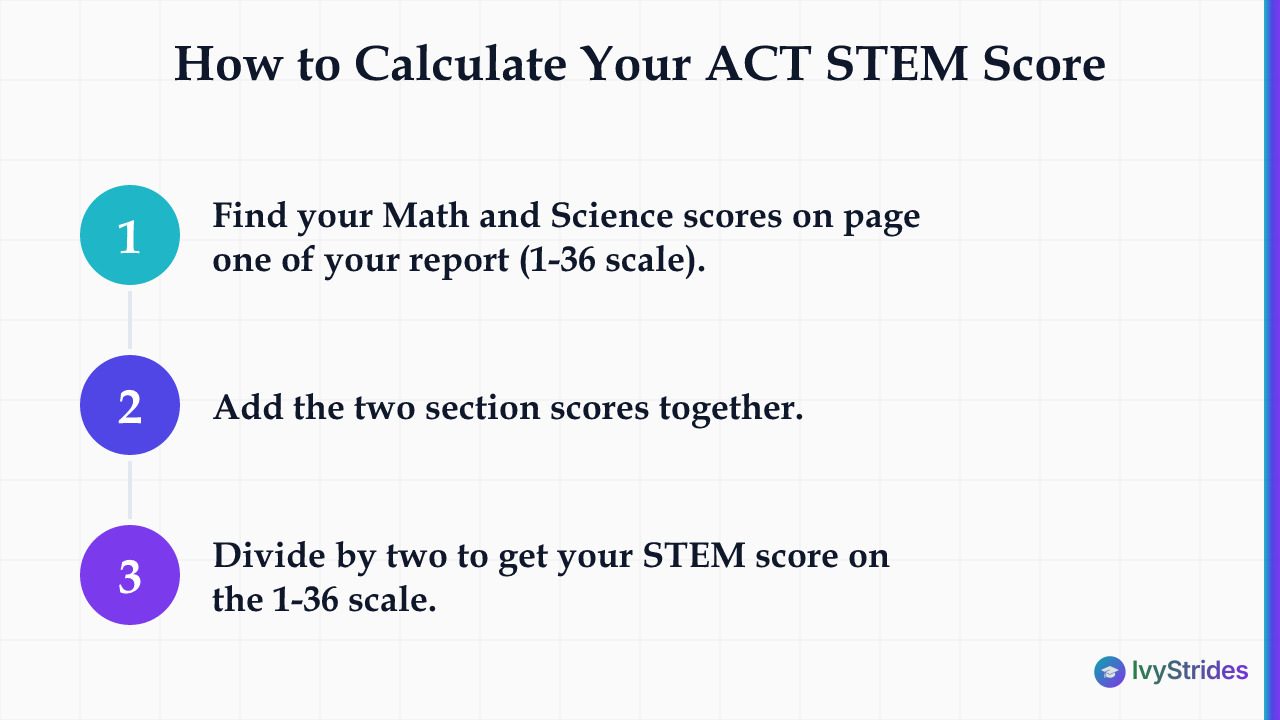
The ACT STEM score is the average of your Math and Science section scores. That is the whole formula: add the two, then divide by two. Both feed in on the same 1 to 36 scale, so a Math of 28 and a Science of 26 produce a STEM score of 27.
Because Science is optional, that calculation only runs when you sit it. A student who skips Science gives the formula one input instead of two, so no STEM score appears on the report. Settle whether the optional ACT Science section is worth adding before you worry about what a good STEM score looks like, since a skipped section leaves nothing to average.
Both sections carry field-test items that do not count toward your score. On the enhanced ACT, 41 of the 45 Math questions are scored, and 34 of the 40 Science questions are scored. Answer every question anyway: your score counts only correct answers, with no penalty for wrong ones. Math questions now offer four answer choices instead of five, one of the changes the enhanced ACT made to the test.
The pace gap matters here. IvyStrides' analysis of ACT's published section times, 40 minutes for 40 Science questions and 50 minutes for 45 Math questions, puts Science at 60 seconds per question and Math at about 67 seconds, so Science is the tighter of the two sections behind your STEM score. When your STEM score comes in low, check your Science timing before you assume a content gap.
How to Calculate Your ACT STEM Score in Three Steps
-
Find your Math and Science section scores on page one of your report, each on the 1 to 36 scale.
-
Add the two scores together.
-
Divide by two. That is your STEM score, on the same 1 to 36 scale.
Get your Daily IV Dose on Instagram: quick study tips and test-day advice for high school students. Follow @ivy.strides.
If your Science score trails your Math score, time yourself on a full Science practice section to see whether pacing or content is costing you the points.
Figures above: ACT exam sections and structure, and ACT counselor blog.
What Is a Good ACT STEM Score for College and Scholarships?
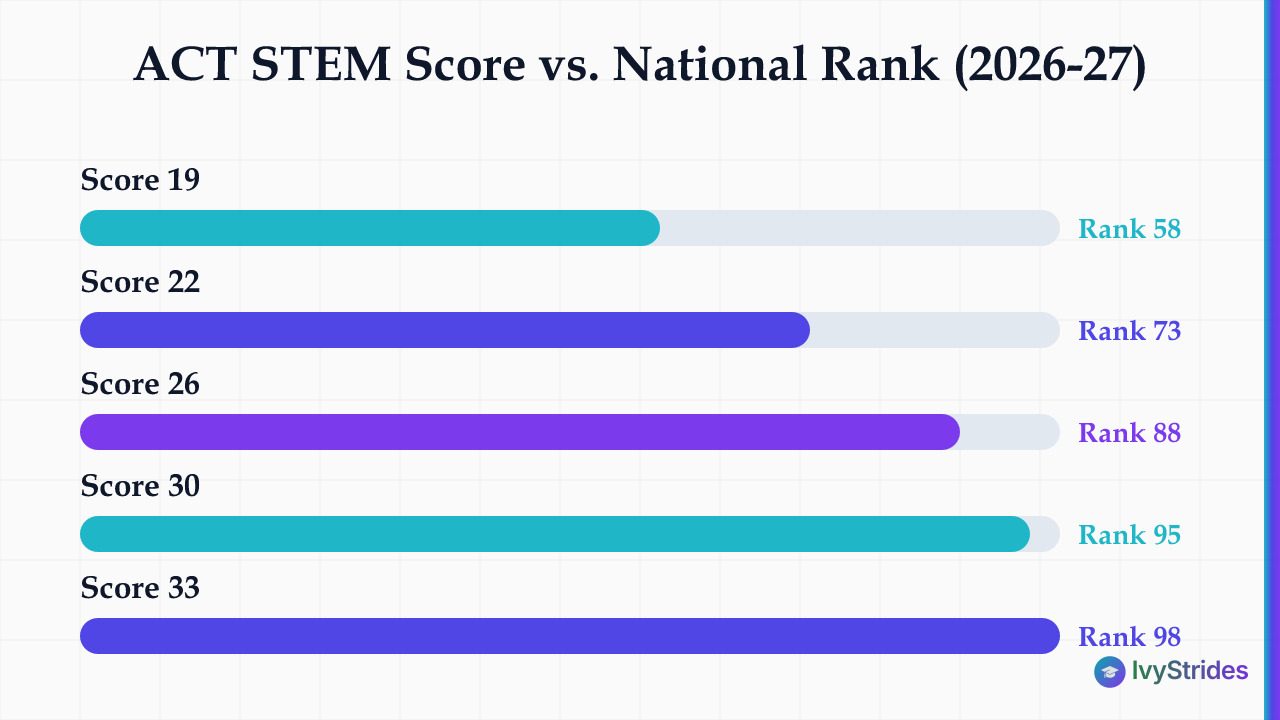
A good ACT STEM score tracks closely with a good Math and Science section score, because STEM is just their average. On ACT's 2026-27 national ranks, used for tests taken September 2026 through August 2027, the mean STEM score is 19.5 and the mean Composite is 19.1. A STEM score of 26 carries a national rank of 88: 88 percent of recent ACT-tested graduates scored 26 or lower.
| Score | STEM National Rank | Composite National Rank |
| 19 | 58 | 58 |
| 22 | 73 | 72 |
| 24 | 81 | 80 |
| 26 | 88 | 86 |
| 28 | 92 | 91 |
| 30 | 95 | 94 |
| 33 | 98 | 98 |
National rank: the percent of ACT-tested high school graduates of 2024, 2025, and 2026 who earned that score or lower. Source: ACT, ACT Score National Ranks 2026-2027.
The two columns run close, so read each score against its own column. A national rank shows where you stand among recent ACT-tested graduates, not at a particular college. For that, start with the Composite: checking published ACT score ranges at top colleges tells you more about your college list than any STEM figure.
Where it can carry weight. If a merit scholarship or honors program you want names a minimum STEM score alongside a Composite threshold, check both numbers when you set a prep goal. Because ACT scores connect to merit scholarship thresholds differently from one award to the next, the only reliable figure is the one the scholarship itself publishes.
Two caveats before you treat any rank as a target. Test-optional policies vary by school and by year, so a strong STEM score only helps where scores are read at all. And College Board's list of colleges that currently or soon will require SAT or ACT scores names 21 private and 42 public colleges, with the warning that the list changes frequently. Confirm each target school's current policy on its admissions site before you plan around a number.
Should You Take the Optional ACT Science Section to Get a STEM Score?

Photo by Jahra Tasfia Reza on Pexels
Adding the optional ACT Science section is worth it when a STEM score will be read, and skippable when it will not. On ACT's current fee page, Science is a $5 add-on to the $70 English, math, and reading test, and you can add or remove it through the late deadline. The section runs 40 questions in 40 minutes, with 34 scored. The fee is small; the 40 minutes of fast data-reasoning work, and the prep behind them, are the real investment.
That trade-off follows directly from the pacing gap above: Science runs at a tighter pace than Math, so the extra 40 minutes buy you a useful STEM score only if your Science pace holds up. A timed Science practice section before you register shows whether adding Science is likely to strengthen your profile or dilute it.
IvyStrides' 1-on-1 ACT prep starts with a diagnostic test and a custom ACT roadmap, and its section strategy includes the call on whether to take Science. Add Science when it clears a real bar. Skip it when nobody is reading it.
Should You Add ACT Science? A Quick Decision Checklist
- You are applying to a STEM major, engineering school, or honors program that requests a STEM score.
- A scholarship you want lists a minimum STEM score in its published requirements.
- Your target schools read scores at all, which you have confirmed on their admissions sites.
- Your Science pace on a timed practice section holds steady under the 40-minute limit.
- You have time to prep Science before a remaining 2026-27 ACT national test date: December 12, 2026 (its regular deadline has passed; late registration closes November 29), or February 27, April 10, June 12, or July 10, 2027.
- If none of these apply, the Composite is your signal and Science is optional in practice as well as in name.
Science passages fall into recognizable types, so before your next sitting, use section-by-section ACT prep to log each Science miss by passage type and practice the type that costs you the most points. One last caveat: admissions outcomes depend on the full application, not on any single score, so no STEM figure guarantees a seat anywhere.
FAQ: ACT STEM Score Questions
What is my ACT STEM score?
Your ACT STEM score is on page one of your score report, alongside your Composite and section scores. It is the average of your Math and Science section scores on the 1 to 36 scale. If you did not sit the optional Science section, ACT produces no STEM score.
How is the ACT STEM score calculated?
Add your Math section score and your Science section score, then divide by two. A Math score of 28 and a Science score of 26 produce a STEM score of 27. Both sections use the same 1 to 36 scale.
What is a good ACT STEM score?
On ACT's 2026-27 national ranks, the mean STEM score is 19.5, and a STEM score of 26 has a national rank of 88. A good score for you is one that fits the programs you are applying to, so check each program's own published requirements.
Does the ACT STEM score matter?
The STEM score is supplementary: it never changes your Composite. It matters most when a STEM honors program, an engineering school, or a scholarship you want names it in its requirements. Admissions outcomes depend on the full application, not any one score.
Your Next Step With the STEM Score
The ACT STEM score is a mirror of two sections you already control: Math and Science. Read it as a signal, confirm whether your target schools and scholarships care about it, and decide the Science question before you register.
- Pull your Math and Science scores off page one and run the three-step average.
- Confirm on each target school's admissions site whether scores are read at all.
- Set your Composite target from the ACT score your colleges expect, then decide whether a STEM score adds to it.
- Check any STEM scholarship's published minimum against your current figure.
- If a STEM score will be read, plan Science prep around pacing, then register.
Watch the method, then try it: IvyStrides explains SAT and ACT question types on YouTube.

Hemant is a seasoned entrepreneur, investor, and growth strategist with deep ground in education and technology-driven learning. His core training is in Mathematics and Physics — he authored Physics for IB Diploma: Ultimate Revision Guide, recognized as a top student resource.