
Should You Submit ACT Scores If Test-optional? Here Is What You Need to Know in 2026

On this page
- The Short Answer: A One-Rule Framework for Most Students
- What Test-Optional Actually Means in 2026 (and What It Does Not Mean)
- How to Find Your School's Middle-50% ACT Range (and What to Do With It)
- What ACT Score Is Too Low to Submit? A Score-Band Decision Guide
- Does Going Test-Optional Actually Hurt Your Application?
- Does the ACT Writing Section Affect Your Score? What to Know Before You Register
- Should You Send Both Your SAT and ACT Scores?
- Practical Steps: How to Submit (or Withhold) Your ACT Score
- If Your Score Is Not Where You Want It, Here Is What to Do Before You Apply
- FAQ
- What ACT score is generally not worth submitting to a selective college?
- Does applying test-optional hurt your chances compared to students who submit scores?
- Should I submit a 29 ACT score to a test-optional school?
- Is it necessary to submit both SAT and ACT scores?
- Do colleges really treat test-optional applications the same way?
- What is the ACT writing section and does it affect my composite score?
Submit your ACT score to a test-optional college if it lands at or above roughly the school's 25th percentile for enrolled students. Withhold it if it falls below that mark. The middle-50% range, meaning the 25th to 75th percentile band, lives in Section C9 of each college's Common Data Set.
That range comes from each school's own institutional research office, not a ranking site. The harder questions are the edge cases: what to do at 24-27, whether withholding actually hurts you at highly selective schools, and how the 2026-2027 policy shifts (including the University of Michigan's return to test requirements) change the calculus. The sections below walk each of those decisions.
The Short Answer: A One-Rule Framework for Most Students
Here's the rule, stated plainly: if your ACT composite sits at or above roughly the 25th percentile of enrolled students at a given school, submit. If it sits below, withhold. That's the working default, and it holds for the vast majority of applicants at test-optional schools.
The middle-50% range is a shorthand for the 25th-to-75th percentile band of admitted or enrolled students. So if a school reports a middle-50% ACT range of 32-35, the 25th percentile is a 32 and roughly the 75th is a 35. A 33 is squarely in range and worth submitting. A 31 sits one point below the 25th percentile, which is the classic borderline case. In that borderline zone, weigh your GPA, course rigor, and the school's score submission rate before you decide.
You'll find these numbers in Section C9 of the school's Common Data Set. Not on a college rankings site, not on Reddit, not on a third-party aggregator. The Common Data Set is what each university's institutional research office publishes and updates annually, and it's the number an admissions officer would look at.
One more note before we go deeper. If you have both an SAT and ACT score in hand, the SAT to ACT score concordance is the tool that lets you compare them on the same scale before you pick which one to submit.
What Test-Optional Actually Means in 2026 (and What It Does Not Mean)
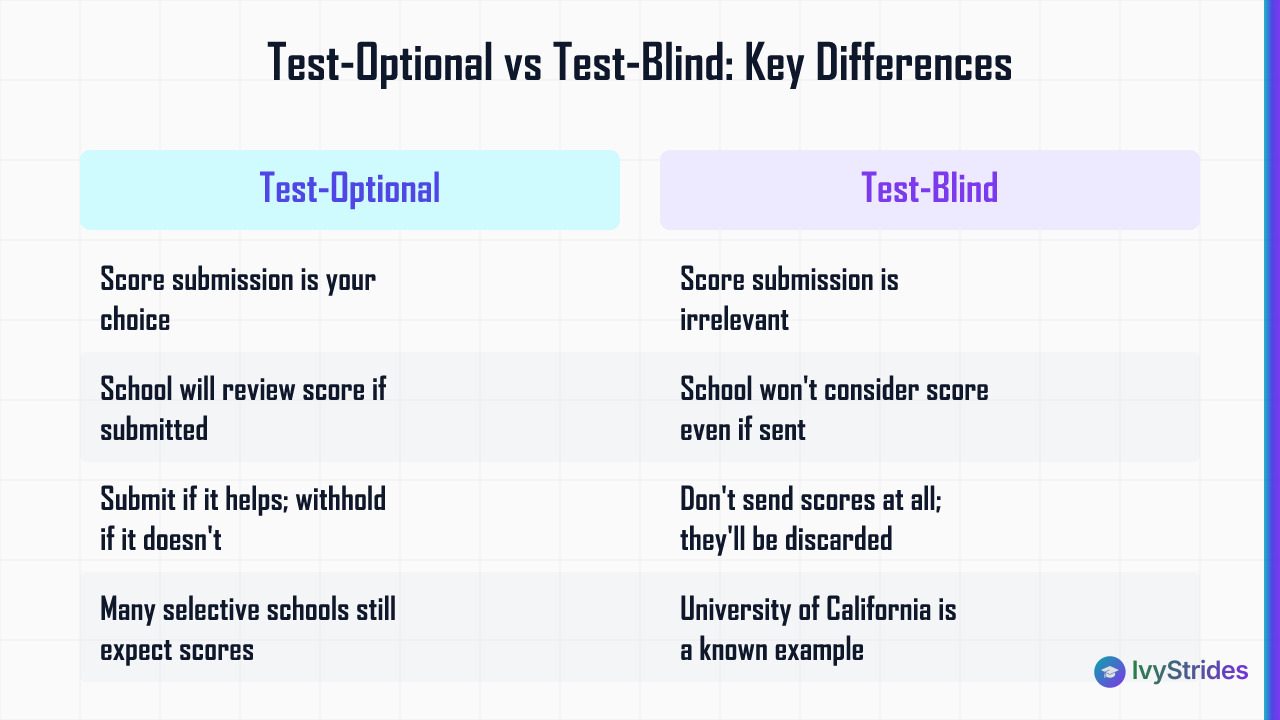
Test-optional means the school won't require you to submit an ACT or SAT score, but will review your score if you choose to submit one. It doesn't mean the school ignores scores. It means the score is a piece of evidence you control: submit it if it helps, withhold it if it doesn't.
That's different from test-blind, where the school won't consider a score even if you send one. The University of California system is the most widely known test-blind system in the country. If a school is truly test-blind, don't send scores at all; they'll be discarded.
The current test-optional landscape is tracked by FairTest, which maintains a live list of test-optional and test-blind institutions. Verify each school on your list on that tracker, then confirm on the school's own admissions page, because policies shift year to year.
Two shifts matter for the 2026 and 2027 cycles. First, some highly selective schools are reinstating test requirements. Michigan, for example, has announced a return to test-required admission for Fall 2027 applicants. Dartmouth, Yale, Brown, MIT, Georgetown, and several others have made similar moves. Read each school's current policy carefully.
Second, at schools that remain test-optional, the majority of admitted students at the most selective institutions are still submitting scores. That gap between "test-optional on paper" and "test-optional in practice" is the single most important nuance in this whole conversation.
One caveat that applies to everything in this article: test-optional policies vary by school and by year. Always verify on the school's official admissions page before you finalize your application.
How to Find Your School's Middle-50% ACT Range (and What to Do With It)
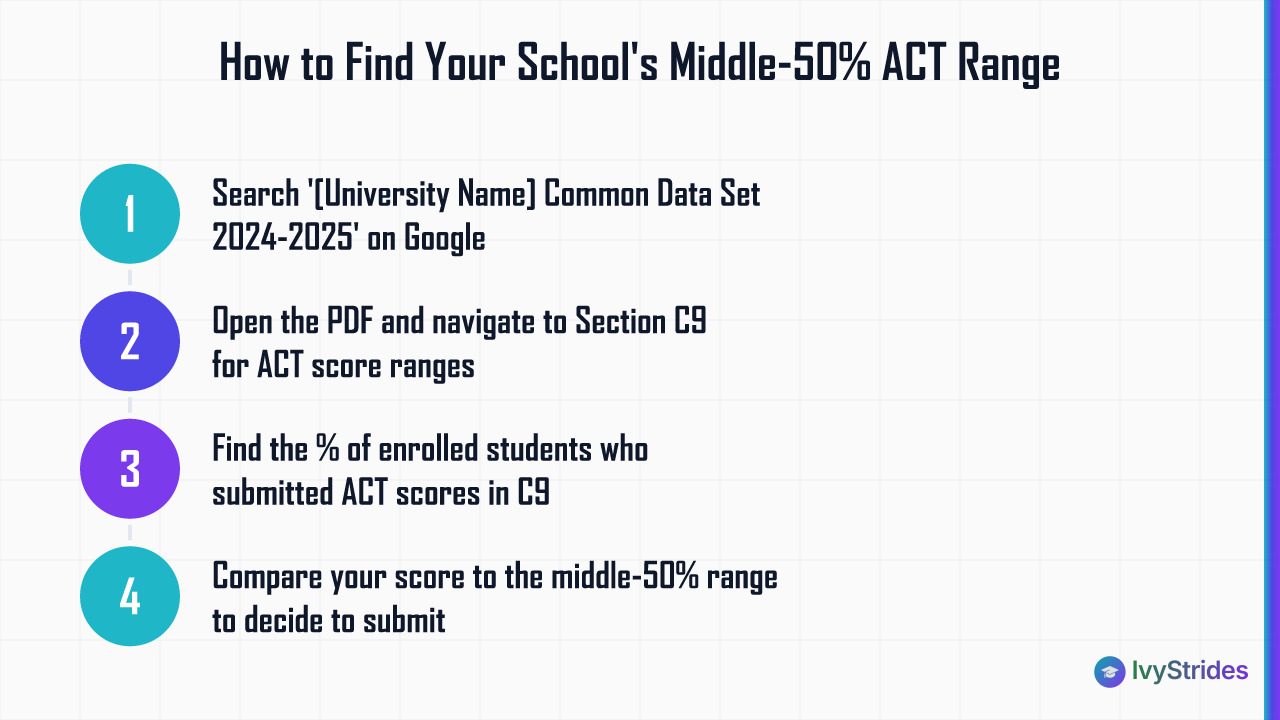
Here's the two-minute lookup, step by step.
Step 1. In Google, search: "[University Name] Common Data Set 2024-2025". If the 2024-2025 version isn't out yet for that school, use 2023-2024. Every college publishes a PDF, usually hosted by its institutional research office.
Step 2. Open the PDF and go to Section C9. That section reports SAT and ACT score distributions for enrolled first-year students. You'll see roughly the 25th percentile ACT composite, the 75th percentile ACT composite, and often the percentiles for each subsection (English, Math, Reading, Science).
Step 3. In the same Section C9, find the row showing the percentage of enrolled students who submitted ACT scores (and, separately, SAT scores). This number is the tell. If roughly 85% of enrolled students submitted a score, that school is functionally test-required for competitive applicants. If only around 30% to 40% submitted, the school is genuinely test-optional in practice, and withholding a below-median score carries less risk.
Here's a rough sense of the landscape, drawn from recent Common Data Set filings across three tiers. Highly selective private universities typically report middle-50% ACT ranges around 34-36. Moderately selective flagship publics and mid-tier privates cluster around 28-32. Less selective four-year colleges often fall roughly in the 22-27 band. Don't rely on those ranges; verify each of your target schools directly. A single point off can flip the submit-or-withhold decision.
If you're still deciding which test to take before you face this submission question, our comparison of act vs sat difficulty can help you choose the right exam first.
For students still building their ACT score baseline, our act practice test online library gives you full-length sittings to see where your composite lands before you commit to submitting anywhere. If Duke happens to be on your list, we have a full workup on Should You Apply to Duke University? Key Factors Explained.
What ACT Score Is Too Low to Submit? A Score-Band Decision Guide

Photo by Andy Barbour on Pexels
This is the question most students actually type into Google, so here's the direct score-band framework. Read the band that matches your composite, then apply it against each school's Common Data Set.
33 to 36. Submit everywhere. This band sits at or above roughly the 75th percentile at nearly every college in the country, including the most selective. There's no scenario where withholding a 33+ helps you.
28 to 32. Submit to most schools. At moderately selective universities where the middle-50% is 27-31 or 28-32, this band is competitive. At highly selective schools with a 34-36 middle-50%, a 28-32 falls below roughly the 25th percentile and is generally a withhold. Verify per school.
24 to 27. The judgment zone. Submit only where this composite falls within the middle-50% at that specific school. At schools with a 22-27 range, a 26 or 27 is strong and worth submitting. At schools with a 32-35 range, a 24 is well below roughly the 25th percentile and should be withheld.
Below 24. Withhold at most four-year colleges unless the school's middle-50% clearly includes your score. Check the score submission rate too; if fewer than roughly 40% of enrolled students submitted scores, you can withhold with even more confidence.
Two edge cases where submitting a below-median score can still help.
Edge case 1, the GPA rebalance. If your unweighted GPA is slightly below a school's typical enrolled range and your ACT is within the middle-50%, submitting the score can rebalance the academic narrative. It signals that your standardized test performance backs up your transcript.
Edge case 2, merit scholarships. Some public flagships and private universities award merit scholarships at specific ACT thresholds (29, 30, and 32 are common cutoffs). A 29 ACT might be below the median for admissions purposes but still unlock scholarship consideration worth tens of thousands of dollars over four years. Look at the school's scholarship page, not just its admissions requirements.
Across hundreds of application cycles we've coached, the most common mistake we see is students withholding a score that actually falls within the middle-50% because they assumed it was too low without checking the Common Data Set. Look up the numbers before you decide.
If your score currently sits below the 25th percentile at your target schools, the most direct path forward is a diagnostic-driven ACT prep plan that identifies your weakest sections before you retest. Our 1-on-1 ACT prep starts from a full-length diagnostic and pairs you with section specialists for English, Math, Reading, and Science.
Does Going Test-Optional Actually Hurt Your Application?
The honest answer: it depends on the school's selectivity tier and how strong the rest of your file is.
At highly selective schools with acceptance rates under roughly 15%, the majority of admitted students in recent cycles still submitted test scores. Applying test-optional at those schools isn't disqualifying, but it does shift more weight onto GPA, course rigor, AP performance, extracurricular depth, and essays. If any of those is thin, the missing score is one more thing pulling against you.
At moderately selective schools with acceptance rates roughly between 20% and 50%, withholding a below-25th-percentile score typically doesn't hurt if your GPA and course rigor are solid. Admissions officers at these schools state that they evaluate test-optional applicants on the same holistic criteria without penalizing the missing data point.
Here's the part most students miss. Admissions officers don't flag your file as "test-optional" in a negative way. But without a score, the academic readiness signal has to come from somewhere: your transcript, your AP exam scores, your teacher recommendations. In our coaching with students applying test-optional to highly selective schools, those who had strong AP records (multiple 4s and 5s in rigorous subjects) were consistently better positioned than those who had neither a submitted score nor strong AP performance. AP scores can partially compensate for the missing test score signal; they do not fully replace it.
For students applying test-optional, the admissions essay carries more weight, making a polished Common App personal statement and strong supplemental essays especially important. Our common app essay tutor works with students directly on brainstorming, drafting, and revising application essays.
If you're a junior weighing whether to prep for the ACT or focus on the PSAT/NMSQT for National Merit consideration, those are separate strategic decisions with different timelines, and worth thinking through before you commit hours.
If Northwestern is on your radar, our take on Should You Apply to Northwestern University in 2026? works through the specific score and application context there.
Does the ACT Writing Section Affect Your Score? What to Know Before You Register
Short answer: no, the ACT writing section doesn't affect your composite score.
The ACT writing test is an optional 40-minute essay that costs $25 extra at the time of registration, per ACT, Inc. Your composite score is calculated from English, Math, Reading, and Science only. The writing section is scored separately and reported separately.
Taking the writing test adds an English Language Arts (ELA) score to your report. The ELA score is a 1-36 composite that combines your English, Reading, and Writing scores into a single number.
Do you need it? Most colleges no longer require or recommend the ACT writing section. A small number of programs, some honors colleges, and a handful of specific university systems still request it, so check each school's testing requirements page individually. If none of your target schools require it, skip it. Save the roughly $25 and the 40 minutes of test-day energy.
Should You Send Both Your SAT and ACT Scores?
Most colleges don't require both. Sending both is optional and strategic, and the strategy is straightforward.
Submit both only if both scores are at or above roughly the 25th percentile at that school. If one is strong and the other is weak, submit only the strong one. A weak second score doesn't add information the admissions officer will use in your favor; it just dilutes the academic narrative.
Use the concordance to compare your two scores on the same scale before you decide. As a rough anchor, a 1480 SAT converts to about a 33 ACT. If your SAT-to-ACT concordance shows the two scores are within a point or two, pick the one that's stronger relative to that specific school's ranges. A 1480 SAT might sit around the 75th percentile at School A while the concorded 33 ACT sits closer to the 50th percentile. Send the SAT.
Check whether the school superscores the ACT, meaning they use your best section scores across multiple sittings to build the highest possible composite. If so, and you've taken the ACT more than once, your superscore may be strong enough to submit even if no single sitting was.
If you have both an SAT and an ACT score and are unsure which is stronger relative to a school's ranges, our SAT to ACT score concordance guide shows how the two scales compare. If you're still weighing which test to prep for going forward, is the SAT harder than the ACT is the deeper comparison.
Practical Steps: How to Submit (or Withhold) Your ACT Score
Once you've made the decision, the logistics are simple.
Most colleges now allow you to self-report ACT scores on the Common App or the school's application. Official scores, sent directly from ACT, Inc., are typically required only after you're admitted and decide to enroll. Self-reporting saves the score-report fee for every school you apply to, so use it where allowed.
If a school requires official scores at the time of application, log in to your account at act.org and order an official score report to that school. Allow several weeks for delivery.
If you decide to withhold, simply don't enter a score in the test score section of the Common App. Leave it blank. You're not required to explain the omission, and admissions officers won't ask. Your application will be processed as test-optional automatically.
Check each school's application deadline and score receipt deadline separately. Some schools require scores to be received by the application deadline, not just sent. That distinction has cost more than a few students their preferred admissions round.
Once you decide to submit, you'll also need to know whether to self-report your score on the application or send an official report through ACT, Inc., which is covered in our guide on should you self-report or send official ACT scores. Related: how to change or cancel an ACT registration if you decide to retest.
If Your Score Is Not Where You Want It, Here Is What to Do Before You Apply
If your composite is below roughly the 25th percentile at your target schools and you have time before your application deadline, retesting is worth serious consideration. The question isn't whether you can improve. It's whether you have the weeks and the plan.
For students completing our 1-on-1 ACT program, a 4+ composite point gain is typical. In our coaching with students at score bands between 24 and 28, a diagnostic-driven plan that targets the two weakest sections (usually two of English, Math, Reading, Science) tends to produce roughly a 3 to 5 point composite improvement over about 10 to 14 weeks. Outcomes depend on starting score, hours invested, and how consistently you complete practice tests. They aren't guaranteed, and any coach who promises a specific number isn't being honest with you.
The methodology isn't a mystery. Full-length diagnostic practice test to establish the real baseline. Section-by-section error analysis to identify the patterns behind your missed questions (careless errors vs. content gaps vs. pacing failures). Targeted work with a section specialist, because section coaches know their subject best. Spaced retesting under real timing conditions to build stamina. That's the loop.
A realistic timeline: students who begin prep roughly 10 to 14 weeks before their target test date and complete about 3 to 4 full-length timed practice tests tend to see the most consistent gains. Shorter than that, and there isn't enough runway to move the composite meaningfully. Longer than that, and the plan loses focus.
At IvyStrides, we assign section specialists rather than generalist tutors. Our ACT English coaches, Math coaches, Reading coaches, and Science coaches each work only in their section. You can meet our ACT section specialists directly. For self-directed prep, our digital ACT prep library provides full-length timed practice tests with score-band analysis.
FAQ
What ACT score is generally not worth submitting to a selective college?
Any composite below roughly the 25th percentile of enrolled students at that specific school is generally not worth submitting. At highly selective schools with a middle-50% range of 33-36, that means a 31 or below. At moderately selective schools with a middle-50% of 28-32, that means a 27 or below. Verify against the school's own Common Data Set, Section C9, rather than relying on a general cutoff.
Does applying test-optional hurt your chances compared to students who submit scores?
At highly selective schools, most admitted students in recent cycles submitted scores, so applying test-optional there carries more risk unless the rest of your application is exceptionally strong. At moderately selective schools, withholding a below-25th-percentile score typically doesn't hurt if your GPA, course rigor, and essays are competitive. Admissions officers don't penalize the absence of a score, but they will look harder at everything else in the file.
Should I submit a 29 ACT score to a test-optional school?
Depends on the school. A 29 is a strong score at many public flagships and private universities where the middle-50% is 27-31; there it sits at or above the median and is worth submitting. At a school with a 33-35 middle-50%, a 29 is below roughly the 25th percentile and should generally be withheld. A 29 also frequently unlocks merit scholarships at public universities, so check scholarship pages separately from admissions pages.
Is it necessary to submit both SAT and ACT scores?
No. Most colleges don't require both, and submitting both is only strategic if both are at or above roughly the 25th percentile at that school. If one score is stronger than the other after applying the SAT-to-ACT concordance, submit only the stronger one. A weak second score doesn't add useful information for admissions.
Do colleges really treat test-optional applications the same way?
Admissions offices state that they don't penalize test-optional applicants. But without a score, the academic readiness signal must come from GPA, AP exam scores, course rigor, and essays. In practice, at the most selective schools, a strong score is still a meaningful differentiator, which is why most admitted students at those schools continue to submit.
What is the ACT writing section and does it affect my composite score?
The ACT writing section is an optional 40-minute essay that costs roughly $25 extra at registration. It doesn't affect your composite score (1-36 scale). It adds a separate English Language Arts (ELA) score to your report, which combines English, Reading, and Writing on a 1-36 scale. Most colleges no longer require or recommend it. Take it only if a specific school or program on your list requests it.
The core decision is simple once you have the data in front of you. Look up each target school's Common Data Set. Compare your composite to roughly the 25th percentile. Apply the score-band rules. Where it's a judgment call, weigh score submission rate, GPA fit, and scholarship eligibility. If you're still on the fence, get a second read from someone who does this every week.

Award-winning author (South Asian Book Award) and graduate of BITS Pilani and UCLA Luskin School of Public Affairs. Brings a published writer's eye to Common App essays and grammatical precision to SAT and ACT R&W instruction.