
Everything You Need to Know About SAT to ACT Score Concordance in 2026

On this page
- What SAT to ACT Score Concordance Actually Means
- The Official SAT to ACT Concordance Table: Key Score Pairs for 2026
- What the Concordance Table Actually Shows (and What It Does Not)
- I Have Both Scores: Which One Is Actually Stronger?
- Should You Submit Your SAT Score, Your ACT Score, or Both?
- How to Use Concordance to Decide Which Test to Prep For
- Concordance for High-Score Bands: 32, 33, 34, 35, and 36 ACT
- Concordance for Mid-Range Scores: 24 Through 31 ACT
- A Note on the 2026 Concordance Tables: What Has and Has Not Changed
- FAQ
- Is a 33 ACT the same as a 1480 SAT?
- Should I submit both my SAT and ACT scores to colleges?
- Can I use the concordance table to convert a 2400-scale SAT score to an ACT score?
- How do colleges actually use concordance tables when reviewing applications?
- Is a 35 ACT better than a 1540 SAT?
- Where can I download the official SAT to ACT concordance PDF?
- Where This Leaves You
SAT to ACT score concordance links comparable scores across both tests by matching student percentile ranks, not by converting raw points. A 1600 SAT is concordant with a 36 ACT. A 1520 SAT with a 34 ACT. A 1480 SAT with a 33 ACT. A 1430 SAT with a 32 ACT. A 1350 SAT with a 29 ACT. A 1060 SAT with a 24 ACT. The tables were jointly produced by College Board and ACT, Inc. and reflect similar relative performance, not identical skills.
Those pairings come straight from the joint 2018 ACT-SAT Concordance Tables, still hosted on act.org and referenced from satsuite.collegeboard.org. The harder question isn't what the table says. It's what to do with the answer: which score to submit, which test to prep for, and how much the 2018 tables can be trusted now that the Digital SAT (March 2024) and the Enhanced ACT (2025) have both changed the underlying format. The next sections work through each.
What SAT to ACT Score Concordance Actually Means
Concordance is a statistical method that lines up two different tests on a common scale by matching percentile ranks. If roughly 99 percent of students score at or below a 1450 SAT, and roughly 99 percent score at or below a 33 ACT, then 1450 and 33 are concordant. They mark the same relative position in their respective testing populations.
That's a different animal from a conversion formula. There's no arithmetic that turns an SAT composite into an ACT composite. The tests measure overlapping but not identical constructs, and the mapping is empirical, built from real score data on students who took both exams. That's why the concordance tables show composite score ranges, not single-point equivalents. This process is called equating, and it depends on percentile rank distributions rather than raw point math.
The joint concordance study was published by College Board and ACT, Inc. in 2018. Those tables cover the current 400-1600 SAT scale (introduced in 2016) and the 1-36 ACT composite scale. Two format changes have happened since. The Digital SAT launched in March 2024 with an adaptive two-module structure across Reading and Writing and Math. The 2025 Enhanced ACT rolled out a shorter test with more time per question and a revised composite. Neither testing body has released updated tables. The 2018 tables remain the official reference and are still what admissions offices use.
If you're new to what these composites signal at competitive schools, our guide on what is a good SAT score gives you the percentile context.
The Official SAT to ACT Concordance Table: Key Score Pairs for 2026
Here's the concordance table condensed to the most-searched score bands. These are ranges, not single-point conversions. A student scoring anywhere in the SAT range concords with the matched ACT composite.
| ACT Composite | Concordant SAT Range |
| 36 | 1570-1600 |
| 35 | 1530-1560 |
| 34 | 1490-1520 |
| 33 | 1450-1480 |
| 32 | 1420-1440 |
| 31 | 1390-1410 |
| 30 | 1360-1380 |
| 29 | 1330-1350 |
| 28 | 1290-1320 |
| 27 | 1250-1280 |
| 26 | 1210-1240 |
| 25 | 1180-1200 |
| 24 | 1140-1170 |
| 23 | 1110-1130 |
| 22 | 1080-1100 |
| 21 | 1060-1080 |
| 20 | 1030-1050 |
| 17 | 900-920 |
| 14 | 780-820 |
| 11 | 590-630 |
The high-demand bands are worth calling out individually. A 33 ACT is concordant with a 1450-1480 SAT. A 34 ACT is concordant with 1490-1520. A 32 ACT is concordant with 1420-1440. A 35 ACT concords with 1530-1560. A 27 ACT concords with 1250-1280. A 24 ACT concords with 1140-1170.
The full official score concordance PDF is downloadable directly from ACT, Inc. (search "ACT SAT Concordance Tables") and referenced on the College Board SAT-ACT comparison page. Pull from those primary sources; third-party "updated" tables that claim to reflect the Digital SAT are unofficial.
For a deeper look at what these numbers mean in admissions terms, see our breakdown on SAT scores explained. If you're wondering where 1300 sits specifically, we cover is 1300 a good SAT score separately.
What the Concordance Table Actually Shows (and What It Does Not)
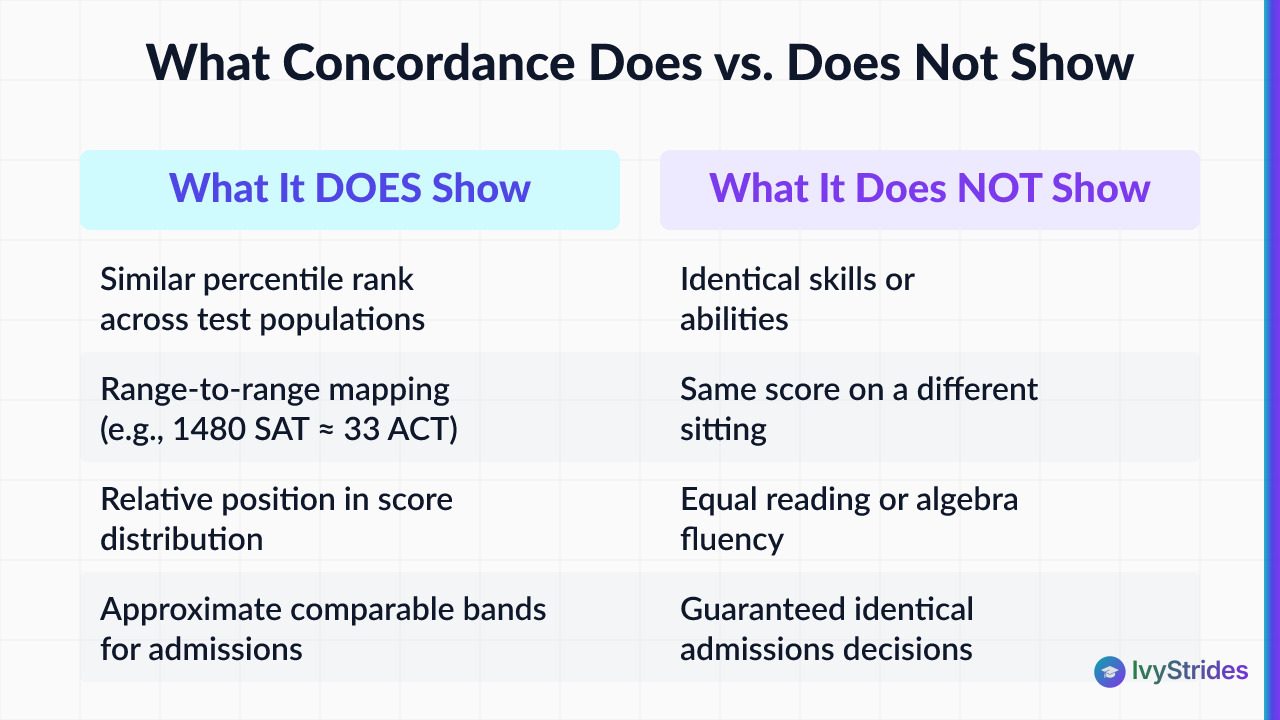
Concordance shows that two students, one with a 1480 SAT and one with a 33 ACT, performed at approximately the same percentile relative to their respective testing populations. It doesn't show that they have identical skills, would score the same on a different sitting, or would receive identical admissions decisions.
Look, the underlying methodology is percentile equating. College Board and ACT, Inc. gathered data from students who took both tests, aligned the distributions, and produced a range-to-range mapping. That's it. There's no claim that a 1450 and a 33 measure exactly the same reading comprehension or algebra fluency. They sit at similar relative positions.
Three caveats matter for 2026. First, the tables were released in 2018 and haven't been formally updated. Second, the Digital SAT (post-March 2024) is a shorter, adaptive test that behaves differently from the paper SAT the 2018 tables were built on. Third, the 2025 Enhanced ACT introduced a shorter test with more time per question and revised the composite structure. Neither testing organization has published new tables reflecting these changes.
Practical implication: treat concordant scores as approximate ranges, especially near band boundaries. A 1440 SAT technically concords with a 32 ACT, but it's a hair below the 33 band. Admissions readers know this and don't parse the table with a magnifying glass.
PSAT scores also have a concordance relationship with ACT scores, which matters for students tracking their National Merit Selection Index alongside ACT performance. If National Merit is on your radar, see our state-by-state breakdown of National Merit cutoffs by state. Check the current SAT test dates 2026 if you're still deciding when to sit.
I Have Both Scores: Which One Is Actually Stronger?
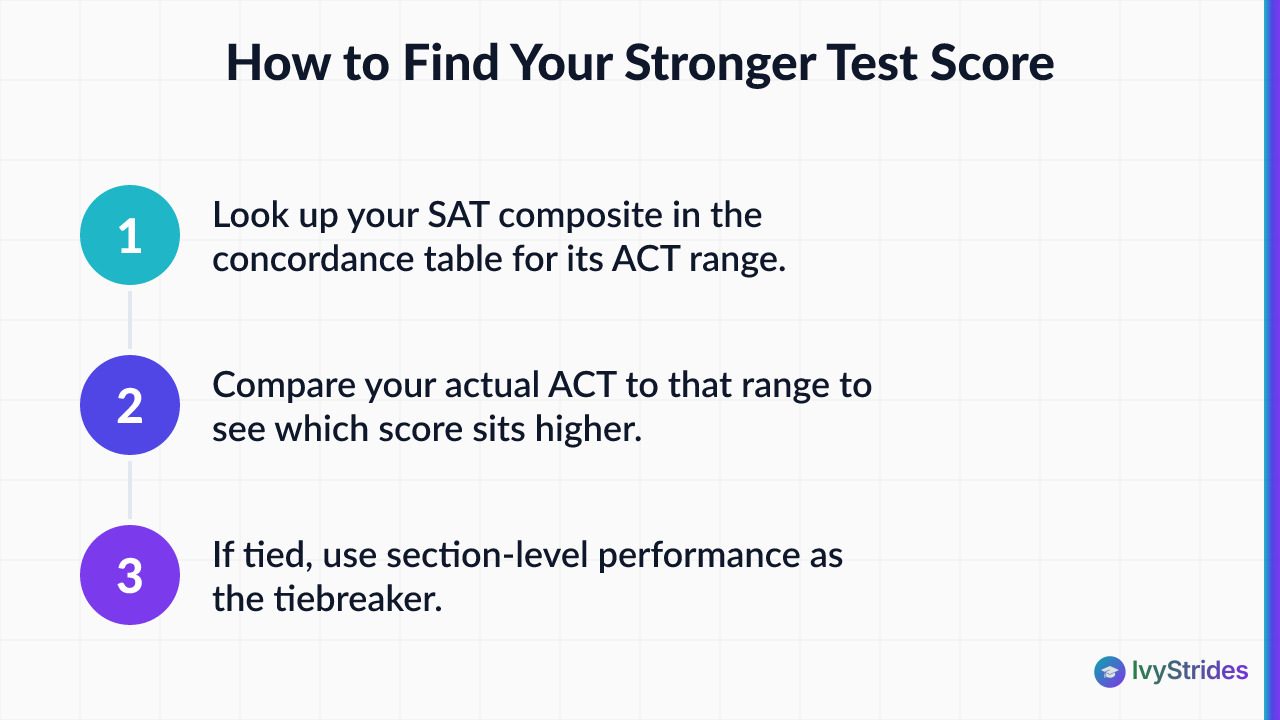
Here's the process we walk students through in 1-on-1 sessions.
Step 1. Look up your SAT composite in the concordance table and find the concordant ACT range.
Step 2. Compare your actual ACT composite to that range. If your ACT sits above the concordant ACT for your SAT, your ACT is relatively stronger. If it sits below, your SAT is stronger. If they sit in the same band, neither is definitively stronger.
Step 3. When scores land in the same band, look at section-level performance. The section where you have the most room to grow, and the most fluency in the underlying format, is the tiebreaker.
Worked examples on the most common pairings:
- 1450 SAT vs. 33 ACT. Same concordant band (1450-1480 = 33). Neither is stronger on paper. Decide based on section-level room to improve.
- 1430 SAT vs. 32 ACT. Same concordant band (1420-1440 = 32). Equivalent. Same tiebreaker logic.
- 1540 SAT vs. 34 ACT. The 1540 sits above the concordant range for a 34 (1490-1520), which puts it one band up, closer to a 35 (1530-1560). Submit the 1540.
- 1420 SAT vs. 29 ACT. The 1420 concords with a 32 ACT. The 29 concords with 1330-1350 SAT. The SAT is meaningfully stronger here, by roughly three ACT points. Submit the SAT.
One more variable: superscoring. If a college superscores the SAT and you've taken it more than once, your effective SAT composite may be higher than any single sitting. Check each school's superscore policy on their admissions page or Common Data Set.
In our coaching, students who run a diagnostic on both tests before choosing a prep path typically avoid roughly 8-12 weeks of misdirected effort on the wrong exam. That single decision, made from data instead of gut feel, is often what separates a typical 200-point SAT gain from a stalled retake cycle. If you're at this decision point, our 1-on-1 SAT prep page walks through the SAT diagnostic path. Our act practice test online library gives you the ACT-side diagnostic materials. For structured prep beyond the diagnostic, see our SAT study plan framework.
Should You Submit Your SAT Score, Your ACT Score, or Both?
Three scenarios cover almost every student.
Scenario 1: One score is clearly concordantly stronger. Submit that score. "Clearly stronger" means at least one full ACT point or roughly 30-40 SAT points above the concordant range for the other. Sending the weaker score alongside it adds nothing and gives an admissions reader a lower data point.
Scenario 2: Scores are in the same concordant band. Submit both. Most colleges that require scores accept both and don't penalize students for submitting both. Consistency across two different test formats is a mild positive signal.
Scenario 3: Test-optional school. The question shifts. Now you're deciding whether to submit any score at all. At test-optional schools (verify current status via the FairTest tracker), the decision of whether to submit takes priority over which to submit. A score below the school's 25th percentile in its published range typically hurts more than no score. In our coaching, students who submit a score below a school's 25th percentile range often weaken their application even at test-optional schools.
Caveats worth stating plainly: test-optional policies vary by school and by admissions cycle. Verify each school's current policy on its official admissions page, and cross-check the 25th-75th percentile range on the school's most recent Common Data Set. For the mechanics of sending scores, see how to send SAT scores to colleges. If your target is on the ACT side, 1-on-1 ACT prep is where we build score-to-target roadmaps. And if you're wondering how a 1540 lands at top schools specifically, we cover is 1540 a good SAT score with the percentile context.
Once you've locked in the stronger score, redirect that prep energy toward the college admissions essay, which carries significant weight at selective schools and can move an application further than the marginal 20 SAT points a fourth retake might buy.
How to Use Concordance to Decide Which Test to Prep For

If you haven't taken both tests yet, concordance is still useful. It turns two practice tests into a fair comparison.
The workflow: sit one full-length official practice SAT and one full-length official practice ACT within a week of each other, timed and under real conditions. Score both. Convert both to a common scale using the concordance table. The test where you land higher on the concordant scale is your starting-advantage test.
Section-level analysis sharpens the call. Students who score relatively higher on ACT Science and Reading than on SAT R&W Module 2 often find the ACT a better fit, because ACT Reading rewards fast passage triage and ACT Science rewards data-graph fluency. Both are more trainable in short timelines than SAT R&W Module 2 inference questions. On the flip side, students who thrive on longer per-question time and dislike ACT pacing pressure typically gain faster on the Digital SAT.
Timeline matters too. If you have roughly 10-12 weeks before your target test date, splitting prep across both tests almost always produces weaker results than focusing on one. Pick a lane. In our coaching with students in the 1200-1350 SAT / 25-29 ACT band, a diagnostic comparison before choosing a test typically saves roughly 6-8 weeks of misdirected prep.
If your concordant ACT score is stronger than your current SAT score, that gap is a signal worth investigating with a diagnostic SAT practice test before committing to more SAT prep. Students who find their ACT composite consistently outpaces their concordant SAT score on practice tests often benefit from doubling down on ACT-specific section work rather than splitting prep time across both exams.
Start with our Official SAT practice tests library. Pair that with the score-band pathways in how to raise your SAT score 200 points. For families weighing timeline questions, when should my child start ACT prep covers the planning side.
Concordance for High-Score Bands: 32, 33, 34, 35, and 36 ACT
At the top of the scale, the concordant ranges compress. A single ACT point covers a 30-point SAT range, and the difference between "same score" and "one band higher" is smaller than most students think.
- 36 ACT = 1570-1600 SAT. A perfect 36 ACT concords with a range that includes the perfect 1600 SAT, but also a 1570. Both are ceiling scores in admissions terms.
- 35 ACT = 1530-1560 SAT. A 1540 SAT and a 35 ACT are concordant. Neither is functionally stronger.
- 34 ACT = 1490-1520 SAT. A 1490 SAT and a 34 ACT sit in the same band. A 1520 SAT sits at the top of that band, marginally stronger in relative terms but not in admissions impact.
- 33 ACT = 1450-1480 SAT. A 1450 and a 33 are concordant.
- 32 ACT = 1420-1440 SAT. A 1430 and a 32 are concordant.
At this level, admissions offices at the most selective schools treat concordant scores as equivalent. MIT SAT requirements show a middle-50% SAT range around 1510-1580 in recent cycles. Stanford superscore SAT practices show a middle-50% range around 1500-1570. A 34 ACT and a 1500 SAT both land inside those ranges. Neither is going to be the reason an application succeeds or fails on the score front.
Practical rule for high scorers: if you have both scores and one sits at the ceiling of its concordant band while the other sits at the floor of the equivalent band, the ceiling score reads slightly stronger. Otherwise, they're equivalent and section-level performance is the tiebreaker.
Concordance for Mid-Range Scores: 24 Through 31 ACT
This band is where most retake and switch-test decisions get made. The mid-range concordant pairs:
- 31 ACT = 1390-1410 SAT.
- 30 ACT = 1360-1380 SAT.
- 29 ACT = 1330-1350 SAT. A 1350 and a 29 are concordant; neither is definitively stronger.
- 28 ACT = 1290-1320 SAT.
- 27 ACT = 1250-1280 SAT. A student searching "what does a 27 ACT convert to SAT" should expect the 1250-1280 range.
- 26 ACT = 1210-1240 SAT.
- 25 ACT = 1180-1200 SAT.
- 24 ACT = 1140-1170 SAT.
In this band, section-level performance carries more weight than concordance. Students who struggle with ACT Science timing but perform well on SAT Math tend to gain faster on the SAT. Students who read quickly but freeze on SAT R&W Module 2 inference questions often break through faster on ACT English and Reading. The concordance table tells you where you are; section diagnostics tell you where you'll gain fastest.
In our coaching with students in the 1200-1350 SAT band, targeted work on SAT Math Module 2 and R&W Module 2 question types typically produces the fastest score gains. For self-directed prep, our SAT math prep guide covers the Module 2 question archetypes. Our sat resource sheet collects the free official materials worth using.
A Note on the 2026 Concordance Tables: What Has and Has Not Changed
Honestly, this is the caveat everyone glosses over.
The official concordance tables were released in 2018. As of publication, neither College Board nor ACT, Inc. has published updated tables reflecting the two big format changes since. Here's what's changed and what it means.
Digital SAT (March 2024 forward). The Digital SAT is an adaptive two-module test on the 400-1600 scale. Section 1 is Reading and Writing, split into Module 1 (mixed difficulty) and Module 2 (difficulty determined by Module 1 performance). Section 2 is Math with the same adaptive structure. The 2018 tables were built on the paper-based SAT, which was linear. Percentile distributions have shifted modestly under the new format, though not enough to invalidate the 2018 tables for practical use.
2025 Enhanced ACT. The Enhanced ACT is a shorter test with more time per question. Science moved out of the required composite in some configurations, changing what "ACT composite" means. ACT, Inc. hasn't republished the concordance tables.
Practical guidance for 2026: use the 2018 tables. They're still the official reference and admissions offices still rely on them. Treat concordant ranges as approximate, especially at band boundaries and especially post-format-change. Verify at satsuite.collegeboard.org and act.org before trusting any third-party site claiming to have "updated" concordance data.
If you're an international applicant navigating this landscape, ACT fees for international students covers the registration side.
FAQ
Is a 33 ACT the same as a 1480 SAT?
According to the official 2018 concordance tables, a 33 ACT is concordant with a 1450-1480 SAT range. A 1480 sits at the top of that band, so the two scores represent similar relative performance. Both land at roughly the 99th percentile nationally. Neither is definitively stronger, and admissions offices treat them as equivalent.
Should I submit both my SAT and ACT scores to colleges?
Most colleges that require standardized test scores accept both and don't penalize applicants for submitting both. If one score is concordantly stronger by at least one ACT point or roughly 30-40 SAT points, lead with that one. If both scores fall in the same concordant band, submitting both can demonstrate consistency across formats. Always verify the specific school's policy on its admissions page or Common Data Set, and note that test-optional policies vary by school and admissions year.
Can I use the concordance table to convert a 2400-scale SAT score to an ACT score?
The current official concordance tables are built on the 1600-scale SAT (introduced in 2016) and don't directly map old 2400-scale SAT scores to ACT composites. If you have an old 2400-scale score, you'd first convert it to the 1600 scale using College Board's official conversion chart, then apply the concordance table. Third-party sites that show direct 2400-to-ACT conversions are using unofficial methodology.
How do colleges actually use concordance tables when reviewing applications?
Admissions offices use concordance tables to place SAT and ACT scores on a comparable scale when reviewing applicants who submitted different tests. The tables aren't applied as strict cutoffs; they're a reference for understanding relative performance. A 34 ACT and a 1490-1520 SAT are treated as roughly equivalent. The tables also inform how schools report their 25th-75th percentile score ranges in Common Data Sets, which is why those ranges often line up neatly between the two tests.
Is a 35 ACT better than a 1540 SAT?
A 35 ACT is concordant with a 1530-1560 SAT range. A 1540 SAT sits inside that band, so the two scores represent similar relative performance. Both are competitive at highly selective schools. If pressed, the 35 ACT sits at the upper end of the concordant range for a 1540 SAT, making it marginally stronger in relative terms, but the practical difference in admissions is minimal.
Where can I download the official SAT to ACT concordance PDF?
The official concordance tables PDF is available directly from ACT, Inc. (search "ACT SAT Concordance Tables PDF"). College Board also links to the tables on its SAT-ACT comparison page. Download from these primary sources rather than third-party sites to ensure you're using the current official version.
Where This Leaves You
Concordance answers a narrow question: how do these two scores compare on a common scale. It doesn't tell you which test to prep for, whether to retake, or how to allocate the next 10 weeks. That's a diagnostic-and-strategy question, and it's the one we solve on the strategy call.

Award-winning author (South Asian Book Award) and graduate of BITS Pilani and UCLA Luskin School of Public Affairs. Brings a published writer's eye to Common App essays and grammatical precision to SAT and ACT R&W instruction.