
What Happens in a First College Counseling Session? What to Bring and What to Ask
On this page
- What Happens in a First College Counseling Session, Step by Step
- Typical Agenda for a First College Counseling Session
- What to Bring to Your First College Counseling Session
- First College Counseling Session: What to Bring
- What Good Questions to Ask a College Counselor Actually Cover
- High-Value Questions to Ask in Your First College Counseling Session
- When Should You Start College Counseling, and Does Grade Level Change the Session?
- First College Counseling Session Focus by Grade Level
- FAQ: First College Counseling Session Questions
- When should you start college counseling?
- What are good questions to ask a college counselor?
- How do I address a college counselor?
- What should I bring to a first college counseling appointment?
- Your Next Step Before the Session
A first college counseling session is an intake meeting where the counselor reviews your transcript, test scores, extracurricular list, and target schools, then maps a preliminary roadmap. Bring an unofficial transcript, any SAT or ACT score reports, a rough activity list, and a short college list.
Those four inputs are what let a counselor give you specifics instead of general advice. The session is also your chance to check the counselor: sound advice is built from your documents, ends in dated next steps, and never promises admission. The harder question is what you ask once the review is done, because that is what turns orientation into planning.
What Happens in a First College Counseling Session, Step by Step

Photo by World Sikh Organization of Canada on Pexels
A first college counseling session is a structured intake meeting, not a generic information talk. Expect it to open with your academic profile: your unofficial transcript, your current GPA, and your course rigor across AP, IB, or honors classes.
From there the agenda moves to numbers. The counselor benchmarks any SAT or ACT scores you have against the 25th-75th percentile range at the schools you are eyeing. NCES College Navigator lists those percentiles per school for the SAT sections and the ACT, and a college's Common Data Set, where it publishes one, adds the total SAT range in item C9. Both describe enrolled first-time students who submitted a score, not admitted students, and they only matter where a school actually uses scores. Test-optional policies vary by school and year, so the benchmark is a planning signal, not a cutoff.
The extracurricular audit comes next. The counselor looks for a through-line, a spike, rather than a long flat list of clubs. Then comes preliminary college list scoping: sorting candidate schools into reach, target, and likely schools against your profile as it stands today.
Course rigor weighs alongside GPA, because colleges read your course choices against what your school offered, not against a national standard. A counselor flags a thin junior-year schedule early, while you can still fix it.
The output is the point. You should leave with a preliminary roadmap and agreed next steps, written down, not a vague sense that things went well.
Typical Agenda for a First College Counseling Session
-
Academic profile review: unofficial transcript, GPA, course rigor.
-
Test score benchmark against target-school percentile ranges.
-
Extracurricular audit: looking for a spike, not a list.
-
Preliminary college list scoping into reach, target, and likely schools.
-
Intended major and any geographic or financial constraints.
-
Agreed next steps and a written preliminary roadmap.
Remember that admissions outcomes depend on the full application, not any single element on that agenda.
What to Bring to Your First College Counseling Session
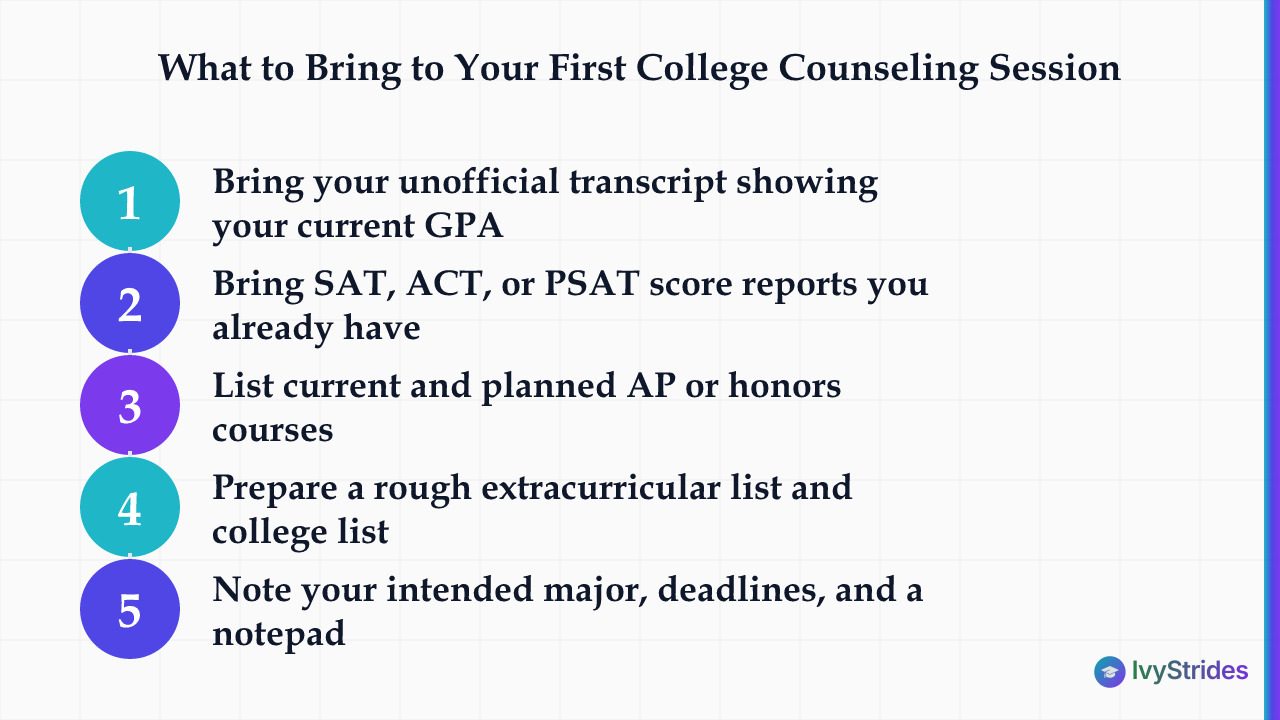
Bring real documents to a first college counseling session: the counselor's review only works from them, so the preliminary roadmap you leave with is only as good as what you put on the table.
Your unofficial transcript is the starting point. The GPA printed on it may look different once a college applies its own recalculation formula to the same transcript.
Daily SAT and ACT prep on YouTube: short strategy videos from IvyStrides. Subscribe to IvyStrides on YouTube.
Bring your SAT, ACT, or PSAT score reports too. The SAT total runs on a 400-1600 scale and the PSAT/NMSQT total runs 320-1520, per College Board's score guide. Your score report lets the counselor check whether your current score sits inside each target school's range and flag whether a retake belongs on the plan. Again: test-optional policies vary by school and year.
Course rigor counts alongside grades. Bring a list of your current and planned AP or honors courses. The College Board's AP Program says AP on a high school transcript shows colleges you are motivated to succeed, and a counselor will ask whether your schedule is ambitious for what your school offers.
First College Counseling Session: What to Bring
- Unofficial transcript with current GPA
- SAT, ACT, or PSAT score reports (any you have)
- List of current and planned AP or honors courses
- A rough extracurricular activity list, newest and most serious first
- A short, even messy, college list
- Your intended major or two or three areas of interest
- Any application deadlines you already know
- A notepad for the roadmap and next steps
A rough college list beats no list. Even three schools gives the counselor something to scope into reach, target, and likely buckets.
What Good Questions to Ask a College Counselor Actually Cover
The best questions to ask a college counselor ask for specifics, because generic questions produce generic advice. "What should I do to get into a good school?" earns a shrug. "Given my 3.7 GPA and this score, which of my target schools are realistic reaches?" earns a plan.
Once the counselor has reviewed your profile, your questions should pull a concrete next step out of every topic area, and the timeline question should get dated answers. A dated answer looks like the month-by-month plan behind IvyStrides' college counseling from 9th grade to the deposit deadline: a PSAT baseline and then the SAT-or-ACT decision in grade 10; all testing finished by March of grade 11, recommendations requested in May, and the college list started in June; the personal statement finished by mid-September of grade 12.
High-Value Questions to Ask in Your First College Counseling Session
| Topic area | Question to ask | What it surfaces |
| College list | Which of my targets are reaches at my current profile? | A realistic reach, target, and likely split |
| Test scores | Does a retake belong on my plan this year? | Whether to test again, or apply without scores where a school allows it |
| Timeline | When do I start each application component? | A dated admissions timeline |
| Essays | When should I begin the Common App personal statement? | Essay priority and sequencing |
| Extracurriculars | Where is my biggest strength, and biggest gap? | What to build before senior year |
| Early rounds | Am I a candidate for Early Decision or Early Action? | Whether to apply early, and whether a binding plan fits |
| Next step | What is the one thing I do before we meet again? | A concrete, single action item |
On essays: the Common App kept its seven essay prompts unchanged for 2026-27, its instructions cap the personal essay at 650 words, and the application reaches more than 1,200 member colleges. If the counselor flags the personal statement as a near-term priority, choosing a topic and shaping a first draft moves to the top of your list.
On early rounds: Early Decision is binding and Early Action is not, so settle how the early rounds differ before the counselor writes either one into your timeline.
When Should You Start College Counseling, and Does Grade Level Change the Session?
Starting college counseling in 9th or 10th grade leaves the most room to plan, and yes, the first session agenda shifts by grade. The earlier you start, the more of your record is still unwritten and still changeable.
Because course rigor and extracurricular choices drive so much of the first-session agenda, grade level decides what the counselor can actually influence. A 9th grader is planning courses; a 12th grader is sequencing deadlines. Starting in 9th grade is not too early, because the record colleges read begins with freshman year courses and grades.
First College Counseling Session Focus by Grade Level
| Grade | Primary session focus | Key output |
| 9th | Course selection, early extracurricular direction | A rigor and activities plan |
| 10th | PSAT baseline, AP course planning, draft college list | Testing and course roadmap |
| 11th | Test strategy, college list, essay timeline | A dated admissions timeline |
| 12th | Deadline sequencing, essay completion, final list | A submission schedule |
IvyStrides' reading of College Board's PSAT/NMSQT rules puts the testing plan in the sophomore session. College Board offers the test to 10th and 11th graders and counts it toward National Merit for 11th graders only, so a 10th-grade sitting works as a baseline and the 11th-grade sitting is the one National Merit uses. The junior session is then where scores, list, and essays finally line up.
By a senior-fall early deadline, the transcript a college reads holds final grades from three school years, 9th through 11th. A 9th-grade start can shape all three years of that record; a 12th-grade start can shape only the senior courses still in progress. For families who want that longer arc, college counseling that starts in grade 9 or 10 puts strategy, counseling, and essay coaching in one plan.
Starting late is still worth doing. A 12th-grade first session can't rebuild a transcript, but it can sequence deadlines, triage essays, and keep a scattered application on track. None of this guarantees admission, and a strong school counselor or a self-directed student can cover the same ground; the question is how much dedicated time you want on it.
FAQ: First College Counseling Session Questions
When should you start college counseling?
Starting in 9th or 10th grade leaves the most room, because course selection and extracurricular planning still have years to develop. An 11th-grade start still leaves room for test strategy and college list work. A first session in 12th grade can still help with application sequencing and essay priorities, though the planning window is shorter.
What are good questions to ask a college counselor?
Ask for specifics: which schools fit my profile at my current GPA and test score, whether a test retake belongs on the plan, when to start the Common App personal statement, and what the single most important action is before the next session. Generic questions produce generic answers, so anchor each one to your actual numbers.
How do I address a college counselor?
In private college counseling, first names are common. If you are unsure, ask at the start of the first session: "How would you like me to address you?" School guidance counselors are typically addressed as Mr. or Ms. followed by their last name. Either way, asking directly sets a professional tone.
What should I bring to a first college counseling appointment?
Bring your unofficial transcript, any SAT, ACT, or PSAT score reports, a list of your current AP or honors courses, a rough extracurricular activity list, and a short list of colleges you are considering. Having these ready lets the counselor give specific guidance rather than general advice.
Your Next Step Before the Session
A first college counseling session rewards preparation. Walk in with documents in hand and questions already written, so the session goes to planning rather than orienting.
- Pull your unofficial transcript and any score reports into one folder.
- List your AP or honors courses and your three or four most serious activities.
- Draft a rough college list, even if it is just a starting guess.
- Write five to seven specific questions, each tied to your real numbers.
- Decide how your family wants to leave the session: with a written roadmap and one clear next action.
College admissions insights on LinkedIn: follow IvyStrides for application guidance and counseling updates.

Rajesh is a technology leader, entrepreneur, and angel investor with 28+ years in Business & Technology Leadership and Product & Solution Engineering. He is passionate about education, mentoring, and driving digital transformation.