
First-Generation College Applicants: What Changes and Where to Get Real Help
On this page
- How to Know If You Qualify as a First-Generation College Applicant
- What First-Generation Status Means for Your Test Scores and AP Courses
- How the College Essay Works Differently for First-Generation Applicants
- Free and Paid Resources First-Generation Applicants Should Know About
- FAQ: First-Generation College Application Questions
- How do you know if you are a first-generation college student?
- Does being first-generation actually help your college application?
- What free resources exist specifically for first-generation college students?
- Are there scholarships specifically for first-generation college students?
A first-generation college applicant is a student whose parents did not complete a four-year bachelor's degree. The Common App and the federal Higher Education Act both use that test, and individual colleges write their own versions. The application itself is the same. The knowledge gaps are what change: deadlines, test strategy, essay framing, and financial aid all run on information that college-educated families often pass down informally.
That's fixable. The gaps are specific, and each one maps to a concrete kind of help: federal TRIO programs such as Upward Bound, fee waivers from the Common App, College Board, and ACT, your school counselor, the FAFSA, QuestBridge, and paid counseling or coaching if a family wants more.
How to Know If You Qualify as a First-Generation College Applicant
The Common App counts you as first-generation when neither parent has received a four-year bachelor's degree or higher. The federal definition in the Higher Education Act, which governs TRIO programs, uses the same test and adds one case: if you lived with and were supported by only one parent, only that parent's degree counts.
Colleges differ. Yale describes a first-generation student as someone whose parents or legal guardians did not attend college, a test based on attendance rather than a degree, while CU Boulder says you may identify as first-generation if your parents earned their degrees outside the United States.
On the Common App, the Family section usually does this work: you report each parent's education level, and your first-generation status comes from those entries. The Common App serves more than 1,200 colleges and universities for 2026-27, so one accurate entry reaches every member college on your list. It also matters for Common App Direct Admissions, where 234 participating colleges send proactive admission offers to first-generation and low- and middle-income students in 2026-27.
Edge cases trip people up, and each has its own answer.
| Your situation | Are you first-generation? | What to do on the Common App |
| Neither parent attended college | Yes | Report their actual highest level |
| A parent earned a bachelor's degree abroad | No on the Common App; possibly at some colleges, such as CU Boulder | Report the degree, then read each college's definition |
| A parent has an associate degree or some college | Yes on the Common App; no under Yale's test | Report the level they reached |
| An older sibling attended college, parents did not | Yes; parent education decides it | List siblings as the Family section asks |
First-generation status does not replace admission requirements or guarantee admission or financial aid, as ASU tells its applicants. It can open campus support once you enroll, such as TRIO Student Support Services. Parents who did not attend a US college can still play a real role, and helping with the college essay doesn't require having written one.
What First-Generation Status Means for Your Test Scores and AP Courses
First-generation status sits inside holistic review as one piece of context, not a score multiplier, and colleges weigh it differently. In item C7 of their 2025-26 Common Data Sets, the University of Michigan rates first generation "Important" and Georgia Tech marks it "Not Considered". A strong SAT or ACT score matters for a plainer reason: it reads the same at every college that considers scores, regardless of your school's resources.
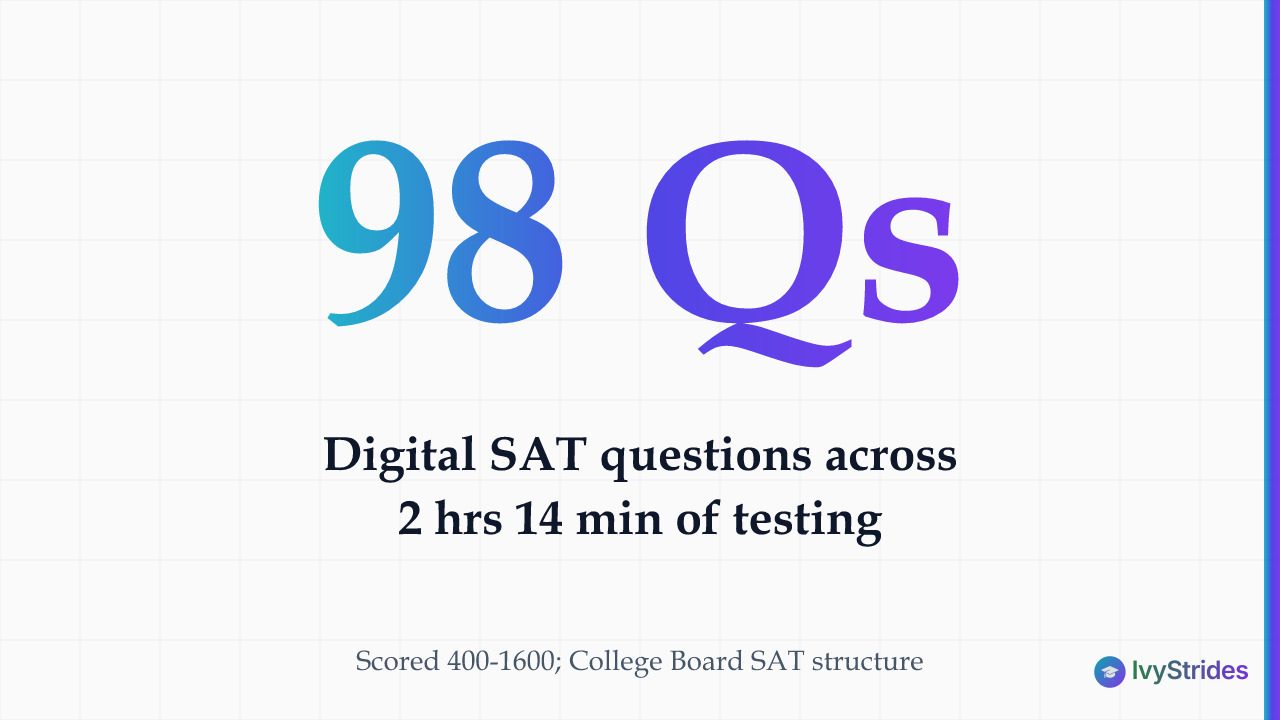
Know the format cold. The Digital SAT runs 98 questions across 2 hours 14 minutes of testing, scored 400 to 1600. The Enhanced ACT core, English, Math, and Reading, is 131 questions in 125 minutes, and the composite averages only those three sections.
| Signal | Why it matters for first-gen applicants | Where to start |
| SAT or ACT score | Reads the same at every college that considers scores | A timed full-length practice test |
| AP courses | Shows rigor even at under-resourced schools | One or two APs in your strongest subjects |
| Fee waivers | Cover test registration for eligible low-income students in grades 11 and 12 | Your high school counselor |
Test-optional is not test-irrelevant. Test policies vary by school and year, so read each college's current policy for fall 2027 entry before deciding. At a test-optional school, a score in the upper half of the published middle 50% range for enrolled students who submitted one, or above it, is usually worth sending, and whether a retake would get you there is a separate decision.
Test fee waivers run on financial need, not parent education. College Board offers SAT fee waivers to low-income 11th and 12th graders, and your school counselor is where to start for ACT fee waivers. If your school offers few AP courses, you can still build a rigorous record through AP classes taken online. AP credit policies vary by college, so check before counting on placement.
How the College Essay Works Differently for First-Generation Applicants
The Common App personal statement is one of the few places in the application where a first-generation background can be framed on your own terms. It runs 250 to 650 words, with seven prompts unchanged for 2026-27.
Daily SAT and ACT prep on YouTube: short strategy videos from IvyStrides. Subscribe to IvyStrides on YouTube.
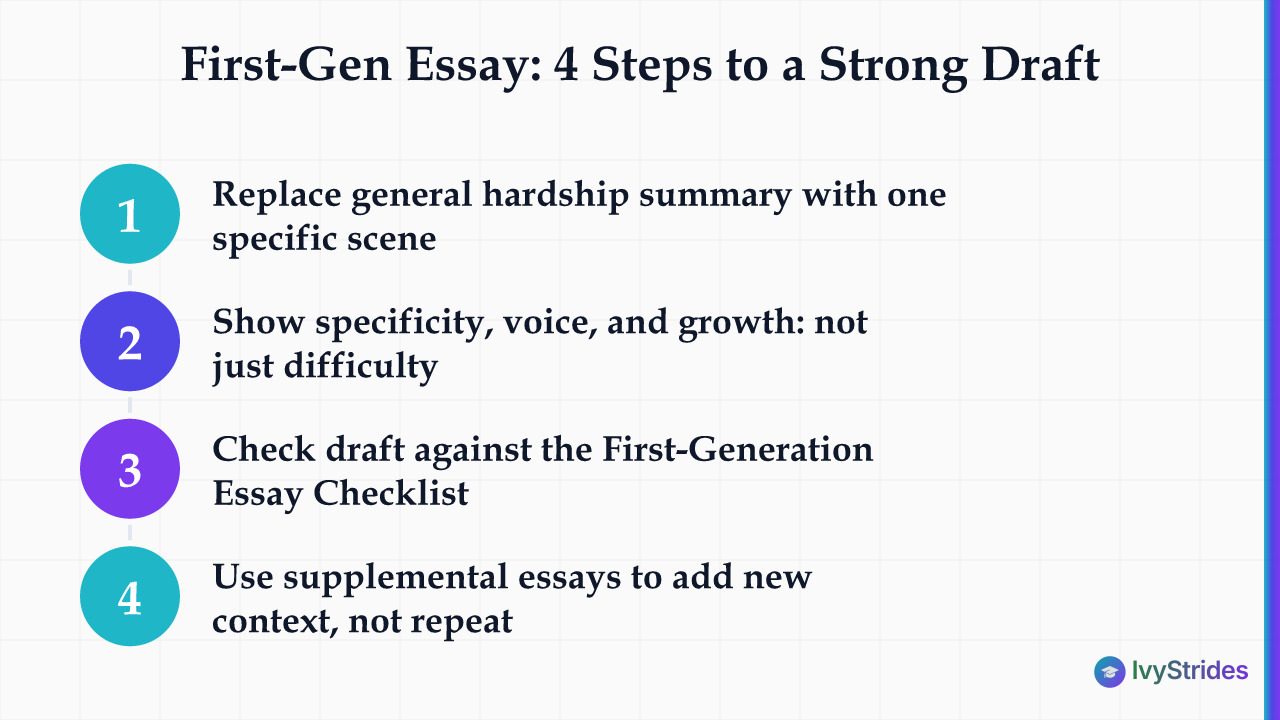
The common mistake is predictable. A common weakness in first-generation drafts is a general hardship narrative where a concrete scene should be. A first-generation background is not automatically a compelling topic; the craft of making an ordinary topic compelling in your personal statement is what separates a strong draft from a flat one.
Three qualities do the work: specificity, voice, and growth. Give the reader the scene, not the summary, and show how you think, not how hard things were.
First-Generation Essay Checklist: Before You Submit
- Does the essay show one specific scene, not a general summary of hardship?
- Does it end on growth or insight, not on sympathy?
- Does it sound like you out loud, not like an admissions template?
- Have you stayed within the 250 to 650 words?
- Does any supplemental essay add new context rather than repeating the personal statement?
Supplemental essays can also carry first-generation context, because a "why us" prompt lets you connect your background to a specific program. An experienced reader can spot where a story is undersold and where it's over-explained, and that's the work behind college essay coaching for the Common App and supplemental essays.
Free and Paid Resources First-Generation Applicants Should Know About
Free help comes first, and TRIO programs are the anchor. The US Department of Education's TRIO programs serve low-income individuals, first-generation college students, and individuals with disabilities. Upward Bound serves high school students from low-income families or families where neither parent holds a bachelor's degree, and every project must provide academic tutoring, course advice, and help with college entrance exams, admission applications, and the FAFSA.
To join, you must be eligible and accepted into a funded project that serves your school or area, so ask your counselor which projects run near you.
| Resource | What it covers | Cost | Best for |
| TRIO / Upward Bound | Tutoring, course advice, test prep, application and FAFSA help | Free | Eligible students served by a funded project |
| Common App fee waiver | Application fees at colleges that accept it | Free | Students who meet a need-based qualification |
| QuestBridge | College Prep Scholars for juniors; National College Match for seniors | Free to apply | High-achieving students from low-income backgrounds |
| High school counselor | Transcripts, deadlines, local referrals | Free | Every student |
| FAFSA | Federal, state, and college aid consideration | Free to file | Every family seeking aid |
| College admissions counseling | College list, timeline, essay strategy, grades 9-12 | Paid | Families wanting a full roadmap |
| Essay and test-prep coaching | Personal statement, supplements, SAT/ACT | Paid | Students closing a specific gap |
The Common App fee waiver depends on need, not first-generation status. Qualifications include free or reduced-price lunch, an SAT or ACT fee waiver, family income, public assistance, or a low-income program such as TRIO, and your counselor is asked to confirm it. Some colleges run their own waivers, and Bowdoin automatically waives its fee for first-generation applicants.
The FAFSA is a parallel process with state and college deadlines of its own, and some aid is limited, so file early. The 2027-28 form opened on September 23, 2026, so seniors applying for fall 2027 entry can already file.
Where paid help earns its place. Free resources cover the mechanics. Professional counseling adds value when a family needs a single map of the whole thing.
With first-generation families, IvyStrides' college counselors can start by mapping every application deadline onto one calendar, because a missed deadline is among the most preventable gaps in a first-generation application. A counselor who starts early can build the course record, activity list, and testing timeline through grade-by-grade college counseling from 9th through 12th grade.
Before senior year, it helps to see the whole calendar in one place, laid out in the full college application timeline and when to write your essays. Timing matters for coaching too, and when to bring in a college essay coach depends on whether you want help choosing a topic or polishing a draft.
A first-generation family with no one to ask also needs a way to judge any professional before committing, so go in with specific questions for a college counselor about credentials, scope, and fees.
College admissions insights on LinkedIn: follow IvyStrides for application guidance and counseling updates.
Being first-generation changes what you know going in, not what you're capable of. Work through the gaps in order:
- Report parent education accurately, then read how each college on your list defines first-generation.
- Pick the two or three gaps most likely to affect you: test scores, essays, or financial aid.
- Ask your counselor about TRIO projects and SAT/ACT fee waivers.
- File the FAFSA in the fall of senior year, alongside your applications.
FAQ: First-Generation College Application Questions
How do you know if you are a first-generation college student?
You're first-generation on the Common App if neither parent has received a four-year bachelor's degree or higher, based on your Family section answers. The federal TRIO definition adds a one-parent rule. Colleges vary: Yale's test is whether parents attended college, and CU Boulder includes degrees earned abroad.
Does being first-generation actually help your college application?
First-generation status is one factor in holistic review at many colleges, but it does not guarantee admission or replace strong grades, test scores, and essays. A college's Common Data Set, item C7, shows how that college rates it. It can also bring Common App Direct Admissions offers.
What free resources exist specifically for first-generation college students?
The main free federal resources are TRIO programs, including Upward Bound, which run through funded projects at colleges, school districts, and nonprofits. The Common App, College Board, and ACT offer fee waivers based on financial need, not first-generation status. Your high school counselor covers transcripts, deadlines, and local referrals.
Are there scholarships specifically for first-generation college students?
Yes, at some colleges, such as CU Boulder's First Generation Scholarship. Federal Pell Grants work differently: they go to undergraduates with exceptional financial need, not by parent education, and you start with the FAFSA. Check each program's current rules and deadlines with the organization that awards it.

Hemant is a seasoned entrepreneur, investor, and growth strategist with deep ground in education and technology-driven learning. His core training is in Mathematics and Physics — he authored Physics for IB Diploma: Ultimate Revision Guide, recognized as a top student resource.