
College Admissions Consultant vs College Counselor: What Is the Difference?
On this page
- College Admissions Consultant vs School Counselor: The Core Difference
- What a College Admissions Consultant Does That Your School Counselor Cannot
- What a Private Admissions Consultant Typically Covers
- How to Decide Whether a College Admissions Consultant Is Worth It for Your Student
- How School Counselors and Private Consultants Work Together on College Applications
- FAQ: College Admissions Consultant vs Counselor
- Is a college admissions consultant worth it?
- What is the difference between a counselor and a consultant?
- What does a college admissions consultant do?
- Are college admissions counselors worth it?
- Your Next Step on Choosing Admissions Support
A school counselor is employed by your high school, splits their time across a caseload of students, and handles academic planning alongside college guidance. A private college admissions consultant is hired by the family and works one-on-one on application strategy, essays, and the college list. The two roles complement each other: the school counselor submits the official school forms, and the consultant adds optional depth.
That difference is the whole decision most families are trying to make. What matters is who employs the person, how many students they serve, and what they actually deliver.

College Admissions Consultant vs School Counselor: The Core Difference
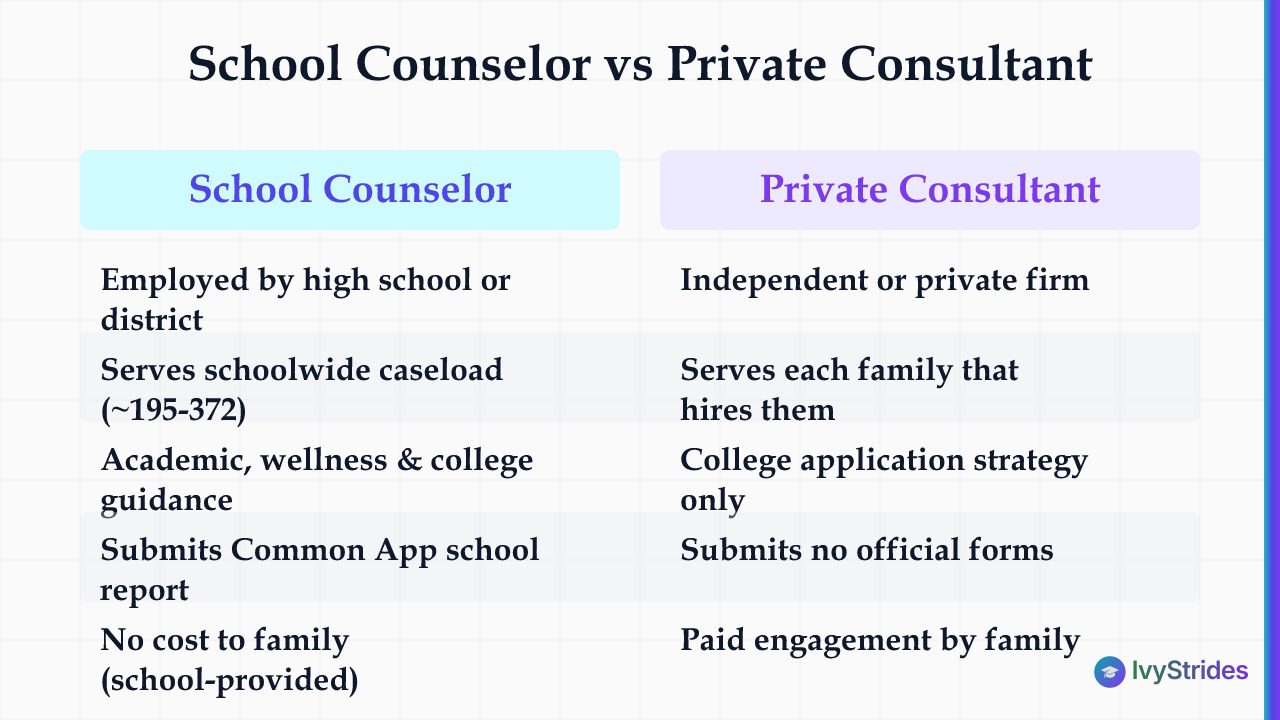
A school counselor is a school-employed professional who serves a caseload of students across the school and submits the official application paperwork. A college admissions consultant, by contrast, is a privately hired adviser who works one-on-one with a single student on application strategy. That is the core difference between a counselor and a consultant: employer, caseload, and scope.
The caseload gap is the real story. The American School Counselor Association's ratio report puts the national average at 372 students per school counselor for the 2024-2025 school year, the most recent year with data, against the 250-to-1 ratio it recommends. High schools run lower: from the 35 states that count high school counselors separately, ASCA estimates 195 to 224 students per counselor. College guidance is only one part of that job, which ASCA describes as supporting students' academic, career, and social/emotional development.
A private consultant is paid by the family, so the engagement is focused only on that student's college applications. That focus is what families are really paying for when they ask whether private college counselors are worth it.
| Factor | School Counselor | Private Admissions Consultant |
| Employer | The high school or district | Independent or a private firm |
| Students served | A schoolwide caseload | Each family that hires them |
| Primary focus | Academic planning, wellness, college guidance | College application strategy only |
| Common App school report | Submits it | Submits no forms |
| Counselor recommendation | Writes it | No official role |
| Cost to family | None (school-provided) | Paid engagement |
| Time per student | Limited | Dedicated |
Note the fourth row. Common App defines the school report as a form submitted by the high school counselor, and a private consultant the student adds in Common App's advisor role can follow the application's progress but does not submit any forms on the student's behalf. That alone tells you the two roles are not substitutes. If you are weighing private support, go into the first consultation prepared: knowing what to bring and what to ask in a first counseling session lets you test an adviser's approach before you sign anything.
The National Association for College Admission Counseling's Guide to Ethical Practice in College Admission gives the private role its formal name: independent educational consultants or counselors are professionals who work on a fee-for-service basis for students and families in the college selection and application process. The same guide's definition of counselors covers both school counselors and independent educational consultants, so a title alone tells you little.
What a College Admissions Consultant Does That Your School Counselor Cannot
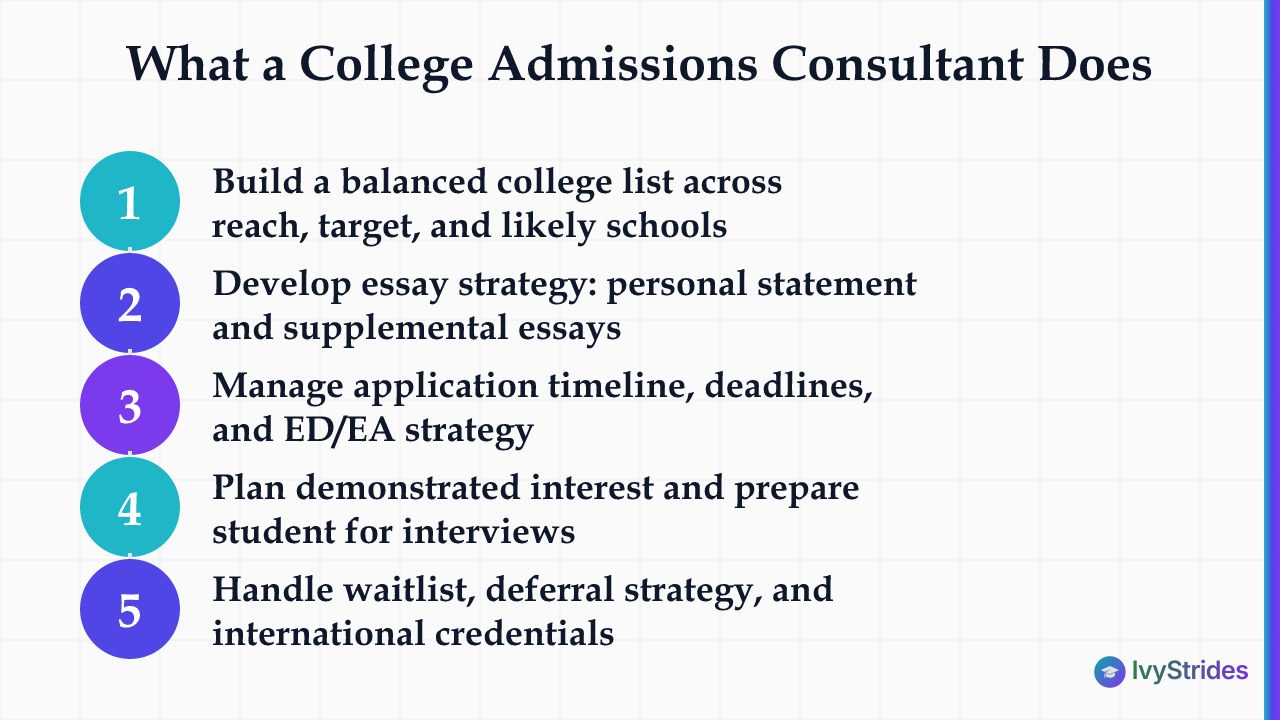
A college admissions consultant builds the student's college list, develops essay strategy, manages the application timeline, prepares the student for interviews, and advises on early decision and early action choices. These are the deliverables a school counselor, stretched across a full caseload, has little time to develop one-on-one. The caseload gap from the section above is exactly what this individualized work fills. Whoever builds the list, each college's admission rate and net price can be checked on NCES College Navigator.
Essay strategy is where the hours go. It is one of the most time-intensive parts of a private consultant's work. The Common App personal essay has a 650-word limit, students choose from seven prompts that Common App kept unchanged for 2026-2027, and many colleges add supplemental essays of their own.
Much of that time goes into the stage before drafting: choosing which story the personal statement tells and which supplements carry the rest, so each essay adds something the others do not.
What a Private Admissions Consultant Typically Covers
- College list building, balanced across reach, target, and likely schools
- Common App personal statement strategy and revision
- Supplemental essays for each college on the list
- Application timeline and deadline management
- Early decision and early action strategy
- Demonstrated interest planning
- Interview preparation
- Waitlist and deferral strategy
Watch the method, then try it: IvyStrides explains SAT and ACT question types on YouTube.
A consultant can also help with the extra layers facing applicants from outside the US, including international transcripts and credential evaluation, which a school counselor with a full caseload may have little time to work through.
What a consultant cannot do matters just as much. Even students working with a private consultant still need their school counselor to submit the Common App school report, so the two relationships run in parallel. A consultant also cannot sway an admissions office, write the counselor recommendation, or promise a result. For families aiming at the most selective colleges, what an Ivy-focused consultant can and cannot change is the first thing to pin down when vetting one. Admissions outcomes depend on the full application, not any single service.
How to Decide Whether a College Admissions Consultant Is Worth It for Your Student
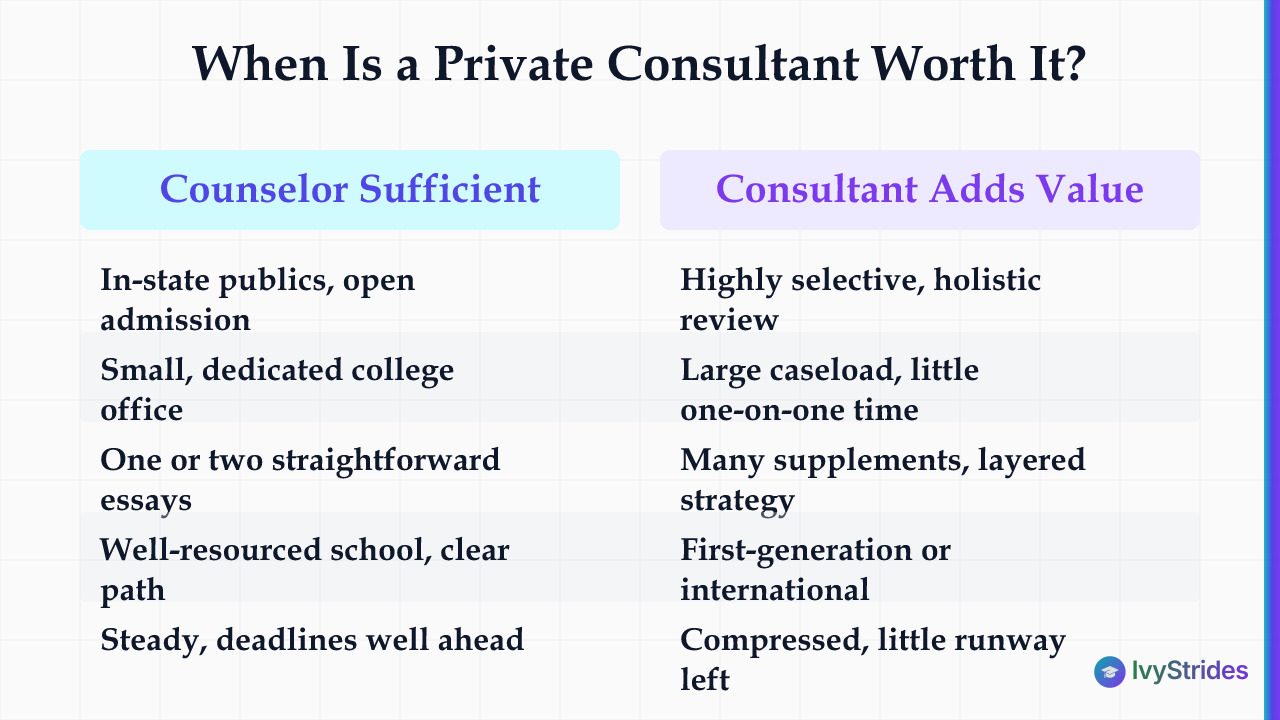
A private college admissions consultant is worth it when the student is targeting highly selective schools, the school counselor's bandwidth is stretched thin, or the application demands a nuanced essay and timeline strategy. It is not worth it for every family. The signals that point toward private support are concrete, and they build directly on the caseload and deliverable differences above.
| Your Situation | School Counselor Likely Sufficient | Private Consultant Adds Clear Value |
| Target schools | In-state publics, open admission | Highly selective, holistic review |
| Counselor caseload | Small, dedicated college office | Large caseload, little one-on-one time |
| Essay complexity | One or two straightforward essays | Many supplements, layered strategy |
| Applicant profile | Well-resourced school, clear path | First-generation or international |
| Timeline | Steady, deadlines well ahead | Compressed, little runway left |
Start early if you start at all. Support that begins in 9th or 10th grade has time to shape course choices and activities while they can still change; support that begins in 12th grade mostly works with the record that already exists. The right entry point depends on the grade and how much runway remains.
IvyStrides builds its college admissions counseling around that runway: a month-by-month plan from the summer before 9th grade to the deposit deadline that covers courses, activities, testing, the college list and the essays.
Two caveats hold regardless of which path you choose. Testing policies change by school and by year: Princeton remains test-optional for students entering in fall 2027 and will require the SAT or ACT for fall 2028 entry, so a testing plan still matters even where scores are optional. And no adviser, school or private, can substitute for genuine grades, rigor, and extracurricular depth, or promise an admission decision.
How School Counselors and Private Consultants Work Together on College Applications
School counselors and private consultants work together by dividing the application cleanly: the counselor owns the official school documents, the consultant owns strategy and essays, and the student owns the work. That division resolves the either/or framing many families arrive with: you are not choosing one role at the expense of the other.
The school counselor submits the Common App school report, with the official transcript as part of it, and writes the counselor recommendation. No private consultant can do either.
| Application Task | School Counselor | Private Consultant | Student |
| Common App school report | Completes | No role | Provides info |
| Counselor recommendation | Writes | No role | Builds relationship |
| Transcript submission | Sends | No role | Reviews accuracy |
| College list | Suggests | Builds and refines | Approves |
| Essay strategy | Limited time | Leads | Writes |
| Timeline management | Deadlines only | Full calendar | Executes |
| Interview prep | Rarely | Leads | Practices |
| Demonstrated interest | No role | Advises | Acts |
Homeschooled students, and international students whose schools have no designated counselor, face an extra step in getting the school report submitted without a counselor. For everyone else, put the counselor's submission dates and the consultant's essay milestones on one shared calendar so neither side is caught short before a deadline.
Essays are the heaviest item in the consultant's column, and IvyStrides' one-on-one essay coaching keeps the same division: the student drafts, and a coach reads every draft of the personal statement and supplements, from the first brainstorm to the final polish. Run both relationships in parallel and the application stays coherent. Admissions outcomes still depend on the full application, not any single adviser.
FAQ: College Admissions Consultant vs Counselor
Is a college admissions consultant worth it?
Private support adds the most value when a student is targeting selective schools, their school counselor carries a large caseload, or the application requires a nuanced essay strategy. For students at well-resourced schools with strong counseling programs and straightforward college lists, school counselor support may be sufficient. Admissions outcomes depend on the full application.
What is the difference between a counselor and a consultant?
A school counselor is employed by the high school, serves a caseload of students, and is responsible for official application documents including the Common App school report. A private admissions consultant works one-on-one with a student on strategy, essays, and the college list. Private advisers use either title; NACAC calls them independent educational consultants or counselors.
What does a college admissions consultant do?
A private consultant builds the student's college list, develops essay strategy for the personal statement and supplementals, manages the application timeline, prepares the student for interviews, and advises on early decision and early action choices. They do not submit the Common App school report, which remains the school counselor's responsibility.
Are college admissions counselors worth it?
Private admissions counselors are most worth it for students targeting highly selective schools, navigating complex essay requirements, or applying from international or under-resourced schools. They are not a substitute for strong grades, rigorous coursework, and genuine extracurricular depth.
Your Next Step on Choosing Admissions Support
The choice is not consultant or counselor. It is whether your student's situation warrants adding individualized strategy on top of the school support they already have.
- Confirm your school counselor's caseload and how much college guidance time that leaves.
- Match your student's target schools against their essay and timeline complexity.
- Decide which grade is the right entry point, earlier for selective targets.
- Keep both relationships running in parallel; the school report stays with the counselor.
College admissions insights on LinkedIn: follow IvyStrides for application guidance and counseling updates.

Rajesh is a technology leader, entrepreneur, and angel investor with 28+ years in Business & Technology Leadership and Product & Solution Engineering. He is passionate about education, mentoring, and driving digital transformation.