
How to Write a Standout Personal Statement in 2026 (Step-by-Step)
On this page
- What a Personal Statement Actually Does in a College Application
- How to Find a Topic Worth Writing About (Brainstorming That Actually Works)
- How to Start Your Personal Statement: Opening Lines That Pull Readers In
- The Structure of a Strong Personal Statement (From First Draft to Final Version)
- Common Personal Statement Mistakes That Admissions Readers Notice Immediately
- Revise, Read Aloud, and Get a Second Opinion
- Your Personal Statement Timeline for the 2026 Application Cycle
- FAQ
- How do you start a personal statement when you have no idea what to write about?
- What is the 650-word rule for the Common App personal statement?
- Can I use AI to write my personal statement?
- What is the difference between a personal statement and supplemental essays?
- Does a strong personal statement guarantee college admission?
- How many times should I revise my personal statement before submitting?
To write a personal statement for college, pick one specific experience that reveals something true about you, open with a scene or detail that pulls the reader in, build a short narrative that shows rather than tells, and close with honest reflection on what the experience means. Keep it inside the Common App's 650-word maximum (250-word minimum). The essay isn't a resume in paragraph form; it's your only unmediated voice in the application. Brainstorm freely, draft without editing, then revise for clarity, voice, and concision before asking a trusted reader for feedback.
Those word limits come from Common App's official documentation. The harder question is how to pick a topic that sounds like you and structure 650 words so an admissions reader remembers the essay after they close the file. That's what the rest of this guide walks through, for the 2025-26 application cycle.
What a Personal Statement Actually Does in a College Application
The Common App personal statement is the one essay you write once and submit to every Common App member school on your list. Over 1,000 colleges use the Common App, per commonapp.org. It answers one of seven broad prompts in 250 to 650 words. Admissions readers use it to understand the person behind the GPA, the course rigor, and the score report.
Here's the part most students miss. Your personal statement doesn't exist in isolation: admissions readers see it alongside your SAT or ACT scores, your AP course load, and your activities list, so the essay's job is to add a dimension that numbers cannot. Admissions readers already see your AP course selections in your transcript; your essay doesn't need to explain your academic rigor, it needs to reveal the person behind it. If you're still calibrating how your essay fits with the rest of your application, our AP, SAT, and ACT testing plan breaks down how the pieces connect.
Test-optional adds another wrinkle. At test-optional schools, the essay often carries more weight because it may be the primary differentiator between two academically similar applicants, which makes a well-crafted personal statement even more consequential. Test-optional policies vary by school and year, so verify each college's current stance through their admissions page or the FairTest tracker.
One honest caveat before we go further: a strong essay doesn't guarantee admission. Admissions is holistic, and outcomes depend on your full application, including transcript, recommendations, activities, and, where submitted, scores.
How to Find a Topic Worth Writing About (Brainstorming That Actually Works)
Blank page. Blinking cursor. A vague sense that nothing in your life is essay-worthy. That's where almost every strong personal statement starts, so you're not behind.
The Common App gives you seven prompts for the 2025-26 cycle (verify these on commonapp.org before you draft):
-
Background, identity, interest, or talent so meaningful your application would be incomplete without it.
-
A time you faced a challenge, setback, or failure, and what you learned from it.
-
A time you questioned or challenged a belief or idea.
-
Something someone has done for you that made you grateful in a surprising way, and how gratitude has affected or motivated you.
-
An accomplishment, event, or realization that sparked personal growth.
-
A topic, idea, or concept you find so engaging it makes you lose track of time, and what you do to learn more.
-
An essay on a topic of your choice, or one you've already written for another purpose.
Prompt 7 is the most flexible and the most dangerous. Flexible because it fits anything. Dangerous because "topic of your choice" invites students to write something with no clear reason for being in an admissions file. If you pick 7, make sure your essay would still work under a specific prompt; the freedom is a feature, not a shortcut.
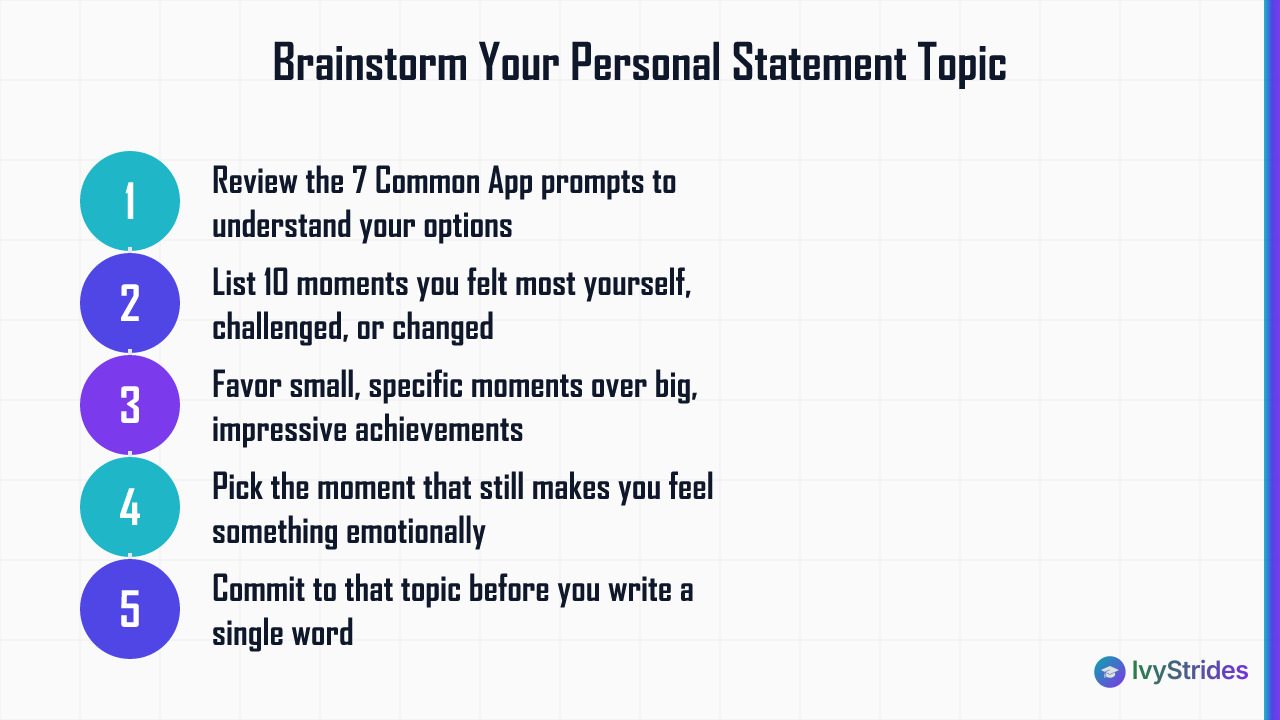
Now the brainstorm. The method that works best is what we call small moment, big meaning. List 10 moments when you felt most like yourself, most challenged, or most changed. Don't filter for impressiveness. A vague topic like "my passion for science" is a category, not an essay. A specific one, "the afternoon I rebuilt a broken radio with my grandfather", is a scene you can actually write.
In our coaching, essays about small, specific moments consistently outperform essays about big, impressive achievements. The 45 minutes you spent teaching your younger sister long division. The Saturday you learned your favorite bakery had closed. The night you finally understood why your calculus teacher kept saying "the derivative is a rate". Ordinary events, treated with depth, beat dramatic events treated superficially almost every time.
Once your list of 10 is on paper, pick the moment that still makes you feel something. That emotional residue is a signal there's more to say. If you want a coach to help you sort through the list before you commit, working with our common app essay tutor at the brainstorm stage saves weeks of revision later.
How to Start Your Personal Statement: Opening Lines That Pull Readers In

Photo by Lukas Blazek on Pexels
Admissions readers move through hundreds of essays a season. Your first sentence decides whether they read the next one carefully or start skimming.
Two openings to avoid on sight:
- "Webster's Dictionary defines perseverance as…" A cliche flag. Readers see it constantly, and it signals you don't trust your own material.
- "Ever since I was a child, I have always loved…" Another cliche flag. Vague, telescoped, forgettable.
What works instead is in medias res, dropping the reader into a specific moment with sensory detail. Not "I have always loved chemistry", but "The beaker cracked at 11:47 p.m., three minutes before my titration was due". The second version tells the reader nothing about your love for chemistry directly, but it makes them ask what happens next, which is the only question a strong opening needs to trigger.
In our coaching, essays that open mid-scene consistently hold reader attention longer than essays that open with a thesis statement. Readers are trained by every book and film they've ever consumed to lean in when a story starts. A thesis statement asks them to evaluate; a scene asks them to follow. Ask them to follow.
Rhetorical questions in the opener are a mixed bag. "Have you ever wondered what it feels like to…" reads as writing-workshop filler. But a question grounded in the specifics of your story, dropped after a scene has already started, can work. Use with judgment.
If you already have a draft and want a coach to pressure-test whether your opening earns its place, our essay review service works line by line on exactly this.
The Structure of a Strong Personal Statement (From First Draft to Final Version)
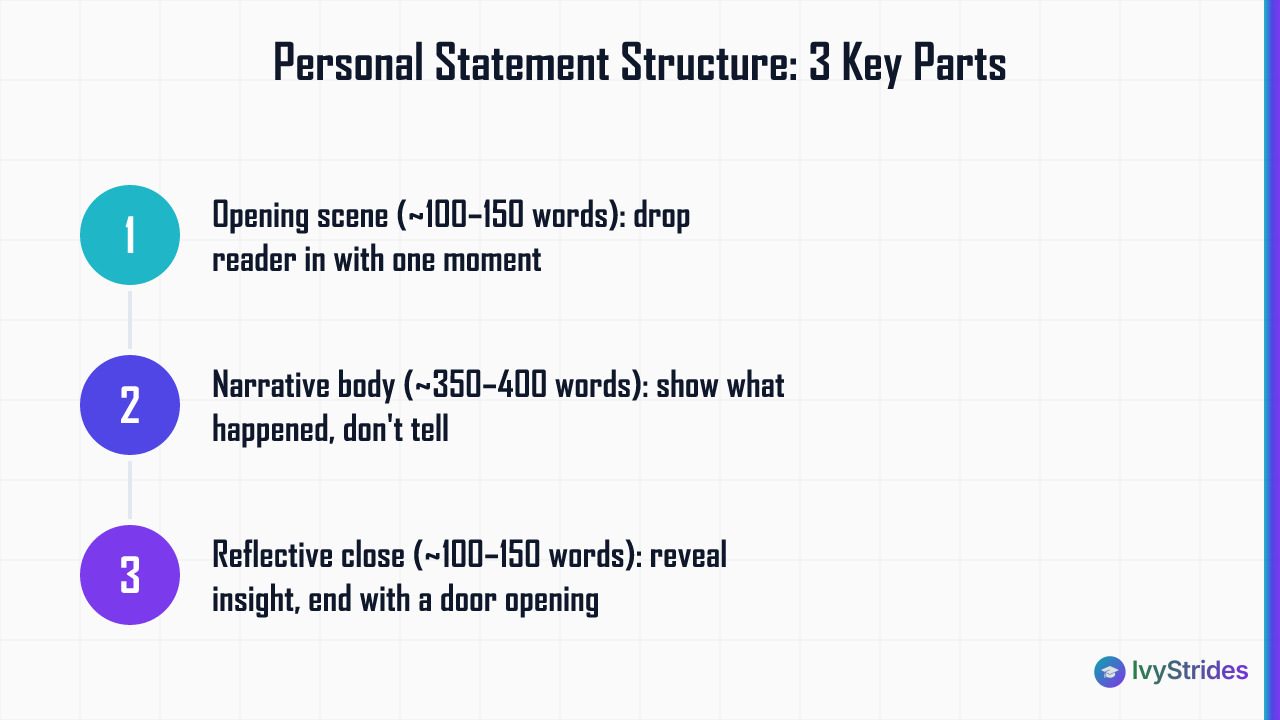
A workable structure for 650 words looks like this:
- Opening scene (roughly 100 to 150 words): drop the reader in. Sensory detail. One moment.
- Narrative body (roughly 350 to 400 words): what happened, what you did, what you noticed, what shifted. Show, don't tell.
- Reflective close (roughly 100 to 150 words): what did the experience reveal about how you think, what you value, or who you are becoming?
Show, don't tell is the single most important craft move in the essay. Here's the difference:
- Tell: "I am a hard worker."
- Show: "At 5 a.m. on a Tuesday, I was re-soldering the third circuit board of the week."
The second sentence never uses the phrase "hard worker" and doesn't need to. The reader draws the conclusion themselves, which is what makes it stick. Every time you catch yourself writing an abstract claim about your character, rewrite it as a specific action, image, or moment.
The reflective close is where a lot of otherwise good essays lose the plot. Don't summarize the essay ("and that is how I learned the value of persistence"). Don't moralize ("this experience taught me that hard work pays off"). Instead, answer: what did this reveal? Where has it left you? What are you still working out because of it?
In our coaching, essays that end with a forward-looking insight, not a summary, leave a stronger impression on readers. The last sentence should feel like a door opening, not a door closing.
One caveat: structure is a guide, not a formula. Voice and authenticity matter more than rigid adherence to the 100-400-150 breakdown. If your essay is 130-380-140 and it sings, leave it alone.
If you want a coach to work through drafts with you and coordinate the essay with your testing plan, we offer one-on-one help for common app essay tied to the full admissions timeline. Students often draft the personal statement while they're still finalizing their score strategy, and our AP, SAT, and ACT testing plan piece maps out how those threads fit together.
Common Personal Statement Mistakes That Admissions Readers Notice Immediately
Some patterns come up in nearly every batch of essays we read. Here are the ones that most consistently weaken an otherwise promising draft.
Cliche topics executed at cliche depth. In our coaching, the most common cliche topics we see are the sports injury comeback, the mission trip epiphany, and the immigrant grandparent tribute. These aren't disqualifying topics. Students have written brilliant essays on all three. But they require exceptional execution to stand out, because the reader has seen the arc a hundred times. If you're writing one of these, the specificity of your details has to do the heavy lifting.
Cliche phrases. Search your draft for these and decide whether each use is earned: "my passion for X began when…", "I have always been fascinated by…", "this experience taught me that…", "little did I know…", "at the end of the day…". Most of the time, you can cut them without losing anything.
Summarizing the activities list. In our coaching, essays that read like a second activities list are among the most common reasons a personal statement fails to add value to an application. The admissions reader already has the list. Don't re-narrate it. Pick one thread and go deep.
Writing what you think the reader wants to hear. Admissions readers are calibrated to detect performance. If your essay sounds like it was optimized for admission rather than written by you, it will read as flat. Write what's true, then make it good.
AI-generated or parent-written voice. Admissions offices are increasingly alert to essays that lack a student's authentic voice. The risk isn't just detection software; it's the loss of the essay's core purpose. A parent's polish and a chatbot's prose both flatten the specific, idiosyncratic details that make an essay memorable.
Word count violations. The 650-word maximum is hard. Going under 500 words without a strong reason signals underdeveloped thought. Aim for 550 to 650. Cut ruthlessly.
If you're also researching where these essays land, our reads on Should You Apply to Johns Hopkins University? Stats and Fit and Should You Apply to Duke University? Key Factors Explained walk through how holistic review works at two schools that read essays carefully.
Revise, Read Aloud, and Get a Second Opinion
Great essays aren't written. They're rewritten.
A revision sequence that works:
-
Story and structure pass. Does the essay have a clear arc? Is the opening a scene? Does the reflection open a door instead of closing one?
-
Voice and cliche pass. Search for "I have always", "ever since", "passion", "journey", "unique". Every use has to justify itself. Read the draft aloud. If you stumble over a sentence, rewrite it. Your ear catches what your eye misses.
-
Clarity and word count pass. Does every sentence either advance the story or deepen the reflection? If not, cut it. Trim filler, tighten verbs, kill adverbs.
In our coaching, students who complete at least three full revision passes before submitting produce measurably stronger final drafts than those who revise once. If you're still working on your SAT or ACT score alongside your essay, both pieces of the application benefit from starting early and revising with expert feedback. For a broader goal-setting framework that pairs well with a multi-week revision cycle, see WOOP Your Way to College Success: A Goal-Setting Tool for High-Achievers.
Once your personal statement is drafted, your supplemental essays need to complement it rather than repeat it, so plan both pieces together before you finalize either. If your personal statement is about music, at least one supplemental essay should explore a different dimension of you. Readers of your file see the essays as a set, whether you plan them that way or not.
Then get a second opinion. A teacher, a counselor, or a coach. Someone who will tell you the truth. A trained reader through our essay review service can flag issues a family member won't spot, especially around voice authenticity and admissions context.
And one more time, because it matters: even a polished essay doesn't guarantee admission. Admissions outcomes depend on the full application.
Your Personal Statement Timeline for the 2026 Application Cycle
The Common App opens August 1 each cycle, per commonapp.org. Early Decision and Early Action deadlines at most selective schools are typically November 1 or November 15; Regular Decision is typically January 1. Verify each of your schools' exact deadlines through their admissions site or Common Data Set.
Here's the timeline we recommend to students in the 1-on-1 essay coaching track:
- June (rising senior summer): brainstorming. Do the list of 10. Write two or three trial paragraphs on different topics before committing.
- July: first full draft. Write badly on purpose. Get the story on paper.
- August: second draft. Rework structure. Test the opening.
- Early to mid-September: third draft. Voice and cliche pass. Read aloud. Get feedback from one or two trusted readers.
- Late September: final polish and word-count tightening.
- October 1: finalize for ED/EA applicants. Buffer week before the November 1 deadline.
Students who start brainstorming in September for a November 1 deadline have roughly six weeks. It's workable, but there's no buffer for major topic changes. In our coaching, students who begin the essay process in June or July consistently submit stronger final drafts than those who start in September, because they have time to abandon a topic that isn't working and start over.
The same summer window is when many students plan their fall testing sittings and finalize their AP course strategy. If you're wondering how AP scores factor into your applications, do colleges accept AP credit explains how AP results interact with admissions and enrollment. If you're still building your college list, Should You Apply to Northwestern University in 2026? is a useful template for the fit questions to ask about any school.
A good personal statement isn't about finding the most impressive moment in your life. It's about finding a specific moment you can write honestly, and taking the time to write it well.
FAQ
How do you start a personal statement when you have no idea what to write about?
List 10 specific moments when you felt most like yourself, most challenged, or most changed. Don't filter for impressiveness. The goal is specificity, not drama. Pick the moment that still makes you feel something when you think about it, because that emotional residue usually signals there's something worth exploring. Write a rough paragraph describing that moment in sensory detail before you worry about structure or word count.
What is the 650-word rule for the Common App personal statement?
The Common App personal statement has a hard maximum of 650 words and a minimum of 250, per commonapp.org. Most strong essays land between 550 and 650 words. Going significantly under 500 words without a compelling reason signals to admissions readers that the essay is underdeveloped. Don't pad to hit 650 exactly; cut every word that doesn't earn its place.
Can I use AI to write my personal statement?
Using AI to generate your personal statement carries real risks beyond detection software. The essay's whole purpose is to give admissions readers your authentic voice, and AI-generated prose tends to flatten the specific, idiosyncratic details that make an essay memorable. Using AI as a brainstorming prompt or grammar check is lower-risk, but submitting an AI-drafted essay as your own work undermines the essay's core function and may violate individual college honor policies. In our coaching, the students who write the strongest essays are the ones who do the messy first-draft work themselves.
What is the difference between a personal statement and supplemental essays?
The Common App personal statement is one essay submitted to every school on your list, up to 650 words, answering one of seven broad prompts. Supplemental essays are school-specific, shorter (typically 150 to 650 words depending on the school), and ask targeted questions about why you want to attend that school, what you plan to study, or how you would contribute to campus life. The two types should complement each other, not repeat the same stories.
Does a strong personal statement guarantee college admission?
No. A strong personal statement is one component of a holistic application that also includes GPA, course rigor (including AP classes), standardized test scores where submitted, letters of recommendation, and extracurriculars. A compelling essay can meaningfully strengthen an application, but admissions outcomes depend on the full picture. No essay coach or prep program can guarantee admission to any college.
How many times should I revise my personal statement before submitting?
In our coaching, students who complete at least three full revision passes produce noticeably stronger final drafts. A useful sequence: first pass for story and structure, second pass for voice and cliches, third pass for sentence-level clarity and word count. After that, one read-aloud pass and at least one round of feedback from a trusted reader or coach before you finalize.

Award-winning author (South Asian Book Award) and graduate of BITS Pilani and UCLA Luskin School of Public Affairs. Brings a published writer's eye to Common App essays and grammatical precision to SAT and ACT R&W instruction.