
How Hard Is It to Get Into UT Austin Below the Top 5%? What UT Weighs
On this page
- How Selective UT Austin Really Is: Overall Rate vs. Your Real Odds
- What UT Austin's Holistic Review Actually Weighs for Non-Auto-Admits
- What UT Austin's Application Actually Requires for Fall 2027
- What GPA and SAT Score You Need for UT Austin's Holistic Review
- FAQ: UT Austin Admissions Difficulty and Requirements
- What GPA do you need to get in UT Austin?
- Is a 1400 SAT good for UT Austin?
- What is the 90% rule at UT Austin?
- How to get into UT Austin without being top 6?
- Your Next Step at UT Austin
Getting into UT Austin is genuinely competitive. The overall acceptance rate is roughly 22%, but that masks a wide split: Texas residents see about 36%, while out-of-state applicants face closer to 7.5%. Those rates are for fall 2025 entry. Texas students in the top 5% of their class receive automatic admission. Everyone else enters holistic review.
Each rate is admits divided by applicants in UT Austin's 2025-26 Common Data Set, which reports in-state, out-of-state, and international counts separately. The harder question is what the holistic review weighs once you are outside that top 5%, and which parts of your file you can still move before the deadline.

How Selective UT Austin Really Is: Overall Rate vs. Your Real Odds
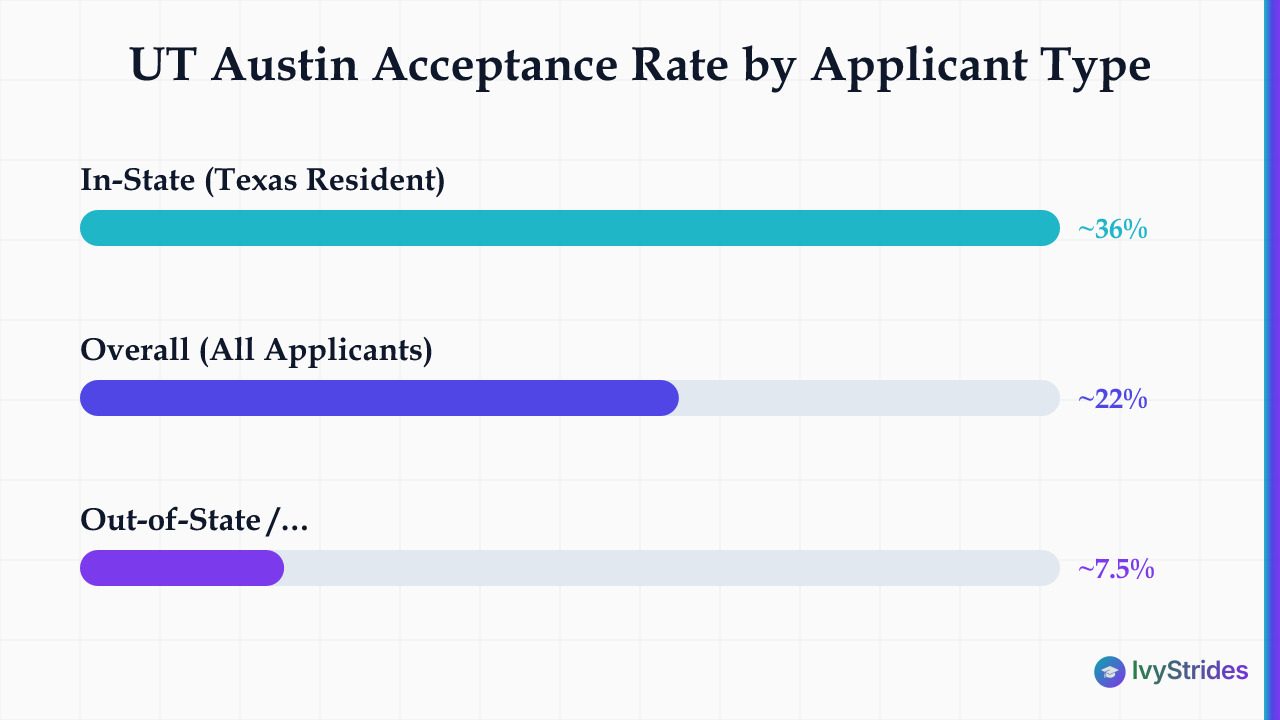
UT Austin is a highly selective public flagship, and the acceptance rate you act on depends on your residency and your class rank. The overall rate of roughly 22% is a blended figure. For a Texas junior staring at a rank just outside the top 5%, and for any out-of-state applicant, the real odds sit well below that number.
Two pathways, not one. UT Austin automatic admission guarantees Texas students in the top 5% of their graduating class a seat at the university. It does not guarantee admission to a specific competitive major. Auto-admit files still go through review to decide the major, per UT's review and decision process. The threshold is top 5% for fall 2026 and fall 2027 applicants; older guidance that cites top 6% is out of date.
Why is the out-of-state number so much lower? Texas law requires UT to fill at least 90% of each freshman class with state residents, which leaves roughly a tenth of the seats for everyone else. That single constraint is why out-of-state applicants face odds about three times harder than the headline 22% suggests. IvyStrides derives that ratio from UT's fall 2025 counts; UT publishes the counts, not the comparison.
| Applicant type | Approximate acceptance rate | Key condition |
| Overall (all applicants) | About 22% | Blended across all pathways |
| In-state (Texas resident) | About 36% | 90% of seats reserved for residents |
| Out-of-state / international | About 7.5% | Competes for the remaining ~10% |
| Top-5% Texas resident | Automatic seat | Major still decided by review |
For the full acceptance-rate picture by residency and year, see our detailed breakdown of the UT Austin acceptance rate by residency. The top-5% threshold and what it does and does not guarantee are covered in full in our article on what UT Austin auto admit actually promises.
What UT Austin's Holistic Review Actually Weighs for Non-Auto-Admits

Photo by https://kaboompics.com/ on Pexels
UT Austin's holistic review weighs its named factors together for every non-auto-admit: class rank, strength of academic background, test scores, achievements and honors, special accomplishments plus work and service, essays, recommendations, and the competitiveness of your chosen major. That last factor, major competitiveness, sits in the same review that decides admission. It is not a side preference.
That combination is why no single factor is decisive. UT states plainly that no rank or score ensures admission other than Texas automatic admission. The major amplifies everything. Students targeting competitive majors like Computer Science or Cockrell Engineering should submit their strongest single-sitting score, because the competitiveness of the major raises the weight of every other item in the file.
The 2026-27 catalog adds a factor the student-facing page leaves out: special circumstances that put a record in context. Socioeconomic status, growing up in a single-parent home, family responsibilities, and overcoming adversity all count. If your transcript dipped during a year you were working or caring for family, that context belongs in your file.
| Review factor | What UT looks at | Actionable implication |
| Class rank | Standing in your graduating class | Context matters more than a raw number |
| Academic background | Course rigor and grades | Take the hardest courses you can sustain |
| Test scores | Official SAT or ACT | Submit your strongest single sitting |
| Achievements, honors | Awards inside and outside school | Name specifics, not generic labels |
| Essays, short answers | One open-topic essay, two short answers | Connect Why Major to the major; write Proudest Activity about a genuine source of pride |
| Major competitiveness | Demand for your chosen program | Match major to your strongest file |
| Special circumstances | SES, adversity, family duties | Supply context the transcript hides |
Where students lose points. The Why Major prompt asks why the major interests you, so write about a specific intellectual connection to the discipline, not a generic career goal. For a step-by-step guide to the Why Major and Proud Activity short answers, see our article on UT Austin's required short answers. Students building a list that puts UT alongside other selective schools can work with a counselor who sequences each file component against the deadline.
What UT Austin's Application Actually Requires for Fall 2027
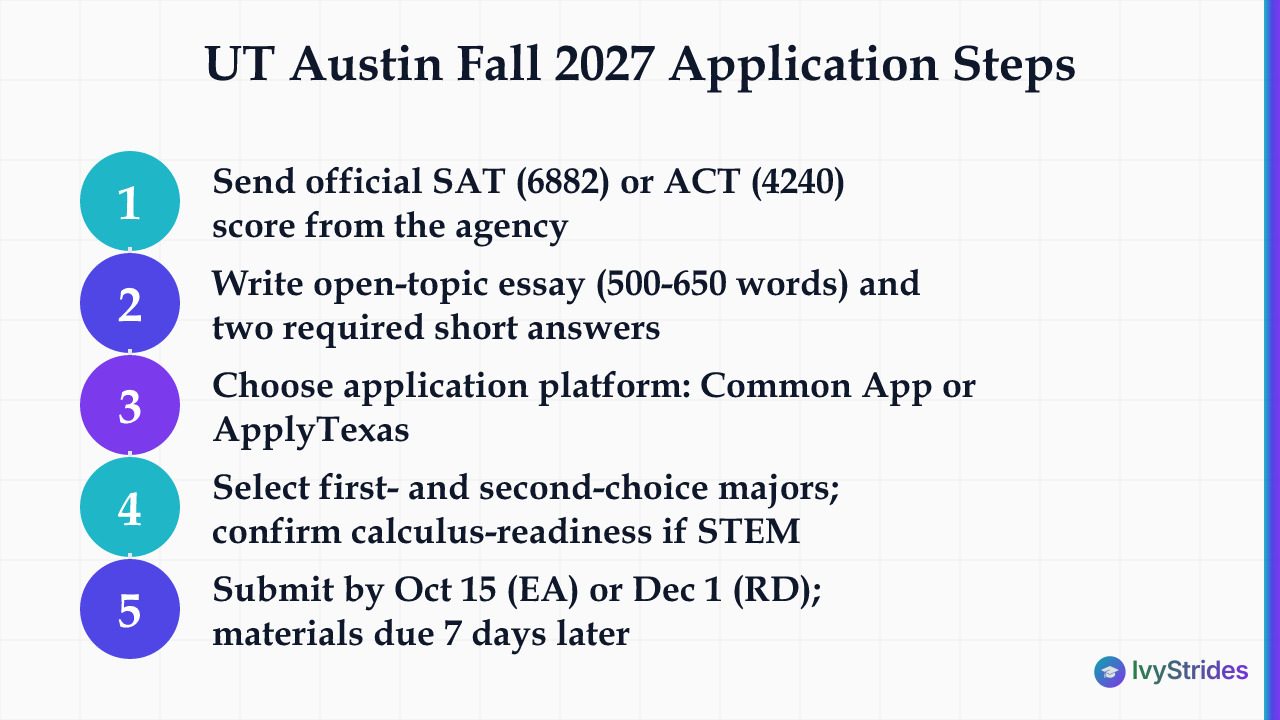
UT Austin is test-required for the 2026-27 cycle, entry fall 2027. You must send at least one official SAT (code 6882) or ACT (code 4240) score directly from the testing agency, per the freshman application page. An official Classic Learning Test score also counts. That requirement sits on top of the essay, short answers, and platform choices below.
Because that score matters so much, here is the constraint to plan around: UT Austin does not superscore. Its admissions FAQ says it uses the highest score from one test date. Our article on why UT reads one sitting rather than a composite explains what that means for timing a retake.
Two rounds, same review. Early Action is non-binding at UT and gives no advantage in review. You apply by Oct 15, materials are due Oct 22, and a decision or deferral arrives by Jan 15, 2027. Regular Decision runs Dec 1 to apply, Dec 10 for materials, decisions by Feb 15, 2027. You can apply through Common App or ApplyTexas; UT encourages Common App but says the choice does not affect your decision.
- Official test score, Required, SAT 6882 or ACT 4240, sent from the agency
- Open-topic essay, Required, 500 to 650 words; Common App personal statement satisfies it
- Short answer 1 (Why Major), Required, about 250 to 300 words or 40 lines
- Short answer 2 (Proudest Activity), Required, about 250 to 300 words or 40 lines
- Optional short answer, Optional, same length cap
- Resume, Optional for freshmen, format and length have no effect on review
- Letters of recommendation, Optional, up to two, none from family
- First- and second-choice major, Required, name both on the application; the FAQ says a student may be considered for the second choice if they qualify for automatic admission and are not admitted to their first choice
- Calculus-readiness, Required for some majors, see note below
The open-topic essay runs 500 to 650 words, and UT reviews only what it requires: your other Common App essays are not read. One more gate matters for STEM applicants. A calculus-readiness requirement applies to all Cockrell Engineering majors, all Jackson Geosciences majors, both Environmental Science majors, and Computer Science plus its combined CS majors. If a competitive major is your first choice, confirm you meet it.
What GPA and SAT Score You Need for UT Austin's Holistic Review
UT Austin publishes no minimum GPA or test score. Reviewers weigh your GPA alongside course rigor, class rank, and the competitiveness of your major. A lower GPA is not disqualifying. It raises the bar on everything else.
Those academic benchmarks feed straight into the test strategy from the previous section. Because UT reads one sitting and no superscore, your strongest SAT or ACT result has to stand on its own in your major's applicant pool. A 1400 SAT sits at the 93rd percentile of SAT takers, which carries more weight for a less-competitive major than for Computer Science. Context is everything here.
| Metric | Typical range (per CDS) | What it means for your file |
| SAT (enrolled students who submitted scores) | Not listed in CDS 2025-26 | Submit your best single sitting |
| ACT (enrolled students who submitted scores) | Not listed in CDS 2025-26 | No superscore, so one result counts |
| Major competitiveness | Not published per major | Match major to your score band |
A caveat worth repeating: UT does not publish per-major acceptance rates, so no one can hand you a score cutoff for CS or engineering. Competitiveness is named as a factor; the exact bar is not disclosed.
Your score deadlines are Oct 22 for Early Action and Dec 10 for Regular Decision, sent straight from the agency. If a retake could strengthen your result for a competitive major, our 1-on-1 SAT coaching built around your baseline and target starts from a diagnostic test. Readers weighing the two Texas flagships will want the side-by-side process in our UT Austin and Texas A&M admissions comparison.
FAQ: UT Austin Admissions Difficulty and Requirements
What GPA do you need to get in UT Austin?
UT does not publish a minimum GPA cutoff. Reviewers read your GPA alongside course rigor, class rank, test scores, and major competitiveness. A lower GPA is not disqualifying, but it raises the bar on every other part of your file.
Is a 1400 SAT good for UT Austin?
A 1400 SAT sits at the 93rd percentile of SAT takers. Whether it is competitive depends on your first-choice major: a 1400 carries more weight for a less-competitive program than for Computer Science or Cockrell Engineering. UT does not superscore, so your single best sitting is what reviewers see.
What is the 90% rule at UT Austin?
Texas law requires UT Austin to fill at least 90% of its freshman class with Texas residents. That leaves roughly 10% of seats for out-of-state and international applicants, which is why the out-of-state acceptance rate is about 7.5%, far below the overall 22%. Out-of-state applicants compete for a much smaller share of the class.
How to get into UT Austin without being top 6?
The threshold is top 5%, not top 6%, for summer/fall 2027 applicants. Students outside the top 5% enter holistic review, where UT weighs class rank, test scores, essays, short answers, achievements, and major competitiveness together. Choosing a first-choice major matched to your profile, writing a specific Why Major short answer, and submitting a strong single-sitting SAT or ACT score are the highest-use moves.
Your Next Step at UT Austin
UT Austin is selective below the top 5%, but the holistic review gives you real levers. The work is figuring out which one or two file components sit furthest from competitive for your target major, then fixing those before Oct 22 or Dec 10.
- Confirm your residency pathway and whether you are auto-admit or non-auto-admit.
- Match your first-choice major to the strength of your current file.
- Check your best single SAT or ACT sitting against your major's competitiveness.
- Draft the Why Major short answer around a specific academic connection, not a career label.
- Add context for any special circumstances the transcript does not show.

Rajesh is a technology leader, entrepreneur, and angel investor with 28+ years in Business & Technology Leadership and Product & Solution Engineering. He is passionate about education, mentoring, and driving digital transformation.