
Should You Join the UT Austin Waitlist? What a 200-Word Update Can Do

On this page
- How the UT Austin Waitlist Works: Unranked, Opt-In, and Major-Specific
- What the UT Austin Waitlist Actually Looks at by Major
- How to Write the UT Austin Waitlist 200-Word Academic Update
- When UT Austin Waitlist Decisions Come Out and What Moves the List
- FAQ: The UT Austin Waitlist
- How do I join the UT Austin waitlist?
- Do waitlisted students usually get accepted at UT Austin?
- How do I check my UT Austin waitlist status?
- How likely is it to get off the UT Austin waitlist?
- Your Next Step on the UT Austin Waitlist
The UT Austin waitlist is an unranked, opt-in pool for freshman applicants not offered admission. Joining is worth it when UT Austin stays your first choice. UT decides waitlist offers by its last July orientation date or when the class fills, and your one controllable lever is a 200-word academic update.
Those process details come from UT Austin's own admissions pages, cited throughout. Opting in takes minutes. The harder questions are what to write in those 200 words and how to protect yourself with a backup while you wait, and that is where this page spends its time.
How the UT Austin Waitlist Works: Unranked, Opt-In, and Major-Specific
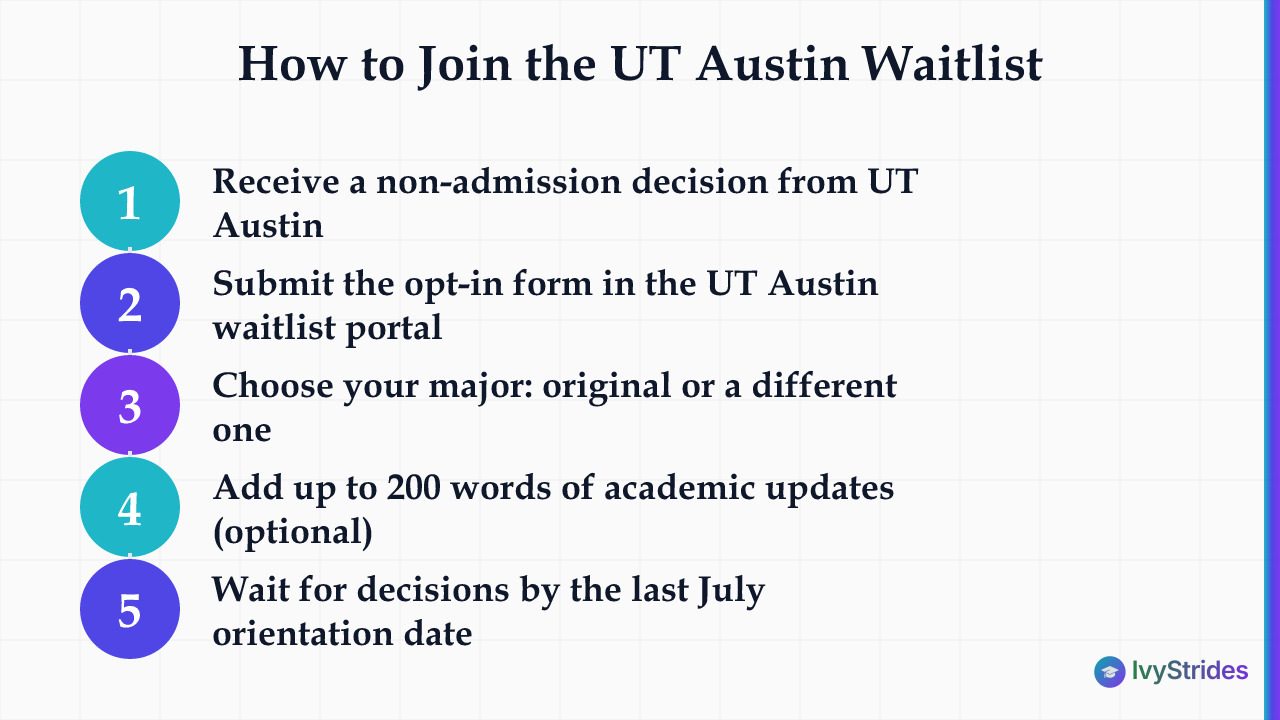
You must opt in; nothing happens automatically. Freshman applicants who were not offered admission join by submitting the form in the UT Austin Admissions waitlist portal. If you don't complete the form, you aren't on the list.
Unranked, not first-come. UT states plainly that the waitlist is not ranked and that it does not know whether any space will open or how many students it will take. Opting in on day one gives you no edge over someone who joins a week later.
Major-specific by choice. On the form you ask to be considered for your original major or a different one. That choice matters, because each major admits against its own capacity and applicant pool, so a first-choice major with little room may never open.
One form, no edit button. To change anything, including the 200-word update, you cancel your original submission and resubmit it. Draft carefully before you send.
A separate route. UT's Coordinated Admissions Program (CAP) is a different path to UT Austin with its own rules; read those on UT's site rather than treating CAP as part of the waitlist.
| Feature | Detail |
| Structure | Unranked pool |
| Eligibility | Freshman applicants not offered admission |
| How to join | Submit the form in the waitlist portal |
| Major | Original major or a different one |
| Optional update | Up to 200 words of academic updates |
| Changes | Cancel the form and resubmit |
| Decisions | By the last July orientation date or when the class fills |
Who lands on the waitlist starts with how selective UT Austin's first round is, major by major.
What the UT Austin Waitlist Actually Looks at by Major
UT reviews waitlist candidates through the same holistic lens it used on the original file. The same holistic factors UT Austin used to evaluate your original application, class rank, academic rigor, test scores, essays, and major competitiveness, are the lens through which any waitlist movement is decided.
UT Austin names its holistic review factors directly: class rank, strength of academic background, test scores, achievements and honors, special accomplishments plus work and service in and outside school, essays, required short answers, and how competitive your chosen major is. UT says no single rank or score guarantees admission, other than Texas automatic admission.
The 2026-27 General Information Catalog adds special circumstances that put achievement in context, including socioeconomic status, growing up in a single-parent home, family responsibilities, and overcoming adversity.
Scores are required, not optional. Per the UT Austin admissions FAQ, official SAT or ACT scores, sent by the testing agency, complete your application, and official Classic Learning Test (CLT) scores also satisfy the requirement. A file without a score is incomplete on the waitlist just as it was in the first round.
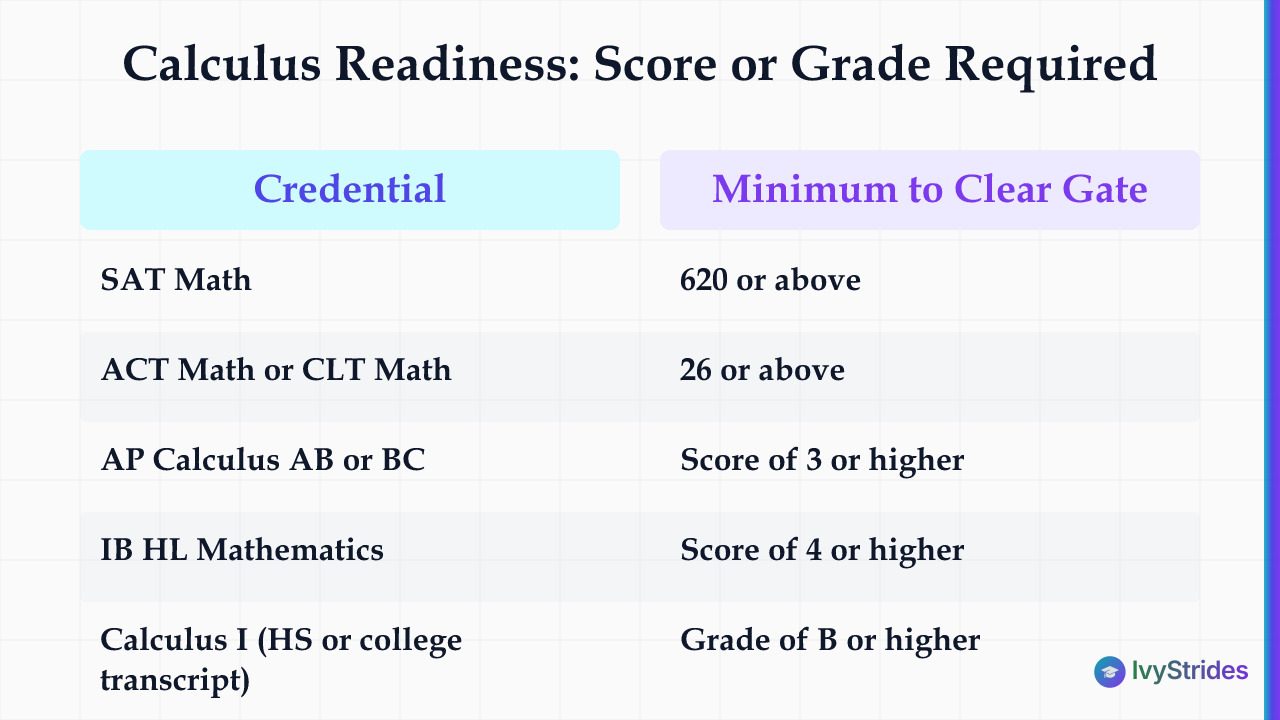
The calculus-readiness gate. Every major in the Cockrell School of Engineering and the Jackson School of Geosciences, both Environmental Science majors, and Computer Science with its related programs require documented calculus readiness, per UT Austin's high school prerequisites page.
| Credential | Minimum That Clears the Gate |
| SAT Math | 620 or above |
| ACT Math | 26 or above |
| CLT Math | 26 or above |
| AP Calculus AB or BC | 3 or higher |
| IB HL Mathematics | 4 or higher |
| Calculus I on a high school or college transcript | Grade of B or higher |
Before you spend energy on a waitlist update, confirm that the major you name keeps you eligible. If you can't tell whether your math credentials clear that gate, a counselor who maps your scores and file against a specific major's requirements can answer that before you invest more time. The same factors show up in what admissions readers value in an applicant at most selective schools.
How to Write the UT Austin Waitlist 200-Word Academic Update
Add one new, verifiable academic development your original application could not have included. The form lets you share academic updates in 200 words or less. Your original essays and short answers remain in your file; the 200-word update is not a chance to rewrite them but to add one concrete new data point those essays could not have included.
In our admissions coaching, the most effective 200-word updates focus on one new, verifiable academic development rather than restating the original application narrative. Treat the update as your letter of continued interest, written in evidence instead of adjectives.
Think grades and evidence, not feelings: a fall-semester GPA, a new AP score, a completed dual-enrollment course, a research placement, a competition result, or a leadership role with measurable scope. UT already knows why you want the major, because your required short answer covered exactly that. Don't repeat it.
A common pattern we see: students use the update to express enthusiasm rather than to add new evidence, which misses the point of the form entirely. UT is looking for a reason to re-read a file that has changed since you applied.
The strongest updates state each development plainly with the number attached. "I earned a 5 on AP Calculus BC in July" does more work than a paragraph about determination.
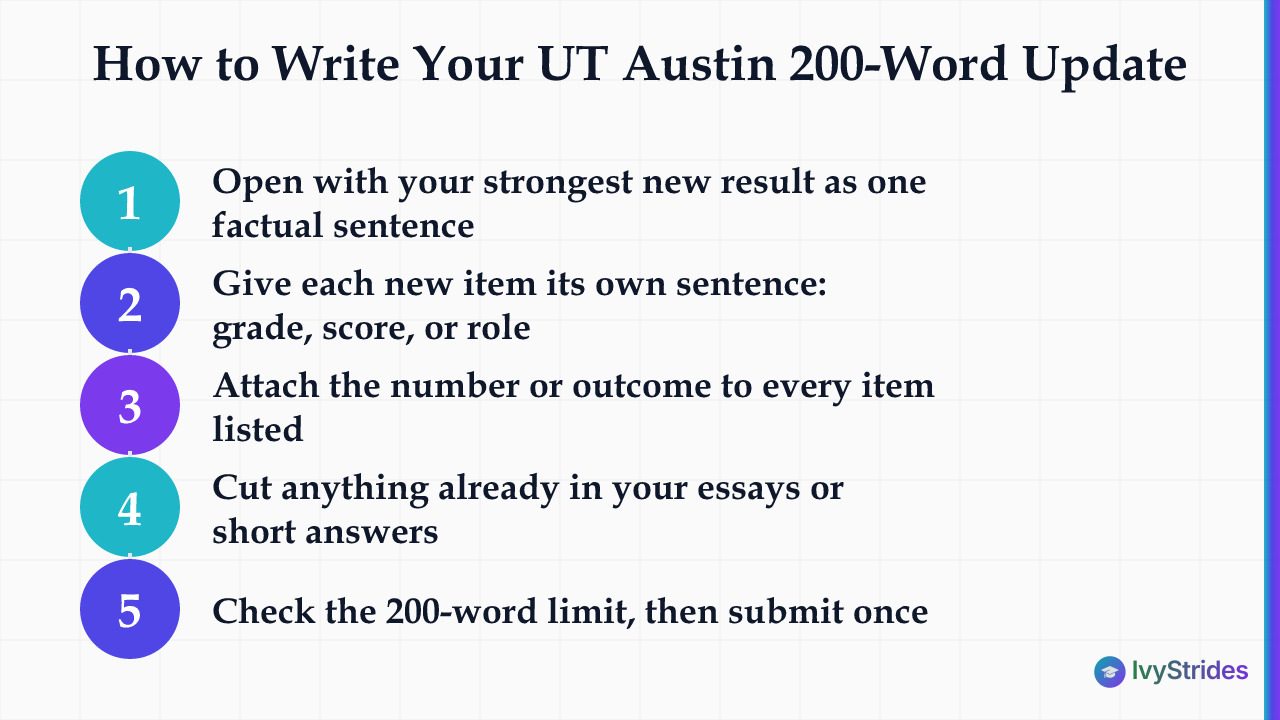
Your 200-word update checklist:
-
Open with your strongest new result, stated as one factual sentence.
-
Give each new item its own sentence: grade, score, course, or role.
-
Attach the number or outcome to every item.
-
Cut anything already in your essays or short answers.
-
Read it against the 200-word limit, then submit once.
| Include | Leave Out |
| New fall or spring semester grades | Restating your original essay narrative |
| A new AP or IB score | Generic "UT is my dream school" lines |
| A completed course or research role | Emotional appeals or pleading |
| A concrete award or competition result | Anything already in your short answers |
If you finish a stronger draft next week, you cancel and resubmit the entire form, so don't rush the send. The same discipline applies to pruning a short supplement down to its single strongest point. For a second reader, a coach who checks a short high-stakes piece for specificity and tone can catch repetition you can't see yourself.
When UT Austin Waitlist Decisions Come Out and What Moves the List
UT makes fall freshman waitlist decisions by its last July orientation date or when the class is full, and shares them through MyStatus. UT's page adds that a waitlist decision posted in MyStatus is final. First-round decisions come earlier: Early Action applicants hear by January 15, 2027 and Regular Decision applicants by February 15, 2027, per the UT Austin FAQ.
May 1 is the National Enrollment Deadline at most colleges. As admitted students commit elsewhere and decline UT, space can open, which is why most waitlists move after that date.
No published rate exists. UT Austin does not publish a waitlist acceptance rate, and it says it does not know how many students it will take, so anyone quoting a figure is guessing. Outcomes depend on how many spaces open in the major you named.
Commit to a backup by May 1. While you wait for UT Austin movement, committing to a strong backup by May 1 is not giving up; it protects you, because UT can make waitlist offers as late as its last July orientation date. Check your backup school's own deposit and withdrawal rules before you pay.
| Date or Window | What Happens |
| Jan 15, 2027 | Early Action decisions |
| Feb 15, 2027 | Regular Decision decisions |
| May 1 | National Enrollment Deadline at most colleges |
| Through July | Waitlist decisions, until the last orientation date or a full class |
| Throughout | Decisions post in MyStatus |
IvyStrides calculates that the UT Austin waitlist timeline spans roughly five months, from the February decision release through the July cutoff. Check MyStatus yourself on a schedule rather than waiting for a message.
Set your backup commitment against the full set of fall 2027 application deadlines. If the waiting feels familiar, the same next-steps logic runs through what to do after an early-round deferral.
FAQ: The UT Austin Waitlist
How do I join the UT Austin waitlist?
Submit the form in UT Austin's waitlist portal after your non-admission decision, name the major you want considered, and add the optional 200-word academic update if you have new information. To change anything later, cancel the original form and resubmit it.
Do waitlisted students usually get accepted at UT Austin?
UT Austin does not publish a waitlist acceptance rate and says it does not know whether any space will become available. Offers depend on how many spaces open in each major. Commit to a backup school by May 1 regardless.
How do I check my UT Austin waitlist status?
Watch MyStatus. UT posts waitlist decisions there, and it says a decision shared in MyStatus is final. Offers can come any time until the last July orientation date or until the class fills.
How likely is it to get off the UT Austin waitlist?
No published figure exists, so no one can give you honest odds. Your chances depend on how many spaces open in the major you named. A specific, factual 200-word update and a file that clears your major's requirements are the factors within your control.
Your Next Step on the UT Austin Waitlist
Joining the UT Austin waitlist is worth it when UT stays your first choice, and it only pays off alongside a realistic backup plan. UT can change its waitlist rules from year to year, so check admissions.utexas.edu before you act.
- Submit the waitlist form and confirm your first-choice major keeps you eligible.
- Draft one specific, factual 200-word academic update built on new evidence.
- Commit to a backup school by May 1.
- Check MyStatus on a set schedule through July.

Award-winning author (South Asian Book Award) and graduate of BITS Pilani and UCLA Luskin School of Public Affairs. Brings a published writer's eye to Common App essays and grammatical precision to SAT and ACT R&W instruction.