
Deferred From Your Early Application? The Complete 2026 Next-Steps Guide
On this page
- What a College Deferral Actually Means (and What It Does Not)
- How Likely Is Acceptance After Being Deferred From Early Application?
- What Deferred Students Should Send Before the Regular Decision Deadline
- Not Sure Which Update Will Actually Move the Needle for Your Application?
- How to Manage Your College List After a Deferral
- Deferral Response Plan Ready. Find Out Which Step Fits Your Specific File.
- FAQ: College Deferrals and Next Steps
- How likely is it to get accepted after being deferred?
- Is being deferred better than being rejected from an early application?
- Is deferred the same as declined in college admissions?
- Can you get deferred from early action as well as early decision?
- Your Next Step After a Deferral
A deferral means the college moved your early application to the regular decision pool for a second review. It is not a rejection. The school saw enough to keep your file alive and wants to compare it against the full applicant pool, often after reading your first-semester senior grades.
That framing comes from ACT.org's admissions guidance, which describes a deferral as a postponed decision the college revisits during the regular admission period. The harder question is what you do with the four to eight weeks between the mid-December notice and the late-January response window.

What a College Deferral Actually Means (and What It Does Not)
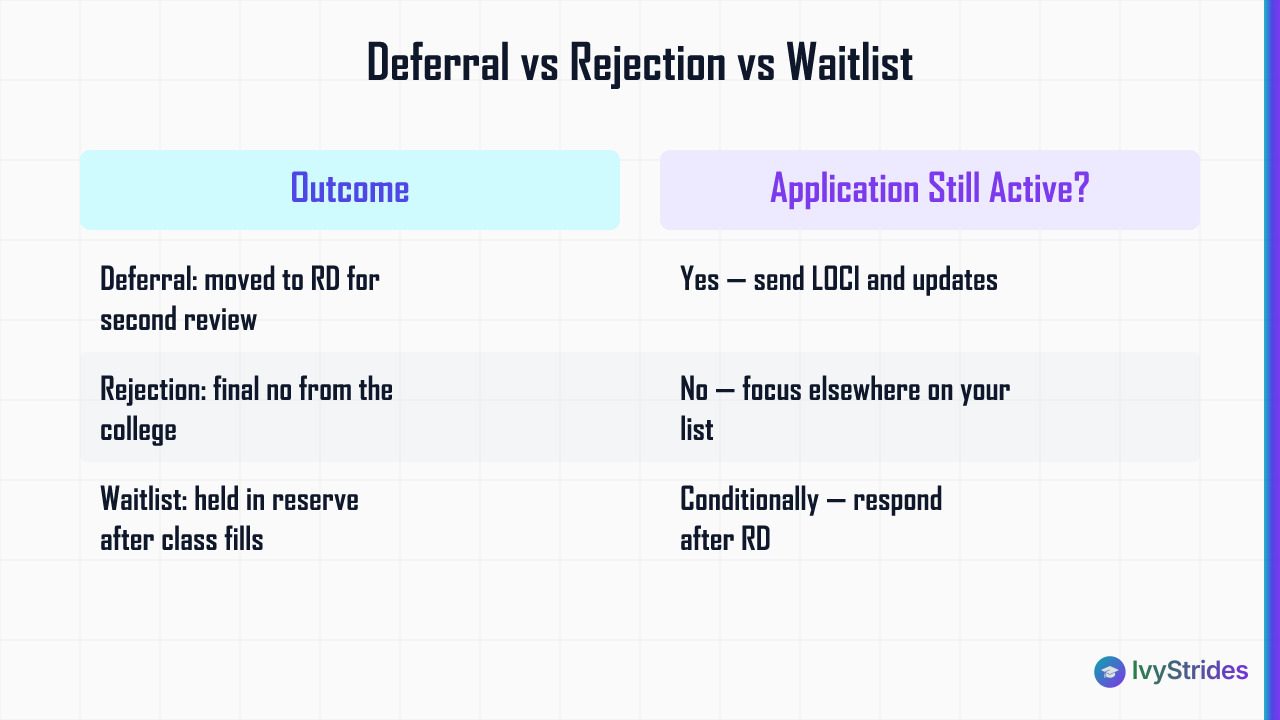
A college application deferral moves your early application from the early round into the regular decision pool for a second read. The college has not said yes, and it has not said no. Per Socrates Post, deferred applicants then compete alongside the larger regular decision pool, which is why the wait feels like admissions purgatory.
A deferral differs from a rejection and a waitlist. A rejection is final. A waitlist happens after a college fills its class and holds you in reserve. A deferral keeps your file in active review, and Collegewise frames it as the college not being ready to say yes yet but not willing to say no.
The EA versus ED distinction matters here. If you were deferred from Early Decision, you are no longer bound by the ED agreement, which means you are free to apply to and commit to any school that admits you in the regular round. Per Common App policy, a deferral releases you from the binding commitment. An EA deferral changes nothing about your other applications, since EA was non-binding to begin with.
Why colleges defer at all. Class composition and yield management drive most of it. Admissions offices shape a class across majors, geography, and background, and some files land in a wait-and-see bucket. Many colleges also want your first-semester senior grades before committing.
Some schools require an opt-in step. You must confirm through the portal or the Common App that you want to stay in the pool, or the file goes inactive. Check your deferral letter for that line first. For the full framework on how these rounds differ, see Early Decision vs Early Action vs Regular Decision. what a deferral signals about your application goes deeper on the file itself.
| Outcome | What it means | Application still active? | Your next move |
| Deferral | Moved to regular decision for a second review | Yes | Send a LOCI and updates |
| Rejection | Final no from the college | No | Focus elsewhere on your list |
| Waitlist | Held in reserve after the class fills | Conditionally | Respond after regular decision |
How Likely Is Acceptance After Being Deferred From Early Application?
Acceptance rates after being deferred from early application vary widely by school selectivity, and most colleges do not publish the figure. At highly selective schools, only a small fraction of deferred applicants are ultimately admitted. At less selective schools, the share is meaningfully higher. Treat any specific percentage online with caution unless it comes from that school's Common Data Set.
Because rates swing so hard by institution, the honest reframe is to stop asking "what are my odds" and start asking "what puts me in the group that gets in." Collegewise notes that some schools admit a real share of deferred students while others admit very few.
Here's the part most students miss. The deferred pool is smaller than the full regular decision pool, which can be a relative advantage: your file already cleared an early screen. What you still control are senior grades, one strong new achievement, and a focused letter. To plan against the calendar, our college application deadlines for fall 2026 post lays out the full timeline.
| What varies | Pattern | Where to verify |
| Deferral-to-admission rate | Wide, by selectivity | School Common Data Set |
| Highly selective schools | Small share admitted | Collegewise framing |
| Less selective schools | Higher share admitted | Collegewise framing |
| What you control | Grades, LOCI, new score | Your own file |
What Deferred Students Should Send Before the Regular Decision Deadline
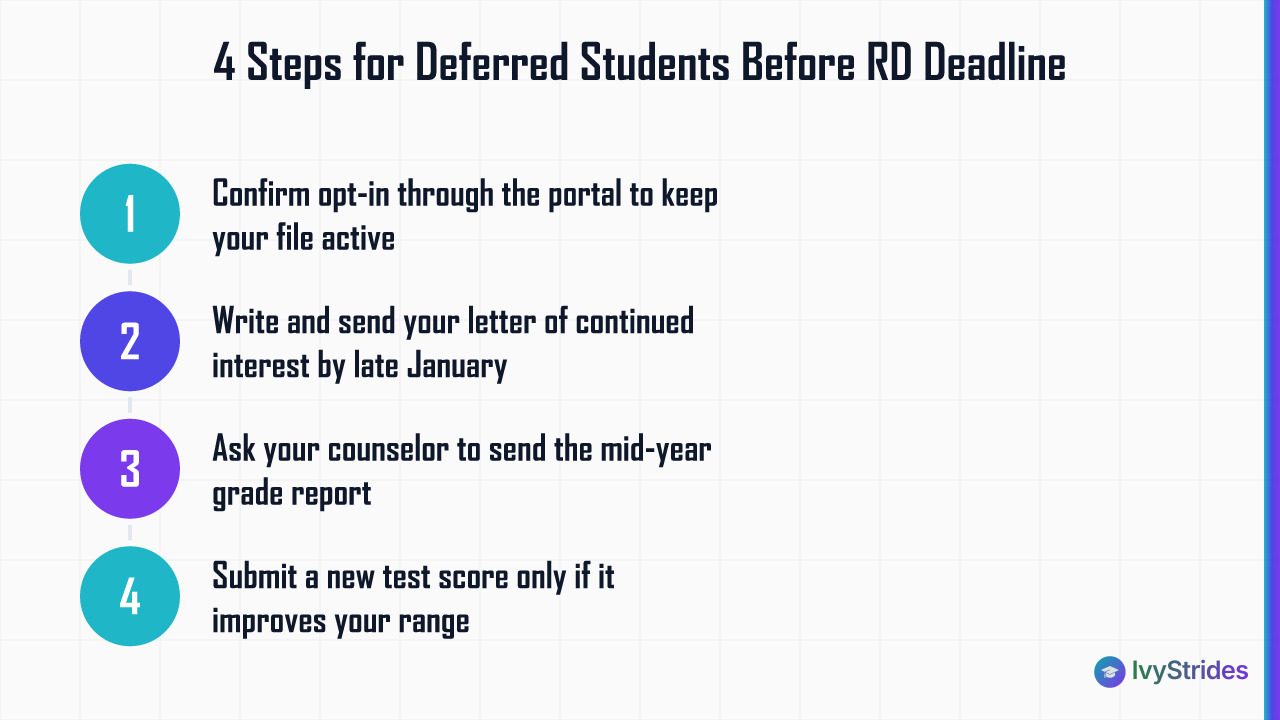
Deferred students should send four things before the regular decision deadline: an opt-in confirmation if required, a letter of continued interest, the mid-year grade report, and a new test score only if it helps. Do these in order, and finish the LOCI by late January.
Because those admission rates vary and your controllable variables are grades and writing, the LOCI is where your remaining use lives. Start the same day you read the letter.
Confirm the file is active. Some schools require an opt-in through the portal to keep a deferred application in the regular decision round. Do this first.
Write the letter of continued interest. A LOCI is a brief, focused update you send to the admissions office after deferral, typically in late January or February. It is the one piece of writing you control after deferral, and the same principles that make a supplemental essay specific and genuine apply here.
Name one concrete reason the school remains your first choice, and add one achievement that was not in your original file. In our coaching with deferred students, the LOCIs that add one specific new achievement and one concrete school-fit reason consistently outperform generic reaffirmations of interest. Keep it under a page, and do not restate the application.
Ask your counselor to send the mid-year grade report. The mid-year grade report goes from your high school counselor, typically in January or February, and the admissions office reviews your first-semester senior grades in the regular round. A strong senior semester is a real signal. For sharpening the letter itself, our guide to college essay feedback applies directly.
Decide on a new test score. If your score was below the school's middle-50 range, a December or January retake is worth considering before the regular decision review begins, but only if you have enough time to prepare meaningfully. If the school is test-optional and you did not submit scores originally, a strong new score can be a meaningful update.
Check the school's specific policy on post-deferral submission, since deadlines are school-set. Georgia Tech, for example, published a February 2, 2026 deadline for deferred applicants to submit updated test scores (admission.gatech.edu). Our deferred: whether to send a new test score page covers that call in full.
One warning: do not call the admissions office repeatedly or flood it with materials. One focused LOCI and one clean update read as mature. A stack of emails reads as anxious.
| Action | Timing | Who does it |
| Confirm opt-in | Same day as notice | Student |
| Write and send LOCI | Late January | Student |
| Send mid-year grades | January to February | Counselor |
| Submit new test score | By school deadline | Student |
| Keep other apps on track | Ongoing | Student |
The LOCI is persuasive writing with a word limit and a specific reader, which is exactly what our college essay coaching is built to strengthen.
Not Sure Which Update Will Actually Move the Needle for Your Application?
You have a deferral notice, a 4-week window, and a list of possible moves. Knowing which one matters most for your school, score, and essay situation takes a real look at your file. A free 15-minute call reviews it, maps the two or three updates worth prioritizing, and tells you whether a retake or a stronger LOCI is the right call before the regular decision review begins.
How to Manage Your College List After a Deferral

Photo by RDNE Stock project on Pexels
Keep your full college list active after a deferral, and do not withdraw other applications while you wait. One deferred school is one data point, not the whole strategy. While your deferred application is under review, your regular decision deadlines for other schools are still running, so keeping the full list on track matters just as much as responding to the deferral.
The same grades and writing that strengthen the deferred file also strengthen every other application. IvyStrides derives this figure from the inputs cited above. In our coaching, students who over-focus on the deferred school in January often submit weaker supplemental essays to their other regular decision schools in the same window. Do not let one file starve the rest.
Celebrate acceptances as they arrive. They are real, they are yours, and they reduce the pressure on the deferred outcome. If the deferred school was your only target, use the wait to add two or three strong-fit schools to the list.
Senior-year performance and course rigor matter at every school, which is why does AP help with college admission is worth a read as you plan the rest of the semester. Check each school's current stance before submitting a new score elsewhere, since test-optional policies vary by school and year (FairTest).
| Task | Priority | Deadline type |
| Finish other RD supplements | High | Fixed RD deadline |
| Send LOCI to deferred school | High | Late January |
| Keep senior grades strong | High | Ongoing |
| Add fit schools if needed | Medium | RD deadline |
| Decide on new score elsewhere | Medium | School-specific |
Deferral Response Plan Ready. Find Out Which Step Fits Your Specific File.
You have the checklist, the LOCI framework, and a clear picture of what the next four weeks require. Turning that into a plan tied to your actual scores, your deferred school, and the deadlines still open is worth a short call. A free 15-minute call maps the highest-leverage move for your situation before the window closes.
FAQ: College Deferrals and Next Steps
How likely is it to get accepted after being deferred?
Acceptance rates from deferral vary widely by school. At highly selective schools, only a small fraction of deferred applicants are admitted; at less selective schools, the share is higher. Your best lever is a focused LOCI, a solid mid-year grade report, and, where relevant, an improved test score before the deadline.
Is being deferred better than being rejected from an early application?
Yes, in a practical sense. A rejection closes the door; a deferral keeps your application active for a second review in the regular decision round. You still have the chance to add new information, write a letter of continued interest, and let a strong senior semester speak for you.
Is deferred the same as declined in college admissions?
No. A declined or rejected application is a final decision. A deferral is a postponed one: the college moves your file to the regular decision pool and reviews it again, typically alongside your mid-year grades and any new materials you submit. Your application stays active.
Can you get deferred from early action as well as early decision?
Yes. Both Early Action and Early Decision applicants can be deferred to the regular decision round. The key difference is that an ED deferral releases you from the binding agreement, while an EA deferral changes nothing about your freedom to apply elsewhere, since EA was already non-binding.
Your Next Step After a Deferral
A deferral is a genuine second read, not a soft rejection. The families who handle it well treat the next four weeks as a short, focused project rather than a source of dread.
- Confirm your application is still active, and opt in if the school requires it.
- Draft a one-page LOCI by late January with one new achievement and one concrete fit reason.
- Ask your counselor to send the mid-year grade report on schedule.
- Decide on a test-score update against the school's specific deadline.
- Keep every other regular decision application on track and celebrate acceptances as they land.

Rajesh is a technology leader, entrepreneur, and angel investor with 28+ years in Business & Technology Leadership and Product & Solution Engineering. He is passionate about education, mentoring, and driving digital transformation.