
UPenn Thank-You Note Essay: Who to Thank and Whether to Send It
On this page
- What Penn's Thank-You Note Prompt Is Actually Asking
- Who to Thank in Your UPenn Note: Choosing a Recipient That Reveals Character
- How to Write the UPenn Thank-You Note in 200 Words or Fewer
- What a Strong UPenn Thank-You Note Example Looks Like
- FAQ: Penn's Thank-You Note Essay
- Who should I write my UPenn thank-you note to?
- What are the prompts for the UPenn supplemental essay?
- Can you provide an example of a thank-you note for the Penn supplemental essay?
- Does Penn really want you to send the thank-you note?
- Your Next Step on Penn's Thank-You Note
Penn's thank-you note prompt is a 50-200 word supplemental essay asking first-year applicants to write a note to someone they have not yet thanked. Penn encourages you to share it with that person if possible. Choose someone whose specific act shaped how you think, not the most obvious name in your life.
That wording comes from Penn's 2026-27 writing page. The harder question isn't who loves you most, it's who did one concrete thing that changed how you see others. That distinction decides whether the note reveals character or wastes a 200-word window.
What Penn's Thank-You Note Prompt Is Actually Asking
Penn's thank-you note prompt reads: "Write a short thank-you note to someone you have not yet thanked and would like to acknowledge." Penn's first-year application requirements list it as "50-200 words, only required for first-year applicants," and the writing page adds: "We encourage you to share this note with that person, if possible, and reflect on the experience!"
This is one of three Penn prompts for first-year applicants: the thank-you note, the community essay ("How will you explore community at Penn?"), and one school-specific prompt for your chosen undergraduate school. All three run 50-200 words, so the note and the community essay should complement each other without repeating the same story.
Whole-person review. The University of Pennsylvania's admissions review is "a comprehensive, whole-person review" that doesn't "favor any one component of your application," and its committee "meets in teams," per Penn's how-to-apply page. The same page says Penn looks for character with "traits inspired by our founder, Benjamin Franklin": students who are "open-minded and curious, inventive and practical" and "relentlessly focused on enhancing social good."
Why does a 200-word note matter inside an application this selective? Penn's 2025-26 Common Data Set rates the application essay and character/personal qualities as "Very Important." Penn also requires the SAT or ACT in the 2026-27 cycle (with a hardship waiver for untested applicants), so your essays work alongside a score, not instead of one.
| Prompt | Who Must Answer | Word Limit | What It Reveals |
| Thank-you note | First-year applicants | 50-200 words | How you notice and value others |
| Community essay | All applicants | 50-200 words | How you'll shape community at Penn |
| School-specific | All applicants | 50-200 words | Fit with College, Wharton, Engineering, or Nursing |
| Personal statement | All applicants | 650-word max on the Common App | Your broader personal story |
Your personal statement can run up to 650 words on the Common App, so it has room to breathe; the thank-you note does not.
Who to Thank in Your UPenn Note: Choosing a Recipient That Reveals Character
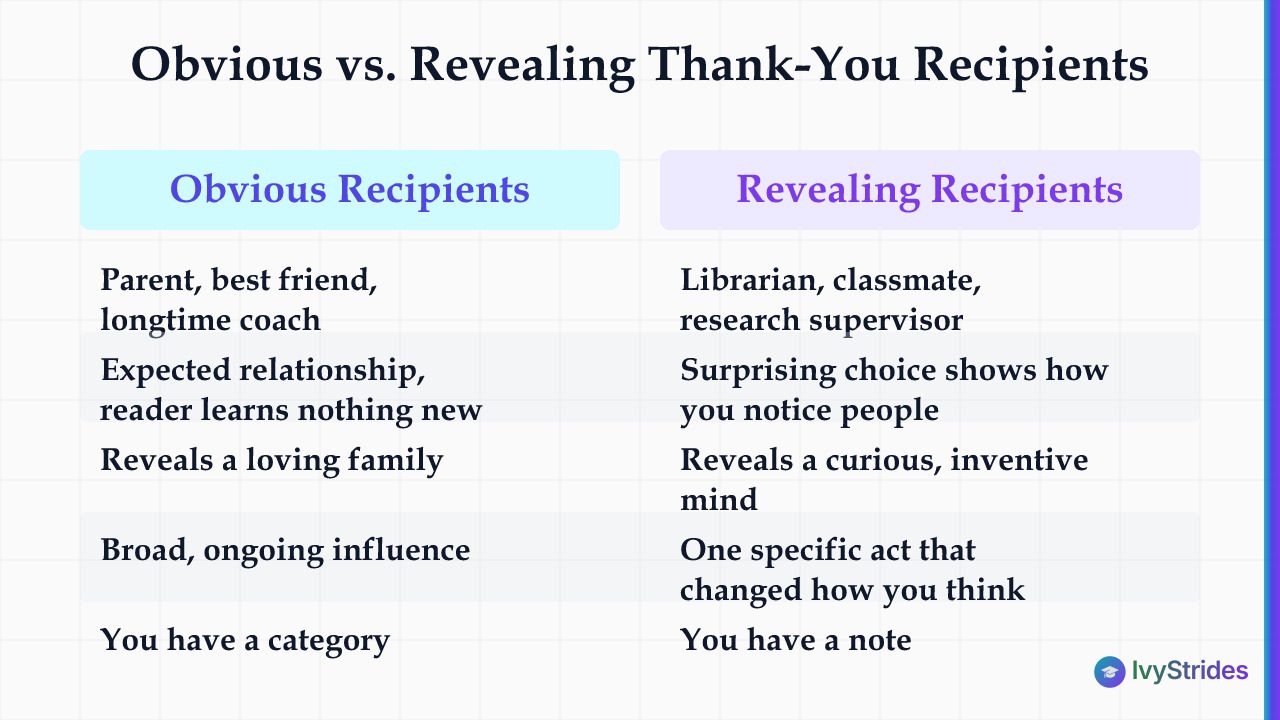
The strongest recipient is someone whose one specific act changed how you think or behave, not the person you love most. Penn's writing page says its short-answer prompts help the committee understand "how you consider others, how you think about community." A recipient choice is a character signal before it's a gratitude exercise.
Here's the part that's easy to miss. The obvious names, a parent, a best friend, a longtime coach, often produce generic notes. The relationship is so expected that the reader learns nothing new about you. A note to your mom for always being there reveals a loving family. It rarely reveals a curious, inventive mind.
Where revealing recipients come from. Think about someone whose influence was narrower and sharper: a librarian who handed you one book, a classmate who disagreed with you and made you rethink a position, a research supervisor whose offhand comment stuck. The surprise in the choice is itself evidence of how you notice people.
Run each candidate through Penn's character framework. Does thanking this person surface open-mindedness, curiosity, inventiveness, or a focus on social good? Penn's review doesn't favor any one component, so the note can't carry your whole application, but it can show one trait vividly.
Your school matters here too, because each Penn school looks for different strengths. Per Penn's academics page, Wharton wants "demonstrated leadership" and "an interest in business to fuel positive change"; Nursing wants "a commitment to patient care"; Engineering wants "an ability to innovate." A Nursing applicant thanking a hospice volunteer lets the note quietly reinforce school fit. Don't force it, but if two recipients are equally strong, pick the one that aligns.
Is your recipient choice strong? Run these four questions:
-
Can you name one concrete act this person did, in a single sentence?
-
Would a Penn reader learn something new about you from the choice itself?
-
Does the note surface a Benjamin Franklin-inspired trait: curiosity, inventiveness, social good?
-
Is the person surprising enough that the choice shows how you see others?
Daily SAT and ACT prep on YouTube: short strategy videos from IvyStrides. Subscribe to IvyStrides on YouTube.
If you answer no to the specificity question, you don't have a note yet. You have a category.
How to Write the UPenn Thank-You Note in 200 Words or Fewer
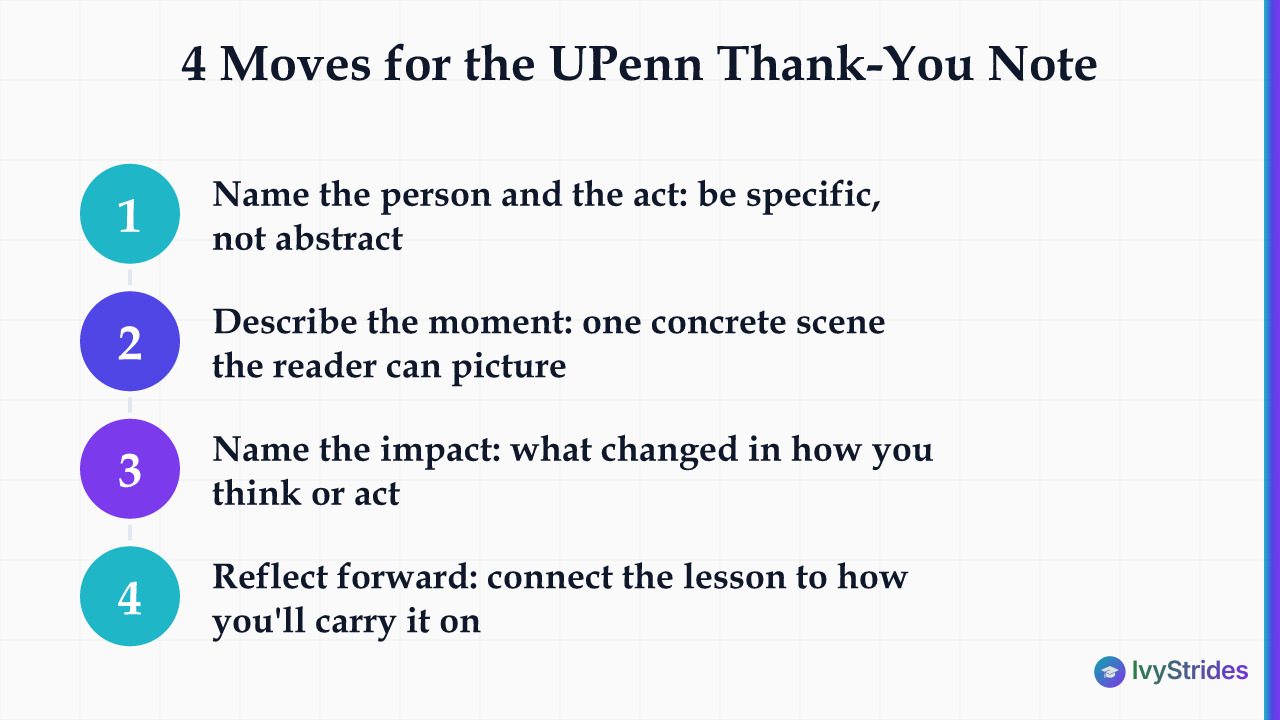
A strong Penn thank-you note does four jobs: it names the person and the act, grounds it in a specific moment, states the impact on your thinking, and closes with a forward-looking reflection. In 50-200 words, every sentence earns its place. Aim for around 150 words.
The four moves, in order:
-
Name the person and the act. Open with who, and what they did. Specific, not abstract.
-
Describe the moment. One concrete scene the reader can picture. This is where the note stops sounding like an essay.
-
Name the impact. What changed in how you think or act? This is the engine of the note.
-
Reflect forward. Connect the lesson to how you'll carry it into the future. The reflection does the heaviest lifting.
Write it as a real note. Penn says "we encourage you to share this note with that person," so draft it as something you'd genuinely send. A note aimed past the recipient at a committee loses the warmth that makes the form work. If you'd cringe handing it to the person, rewrite it.
The reflection is where the note shows how you consider others. A note that stops at "thank you for believing in me" never gets there. A note that says "you taught me to ask the second question, and now I interrupt my own conclusions" does.
Like other short supplements, the 200-word note is a different writing task from your personal statement: it must read as a genuine note, not a compressed essay. If the right recipient is clear but the draft isn't landing, work with an essay coach one-on-one. In IvyStrides' essay coaching, the student drafts, a coach reads every draft, and the voice stays the student's.
What a Strong UPenn Thank-You Note Example Looks Like
A strong UPenn thank-you note example earns every word by moving through the four jobs inside the 50-200 word limit. Here's an illustration written for this article (not a real applicant's essay), about 110 words, built to show the structure:
"Mr. Alvarez, you ran the school's recycling program alone for three years, and I never said anything. The day you asked me to sort compost after everyone left, I almost said no. Instead I stayed, and you spent the hour explaining why the cafeteria's waste numbers mattered to the whole district.
I didn't care about trash. I cared that you cared, publicly, about something unglamorous. I started tracking our lab's plastic use after that, and last month I proposed a reuse system to our chemistry teacher. You taught me that quiet, repeated effort on an ordinary problem is its own kind of leadership. I'm trying to be that patient. Thank you."
The same specificity that makes a thank-you note land, naming a concrete act rather than a general quality, also separates a strong school-specific answer from a generic one. Watch what each move does:
| Section of the Note | What It Says (Example) | What It Reveals to Penn Readers |
| Name person and act | "You ran the recycling program alone for three years" | Notices unglamorous, unrecognized work |
| The specific moment | "You asked me to sort compost after everyone left" | A concrete scene, not a summary |
| The impact | "I started tracking our lab's plastic use" | Curiosity turned into action |
| Forward reflection | "I'm trying to be that patient" | Self-awareness, a practical character |
Compare that to the generic version: "Thank you for inspiring me to care about the environment. You showed me the importance of hard work." No moment, no named act, no self-awareness: it tells instead of shows, so it could belong to any applicant anywhere.
Penn's three prompts are a manageable set, but they add to a supplement count that grows with every school on your list, so pace yourself. No single essay guarantees admission, and Penn's review weighs the full application. The note's job is to reveal one true thing well. A parent can help by asking who the recipient is and why, while supporting the essay without taking over the student's voice.
Penn's binding Early Decision deadline was November 1, 2026, so a note you start now is for the Regular Decision deadline of January 5, 2027, per Penn's first-year applicants page. You have time to get the recipient right. Use it.
FAQ: Penn's Thank-You Note Essay
Who should I write my UPenn thank-you note to?
Choose someone whose specific act shaped how you think or act, not the most obvious person in your life. A mentor, a peer who challenged you, or a community member who did something unexpected often produces a more revealing note than a parent or coach.
What are the prompts for the UPenn supplemental essay?
Penn asks first-year applicants three prompts for 2026-27, each 50-200 words: a thank-you note, a community essay on how you will explore community at Penn and help shape it, and one school-specific prompt for your chosen undergraduate school. Coordinated dual-degree applicants answer additional program-specific essays.
Can you provide an example of a thank-you note for the Penn supplemental essay?
A strong example names one specific act the recipient did, describes the moment concretely, states the impact on the writer's thinking, and closes with a forward-looking reflection. The annotated example above shows each of those four moves inside the 50-200 word limit.
Does Penn really want you to send the thank-you note?
Penn's writing page says: "We encourage you to share this note with that person, if possible, and reflect on the experience!" It's an encouragement, not a requirement. The practical effect is that the note should read as something you'd genuinely send.
Your Next Step on Penn's Thank-You Note
The note works when the recipient choice reveals character and the writing moves through all four jobs in 200 words or fewer. Everything else is polish. Here's what to do next:
- List three recipients whose single concrete act you can name in one sentence.
- Run each through Penn's character framework and pick the one that surprises.
- Draft to around 150 words, hitting all four moves: person and act, moment, impact, reflection.
- Read it aloud as if handing it to the person. If it sounds performed, cut until it sounds true.
- Paste the final note into Penn's section of your application and check that it lands between 50 and 200 words.
College admissions insights on LinkedIn: follow IvyStrides for application guidance and counseling updates.

Rajesh is a technology leader, entrepreneur, and angel investor with 28+ years in Business & Technology Leadership and Product & Solution Engineering. He is passionate about education, mentoring, and driving digital transformation.