
Essay Coaching Classes or One-on-One: When a Class Is Enough
On this page
- Essay Coaching Classes vs. One-on-One: What Each Format Actually Delivers
- Which Essay Coaching Format Fits Your Application Timeline
- What One-on-One College Essay Coaching Covers That a Class Cannot
- When a Group Essay Coaching Class Is the Right Starting Point
- FAQ: Essay Coaching Classes and One-on-One
- Are college essay coaches worth it?
- Do essay coaches write the essay for you?
- Can I start with a class and switch to one-on-one?
- Which college essay review service is the best?
- Your Next Step on the Format Decision
A group essay coaching class is enough when you write independently, carry a modest supplemental load, and have time to revise alone. One-on-one fits better when your supplement list is long for the time you have left, or when you are still hunting for a story. Essay coaching is the structured help a student gets drafting the Common App personal statement and each college's supplements.
The choice turns on three things: how many essays you owe, how selective your targets are, and how much time sits between now and your earliest deadline. The November 1 round has passed for 2026-27, but Common App's grid lists many early deadlines on November 15 and December 1, and many seniors have January deadlines too, while a junior can plan around the Common App's next launch on August 1, 2027.
Know one thing before you compare: IvyStrides coaches one-on-one and does not sell a class. Any class this article calls enough is one you would find elsewhere, such as at your school.

Essay Coaching Classes vs. One-on-One: What Each Format Actually Delivers
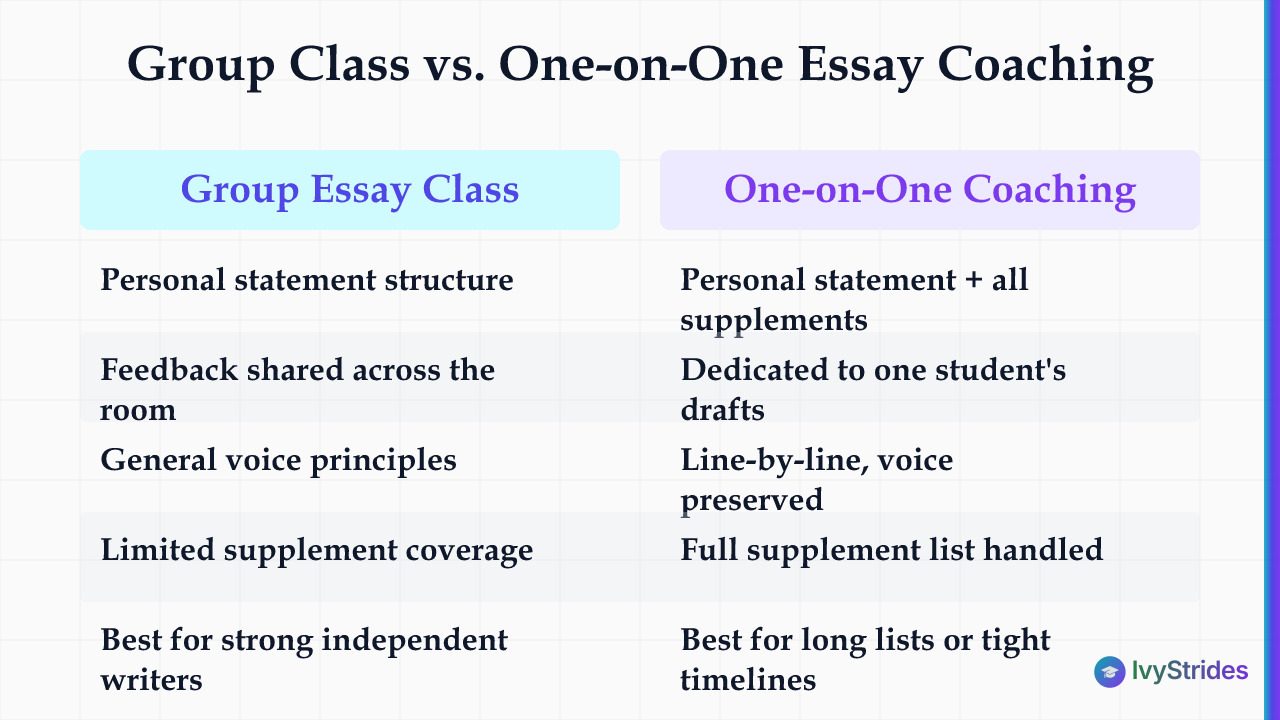
Essay coaching is structured guidance on the admissions essays, and the two formats deliver it very differently. A group class teaches one thing well: structure. A coach walks a room through brainstorming, narrative shape, and what a strong personal statement does, with feedback shared across everyone present. One-on-one coaching assigns a single coach to one student across every draft, from brainstorming to line-by-line revision on the personal statement and each supplement.
The personal statement is the shared anchor. The Common App personal essay has a 650-word limit and seven prompts, unchanged for 2026-27. A class can build around that one essay, because the same piece can go to any college on your Common App list. Each college decides whether the personal essay is required or optional, though you may submit it to any college regardless.
Supplements are a different animal. Not every college requires a writing supplement, and those that do set their own prompts. Your real workload is one personal statement plus every supplement on your list, and because prompt counts differ from one college to the next, only your own list can tell you the total.
| Feature | Group Essay Coaching Class | One-on-One Essay Coaching |
| Primary focus | Personal statement structure | Personal statement and, if you choose, every supplement |
| Feedback | Shared across the room | Dedicated to one student's drafts |
| Voice work | General principles | Line-by-line, voice preserved |
| Supplement load handled | Limited | Full list |
| Accountability | Mostly on you | Deadline-by-deadline |
| Best for | Strong independent writers with time to revise | Long supplement lists or little time to revise alone |
Which Essay Coaching Format Fits Your Application Timeline
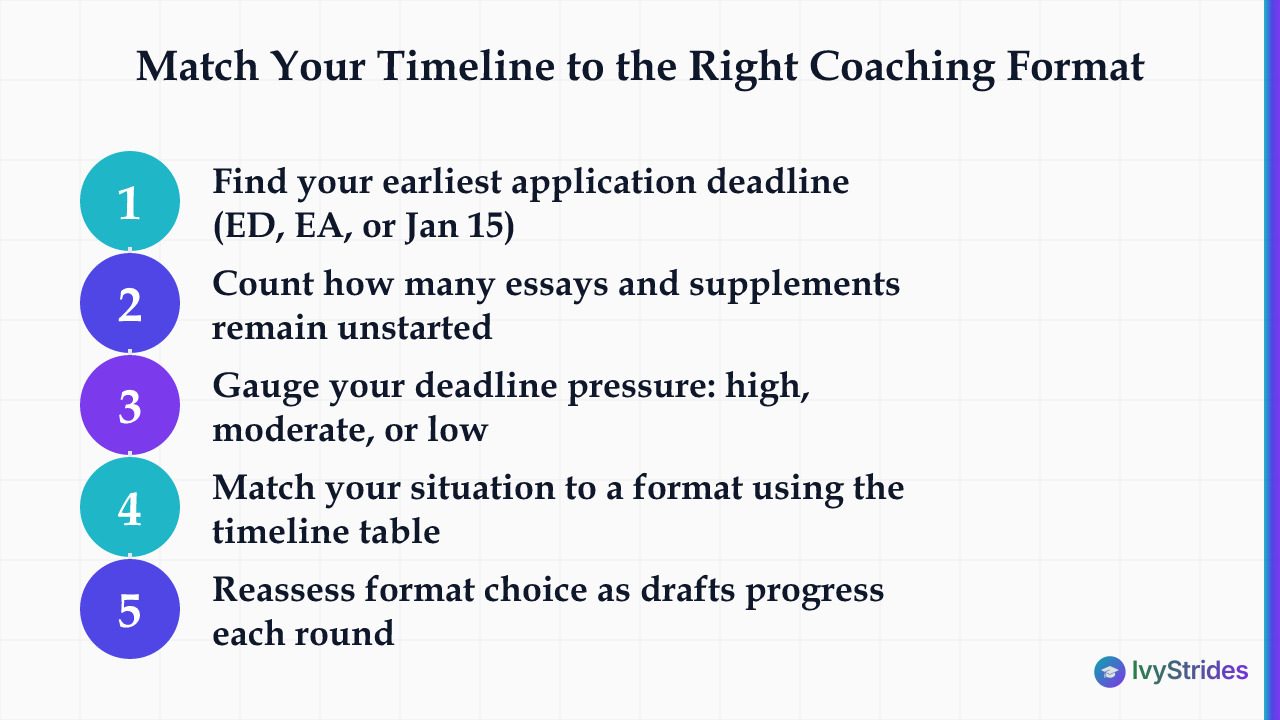
Your application round decides how much revision time you actually have, and that time, set against your essay count, decides which format is realistic. A senior with a January 15 deadline has weeks; a junior planning for the next cycle has months.
Early rounds compress everything. Early Decision is binding, and you may apply ED to only one college; if admitted, you withdraw your other applications. The ED agreement is signed by the student, a parent or legal guardian, and the counselor before it reaches the college. Early Action is non-binding, and admitted students have until May 1 to decide. ED II deadlines vary, but for 2026-27 the most common ED II deadline is January 15, 2027, used by 57 of the 127 member colleges offering it.
A few mechanics shape your planning window. The Common App launched this season on August 1, 2026, and it launches on August 1 each year. Through it, you may apply to a maximum of 20 colleges in one cycle. Each deadline ends at 11:59 pm in your own local time zone, not the college's.
Still deciding whether you need any coaching at all? Timing matters as much as format, because what a coach can still change depends on your application round and how far along your drafts are. Your earliest deadline sets the outer edge of your planning, so lay your essay work against a month-by-month 2026-27 application timeline.
| Where You Are Now | Deadline Pressure | Essay Load | Format That Fits |
| Senior, January deadlines, many supplements unstarted | High | Heavy | One-on-one, if you cannot keep them on schedule alone |
| Senior, ED II on January 15, drafts well along | Moderate | Few remaining | A class or solo revision, if time remains |
| Senior, January deadlines, few supplements left | Moderate | Light | A class may be enough |
| Junior planning for August 1, 2027 | Low | Not yet set | A class, then reassess |
What One-on-One College Essay Coaching Covers That a Class Cannot
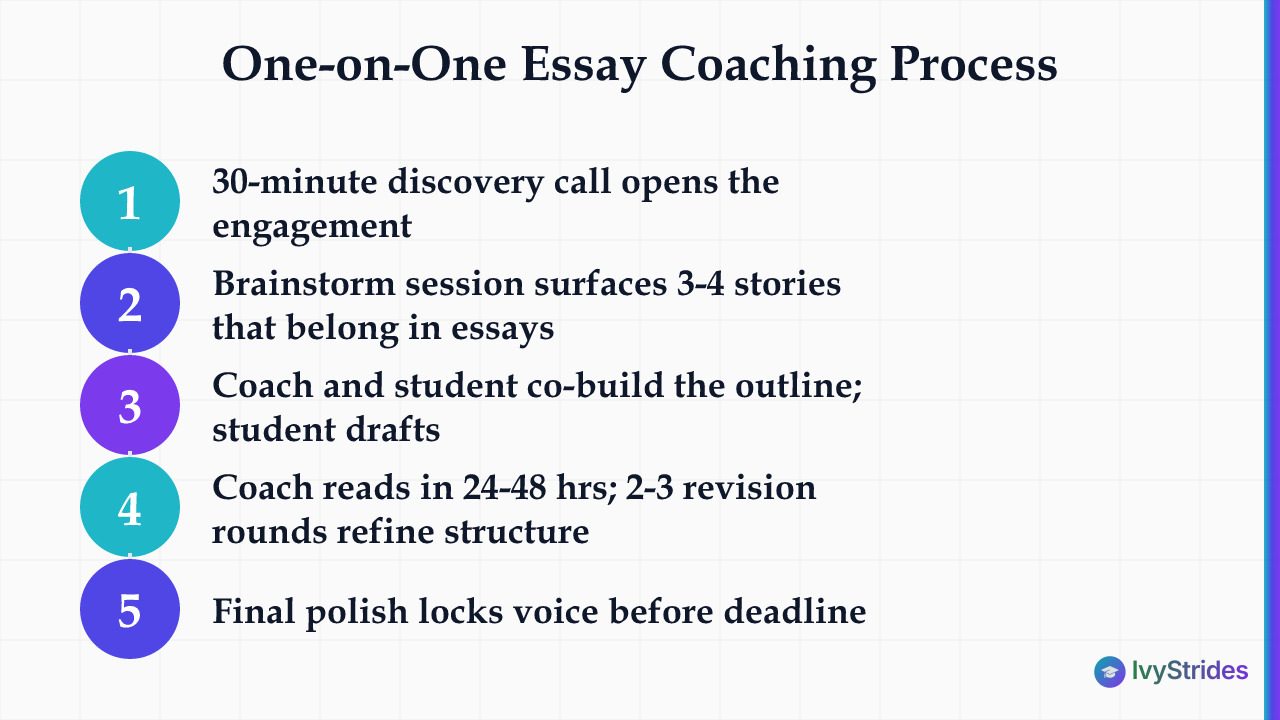
One-on-one essay coaching covers four tasks a shared classroom isn't built for: holding one voice across every essay, line-by-line revision, keeping a long supplement list on schedule, and finding a story when none is obvious. A class can teach what a strong essay looks like; it cannot read your last supplement and tell you it sounds like a different person wrote it.
Daily SAT and ACT prep on YouTube: short strategy videos from IvyStrides. Subscribe to IvyStrides on YouTube.
Your essay count is one personal statement plus each college's supplements, and that count, set against your time, is what tips the format decision. A student with a short list can revise alone after a class. A student with a long list across selective schools is managing a portfolio, and voice consistency across that many pieces is hard to hold without one reader seeing all of them.
Voice preservation is the quiet failure point. You get unlimited edits to the personal essay after your first submission. An edited essay only reaches colleges you have not yet submitted to; once you submit to a college, that college's copy is locked. Editing without a reader who knows your voice can sand it flat. IvyStrides' essay coaching is one-on-one: the student drafts, a coach reads every draft, on the personal statement alone or on every supplement too, and the voice stays the student's.
In our coaching, the sequence is planned backward from your deadline. A 30-minute discovery call opens it, then a brainstorm session surfaces the three or four stories that actually belong in essays, because most students don't pick the right one first.
The coach and student co-build the outline, the student drafts, the coach reads in 24 to 48 hours, and two to three revision rounds move from structure first to sentences last, before a final polish. When the story itself is the problem, the work starts earlier, with brainstorming exercises that surface a story you have not found yet.
Signals that point to one-on-one, not a class:
- Your selective targets ask for several essays, and you want one reader on all of them.
- Your supplement list is longer than you can keep on schedule alone.
- You've redrafted the personal statement and it still reads generic.
- Feedback from a class or a teacher has been structural, never line-by-line.
- You cannot name the one story that belongs in your personal statement.
- Your deadlines cluster and you need someone tracking them.
- Your essays sound different from one supplement to the next.
If none of these sounds like you, a class may well do the job.
When a Group Essay Coaching Class Is the Right Starting Point
A group essay coaching class is the right starting point for a strong independent writer with a modest supplement list and enough runway to revise alone after structured instruction. Not every applicant needs a coach on every draft. If you write cleanly, you know your story, and your list asks for only a few essays, a class that teaches personal statement structure can carry you. Ask your school counselor what your school offers before you look elsewhere.
A class is a reasonable first move, not a lesser one. A good one teaches what admissions readers look for in an essay, which is the same thing a strong one-on-one coach starts from. Start there, draft, and see how far you get before deciding you need more.
A class can drill one writing habit into a room: choose the specific, honest detail over the grand statement. What it can't do is follow your particular draft across every supplement.
Before you join any class, ask two questions: who reads my draft, and how often? If the honest answer is "the group, in general," you're getting structure, not revision. That's fine when structure is what you need. The same two questions apply to college essay help online, which can run as a live video session or as written comments, so find out which you would get.
| Student Profile Factor | Group Class Fits | One-on-One Fits |
| Writing independence | Strong | Needs support |
| Supplement count | Few | Many |
| Target selectivity | You want structure, not a close read | You want a close read on each draft |
| Time to revise alone | Ample | Tight |
| Story clarity | Already clear | Still searching |
FAQ: Essay Coaching Classes and One-on-One
Are college essay coaches worth it?
It depends on your load and time. With a long list of supplemental essays or an unclear story, one-on-one coaching puts one reader on every draft, which a shared class does not do. A strong independent writer with a modest load may find a structured class enough. No coaching format guarantees admission, which rests on the full application.
Do essay coaches write the essay for you?
They should not. IvyStrides coaches never do: they coach, prompt, push back, and edit, you draft, and the voice stays yours. Common App applicants certify that what they submit is their own work, so ask any coach or class how edits get made before you start.
Can I start with a class and switch to one-on-one?
Yes. Reassess after your first drafts. If the feedback stays general, your supplement list grows, or your voice shifts from essay to essay, move to one-on-one while enough time remains.
Which college essay review service is the best?
The best fit depends on what you need. A group class suits structural guidance on the personal statement; one-on-one suits line-by-line feedback across multiple supplements or a search for a story. Judge any service by whether it assigns a dedicated coach, how many revision rounds it includes, and whether the coach knows your target colleges' prompts.
Your Next Step on the Format Decision
Pick the format that matches your real situation, then act before your earliest deadline closes. The decision is simple once you count honestly.
- Count your essays: one personal statement plus each college's supplements.
- Count the weeks between now and your earliest deadline.
- If your list is long for the time left, or your story is unclear, lean toward one-on-one.
- If you write independently with a light load and time to spare, a class, such as one at your school, can start you off.
- Reassess after your first drafts; you can switch to one-on-one if a class leaves gaps.
College admissions insights on LinkedIn: follow IvyStrides for application guidance and counseling updates.

Hemant is a seasoned entrepreneur, investor, and growth strategist with deep ground in education and technology-driven learning. His core training is in Mathematics and Physics — he authored Physics for IB Diploma: Ultimate Revision Guide, recognized as a top student resource.