
A Parent's Guide to the College Essay (Plus Transfer & Scholarship Essays)
On this page
- Why the Essay Matters More Than Parents Often Realize
- How to Help Your Student Brainstorm Without Putting Words in Their Mouth
- What Good Parental Feedback Looks Like (and What Crosses the Line)
- Can Your Student Use ChatGPT for Their College Essay? What Parents Need to Know
- Transfer Essays and Scholarship Essays: How Parental Support Shifts
- When to Stop Helping Alone and Hire a College Essay Consultant
- The Essay Inside the Bigger Admissions Picture: Scores, APs, and Essays Together
- FAQ
- What are the 5 Ds of college essays?
- Can my student write their Common App essay about a parent or family member?
- Is it okay for parents to help edit a college essay, or does that count as cheating?
- Can admissions officers detect essays written with ChatGPT?
- What is the word limit for the Common App personal statement in 2026-2027?
- What free resources are available for college essay writing?
Parents help most by facilitating brainstorming, asking open-ended questions, and giving structural feedback on drafts, not by editing sentences or rewriting paragraphs. The Common App personal statement has a 650-word limit and must sound like the student, not a parent. Admissions readers review thousands of essays each cycle and consistently identify adult voice. Your job is to be a thoughtful first reader: ask what the essay is trying to show, flag where the story gets unclear, and point out where your student's real personality comes through. That's the full scope of effective parental involvement.
The word limits and prompt list come from the Common App; the seven prompts are unchanged for 2026-2027. The harder question is where the line sits between helpful feedback and quiet overwriting, and that's where the next several sections go.
Why the Essay Matters More Than Parents Often Realize
The essay is one of the few pieces of the application where the student, not a teacher, a testing agency, or a transcript, controls the narrative. Selective colleges may receive tens of thousands of applications in a single cycle. Grades and scores tell a reader whether your student can do the work. The essay tells them who is doing it.
At test-optional schools, that weight climbs higher. When the quantitative signal is absent, admissions readers lean harder on the essay and the activities list to differentiate between academically similar applicants. If your student is applying test-optional to any target school, essay quality carries even more weight in the admissions file, which is worth keeping in mind as you help your student prioritize their writing time.
Essays don't operate in isolation, though. Strong AP scores and a strong essay are not separate goals; together they tell a consistent story about academic readiness and intellectual curiosity that admissions readers look for across the full application. A student with three 5s on APs whose essay describes intellectual curiosity through a specific classroom moment reads as coherent. A student whose essay contradicts the transcript, either by claiming a passion the grades don't support or by ignoring the strongest signal in the file, reads as thin.
One caveat: admissions outcomes depend on the full application, not the essay alone. A strong essay does not compensate for a weak transcript at highly selective schools, and a mediocre essay does not sink an otherwise strong file at most schools. The essay matters in proportion to how close the student is to the school's admit band. For students at the margin, it can be decisive. For a step-by-step walkthrough of drafting, our guide on how to write a personal statement covers structure, opening hooks, and the narrative arc.
How to Help Your Student Brainstorm Without Putting Words in Their Mouth
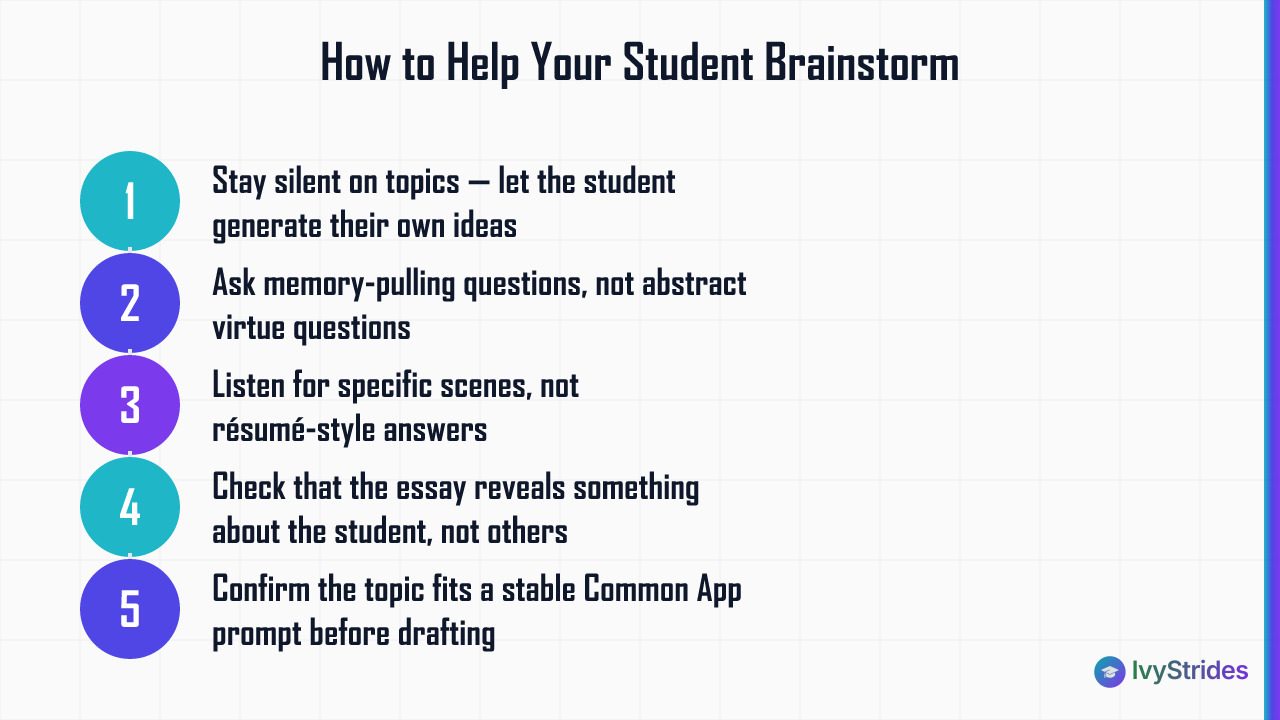
The most common parent mistake happens before the first word is written. Your student sits down to brainstorm, says "I don't know what to write about," and you offer a topic. Maybe a good one. Maybe the one you have always thought captured them best. And now the essay is yours, not theirs, before the draft even begins.
Brainstorming is the phase where student voice is most fragile. Your role is to ask questions and listen, not to propose answers. Two questions that work in our coaching:
- "What moment from the last three years do you think about most?"
- "What would your closest friend say is the most surprising thing about you?"
Notice what those questions do. They pull specific memory, not abstract virtue. A student who answers "I think about the night I stayed up finishing my sister's science project because she was crying" has a scene. A student who answers "resilience" has a résumé bullet.
The Common App confirmed that the seven essay prompts will remain unchanged for 2026-2027, so any brainstorming your student does now is built on a stable foundation. The prompts cover: a background, identity, interest, or talent central to the student; a challenge, setback, or failure and the lesson drawn; a belief or idea challenged; a problem solved or wants to solve; an accomplishment, event, or realization that sparked growth; a topic the student finds captivating; and the gratitude prompt added in recent cycles. The seventh option remains topic of your choice.
Topic choice is often where students get stuck first; our breakdown of the best college essay topics in 2026 flags the overused angles that admissions readers have seen too many times. The short version: sports injury essays, mission trip essays, and immigration stories told without a fresh, student-specific angle are three categories reviewers see most and remember least.
A note on writing about a parent. Yes, your student can write about you, or about a grandparent, sibling, or family member. But the essay must ultimately reveal something about the student, not the parent. If you removed the student from the essay entirely, would it still make sense? If yes, the essay needs revision. Tribute essays that never make the turn back to the applicant are one of the most common structural failures we see. For students who want a step-by-step walkthrough of the drafting process itself, our guide on how to write a personal statement covers structure and narrative arc from first sentence to last.
What Good Parental Feedback Looks Like (and What Crosses the Line)
Here's the hardest part of this whole process, and the reason most parents quietly worry they're doing it wrong.
The line between feedback and rewriting isn't about intent. It's about output. If your student's draft comes back with three sentences rephrased in your vocabulary, you've crossed it, even if you were only trying to help. Admissions officers at selective schools have publicly stated they can identify essays written or heavily edited by adults, based on vocabulary register, sentence complexity, and the absence of authentic teenage voice. Words that no 17-year-old actually uses in conversation are tells. So is a 30-word sentence with three subordinate clauses in a draft where the rest reads like a text message.
Use the 5 Ds of college essays as your feedback framework. This is a coaching checklist, not an official Common App or College Board rubric, but it's how essay professionals structure revision:
- Distinguish: does the essay set the student apart from other applicants writing about similar experiences?
- Demonstrate: does the essay show through specific scene and detail, rather than tell through claim and adjective?
- Describe: is the central moment vivid and sensory, so the reader can picture it?
- Develop: does the narrative build toward a meaningful insight or growth moment, not just recount events?
- Deliver: does the ending land with purpose and leave a clear impression?
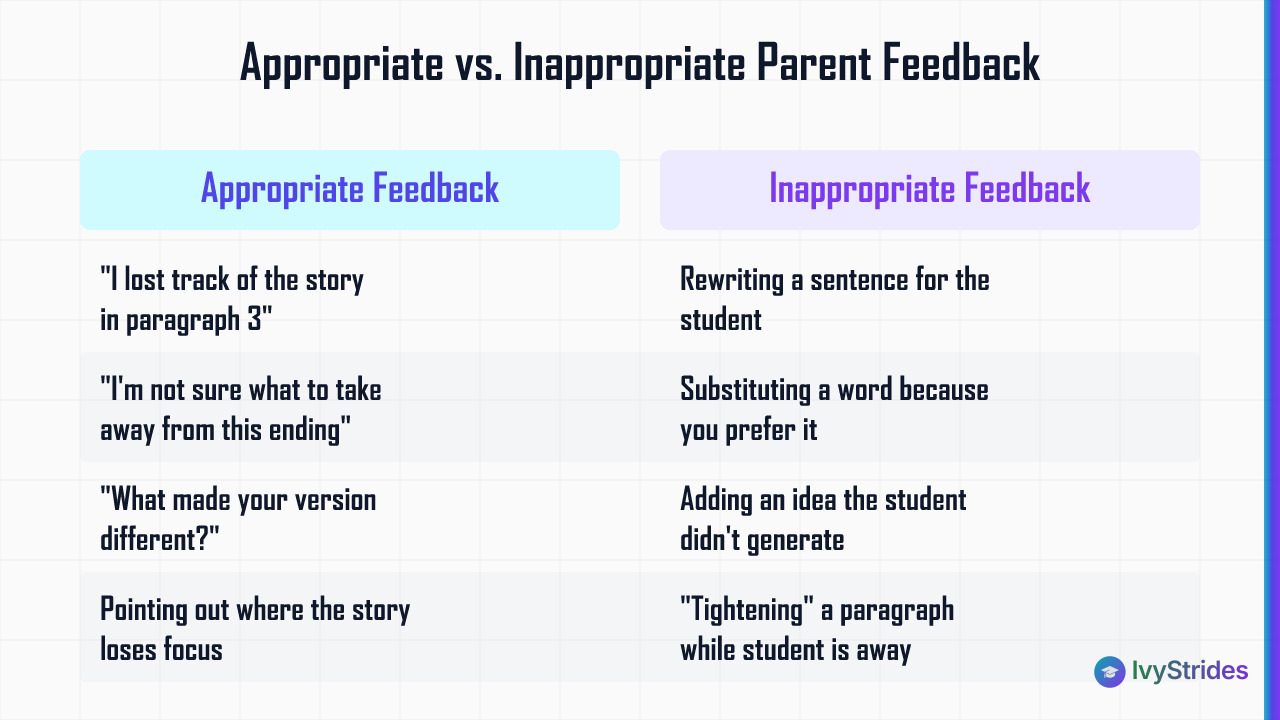
Now translate those into things you actually say out loud. Appropriate feedback sounds like: "I lost track of the story in paragraph 3." Or: "I'm not sure what you want me to take away from this ending." Or: "This paragraph feels like every other essay about volunteering. What made your version different?"
Inappropriate feedback sounds like: rewriting a sentence, substituting a word because you prefer it, adding an idea the student didn't generate, or "just tightening" a paragraph while the student is out of the room.
In our coaching with students, the essays that read most authentically are the ones where the student wrote the first draft alone before any feedback was given. Essays where a parent drafted the opening paragraph are identifiable within the first three sentences.
If your student is ready to move from a rough draft to a polished final version, our detailed walkthrough on how to edit a college essay covers the revision steps that preserve voice while tightening structure. If the student is willing to work with an outside reader but not with you (which is common and healthy), one-on-one help for common app essay work is one option to bridge that gap.
Can Your Student Use ChatGPT for Their College Essay? What Parents Need to Know
Short answer: for brainstorming, cautiously yes. For drafting, no.
The detection landscape has changed fast. Admissions consultants and some admissions offices now use AI detection tools such as Pangram to flag essays before human review. Beyond the software, experienced readers spot AI-generated text by its generic phrasing, its unnaturally balanced sentence rhythm, and vocabulary that doesn't match the student's writing on the rest of the application (short-answer responses, activity descriptions, the additional information section). A student whose Common App essay reads at the register of a consulting memo while their activity descriptions read like a teenager wrote them creates a mismatch that catches attention.
Appropriate AI use looks like: "ChatGPT, what are 10 possible angles for an essay about the summer I worked at my uncle's auto shop?" The student reads the list, picks one, closes the tab, and writes the draft themselves. The AI generated options. The student generated the essay.
Inappropriate use looks like: pasting a prompt into ChatGPT and submitting the output, or asking ChatGPT to "improve" a draft in ways that replace the student's voice with polished but generic prose. Even asking AI to "fix the flow" of a paragraph often flattens the voice enough that a trained reader notices.
One caveat: policies on AI use in college applications vary by school, and some schools have explicit honor code language covering AI-generated application materials. Check each target school's policy before your student experiments. For families who want a professional read on whether a draft is landing without the risks of AI editing, our essay review service is a lighter-touch option than full coaching.
Transfer Essays and Scholarship Essays: How Parental Support Shifts
Most parent-facing essay guides stop at the Common App personal statement. If your student is applying as a transfer or chasing scholarship dollars, they need different support, though your role stays roughly the same.
Transfer essays. The Common App transfer application requires a Why Transfer essay explaining the academic or personal reasons for the move, plus a Why Us essay for each target school. The audience is different: an admissions reader for transfers wants to know that your student will succeed at the new school and stay through graduation. The essay should not read as a complaint about the current school. It should frame the move as a positive academic decision. "I need a stronger program in computational linguistics" reads differently than "the professors here are disappointing." Same underlying truth. One lands. One doesn't.
Scholarship essays. These usually have tighter word limits (typically around 250 to 500 words) and a specific prompt focus: leadership, community service, STEM interest, financial need narrative, first-generation student experience. Students can often adapt two or three paragraphs from the personal statement for scholarship essays when the prompt overlaps, but the opening and closing should be rewritten to match the specific prompt. Don't submit a personal statement as a scholarship essay with a new first line. Scholarship committees read for prompt-specific fit.
Your role in transfer and scholarship essays is identical to your role in the personal statement: brainstorming facilitator and structural reader, not co-author. If anything, the shorter word limits on scholarship essays make voice compression harder, which makes parental overwriting more damaging. Every substituted word takes up a larger fraction of the piece.
Once the personal statement is in strong shape, supplemental essays become the next high-use task; our guide on how to write supplemental essays walks through the Why Us, activity, and community prompts school by school. If your student wants direct expert help on any of these essay types, a common app essay tutor can work across all of them, not just the personal statement.
When to Stop Helping Alone and Hire a College Essay Consultant
There's a point where parental help stops adding value. You'll recognize it in one of these signals:
- Your student has been on the same draft for more than three weeks without meaningful progress.
- You and your student are in conflict over the essay, and the conversations end badly.
- The essay reads generically despite multiple revisions, and you can't articulate why.
- Your student is applying to highly selective schools where essay differentiation carries real weight.
Look, in our coaching, the most common issue is not poor writing ability. It's a lack of clarity about what story to tell. A student who has revised the same draft five times without improvement usually has the wrong topic, not weak sentences. A coach helps the student find the angle, not write the essay for them.
What separates a college essay consultant from generic feedback? A professional essay coach reads with two eyes: one on the draft in front of them, one on the rest of the application. They know whether the essay is doing work that the transcript and activities list are not, or duplicating a signal that is already loud. IvyStrides essay coaching is 1-on-1, not a group workshop or a template-driven service. Coaches work from the student's actual draft and application context.
Free resources for college essay writing are a fine starting point. The Common App's own guidance at commonapp.org is worth reading. Free resources don't give your student personalized feedback on their specific draft, though. For families who want expert eyes on a draft without a full coaching engagement, our standalone essay review service is designed exactly for that gap.
The Essay Inside the Bigger Admissions Picture: Scores, APs, and Essays Together
The essay doesn't sit alone in the application. It sits next to a transcript, a test score decision, an activities list, and letters of recommendation. Treating it as a standalone project is one of the most common strategic mistakes families make.
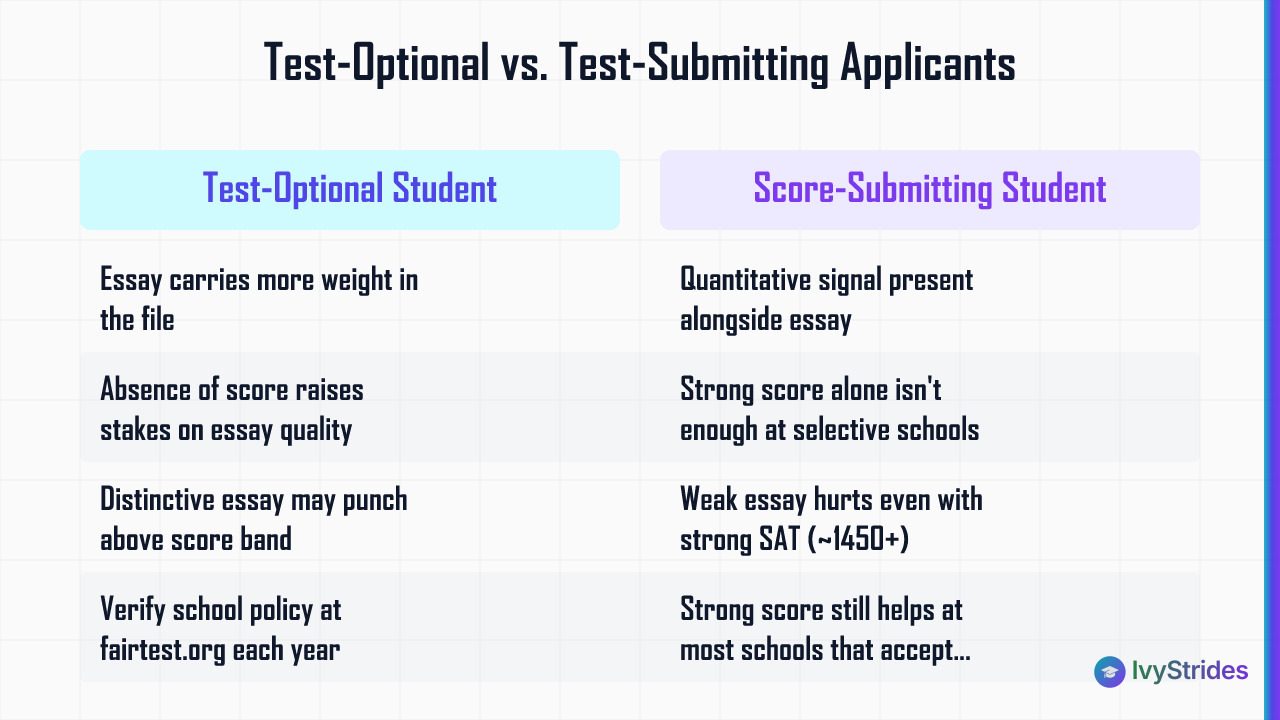
At test-optional schools, the essay and extracurricular narrative carry more weight because the quantitative signal is absent. This makes essay quality more consequential for students who choose not to submit scores. Test-optional does not mean scores are irrelevant, though. Policies vary by school and year, and a strong score still helps at most schools that accept them. Verify each target school's current policy at fairtest.org before deciding whether to submit.
A student with a strong SAT score (around 1450 or above per our sat percentiles breakdown) and a weak essay is not automatically competitive at highly selective schools. Admissions is holistic. Conversely, a student with a moderate score and a genuinely distinctive essay may punch above the score band at test-optional schools. The application components are read together. For families thinking through the score side of the picture, our overview of the official sat study guide 2026 covers what to prioritize.
AP scores work the same way. A student taking four or five APs and scoring 4s and 5s tells a consistent story of academic readiness and intellectual depth that the essay should reinforce, not contradict. In our coaching with students applying to test-optional schools, we consistently see the essay carrying more weight in the file when no score is submitted. That doesn't make the essay decision easier. It raises the stakes on getting the essay right.
One last caveat: college admissions outcomes depend on the full application, not any single component. No essay, however strong, guarantees admission. No essay, however weak, is the sole reason a student is denied. The essay is a lever. Use it well.
FAQ
What are the 5 Ds of college essays?
The 5 Ds are a coaching feedback framework: Distinguish (does the essay set the student apart from other applicants?), Demonstrate (does it show rather than tell?), Describe (is the central scene or moment vivid and specific?), Develop (does the narrative build to a meaningful insight or growth moment?), and Deliver (does the ending land with purpose and leave the reader with a clear impression?). Parents can use these five questions as a structured checklist when reading a draft instead of making line-by-line edits. It's a coaching framework, not an official Common App or College Board rubric.
Can my student write their Common App essay about a parent or family member?
Yes, but the essay must ultimately be about the student, not the parent. If your student writes about your immigration story, your illness, or your career, the essay needs to pivot quickly to what that experience revealed about the student's own values, growth, or identity. Admissions readers have seen many tribute essays that never make the turn back to the applicant, and those essays tend to feel unfocused. The practical test: if you removed the student from the essay entirely, would it still make sense? If yes, the essay needs revision.
Is it okay for parents to help edit a college essay, or does that count as cheating?
Parental feedback on structure, clarity, and whether the essay sounds like the student is appropriate and expected. What crosses the line is rewriting sentences, substituting vocabulary, or adding ideas the student did not generate. Admissions offices don't prohibit parental involvement, but they do expect the essay to reflect the student's own voice and thinking. If the essay sounds like a 45-year-old professional wrote it, admissions readers will notice.
Can admissions officers detect essays written with ChatGPT?
With increasing reliability, yes. Admissions consultants and some offices use AI detection tools such as Pangram to flag essays before review. Beyond detection software, experienced readers often identify AI-generated text by its generic phrasing, overly balanced sentence structure, and vocabulary that doesn't match the student's other application materials. The safest approach is to use AI tools only for brainstorming and have the student write every draft independently. Submitting AI-generated text as original work also raises academic integrity concerns that vary by school policy.
What is the word limit for the Common App personal statement in 2026-2027?
The Common App personal statement has a 650-word maximum and a 250-word minimum for 2026-2027. The seven prompts are unchanged from the previous cycle, per the Common App's official announcement. Most competitive applicants write close to the 650-word limit, but the goal is to use every word purposefully, not to hit the ceiling for its own sake. Verify current word limits and prompts at commonapp.org before each application cycle.
What free resources are available for college essay writing?
The Common App's own website publishes the official prompts, word limits, and applicant guidance at no cost. Peer-discussion forums like r/ApplyingToCollege host wide-ranging advice, though the quality varies and shouldn't replace expert feedback. For students who want structured feedback beyond what free resources provide, IvyStrides offers both a full essay coaching engagement and a standalone essay review service for students who already have a draft.
The essay is where your student gets to be a person on the page, not a set of numbers. Your job is to protect that. Ask the questions, hold the space, resist the impulse to fix. And know when to bring in someone who reads essays for a living.

Award-winning author (South Asian Book Award) and graduate of BITS Pilani and UCLA Luskin School of Public Affairs. Brings a published writer's eye to Common App essays and grammatical precision to SAT and ACT R&W instruction.