
How Many Times Can You Take the PSAT, and Which Sitting Counts?
On this page
- How Many Times Can You Take the PSAT Each Year, and in Total?
- Which PSAT Sitting Counts for National Merit, and Why Only One Does
- How to Use Each PSAT Sitting Strategically by Grade
- What Happens If You Miss the Junior-Year PSAT/NMSQT?
- FAQ: PSAT Sittings and National Merit
- Can I take PSAT twice?
- Can you retake the PSAT for National Merit?
- Is a 900 PSAT score bad?
- Is 1270 a bad PSAT score?
- Your Next Step on the PSAT Sitting You Can Use
You can take the PSAT/NMSQT once per school year. The PSAT/NMSQT is a College Board assessment designed for 10th and 11th graders, and some students sit it twice: once in 10th grade for practice and once in 11th grade as the official qualifier. For students on the usual four-year path, only the junior-year score enters National Merit.
That one-per-year rule, and the junior-year constraint behind it, come from College Board and the National Merit Scholarship Corporation, both cited below. The harder question isn't how many times you can sit it. It's which sitting actually matters, and what to do with the one that counts.

How Many Times Can You Take the PSAT Each Year, and in Total?
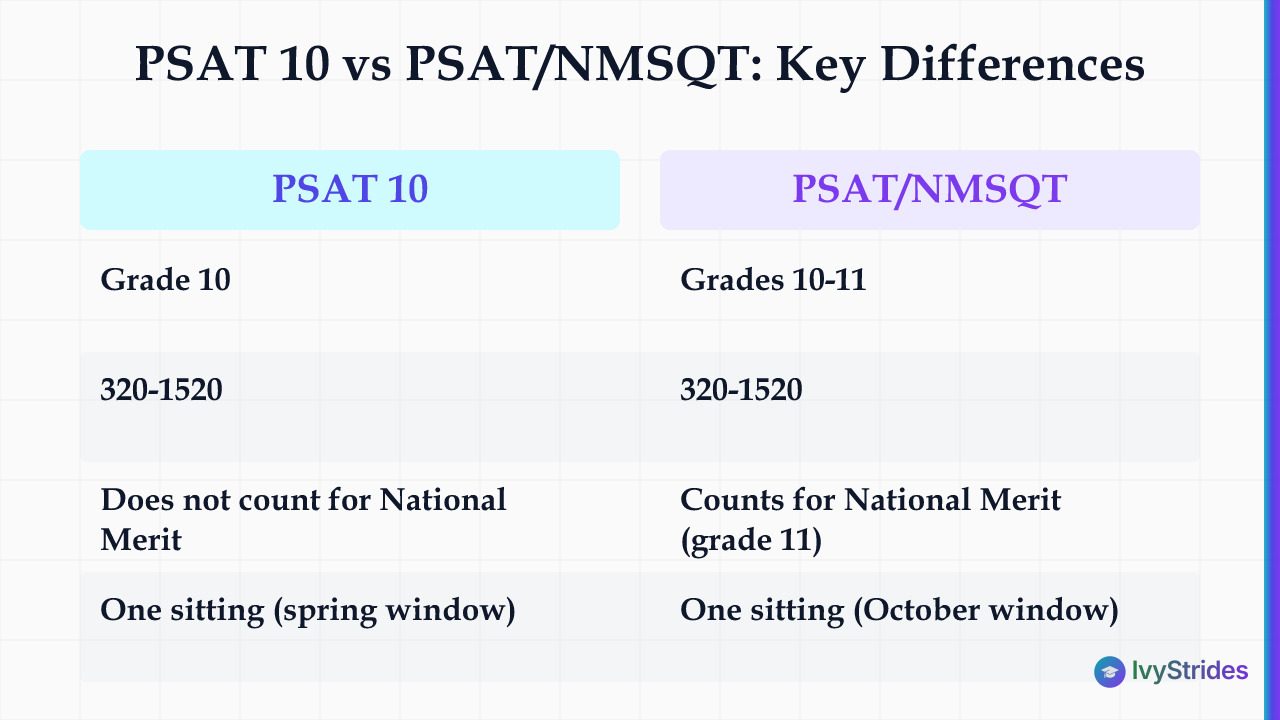
You can sit the PSAT/NMSQT once per school year, and the PSAT family spreads three levels across grades 8 through 11. The PSAT isn't a single test. It's a family of three: the PSAT 8/9, the PSAT 10, and the PSAT/NMSQT. Each targets different grades and allows one valid score per testing window; the PSAT/NMSQT has one window a year.
So across high school, a student might sit the PSAT 8/9 in 9th grade, the PSAT 10 in 10th grade, and the PSAT/NMSQT in 11th grade. That's three sittings in three grades. Some sophomores also sit the PSAT/NMSQT a year early, treating it as a trial run.
Scores scale by grade. The PSAT 8/9 total runs 240 to 1440, with section scores of 120 to 720, per College Board. The PSAT 10 and PSAT/NMSQT both run 320 to 1520. Same scale, same format for those two.
The PSAT/NMSQT gives you 2 hours 14 minutes for 98 questions in two separately timed sections, using the same multistage adaptive digital format as the SAT. Reading and Writing gives you 64 minutes for 54 questions and Math 70 minutes for 44 questions, each in two equal-length modules. The SAT, unlike the PSAT, carries no annual sitting limit; students register for as many SAT dates as they need.
| Test | Designed For | Score Range | Counts for National Merit? | Valid Scores Allowed |
| PSAT 8/9 | Grades 8-9 | 240-1440 | No | One per window (fall, spring) |
| PSAT 10 | Grade 10 | 320-1520 | No | One (spring window) |
| PSAT/NMSQT | Grades 10-11 | 320-1520 | Yes (grade 11 only) | One (October window) |
Registration runs through your school, not College Board. The fall 2026 in-school testing window for the PSAT/NMSQT and PSAT 8/9 runs October 1 to October 30, 2026. List pricing is $18 per student for 2026-27, and some districts and schools cover all or part of it. Some schools add an administrative fee, so what the PSAT costs and whether your school covers the fee varies by school.
Which PSAT Sitting Counts for National Merit, and Why Only One Does
Only the junior-year PSAT/NMSQT qualifies for the National Merit Scholarship Program. The National Merit Scholarship Corporation will not consider the PSAT 10 or PSAT 8/9 for entry. That single rule is why the sitting count matters so much. Nearly all entrants are juniors, so most students get one qualifying attempt, with a retest only after a test-day problem.
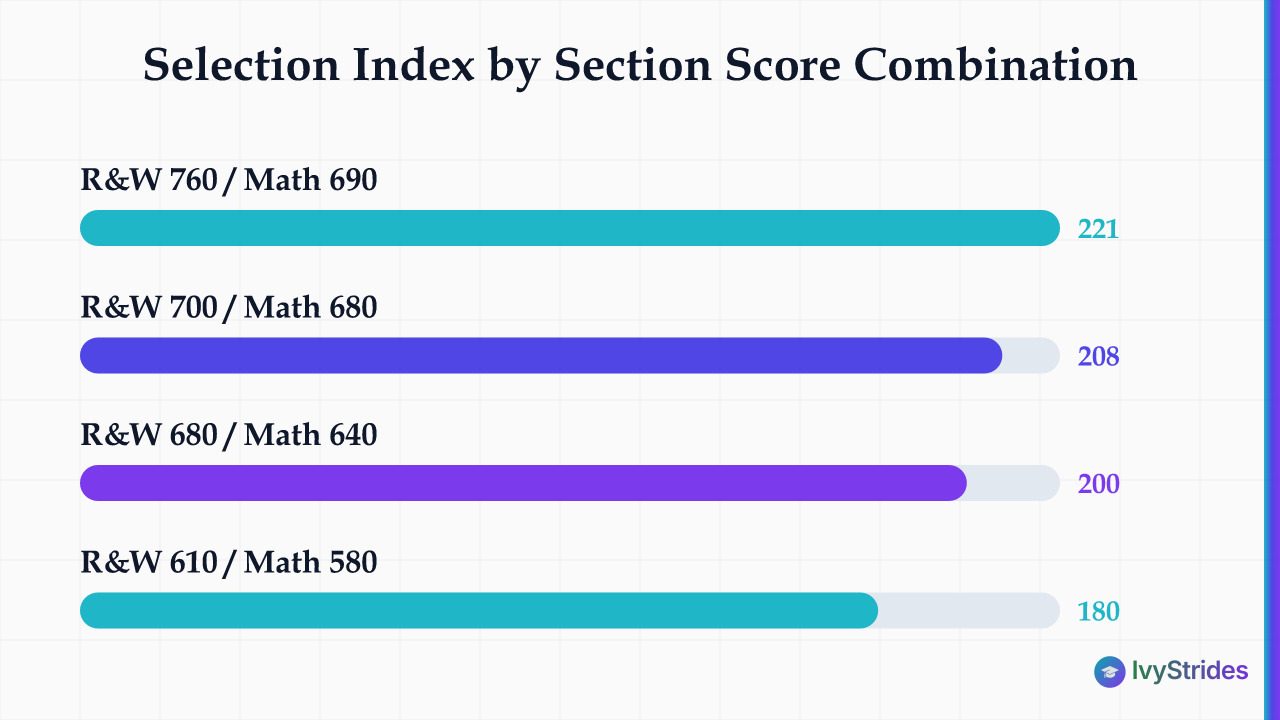
Because the junior-year score is the only one that counts, NMSC screens entrants using the Selection Index, not the 1520 total. The Selection Index doubles your Reading and Writing section score, adds your Math section score, and divides by 10. The scale runs 48 to 228. That double weighting makes each Reading and Writing point worth twice a Math point in the Selection Index.
IvyStrides' analysis of College Board's published section-score range, applied to the NMSC formula, puts the Selection Index at 221 for a student scoring 760 on Reading and Writing and 690 on Math, near the top of the 48 to 228 scale.
| R&W Section Score | Math Section Score | Selection Index |
| 760 | 690 | 221 |
| 700 | 680 | 208 |
| 680 | 640 | 200 |
| 610 | 580 | 180 |
The qualifying scores move from year to year. NMSC uses Selection Index scores to identify roughly 50,000 high scorers; it names about 34,000 of them, more than two-thirds, as Commended Students. Commended Students are named on one national Selection Index score, while Semifinalist scores are set state by state. Any cutoff you see before NMSC announces it is an estimate, because the Selection Index threshold each state requires shifts from year to year.
Once you know which sitting counts, the next question is what score to aim for; the PSAT score range runs 320 to 1520, and the Semifinalist cutoffs that matter for National Merit vary by state. From entry to scholarship awards, the competition runs about 18 months. NMSC notifies Semifinalists through their high schools in early September, about eleven months after the qualifying PSAT/NMSQT. Finalist notification follows in February, and NMSC expects about 95% of Semifinalists to become Finalists.
The money is real. In 2028, NMSC will award some 6,700 National Merit Scholarships and approximately 620 Special Scholarships. Award types differ, from the one-time National Merit $2500 Scholarship to renewable college-sponsored awards, and that range shapes what National Merit Finalist standing is worth in actual dollars.
How to Use Each PSAT Sitting Strategically by Grade
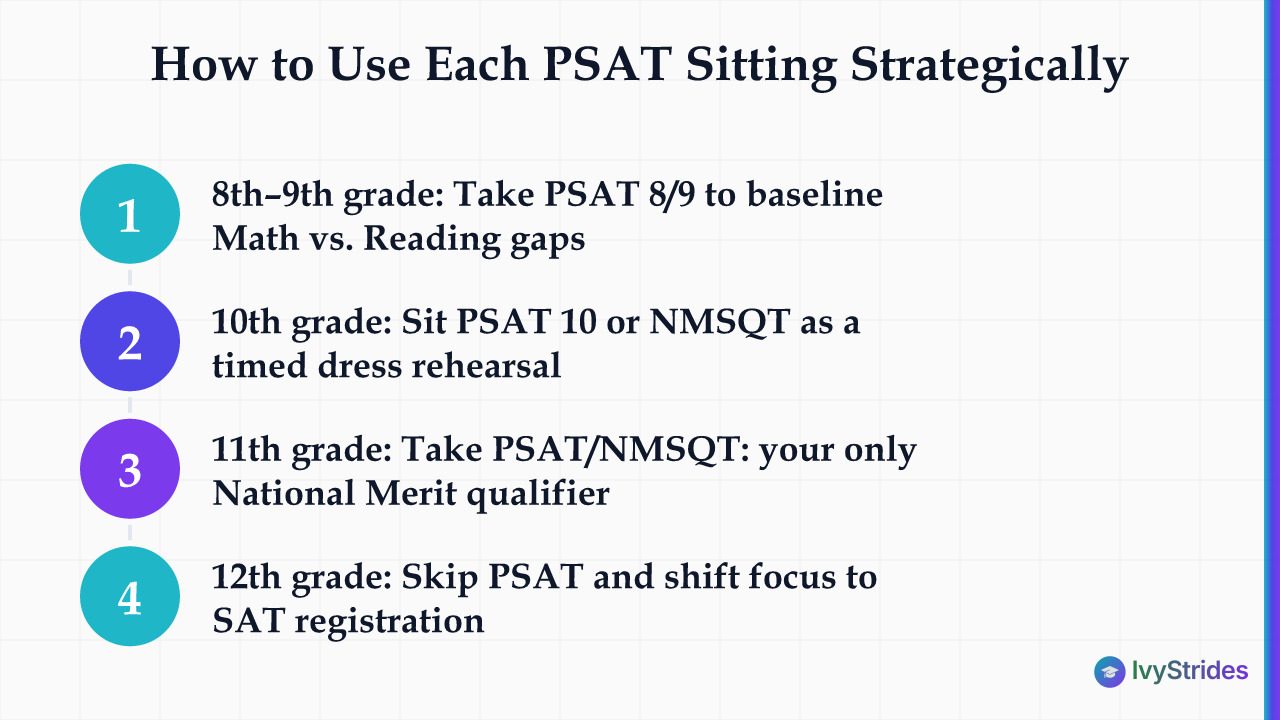
Treat the early PSAT sittings as diagnostics and the junior-year sitting as the one that counts. Because the junior-year PSAT/NMSQT is your only qualifying attempt, each earlier sitting earns its keep by telling you where your section gaps sit, not by producing a score that counts for National Merit. That changes what you do with each grade.
8th and 9th grade: baseline. The PSAT 8/9 (240-1440) gives an early read on grade-level skills. No National Merit stakes, so use it to spot whether Math or Reading and Writing is the weaker side.
10th grade: dress rehearsal. A sophomore can sit either the PSAT 10 or the PSAT/NMSQT, both on the 320-1520 scale. The entire SAT Suite shares a common score scale, so a 10th-grade section score reads directly against the 11th-grade target without any conversion.
11th grade: the qualifier. This is the sitting that enters National Merit. The PSAT/NMSQT is scored on the 320-1520 scale, with each section scored 160 to 760. Commended and Semifinalist lines sit well above the mean, which is why juniors aiming at recognition work backward from a Selection Index target.
| Grade | Test to Sit | Primary Goal | Action Before Test Day |
| 8-9 | PSAT 8/9 | Baseline skills read | Light familiarization |
| 10 | PSAT 10 or PSAT/NMSQT | Timed practice run | One full practice section |
| 11 | PSAT/NMSQT | Qualifying score | Targeted section prep |
| 12 | None | SAT focus | SAT registration |
Your school handles PSAT/NMSQT registration, not College Board's website, so ask your counselor which day in the October window you will test. If the junior-year sitting is your one qualifying attempt, a prep plan built around the October qualifying date matters more than the number of sittings.
Pacing deserves its own practice, because the second module's questions in each section depend on how you performed on the first. In our coaching, every PSAT prep plan starts with a timed diagnostic that maps a student's current section scores against the Selection Index target their state typically requires, so the October sitting becomes a planned performance rather than a guess. That diagnostic is the first step in IvyStrides' PSAT coaching.
What Happens If You Miss the Junior-Year PSAT/NMSQT?
A junior who misses the PSAT/NMSQT has two routes, depending on timing. While the October window is open, you may be able to test on another day or at another school; after it closes, the route is NMSC alternate entry. NMSC considers that route when illness, an emergency, or another extenuating circumstance kept you from testing. The request must be written, and it has a hard deadline.
Once the window has closed, this alternate route is the only way in, and it is narrow. A student who missed the PSAT/NMSQT due to illness or an emergency must write to NMSC no later than April 1 of the following year. Miss that date and there is no further path.
This is not a redo for a low score. Alternate entry is for students who could not test at all. If you sat the test, alternate entry does not apply; report any test-day problem to your school's test coordinator at once, since any retest must fall within the October window. Requesting alternate entry after a missed PSAT takes a short written request: your contact details, your school's details, and a brief explanation of why you could not test.
| Step | Action | Deadline |
| 1 | Window still open: ask your counselor about another test day or school | By October 30, 2026 |
| 2 | Window closed: email or mail NMSC an alternate-entry request | Received or postmarked by April 1, 2027 |
| 3 | Follow NMSC's instructions on any test date | Write early for more date options |
| 4 | Await NMSC eligibility decision | NMSC timeline |
Whichever route you take, the SAT matters at the Finalist stage, where NMSC requires SAT or ACT scores that confirm PSAT/NMSQT performance, so learn how the PSAT and SAT compare early. The narrow deadline is exactly why planning around the one sitting that counts matters, and it's the work IvyStrides' PSAT coaches build each plan around.
FAQ: PSAT Sittings and National Merit
Can I take PSAT twice?
You can take the PSAT/NMSQT once per school year, and you can sit different PSAT versions across grades. Some students take the PSAT/NMSQT in both 10th and 11th grade, giving them two sittings of that specific test. For four-year students, only the 11th-grade sitting qualifies for National Merit.
Can you retake the PSAT for National Merit?
No. Each student gets one valid PSAT/NMSQT score per October window, and for four-year students NMSC uses only the junior-year score. If you scored lower than you hoped in 11th grade, there's no retake inside that year. A student who missed the test entirely due to illness or emergency can request alternate entry from NMSC by April 1 of the following year.
Is a 900 PSAT score bad?
A 900 on the PSAT/NMSQT (scale 320-1520) is a reasonable starting point for a 10th grader. For an 11th grader aiming at National Merit recognition, it falls well below the single national Selection Index score NMSC uses to name Commended Students. The next step is a section-level score report review to find where points are leaking.
Is 1270 a bad PSAT score?
A 1270 on the PSAT/NMSQT is a competitive score. For Semifinalist standing, NMSC uses the Selection Index, not the total, and all Semifinalist scores are extremely high. The exact threshold varies by state and year, and NMSC sets it, not College Board.
Your Next Step on the PSAT Sitting You Can Use
The PSAT rewards planning across grades, not a single October morning. Confirm your grade, know which sitting carries National Merit weight, and prepare for the one that does.
- If you're in 9th or 10th grade: sit the PSAT as a timed diagnostic and read your section report for the weaker side.
- If you're in 11th grade: this October is your qualifying attempt, so confirm your test day with your counselor and prep your weaker section before it.
- If you missed the junior-year test: check whether your circumstance qualifies for NMSC alternate entry and mark the April 1 deadline now.

Hemant is a seasoned entrepreneur, investor, and growth strategist with deep ground in education and technology-driven learning. His core training is in Mathematics and Physics — he authored Physics for IB Diploma: Ultimate Revision Guide, recognized as a top student resource.