
What Are the National Merit Scholarship Benefits, Explained: Everything You Need to Know in 2026
On this page
- What National Merit Scholarship Benefits Actually Look Like in 2026
- The Three National Merit Award Levels: Commended, Finalist, and Scholar
- What PSAT Score Unlocks National Merit Status
- How Much Money Does a National Merit Scholar Actually Receive
- Not Sure If Your PSAT Score Can Reach the National Merit Cutoff?
- How Colleges Actually Use National Merit Status in Admissions
- How Rare Is It to Become a National Merit Scholar
- Is Pursuing National Merit Worth the Preparation Investment
- How to Apply for the National Merit Scholarship: The Timeline from PSAT to Scholar
- FAQ
- What does becoming a National Merit Scholar actually get you beyond the money?
- Does a 1400 PSAT score qualify for National Merit?
- Is a 1470 PSAT score good enough for National Merit?
- Can you get a full ride with National Merit?
- How many students receive the $2,500 National Merit Scholarship each year?
- Do test-optional colleges still care about National Merit status?
- The Next Step
- Ready to Build a PSAT Score That Opens the National Merit Door?
National Merit Scholarship benefits fall into three concrete categories: a one-time $2,500 National Merit Scholarship funded by the National Merit Scholarship Corporation (NMSC), corporate-sponsored awards ranging from about $500 to $10,000 (some renewable across four years), and college-sponsored scholarships that can reach full tuition or a full-ride package at roughly 180 participating universities. Beyond the dollars, Finalist and Scholar status carries real admissions weight at schools that actively recruit top PSAT scorers. Fewer than 1% of the roughly 1.3 million students who enter each year finish as Scholars.
Those figures come from the National Merit Scholarship Corporation and are cross-checked against the College Board PSAT/NMSQT program page, which governs the qualifying test. The harder question, and the one this article answers section by section, is whether the score gap between where your student sits today and their state's cutoff is a realistic climb, and whether the money at the end is worth the prep hours.

What National Merit Scholarship Benefits Actually Look Like in 2026
There are three award tracks. Understand these and the rest of the program makes sense.
1. The National Merit $2,500 Scholarship. NMSC funds this one directly. Approximately 2,500 of these are awarded each year, chosen from the Finalist pool without regard to college choice, family finances, or intended major. It's a one-time payment usable at any accredited U.S. college or university, with one exception: it is not payable for attendance at U.S. service academies.
2. Corporate-sponsored Merit Scholarship awards. Roughly 400 corporations and business-related foundations fund these. Awards typically range from about $500 to $10,000, and some are renewable for up to four years of undergraduate study. Eligibility is narrower here. Most corporate awards are restricted to children of a company's employees, students from specific regions where the sponsor operates, or students planning to pursue specific fields of study. If a parent works for a company on the sponsor list, that's worth checking early.
3. College-sponsored Merit Scholarship awards. Approximately 180 colleges and universities fund their own awards for Finalists who name that college as their first-choice institution with NMSC. This is the tier where the phrase "full-ride scholarship" enters the conversation. Amounts vary widely by school, from partial tuition help to packages that cover tuition, room, board, fees, and a stipend.
Total scholarships offered annually across all three tracks land in the range of roughly 7,500 to 8,500 per year, per NMSC data. If your student is aiming for this pool, the qualifying score is everything, and our guide on what PSAT score you need for National Merit breaks that down state by state.
The Three National Merit Award Levels: Commended, Finalist, and Scholar
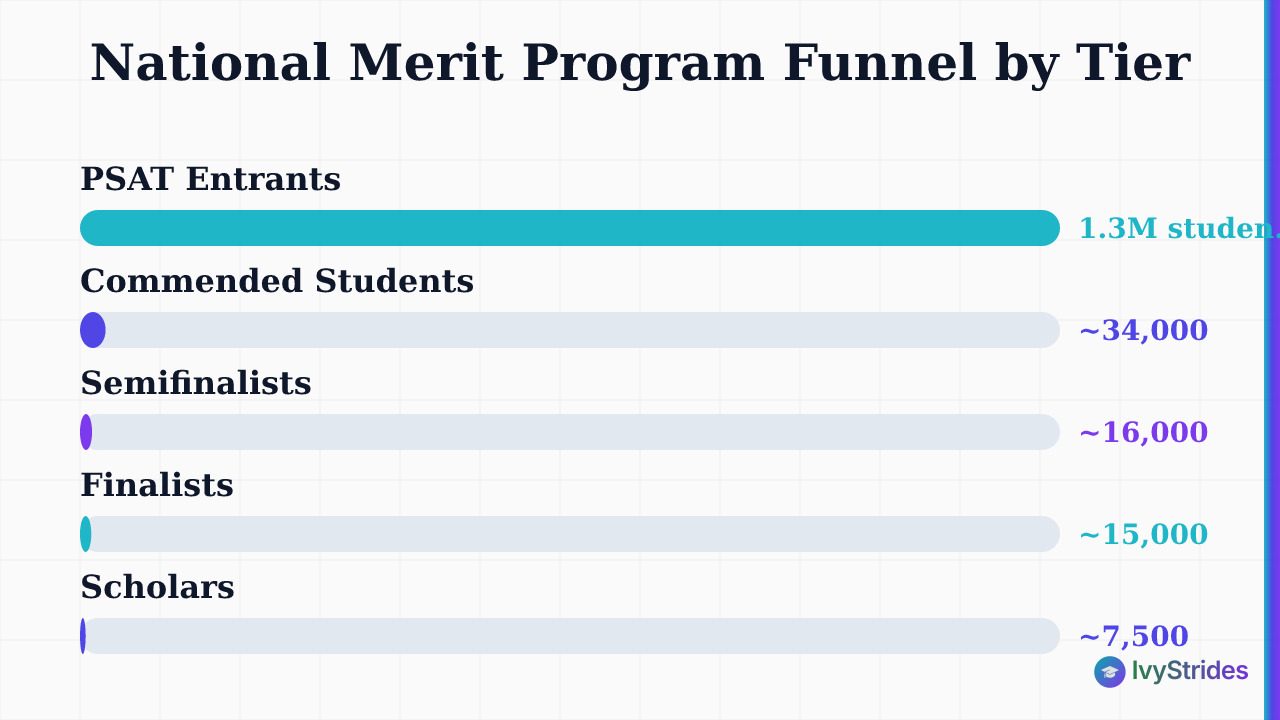
The program is a funnel. Every year around 1.3 million juniors take the PSAT/NMSQT with entry intent. The funnel narrows fast.
Commended Students. Approximately 34,000 students land here, scoring above a national floor but below their state's cutoff score. Commended Students receive a Letter of Commendation from NMSC. They are not eligible for the $2,500 NMSC award or the college-sponsored track, but some corporate sponsors do extend awards to Commended Students, so this recognition isn't a dead end.
Semifinalists. About 16,000 students, the top scorers in each state, are named Semifinalists in September of senior year. Semifinalist status is the first tier that unlocks the full scholarship competition. Students then complete a detailed Semifinalist application, including a school endorsement, a submitted essay, an academic record, and a confirming SAT (or in some cases ACT) score aligned with their PSAT performance.
Finalists. Roughly 15,000 Semifinalists advance to Finalist standing in February of senior year. That advance rate is high, close to 94%. If a Semifinalist completes a strong application with a confirming test score, the odds of reaching Finalist are in their favor.
Scholars. From the Finalist pool, approximately 7,500 are ultimately named National Merit Scholars, announced in phases through the spring. Only about half of Finalists become Scholars. This is the tier where money actually changes hands.
Understanding which tier delivers which benefit matters because the practical Semifinalist question sits at the front of the funnel, and getting there depends on what is the Selection Index for National Merit in your specific state. Students still calibrating their target should also look at where their current score falls relative to good PSAT scores.
What PSAT Score Unlocks National Merit Status
The exact PSAT score you need to qualify as a Semifinalist depends on your state, and our companion guide on what PSAT score you need for National Merit breaks down every state's cutoff with the Selection Index formula.
Here's how the math works. NMSC does not use your PSAT composite score directly. It uses the Selection Index, calculated as:
Selection Index = 2 × (Reading + Writing + Math section scores), on a scale of 48 to 228.
The Selection Index is the single number NMSC uses to rank every entrant, and understanding how it is calculated is the first step toward knowing whether your current PSAT score puts you in contention.
State cutoffs typically range from around 209 in the lowest-competition states to about 222 in the most competitive. High-competition states, including California, Massachusetts, New Jersey, and often Washington D.C., cluster at the top of that range at roughly 219 to 222. Lower-competition states, including several in the Mountain West and Great Plains, tend to sit closer to 209 to 213.
Translated to composite PSAT scores, most students need somewhere in the range of about 1450 to 1520 to reach their state's Semifinalist cutoff. A 1470 PSAT is competitive in many states but often falls short in the highest-cutoff states. A 1400 PSAT is below the Semifinalist cutoff in every state, though it may reach Commended range in some years.
Before targeting the National Merit cutoff, it helps to know where your current PSAT score sits relative to grade-level benchmarks, so it's worth checking whether is 1280 a good PSAT score for your grade and target. Students who score near the National Merit cutoff on the PSAT are typically already in a strong position for the SAT, and a PSAT to SAT score conversion can help you project your likely SAT range.
The PSAT/NMSQT follows the digital adaptive format governed by the College Board, so the practice environment matters. Structured PSAT practice tests that mirror the adaptive Module 1 / Module 2 structure give you a real Selection Index diagnostic, not just a raw score.
How Much Money Does a National Merit Scholar Actually Receive
Real numbers, real caveats.
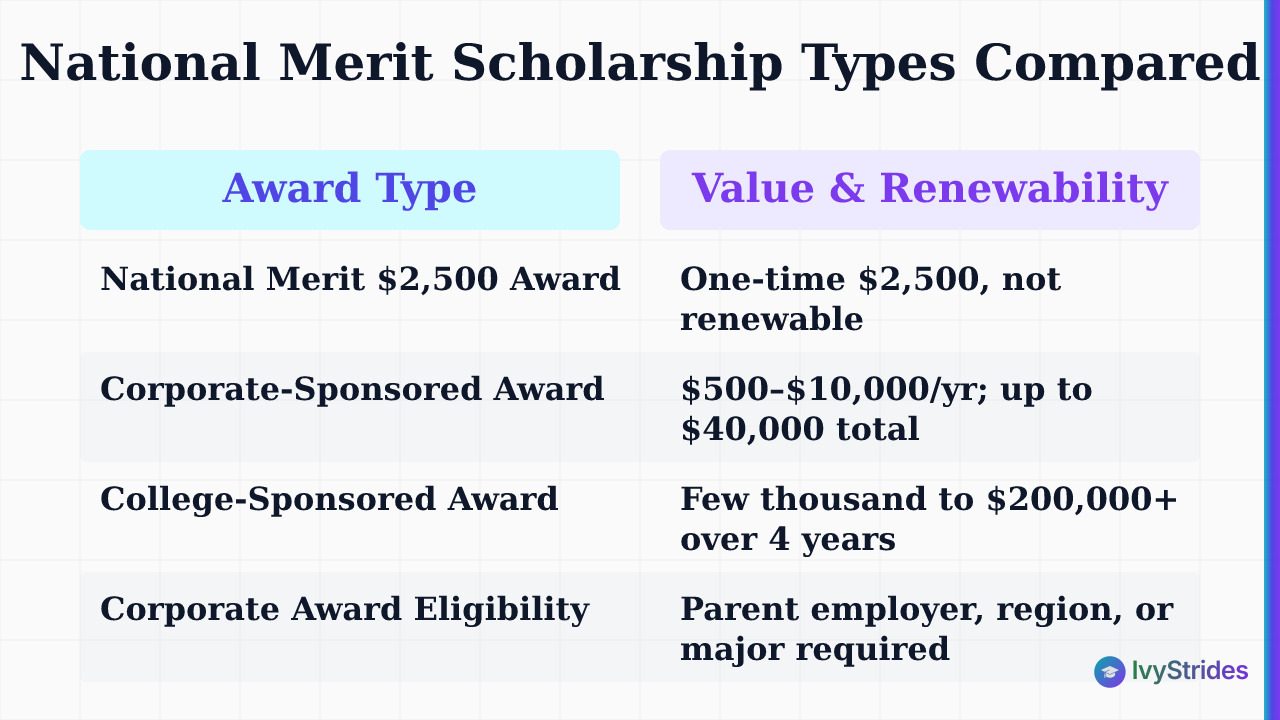
The $2,500 National Merit Scholarship is a one-time payment. It is not renewable across four years. About 2,500 of these are awarded annually to Finalists who meet NMSC's selection criteria. Usable at any accredited U.S. college or university, but not payable for attendance at U.S. service academies.
Corporate-sponsored awards typically range from $500 to $10,000 per year. Some are single-payment; others are renewable for up to four years of undergraduate study, which can push the total value to roughly $40,000 or more. Eligibility is the catch. If a parent works for a company on the NMSC sponsor list, or if the student lives in a region a corporate sponsor targets, or plans to major in a field a sponsor supports, the pool opens up. Otherwise, most corporate awards are out of reach.
College-sponsored awards are where the biggest dollar figures live. Approximately 180 colleges sponsor these, and the awards range from a few thousand dollars per year to full-ride packages worth around $200,000 or more over four years. A few well-known examples of generous packages:
- The University of Alabama has historically offered full-tuition scholarships and additional stipends to National Merit Finalists who name Alabama as their first-choice college.
- The University of Texas at Dallas Honors College has offered packages that cover tuition, fees, a housing stipend, a research stipend, and study-abroad support for National Merit Finalists.
- The University of Southern California has offered a half-tuition scholarship to National Merit Finalists.
Two hard caveats. First, college-sponsored eligibility requires the student to name that specific college as their first-choice institution with NMSC by the published deadline. If the student names a different first choice, or names none, they forfeit the college-sponsored track at that school. Second, sponsoring colleges change their award structures year to year. What was a full-ride offer three years ago may be a partial award today. Always verify current terms on the school's own financial aid or honors college page before making enrollment decisions.
If a student is on the fence about pursuing National Merit seriously, our guide to how to qualify for National Merit walks through the diagnostic and prep steps. For a personal calibration, book a free 30-min SAT consultation and we'll take a look at your current score.
Not Sure If Your PSAT Score Can Reach the National Merit Cutoff?
Book a free 15-minute strategy call. Our coaches will review your current score, calculate your Selection Index, and tell you exactly what it would take to reach your state's Semifinalist threshold.
How Colleges Actually Use National Merit Status in Admissions
Honest answer: it depends on the college, and it depends heavily on whether that college actively recruits Semifinalists.
At schools that use National Merit as an institutional prestige metric, being a Finalist genuinely moves the needle. These schools track their enrolled Semifinalist and Finalist counts publicly and often build merit-aid packages specifically to attract them. This is the group where naming the school as your first choice with NMSC unlocks the largest college-sponsored awards.
At highly selective schools, the picture is different. Admissions officers at those institutions weigh the full application: grades, course rigor, SAT or ACT scores, essays, recommendations, extracurricular depth. All of that carries far more weight than any single credential like National Merit. Finalist status is a positive signal but rarely a decisive one. Think of it as a confirming data point alongside strong grades and test scores, not a golden ticket.
At test-optional schools, National Merit status becomes more interesting. Because the qualifying PSAT score sits at a very high percentile, submitting Finalist status can serve as a voluntary academic signal even if the student chooses not to submit an SAT or ACT score. Test-optional policies vary by school and by year, so verify current policy at each target institution through FairTest or the school's own admissions page.
National Merit status is most powerful when it sits alongside a rigorous AP course load and a strong college admissions essay, because admissions officers evaluate the full application. In our coaching, students who pair National Merit pursuit with strong AP performance and a well-crafted admissions essay present the strongest overall profile. If your student is layering APs onto the strategy, our breakdown of AP certification and recognitions explains which recognitions carry weight. And if supplemental essays are coming up in the fall, the practical question of how many supplemental essays will you write matters as much as any test score.
How Rare Is It to Become a National Merit Scholar
Here are the numbers.
Roughly 1.3 million students enter the competition each year by taking the PSAT/NMSQT in October of 11th grade with entry intent. From that pool:
- Approximately 50,000 receive some form of recognition (Commended plus Semifinalist).
- Approximately 34,000 are Commended Students.
- Approximately 16,000 are Semifinalists, top scorers in each state, roughly the top 1% of scorers per state.
- Approximately 15,000 advance to Finalist.
- Approximately 7,500 are named Scholars.
Scholars represent under 1% of initial entrants. Semifinalists represent roughly the top 1% of scorers. That's the honest arithmetic.
But rarity is not the same as inaccessibility. The relevant question is not "what are the odds across all entrants" but "what are the odds for a student already scoring in the competitive range." A student sitting at a diagnostic PSAT of 1350 to 1400 is closer to the Semifinalist cutoff than the raw stats suggest.
In our coaching with students at this band, juniors who begin PSAT prep with a diagnostic score of roughly 1350 to 1400 and complete a structured 12 to 16 week program have reached Semifinalist-range scores in their state, for students completing the program. A 90-point move from a 1380 to a 1470, for example, sits well within the typical SAT 200+ point range our section-specialist coaches see when Reading & Writing and Math are worked independently.
If you are earlier in the process and wondering what are good PSAT scores for 10th graders, sophomore-year benchmarks give you a longer runway to build toward the junior-year qualifying test. For juniors already close to their target, our 1-on-1 SAT prep works because the PSAT and SAT share section content and adaptive structure.
Is Pursuing National Merit Worth the Preparation Investment
Short answer: yes, for students already within striking distance of their state's cutoff, and probably not for students whose diagnostic PSAT sits more than about 150 to 180 points below their state's threshold with only a few months of prep runway.
Here's the calculus.
The financial upside is real. A one-time $2,500 award is modest on its own. A four-year renewable corporate award at $10,000 per year adds up to about $40,000. A full-tuition or full-ride college-sponsored package can be roughly $80,000 to $200,000 or more over four years. Compare that against typical prep costs (families spend anywhere from around $1,500 to $25,000 or more on college prep across services) and the return on prep hours can be strong when the target is realistic.
The effort is real too. Structured PSAT preparation aimed at a specific state cutoff typically runs about 12 to 16 weeks with a diagnostic baseline, targeted weakness work by section, and spaced retesting. Students already in the 1350+ band are working on refinement (pacing, careful-error elimination, Module 2 hard-question strategy). Students starting further back need longer runways and more foundational work.
The dual benefit is the honest sell. PSAT and SAT share substantial content and structure. Prep hours spent for the October PSAT are not wasted if National Merit doesn't land, because those same hours produce SAT readiness for the March or May SAT of junior year. If your student is running a general SAT study plan, adding PSAT-specific work costs relatively few incremental hours.
Be honest about the gap. Some students are simply not within realistic range of Semifinalist status in their state given their diagnostic, and pushing that goal at the expense of AP grades or essay quality is the wrong trade. Ask whether free SAT prep covers the gap you're trying to close. For a student roughly 40 to 100 points below cutoff, free resources plus disciplined self-study may get there. For larger gaps or students who plateau, structured 1-on-1 work with a section specialist is typically faster.
Still in the preparation phase? Our step-by-step guide on how to qualify for National Merit walks through the diagnostic, practice, and retesting process that gives students the best shot at hitting their state's cutoff.
How to Apply for the National Merit Scholarship: The Timeline from PSAT to Scholar
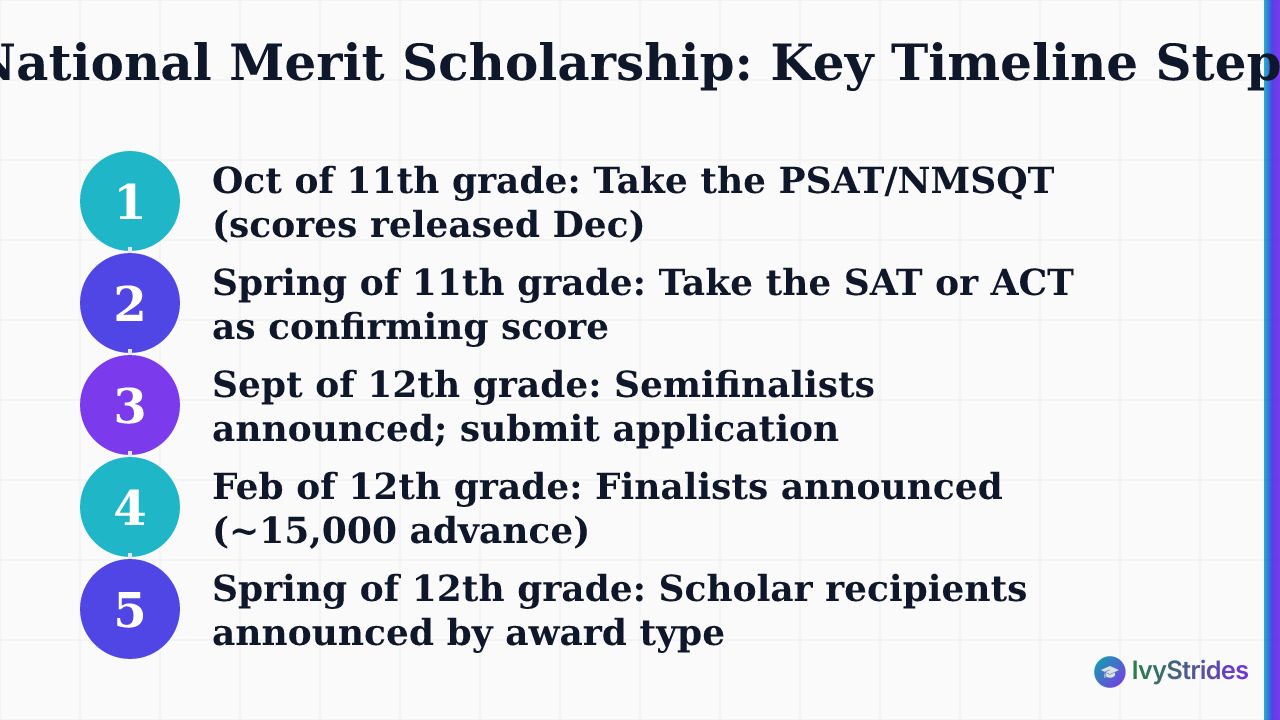
There is no separate application form to enter the competition. Entry happens automatically when a student takes the PSAT/NMSQT in October of 11th grade under conditions that meet NMSC's entry requirements. The rest is a rolling process that unfolds over roughly 18 months.
October of junior year. Take the PSAT/NMSQT. This is the qualifying test. Score reports are released in December.
December of junior year. PSAT scores and Selection Index are released to students and schools. This is when you know, for the first time, whether you're likely in Semifinalist range for your state. Use this window to plan a confirming SAT sitting.
Spring of junior year. Take the SAT (or ACT). A confirming score aligned with your PSAT performance is required later in the Semifinalist application. Most students plan for the March, May, or June SAT of junior year, or an early-fall senior-year sitting.
September of senior year. NMSC announces Semifinalists. Semifinalists receive instructions and an application packet, including requirements for the essay, school endorsement, academic record, and confirming score.
Fall of senior year. Semifinalists complete and submit the application. This is also the window to designate a first-choice college with NMSC if you're targeting a college-sponsored award. First-choice deadlines matter. Miss them and you forfeit the college-sponsored track.
February of senior year. Finalists are announced. Approximately 15,000 of the 16,000 Semifinalists advance.
Spring of senior year. Scholar recipients are announced in phased releases across the three award types. This is when actual scholarship dollars are attached to names.
Two logistical notes. The confirming test score must be sent to NMSC through the College Board or ACT reporting system, so plan your SAT test dates 2026 with enough lead time to have scores ready before the Semifinalist application deadline. If this is the first time your student is registering for the SAT, our walkthrough of how to register for the SAT exam covers the mechanics.
FAQ
What does becoming a National Merit Scholar actually get you beyond the money?
Beyond the direct financial award, National Merit Scholar status appears on college applications and resumes as a distinctive academic credential achieved by fewer than 1% of test-takers. Some colleges use Scholar status as a trigger for additional merit-aid offers even if the student did not name that school as first choice with NMSC. The recognition also carries lasting weight on scholarship applications, honors program admissions, and some graduate program and employer contexts, though it fades in relevance as later credentials accumulate.
Does a 1400 PSAT score qualify for National Merit?
A 1400 PSAT falls below the Semifinalist cutoff in every state. The lowest state cutoffs typically sit around a composite of 1450 to 1460 (Selection Index roughly 209 to 211), and the most competitive states require around 1510 to 1520 or higher. A 1400 may reach Commended range in some years but doesn't clear the Semifinalist bar anywhere. Students at 1400 who want to compete typically need a structured 12 to 16 week prep push to reach Semifinalist range.
Is a 1470 PSAT score good enough for National Merit?
A 1470 PSAT meets or exceeds the Semifinalist cutoff in a majority of lower-competition states, but falls short in high-competition states like California, Massachusetts, New Jersey, and Washington D.C., where cutoffs typically reach around 1510 to 1520. The only reliable way to know is to convert your composite to a Selection Index and compare against your state's most recent NMSC cutoff. Cutoffs shift year to year, sometimes by roughly 1 to 3 index points.
Can you get a full ride with National Merit?
Yes, but only through college-sponsored Merit Scholarships, not the NMSC $2,500 award itself. Approximately 180 colleges fund their own awards for Finalists who name them as first choice, and a subset of those, including institutions like the University of Alabama and the University of Texas at Dallas Honors College, have offered packages covering tuition, room, board, fees, and stipends. Award structures change year to year, so always verify current terms on the school's own financial aid or honors page before making enrollment decisions.
How many students receive the $2,500 National Merit Scholarship each year?
Approximately 2,500 students receive the NMSC-funded $2,500 National Merit Scholarship annually. Another roughly 5,000 to 6,000 receive corporate-sponsored or college-sponsored awards, bringing the total to approximately 7,500 to 8,500 scholarships across all three tracks per year. The exact split between corporate and college-sponsored shifts based on how many sponsoring corporations and colleges participate that cycle.
Do test-optional colleges still care about National Merit status?
At test-optional schools, National Merit status can serve as a voluntary academic signal, roughly comparable to submitting a strong SAT or ACT score. Highly selective test-optional schools still weight the full application (grades, essays, recommendations, extracurriculars) far more heavily than any single credential. National Merit is most valuable at schools that actively recruit Scholars with dedicated college-sponsored packages, and less decisive at schools where the applicant pool is uniformly strong across every academic marker.
The Next Step
The single most useful thing a student targeting National Merit can do is get an accurate diagnostic in the PSAT/NMSQT format, calculate the Selection Index against their state's cutoff, and build a realistic prep plan from that gap. Everything else, the essays, the school endorsement, the confirming SAT score, follows once the qualifying score is in hand.
Ready to Build a PSAT Score That Opens the National Merit Door?
Students and parents: book a free 15-minute strategy call with an IvyStrides coach. We will take a diagnostic snapshot of your current PSAT score, map the gap to your state's cutoff, and recommend the right prep path, whether that is 1-on-1 PSAT prep, a targeted SAT plan, or a combined test-plus-essay strategy.

Award-winning author (South Asian Book Award) and graduate of BITS Pilani and UCLA Luskin School of Public Affairs. Brings a published writer's eye to Common App essays and grammatical precision to SAT and ACT R&W instruction.