
What Princeton's Application Requires That Harvard and Yale Don't
On this page
- What Princeton's Application Checklist Looks Like for 2026-27
- The Three Princeton Requirements Harvard and Yale Don't Have
- Princeton's Test Policy for Fall 2027 and What Changes in Fall 2028
- What GPA and Course Rigor Princeton Expects From Applicants
- Your Next Step on the Princeton Application
- FAQ: Princeton Admission Requirements
- What GPA do you need to enter Princeton?
- Can I get into Princeton with a 1470 SAT?
- How hard is it to get into Princeton?
- What is Princeton's application deadline for 2026-27?
Princeton requires three things Harvard and Yale don't: a graded written paper from high school, a service essay, and an academic essay matched to your degree track (A.B. or B.S.E.). Princeton is test-optional for fall 2027 entry, when Harvard and Yale both require the SAT or ACT. Applications run through the Common App or QuestBridge.
These distinctions come straight from each school's official admission pages, cited below. The one most likely to trip you up isn't the test policy. It's the graded paper, because you can't write it in a weekend. You have to have already written it, graded, sometime in the last three years.
What Princeton's Application Checklist Looks Like for 2026-27
Princeton's first-year application for the 2026-27 cycle asks for a standard set of documents plus a few Princeton-specific items. You submit through the Common App or QuestBridge. Single-Choice Early Action closes November 1, with decisions in mid-December; Regular Decision closes January 1, with decisions in late March.
The table below lists the core components. Note the two optional items at the bottom: the alumni interview and the Arts Supplement. You report SAT or ACT scores in the 2026-27 cycle only if you choose to, since Princeton is test-optional for fall 2027 entry.
| Component | Required or Optional | Deadline (SCEA / RD) |
| Common App or QuestBridge | Required | Nov 1 / Jan 1 |
| School Report + counselor recommendation | Required | Nov 1 / Jan 1 |
| Two teacher recommendations (different academic areas) | Required | Nov 1 / Jan 1 |
| Official transcript | Required | Nov 1 / Jan 1 |
| Midyear School Report | Required | When grades post |
| Princeton-specific questions (essays + short answers) | Required | Nov 1 / Jan 1 |
| Graded written paper | Required | Nov 1 / Jan 1 |
| SAT/ACT scores | Optional for fall 2027 entry | Oct / Dec test date |
| Alumni interview | Optional | By invitation |
| Arts Supplement | Optional | Nov 6 / Jan 8 |
The two teacher recommendations must come from teachers in different academic areas of study, per Princeton's application checklist. Harvard and Yale also require two teacher recommendations, so that piece isn't unique.
The Three Princeton Requirements Harvard and Yale Don't Have
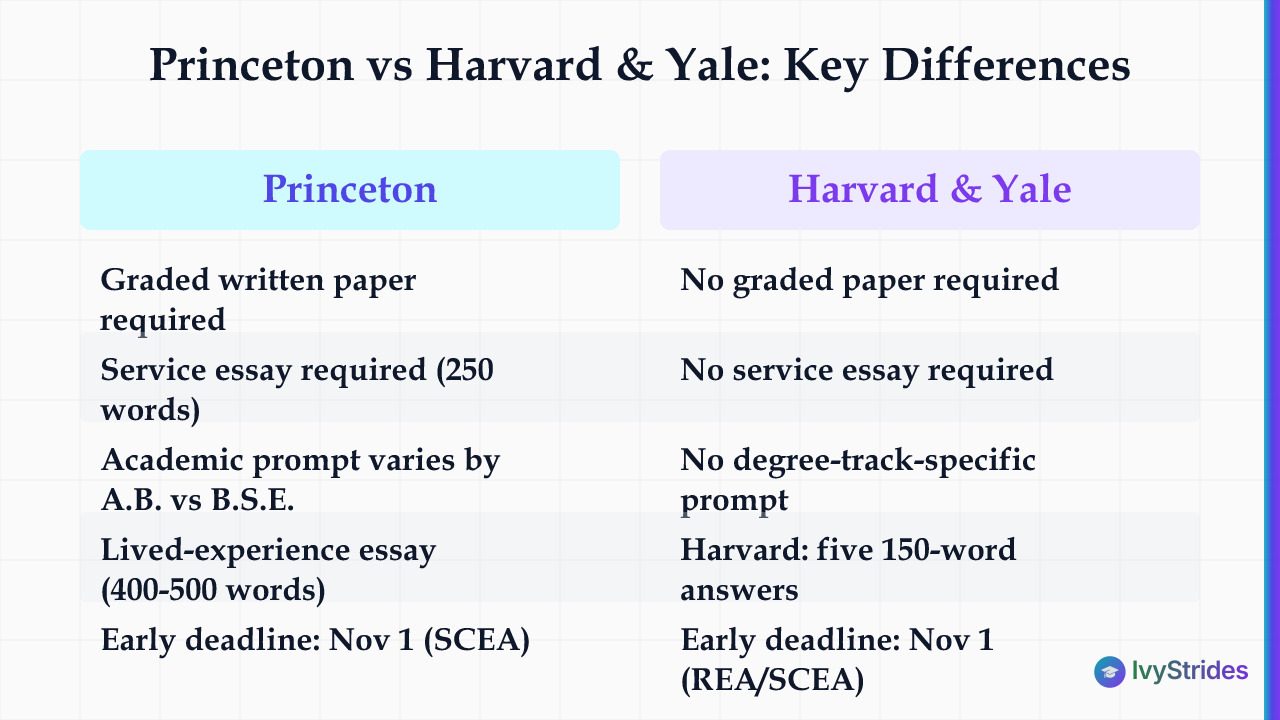
Neither Harvard nor Yale requires these three Princeton components: a graded written paper, a service-focused supplemental essay, and an academic prompt that changes with your degree track. Two of them need lead time you can't recover in October.
The graded written paper. Princeton requires every first-year applicant to submit one graded paper, preferably from English, social studies, or history, written in the last three years of high school. It should be at least one page and include the grade, the teacher's comments, the original prompt, and any rubric. Choose a strong candidate paper early; it avoids a last-minute scramble through old folders for something a teacher actually marked up.
The service essay. Princeton builds civic engagement into the application through a required essay, capped at 250 words, on how your story connects to Princeton's commitment to service. It is separate from the 400-to-500-word essay on how your lived experience will shape conversations on campus, so work out what Princeton's service essay is actually asking and how to answer it before you draft.
The A.B. versus B.S.E. prompt. Princeton's academic question, 250 words or fewer, differs by track. A.B. applicants explain which academic areas spark their curiosity and how Princeton's programs fit; B.S.E. applicants explain why they want to study engineering at Princeton. You choose the track at application, so decide early.
| Requirement | Princeton | Harvard | Yale |
| Graded written paper | Required | Not required | Not required |
| Service essay | Required | Not required | Not required |
| Supplement format | Academic essay (250), lived-experience essay (400-500), service essay (250), three 50-word answers | Five 150-word answers | 200-word academic answer, three short takes, one essay |
| Early plan | SCEA | REA | SCEA |
| Early deadline | Nov 1 | Nov 1 | Nov 1 |
| RD deadline | Jan 1 | Jan 1 | Jan 2 |
| Bars other private early apps | Yes | Yes | Yes |
| Demonstrated interest | Not considered | Not considered | Not considered |
Harvard instead asks for five short answers capped at 150 words each, which demands a different drafting rhythm, detailed in how Harvard's five short answers differ in structure and length. All three bar other private early applications, so the early-plan row isn't where they diverge. Check that restriction before you choose SCEA, not in mid-October.
The graded paper and the service essay need the most lead time, because both require sourcing existing work and framing it deliberately rather than writing from scratch. If that describes where you are, a counselor who maps your graded paper options and service essay angle against the full file can help you plan both before your deadline.
Princeton's Test Policy for Fall 2027 and What Changes in Fall 2028
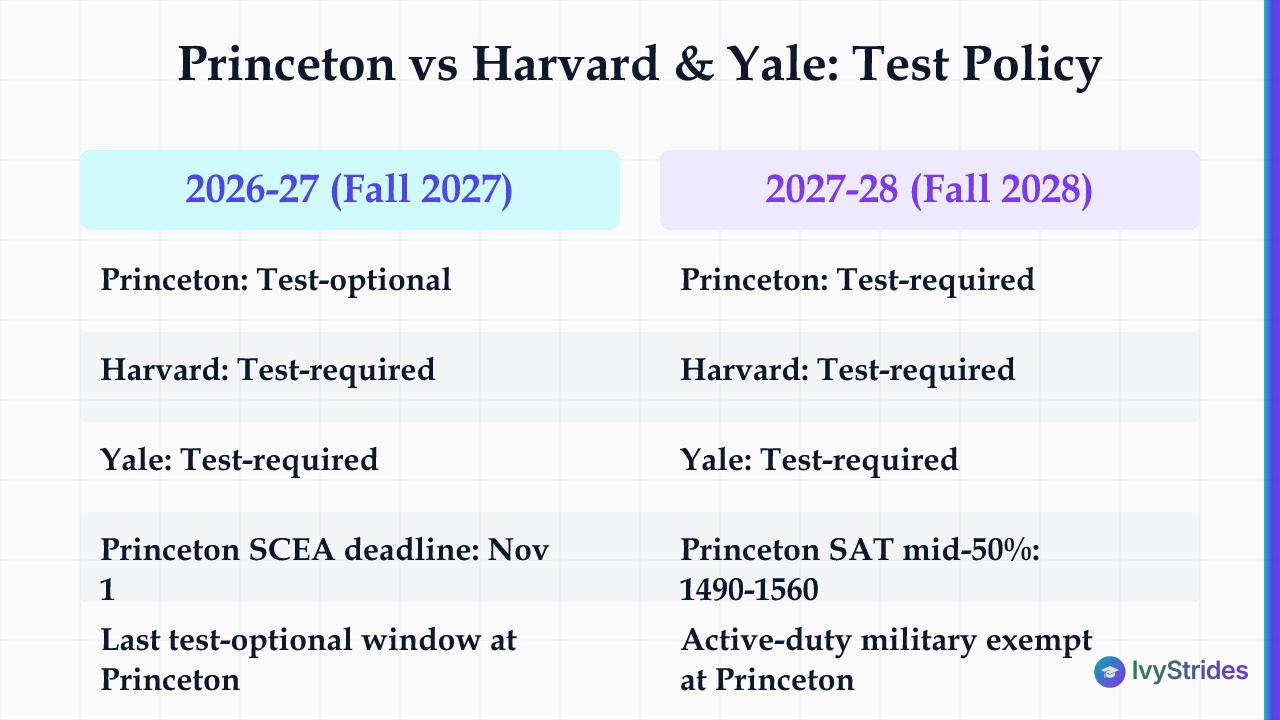
Princeton is test-optional for fall 2027 entry, and it states plainly that applicants who don't submit SAT or ACT scores will not be at a disadvantage. From the 2027-28 cycle (fall 2028 entry), first-year and transfer applicants must submit the SAT or ACT, with active-duty military exempt. The 2026-27 cycle is the last test-optional window, which is why the submission decision carries weight.
Harvard, by contrast, requires the SAT or ACT for fall 2027 entry, and so does Yale under a policy announced on May 27, 2026, which ended its test-flexible approach. With Harvard and Yale now requiring scores, knowing which Ivy League schools require the SAT or ACT in 2026-27 tells you where Princeton's optional window for fall 2027 entry stands apart.
Princeton's 2025-26 Common Data Set rates submitted test scores as a Very Important factor. Test-optional doesn't mean test-blind. The same CDS puts the middle 50% SAT of enrolled fall 2025 students who submitted scores at 1490 to 1560, so whether a 1540 SAT is competitive at Princeton, Harvard, and Yale matters even in the test-optional 2026-27 cycle.
| School | Test Policy, 2026-27 (Fall 2027 Entry) | Early Program | Early Deadline | Test Policy, 2027-28 (Fall 2028 Entry) |
| Princeton | Test-optional for fall 2027 entry | SCEA | Nov 1 | Test-required from fall 2028 entry |
| Harvard | Test-required | REA | Nov 1 | Test-required (no end date announced) |
| Yale | Test-required | SCEA | Nov 1 | Test-required (no end date announced) |
Course of study, not just scores. Princeton recommends four years each of English, math, and one foreign language, plus at least two years each of lab science and history. Engineering applicants should go further: Princeton recommends calculus and lab science including physics and chemistry for B.S.E. candidates. That answers the foreign-language question: four years of one language, not a dabble across two.
What GPA and Course Rigor Princeton Expects From Applicants

Photo by https://kaboompics.com/ on Pexels
Princeton publishes no minimum GPA and no score cutoff. Its 2025-26 Common Data Set, section C7, rates nine factors Very Important: rigor of secondary school record, class rank, academic GPA, standardized test scores, application essay, recommendations, extracurricular activities, talent/ability, and character. None of them alone admits you, and none guarantees admission.
The same C7 section names what Princeton does not consider: state residency, religious affiliation, and level of applicant's interest. So demonstrated interest, visiting campus, opening emails, none of it moves the needle at Princeton. Your transcript does.
| Factor | Princeton Rating | Notes |
| Rigor of secondary school record | Very Important | Honors, AP, dual-enrollment where offered |
| Class rank | Very Important | Read in school context |
| Academic GPA | Very Important | No published cutoff |
| Standardized test scores | Very Important | When submitted |
| Application essay | Very Important | Includes Princeton-specific prompts |
| Recommendations | Very Important | Two teachers, different academic areas |
| Extracurricular activities | Very Important | Impact in school and community |
| Talent/ability | Very Important | Across domains |
| Character/personal qualities | Very Important | Service, civic engagement |
Rigor is read against what your school offered. Princeton says it wants to see you took advantage of honors, AP, and dual-enrollment courses where available, across English, math, foreign language, lab science, and history. The courses you took matter as much as the grades, which is how colleges read your transcript beyond the GPA number. A 3.9 in the hardest available load can read stronger than a 4.0 that dodged the APs your school listed.
Because Princeton weighs rigor explicitly, how many AP courses you took against what your school offered carries real weight in the file. Since rigor, GPA, and class rank are all Very Important, the transcript that matters most starts in 9th grade, not junior year. IvyStrides' counselors map a student's course list year by year against the rigor Princeton expects, which is the move that's hard to make once senior year has started.
Your Next Step on the Princeton Application
Princeton's requirements reward early planning. The graded paper has to already exist, the service essay needs framing before you draft, and the SCEA choice locks out other private early options the moment you commit.
- Pull up a graded English, history, or social studies paper from the last three years and confirm it has the teacher's marks and the prompt attached.
- Decide between Single-Choice Early Action (Nov 1) and Regular Decision (Jan 1), knowing SCEA bars other private early applications.
- Confirm your A.B. or B.S.E. track so you answer the right academic prompt.
- Check your four-year course load against Princeton's recommended study: four years each of English, math, and one language, plus lab science and history.
FAQ: Princeton Admission Requirements
What GPA do you need to enter Princeton?
Princeton publishes no minimum GPA cutoff. Its 2025-26 Common Data Set rates academic GPA as Very Important alongside course rigor and class rank. Princeton's own guidance says it looks for applicants who challenged themselves with the honors, AP, and dual-enrollment courses available to them.
Can I get into Princeton with a 1470 SAT?
Princeton is test-optional for fall 2027, so you can apply without submitting a 1470. When scores are submitted, the CDS rates them Very Important. A 1470 falls below 1490, the 25th percentile SAT of enrolled fall 2025 students who submitted scores, so whether to submit depends on the rest of your file.
How hard is it to get into Princeton?
Princeton is among the most selective universities in the United States. Its 2025-26 CDS rates nine factors Very Important, from course rigor and GPA to essays and character. Admission depends on the full application, not any single factor, and outcomes vary by pool and year. No score or GPA guarantees admission.
What is Princeton's application deadline for 2026-27?
For the 2026-27 cycle (fall 2027 entry), Princeton's Single-Choice Early Action deadline is November 1, with decisions in mid-December. Regular Decision closes January 1, with decisions in late March. SCEA applicants may not apply early to any other private college.

Rajesh is a technology leader, entrepreneur, and angel investor with 28+ years in Business & Technology Leadership and Product & Solution Engineering. He is passionate about education, mentoring, and driving digital transformation.