
Is Stanford Ivy League? No, but It Weighs Applicants Like Princeton

On this page
- Why Stanford Is Not Ivy League, and What That Label Actually Means
- How Stanford's Selectivity Compares to the Ivy League
- What Stanford and the Ivies Actually Look for in an Application
- Should You Apply to Stanford, an Ivy, or Both? Building a Realistic College List
- FAQ: Stanford, the Ivy League, and How They Compare
- Why is Stanford not an Ivy League?
- What is the #1 Ivy League school?
- Which is harder, Harvard or Stanford?
- Is Yale or Stanford better?
- Your Next Step on the Stanford Question
Stanford is not Ivy League. The Ivy League is a formal NCAA athletic conference of eight northeastern universities: Brown, Columbia, Cornell, Dartmouth, Harvard, Penn, Princeton, and Yale. Stanford sits in California and competes in the Atlantic Coast Conference.
Those conference and location facts come from the Ivy League's own athletic-conference history, and its roughly 4.7% acceptance rate still rivals any Ivy. The harder question is the one you actually care about: if Stanford reviews applicants exactly the way Princeton does, does the label change how you should apply? It does not, and this page shows you why.
Why Stanford Is Not Ivy League, and What That Label Actually Means
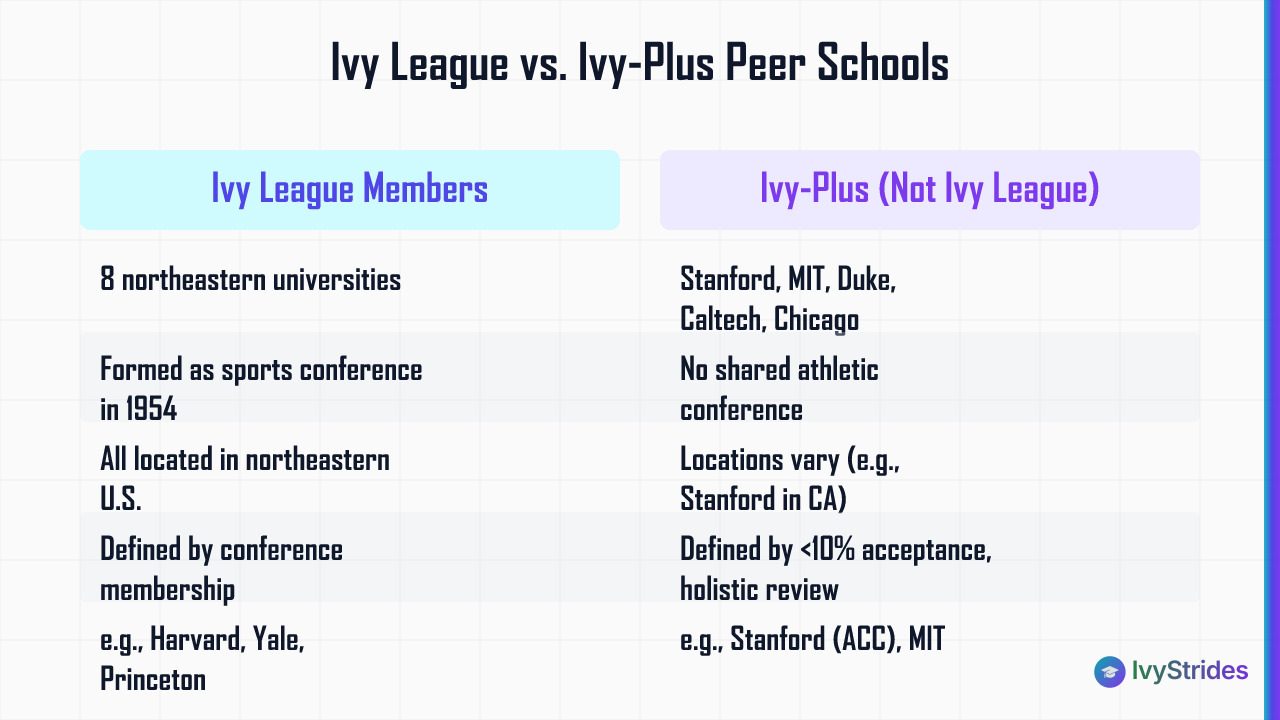
Stanford is not Ivy League because the Ivy League is a sports conference, not a quality tier. The eight Ivy schools formed the conference in 1954, per the Ivy League's own history, and every member is a northeastern university. Stanford, in Palo Alto, joined the Atlantic Coast Conference for athletics, which by definition excludes it.
The confusion is linguistic, not factual. People use "Ivy League" as shorthand for "elite private research university," and Stanford fits that description perfectly, so the phrase stretches to cover it. As Ivy Coach notes, being one of the most selective universities on earth does not make a school Ivy League, because the term describes a conference, not a ranking.
MIT lands in the same bucket. It sits in Cambridge, Massachusetts with an acceptance rate of about 4%, among the most selective universities anywhere, yet it belongs to no Ivy League conference either. Neither does Caltech, Duke, or the University of Chicago.
Counselors group these schools under a working label: the Ivy-Plus peer group. IvyStrides derives this figure from the inputs cited above. This informal grouping describes the eight Ivies alongside Stanford, MIT, Duke, Caltech, and Chicago, all schools with acceptance rates below 10% and holistic review that weighs scores, essays, and extracurriculars the same way. It is a useful frame precisely because the athletic-conference label is not.
| School | Athletic Conference | Location | Ivy League Member? |
| Brown | Ivy League | Providence, RI | Yes |
| Columbia | Ivy League | New York, NY | Yes |
| Cornell | Ivy League | Ithaca, NY | Yes |
| Dartmouth | Ivy League | Hanover, NH | Yes |
| Harvard | Ivy League | Cambridge, MA | Yes |
| Penn | Ivy League | Philadelphia, PA | Yes |
| Princeton | Ivy League | Princeton, NJ | Yes |
| Yale | Ivy League | New Haven, CT | Yes |
| Stanford | Atlantic Coast Conference | Stanford, CA | No |
Once you accept that the tier and the conference are different things, the next question follows on its own: what course rigor does that tier demand? Our breakdown of how many AP classes for Ivy League admission answers it directly.
How Stanford's Selectivity Compares to the Ivy League
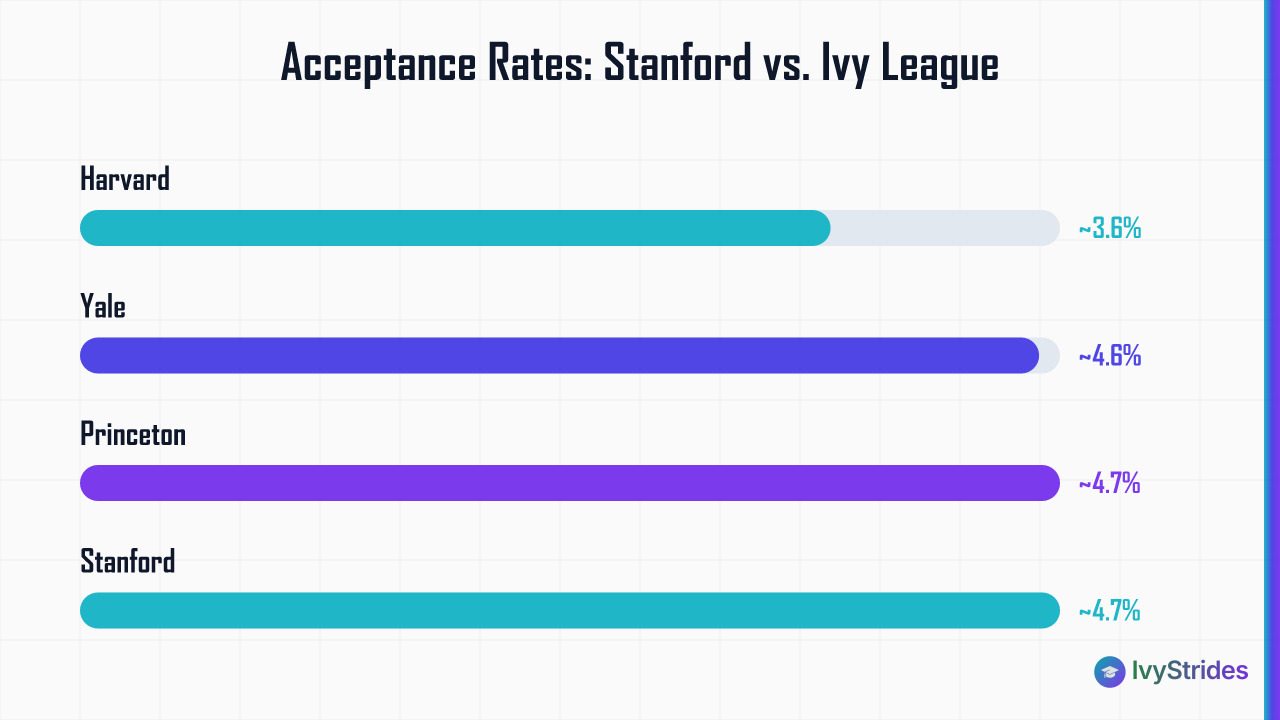
Stanford's selectivity sits squarely inside the most competitive Ivy range. Its acceptance rate is approximately 4.7% for the 2024 cycle, per Stanford's Common Data Set, nearly identical to Princeton's roughly 4.7% and Yale's roughly 4.6%. Harvard runs a bit lower, around 3.6%. The Atlantic Coast Conference label does nothing to soften those numbers.
Because Stanford and the Ivies use nearly identical SAT score ranges in their holistic review, a student targeting any of these schools needs the same score preparation strategy. Stanford's SAT middle 50% range is approximately 1500 to 1570, and Princeton's Common Data Set reports about 1510 to 1570. Harvard's median sits near 1580. These are the same target with a different mailing address.
| School | Acceptance Rate | SAT Middle 50% | Test Policy 2026-27 |
| Stanford | ~4.7% | 1500-1570 | Test-required |
| Harvard | ~3.6% | ~1580 median | Test-required |
| Princeton | ~4.7% | 1510-1570 | Test-required |
| Yale | ~4.6% | 1500-1570 | Test-required |
Test-required is back. Stanford is test-required for the 2026-27 admissions cycle, and six of the eight Ivy League schools have also returned to requiring the SAT or ACT for that cycle. Test-optional policies still vary by school and year, so check each school's current policy before you assume.
That parity has a blunt implication. If your SAT sits at 1420, you have the same gap to close for Stanford as for Yale. Wondering whether your current number clears the bar? Our analysis of whether a 1500 SAT score is good enough for Ivy League admission covers where those ranges land in practice. Our guide to Stanford SAT requirements 2026 covers superscoring and score-sending deadlines.
Acceptance rates and SAT ranges above come from each school's Common Data Set for the 2024 cycle; each figure is the school's own published number.
What Stanford and the Ivies Actually Look for in an Application
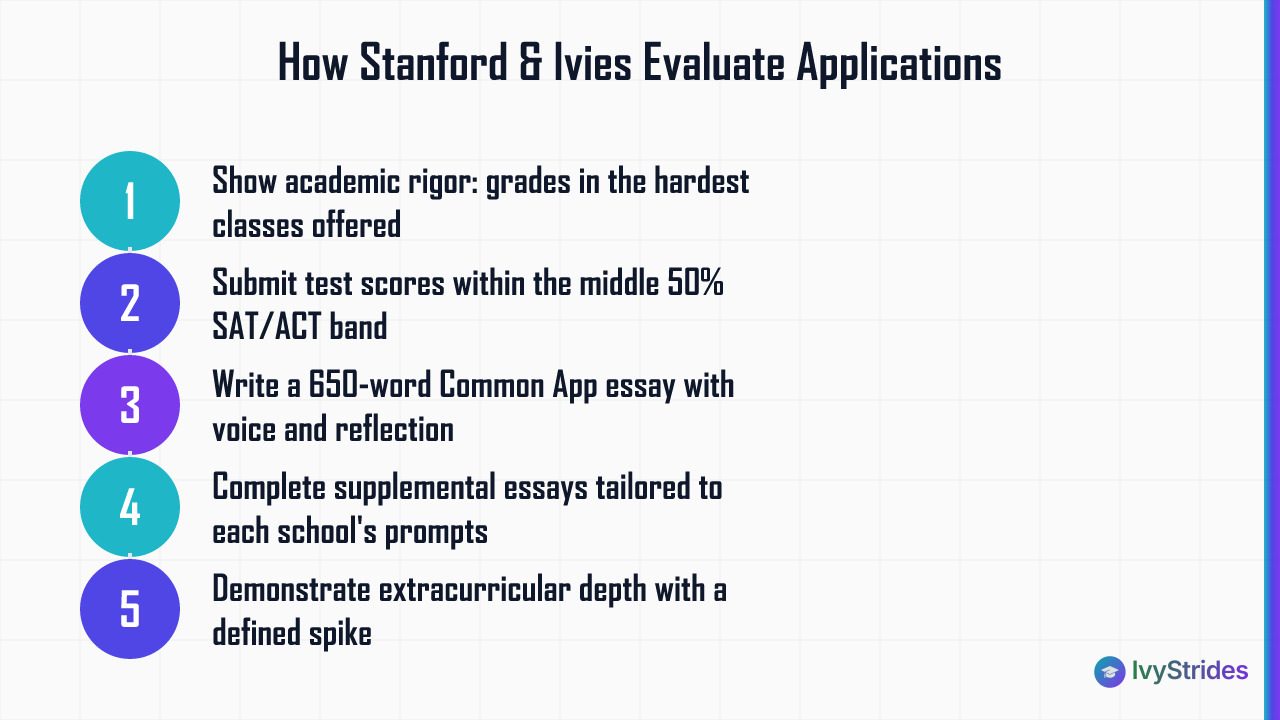
Stanford and the Ivies evaluate the same five things: academic rigor, test scores, essays, extracurricular depth, and recommendations. That is holistic review, the practice of reading the whole application rather than ranking students by a single number. Because the criteria match across all nine schools, so does the preparation.
Course rigor, including AP classes, is evaluated the same way at Stanford and the Ivies: admissions readers look at the most challenging curriculum available at your school. A student from a school offering four APs is not penalized for taking four; context is the whole game.
A strong test score opens the door but the essays and extracurricular narrative determine whether it closes in your favor. At Stanford and every Ivy League school, that is the pattern we see repeatedly. Stanford accepts the Common App personal statement, the same 650-word essay every Ivy accepts, then layers on supplemental essays distinct from any Ivy's supplements, per the Common App.
| Application Component | What Admissions Readers Evaluate |
| GPA and course rigor | Grades in the hardest classes offered |
| Test scores | SAT or ACT inside the middle 50% band |
| Common App essay | Voice, reflection, a 650-word story |
| Supplemental essays | Fit with the specific school's prompts |
| Extracurriculars | Depth and a defined spike, not a list |
| Recommendations | Specific, credible teacher support |
In our college counseling work with students applying to Stanford and Ivy League schools, the most common mistake is treating them as interchangeable targets without accounting for Stanford's distinct supplemental essay prompts and its Restrictive Early Action policy. Students who arrive after a Stanford deferral often have strong scores but underdeveloped supplements, which mirrors what we see in Ivy deferral cases. The score got them read. The essays lost them.
Here is the part most students underestimate: coordinating scores, rigor, essays, and a coherent extracurricular narrative across nine target schools is far harder alone than studying for one test. Our college admissions counseling exists to sequence that work, and admissions outcomes always depend on the full application, never on scores alone.
Should You Apply to Stanford, an Ivy, or Both? Building a Realistic College List
Apply to both if your profile is competitive; the marginal cost is a few supplements. Because Stanford and the Ivies share an admissions tier and holistic review, a student strong enough for one is usually a credible applicant at several. The real decisions are fit and timing, not whether the label counts.
Stanford and the East Coast Ivies differ in culture more than in difficulty. Stanford leans into engineering, technology, and entrepreneurship inside a West Coast research culture; schools like Yale and Princeton carry deeper liberal arts and humanities traditions. The better fit depends on your intended field and the campus you actually want.
| Factor | Stanford | Ivy League (typical) |
| Early round | Restrictive Early Action | Binding Early Decision |
| Athletic conference | Atlantic Coast Conference | Ivy League |
| Region | West Coast | Northeast |
| Academic identity | STEM, entrepreneurship | Humanities-strong |
| Test policy 2026-27 | Test-required | Six of eight required |
| Review model | Holistic | Holistic |
Early rounds are where the plans diverge. Stanford offers Restrictive Early Action, which is non-binding but bars you from applying early to most other private schools. Most Ivies offer binding Early Decision, while Harvard and Yale run non-binding Early Action. You generally cannot apply early to Stanford and to an ED Ivy in the same cycle, so pick one early target with intent. Our guide to early decision vs. early action lays out which round fits which profile.
Build a balanced list underneath these reaches: a few reaches, several matches, a couple of likelies. Stanford and every Ivy are reaches for nearly everyone, including 1550-scorers, because the acceptance rates leave no other honest label. Start from a diagnostic of your current SAT or ACT and an honest read of essay readiness. Our college admissions counseling for grades 11-12 delivers that list-and-readiness assessment. AP credit policies vary by college, so confirm each school's current rules before you count on them.
FAQ: Stanford, the Ivy League, and How They Compare
Why is Stanford not an Ivy League?
The Ivy League is a formal NCAA athletic conference, not an academic ranking. Its eight members are all northeastern universities that formed the conference in 1954. Stanford is in California and competes in the Atlantic Coast Conference, so it meets neither the geographic nor the conference-membership criteria.
What is the #1 Ivy League school?
No single Ivy League school holds a universally agreed top rank. Harvard, Princeton, and Yale consistently appear atop major rankings like US News, but the order shifts with methodology. Acceptance rates at Harvard (around 3.6%), Princeton (around 4.7%), and Yale (around 4.6%) are among the lowest in the group.
Which is harder, Harvard or Stanford?
Both rank among the most selective universities in the world. Harvard's acceptance rate is approximately 3.6% and Stanford's is approximately 4.7%, which makes Harvard marginally more selective by that single number. In practice, both require a near-perfect academic profile, strong scores, and a compelling narrative.
Is Yale or Stanford better?
Yale and Stanford are peers in reputation and selectivity, with acceptance rates around 4.6% and 4.7% respectively. Yale carries a stronger traditional liberal arts and humanities identity; Stanford is known for engineering, technology, and entrepreneurship. The better fit depends on your intended field and campus-culture preference.
Your Next Step on the Stanford Question
Stanford is not Ivy League, but for admissions purposes that changes nothing. Same score bands, same holistic review, same essay and extracurricular expectations as Princeton or Yale. The label is trivia; the preparation is the real work.
Here is what to do with that:
- Pull your latest SAT or ACT score and compare it against the 1500-1570 band these schools expect.
- Audit your course rigor against the hardest curriculum your school offers.
- Draft or gap-check your Common App essay and note which supplements each target school requires.
- Decide your single early-round target, since Stanford's Restrictive Early Action and Ivy Early Decision cannot both be used.

Two decades teaching quantitative and verbal aptitude on standardized tests. Rare dual expertise across Math and Verbal — particularly effective for students with gaps on both sides. Senior AP Mentor for our Calculus and English tracks.