
Five Harvard Supplemental Essays, About 100 Words Each: What to Say
On this page
- What Harvard's Five Supplemental Essay Prompts Are Actually Asking
- How to Write Each Harvard Supplemental Essay in About 100 Words
- Common Mistakes That Weaken Harvard Supplemental Essays
- Harvard Supplemental Essays and the Bigger Admissions Picture
- FAQ: Harvard Supplemental Essays
- How many Harvard supplemental essays are there?
- Does Harvard do supplemental essays?
- How long should a Harvard supplement essay be?
- Do Harvard supplemental essays change every year?
- Your Next Step on the Harvard Supplement
Harvard's supplement is five required short-answer essays for the 2026-27 cycle, each capped at 150 words. Harvard suggests about 100 words per answer. The prompts cover your personal background, intellectual engagement, an extracurricular commitment, your future goals and use of Harvard's resources, and a time you strongly disagreed with someone.
Those five prompts come straight from Harvard's 2026-27 first-year supplement, unchanged from the previous cycle. The harder question is not what they say on the surface. It is what the committee is actually trying to learn from each one, and how you answer honestly inside so few words.
What Harvard's Five Supplemental Essay Prompts Are Actually Asking
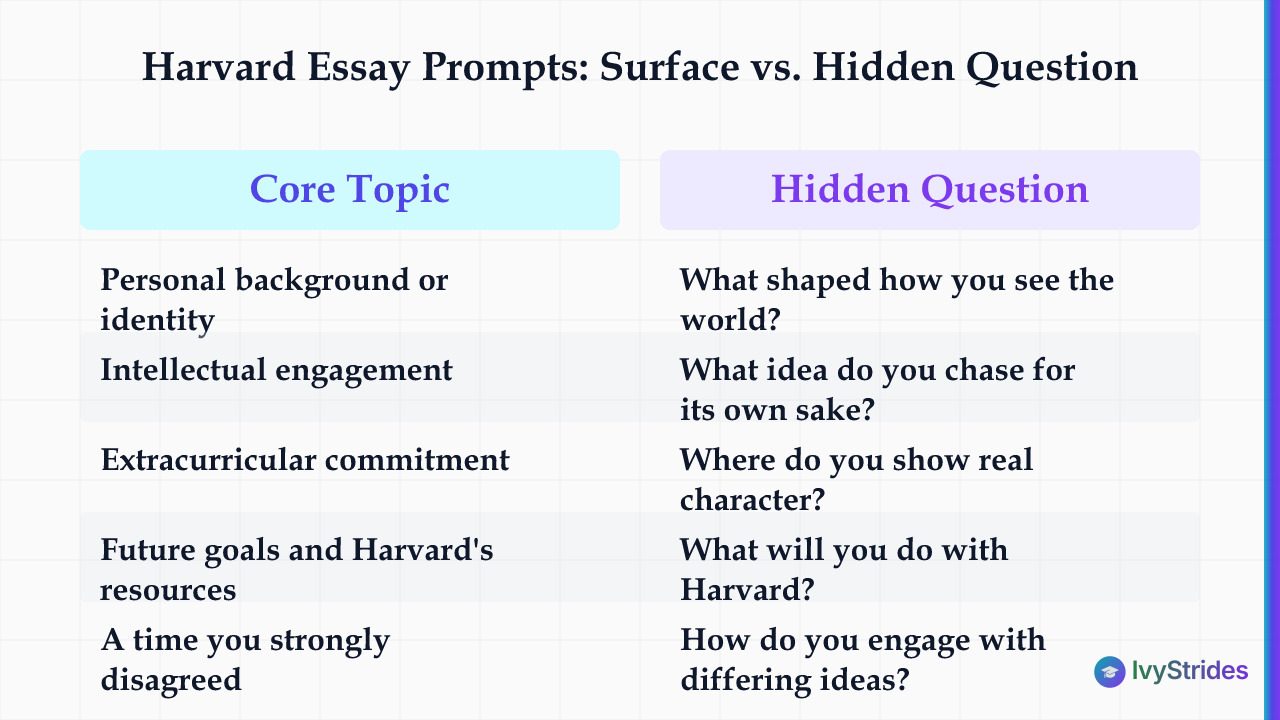
Harvard's five supplemental essays are short-answer questions, each with a 150-word limit, submitted through the Common App. Harvard's own guidance says about 100 words answers each one, which tells you the committee wants focus, not a miniature personal statement. Every prompt has a surface topic and a hidden question beneath it.
Harvard states there is no formula for admission; alongside academics it weighs community involvement, leadership, and personal qualities, and the five short answers are the committee's primary window into those dimensions. Grades and scores already sit in your file. The supplement is where a reader learns who shows up to use them.
Test-required, so the essays decide among the qualified. Harvard requires the SAT or ACT for the 2026-27 cycle, so a competitive score is a prerequisite before the supplement even matters. Your five answers do not raise a weak transcript. They differentiate you from the thousands of applicants who look, on paper, a lot like you.
Harvard's five rank among the most character-focused in the pool, which matters when you weigh how many supplemental essays you will write across your full list. In our experience, students applying to eight to twelve schools often write a sizeable number of supplemental responses in total.
| Prompt | Core topic | Hidden question | Word limit |
| 1 | Personal background or identity | What shaped how you see the world? | 150 words |
| 2 | Intellectual engagement | What idea do you chase for its own sake? | 150 words |
| 3 | Extracurricular commitment | Where do you show real character? | 150 words |
| 4 | Future goals and Harvard's resources | What will you do with Harvard? | 150 words |
| 5 | A time you strongly disagreed with someone | How do you engage with differing ideas? | 150 words |
How to Write Each Harvard Supplemental Essay in About 100 Words
Each Harvard short answer rewards one specific scene over a general claim. The drafting challenge is the same one that runs through every supplemental essay: one specific moment beats a summary. You have room for one true thing.
Prompt 1, personal background. Show a dimension the rest of the application cannot. Not "my heritage taught me resilience," which could belong to anyone. A single detail, honestly rendered, does the work.
Prompt 2, intellectual engagement. Name the actual subject, question, or problem that pulls you in. "I love learning" says nothing. "I spent a weekend trying to prove why a sorting algorithm fails on nearly sorted data" says you follow a question past the assigned point.
Prompt 3, the extracurricular. Harvard cares more about the quality of activities than how many you list, and a commitment to excellence in any activity, including a job or family responsibility, can show underlying character. If you work twenty hours a week at a grocery store, write that.
Prompt 4, future goals and fit. Harvard does not admit by major; applicants list up to three fields of interest. There is no "Why Harvard" praise essay here. Harvard looks for students who will use the full breadth of its resources. Name a specific program or lab and connect it to something you already do.
Prompt 5, the disagreement. Harvard names the willingness to respectfully engage with differing ideas as a criterion, and this required short answer asks about a time you strongly disagreed with someone. It is a character window, not a platform. It rewards showing rather than telling in a tight word count, where one concrete detail about how you behave reveals more than a string of adjectives.
The disagreement prompt generates the most anxiety in our coaching sessions. Students either avoid any real disagreement to seem agreeable or pick a politically charged example that overshadows the point, which is intellectual honesty and respect. It is not a trap. Pick a genuine disagreement, show you listened, and show what you did with what you heard.
A word on help. Harvard permits human or technological guidance, but you may not submit substantive content from other sources, and you must certify the essays are your own work. Use a reader. Do not outsource the writing.
Good revision on these short answers replaces a general claim with a single specific scene that does the same work in fewer words. IvyStrides' essay coaches work specifically on supplemental answers, so once you have a draft, getting a second read before the November 1 deadline is the fastest way to catch an answer that sounds generic to someone who does not already know you.
-
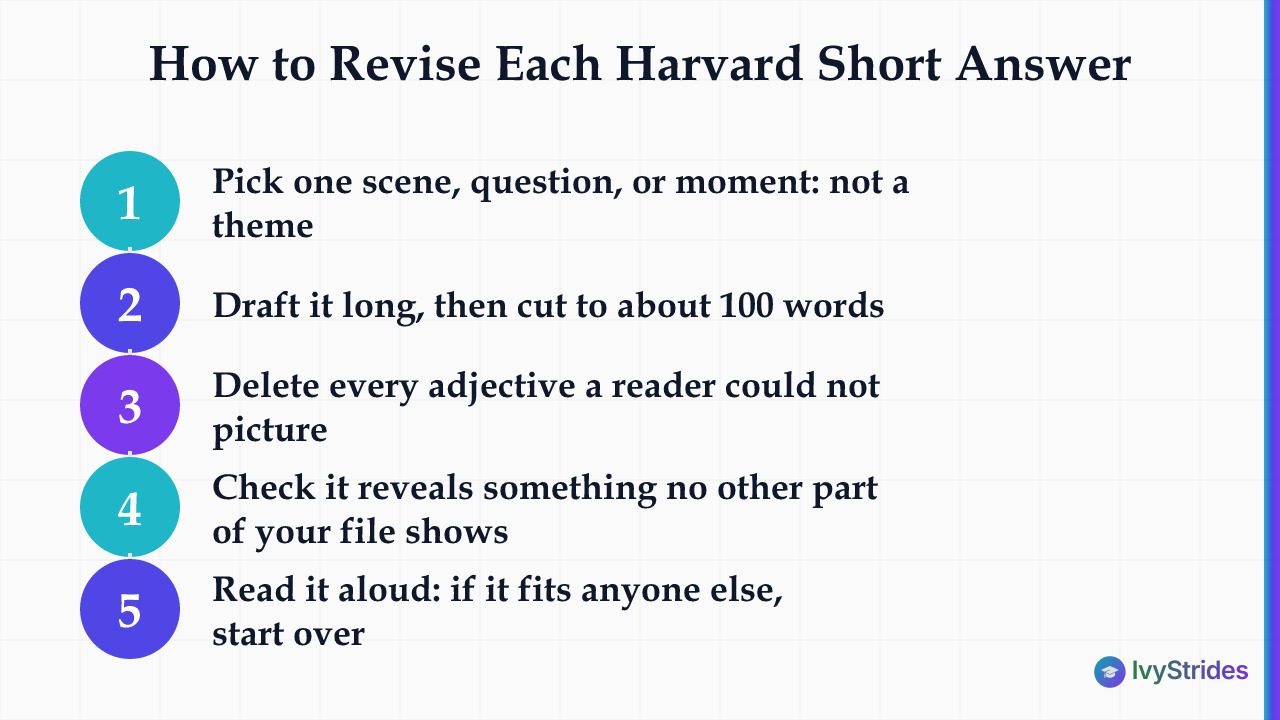
Pick one scene, question, or moment, not a theme.
-
Draft it long, then cut to about 100 words.
-
Delete every adjective a reader could not picture.
-
Check the answer reveals something no other part of your file shows.
-
Read it aloud. If it could be another applicant's, start over.
Common Mistakes That Weaken Harvard Supplemental Essays
Harvard supplemental essays most often fail not on grammar but on sameness: a clean answer any strong applicant could have submitted. The committee weighs what you would add to the community, talents of all kinds, and perspectives shaped by your life. An answer that reveals none of that wastes space, even at a polished 148 words.
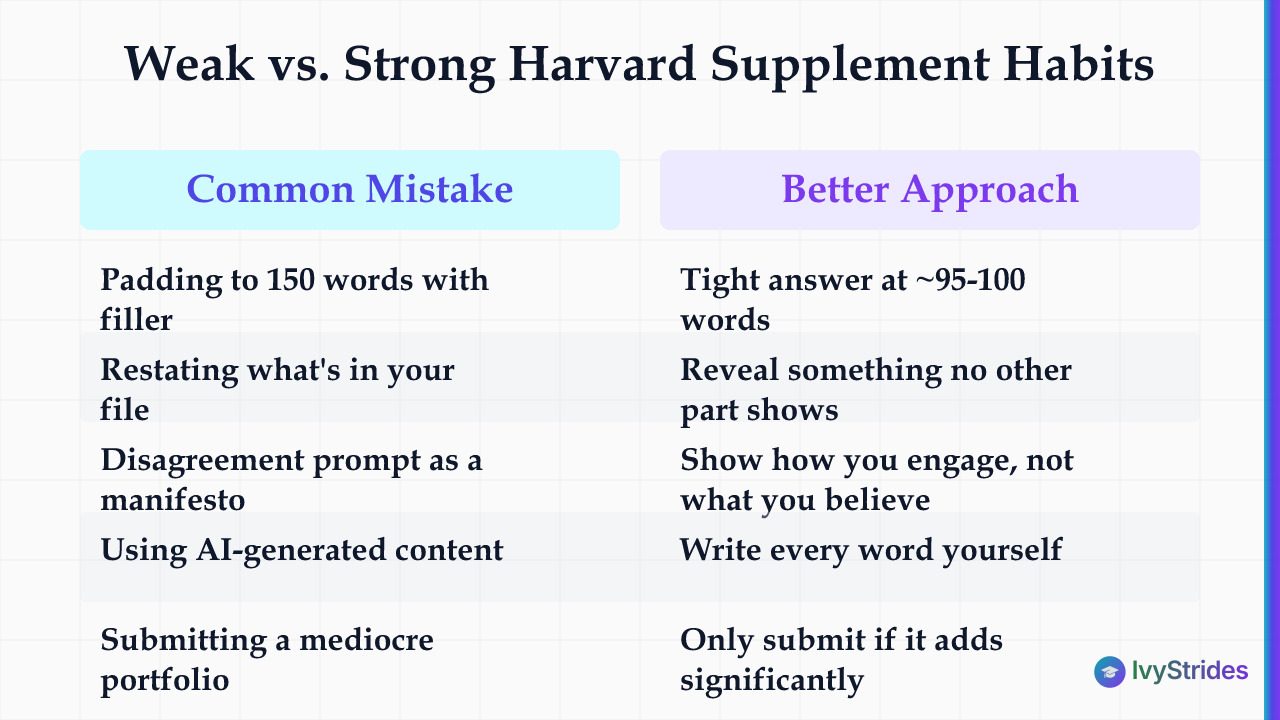
Padding to the limit. Stretching to 150 words when you finished at 100 almost always adds throat-clearing a reader skips. A tight answer at 95 words beats a padded one.
Repeating the rest of your file. Harvard's committee reads the supplement alongside your transcript, recommendations, and activities list, so an answer that restates what is already visible adds nothing. The mission trip, the sports injury, and the leadership role named by its title are all college essay topics that tend to produce generic answers.
Misreading the disagreement prompt as a platform. It is about how you engage, not what you believe. A political manifesto buries the quality Harvard named.
Leaning on AI. You must certify the essays are your own, so substantive AI-generated content both breaks the rule and usually reads as obviously generic.
Students also over-reach on optional supplementary materials. Harvard says portfolio materials in music, art, or research are neither expected nor required and belong in the file only if they add significantly. Do not submit a mediocre portfolio to seem well-rounded.
REA applicants face a November 1 deadline and cannot apply early to any other private college (ED, EA, or REA) or to a binding early program at a public university, so finish your Harvard drafts early. That is a short runway for five answers you want to get right.
- Each answer sits at or near 100 words, not padded to 150.
- Every answer reveals something no other part of your file shows.
- The disagreement answer shows respect, not a position.
- No scene is lifted from your personal statement.
- You wrote every word yourself.
- Prompt 4 names a specific Harvard resource, not generic praise.
- You read each answer aloud and it sounds like you.
Harvard Supplemental Essays and the Bigger Admissions Picture
Harvard's supplemental essays are one piece of a whole-person review, and they cannot carry a weak file alone. The committee weighs academics alongside community involvement, leadership and distinction in activities, and personal qualities. The essays show who you are. They do not replace the transcript, the recommendations, or the score.
That frame has practical consequences. Harvard does not consider demonstrated interest, so no amount of campus visiting or email opening moves your file. And Harvard requires the SAT or ACT for the 2026-27 cycle, so a competitive score comes first. Harvard publishes section score ranges for enrolled students (Reading and Writing 720–770, Math 730–790), so see how your section scores compare before you pour weeks into essays.
Harvard also requires a Secondary School Report with your counselor letter and transcript, two teacher recommendations from different academic subjects, a Midyear Report, and a Final Report. The essays sit inside that package.
| Component | Required or optional | Deadline |
| Five short-answer essays | Required | REA Nov 1 / RD Jan 1 |
| SAT or ACT score | Required | By application deadline |
| Secondary School Report + transcript | Required | By application deadline |
| Two teacher recommendations | Required | By application deadline |
| Midyear Report | Required | When grades post |
| Final Report | Required | After admission |
| Portfolio materials | Optional | By application deadline |
| Alumni interview | Assigned by committee | N/A |
REA applicants who cannot apply early anywhere else private need their drafts finished early, which is why planning your college application timeline around the November 1 REA deadline governs everything else. Students applying to Harvard alongside a broader list benefit from IvyStrides counselors who map each school's supplement requirements against one drafting calendar. Admission depends on the full application, not on any single essay.
FAQ: Harvard Supplemental Essays
How many Harvard supplemental essays are there?
Harvard requires five supplemental short-answer essays for the 2026-27 cycle, each capped at 150 words. Harvard's guidance says about 100 words answers each one. The prompts cover personal background, intellectual engagement, an extracurricular commitment, future goals and use of Harvard's resources, and a time you strongly disagreed with someone.
Does Harvard do supplemental essays?
Yes. Harvard requires five short-answer supplemental essays, submitted through the Common App, with a 150-word maximum each. There is no traditional "Why Harvard" essay. Instead, the fourth prompt asks how you plan to use Harvard's education and resources going forward.
How long should a Harvard supplement essay be?
Each Harvard short answer caps at 150 words, and Harvard's own guidance suggests about 100 words answers each. Padding to 150 when the answer is complete at 100 rarely helps. A tight, specific answer around 95 words reads stronger than a padded one.
Do Harvard supplemental essays change every year?
The 2026-27 Harvard supplemental prompts are unchanged from the previous cycle. Harvard does not revise its short-answer prompts every year, though the format did shift to five required short answers in a recent cycle. Always verify against the current supplement PDF before you draft.
Your Next Step on the Harvard Supplement
The five prompts are a character test disguised as a word-count exercise. Your job is not to fill 150 words; it is to reveal, in about 100, something the rest of your application cannot show.
- Draft one specific scene per prompt, then cut to roughly 100 words.
- Check each answer against the self-review checklist above.
- Confirm your deadline: November 1 for REA, January 1 for Regular Decision.
- Get a reader who does not already know you to flag any answer that sounds generic.

Award-winning author (South Asian Book Award) and graduate of BITS Pilani and UCLA Luskin School of Public Affairs. Brings a published writer's eye to Common App essays and grammatical precision to SAT and ACT R&W instruction.