
The 8 Ivy League Schools: Which 6 Require the SAT or ACT in 2026-27

On this page
- What Are the 8 Ivy League Schools and Where Are They Located
- Are There 12 or 8 Ivy League Schools in the USA
- Why Stanford and MIT Are Not Ivy League Schools
- Ivy League SAT and ACT Score Ranges for 2026-27 Applicants
- FAQ: Ivy League Schools and Test Requirements
- Are there 12 or 8 Ivy League schools in the USA?
- Which Ivy League school is the most prestigious?
- Why is Stanford not an Ivy League school?
- Is a 3.7 GPA competitive for Ivy League admissions?
- Your Next Step With the Ivy League List
There are exactly 8 Ivy League schools: Brown, Columbia, Cornell, Dartmouth, Harvard, Princeton, the University of Pennsylvania, and Yale. The Ivy League is a group of 8 private universities in the northeastern United States. For 2026-27 applicants, six require the SAT or ACT; Yale stays test-optional.
Competitive SAT scores run roughly 1500 to 1580, and each band and policy label below comes from the school's Common Data Set. The harder question for a grade 9 to 11 student is simpler than it looks: is your score in range, and do you even need to submit one? That answer changes school by school, so start with the list.
What Are the 8 Ivy League Schools and Where Are They Located
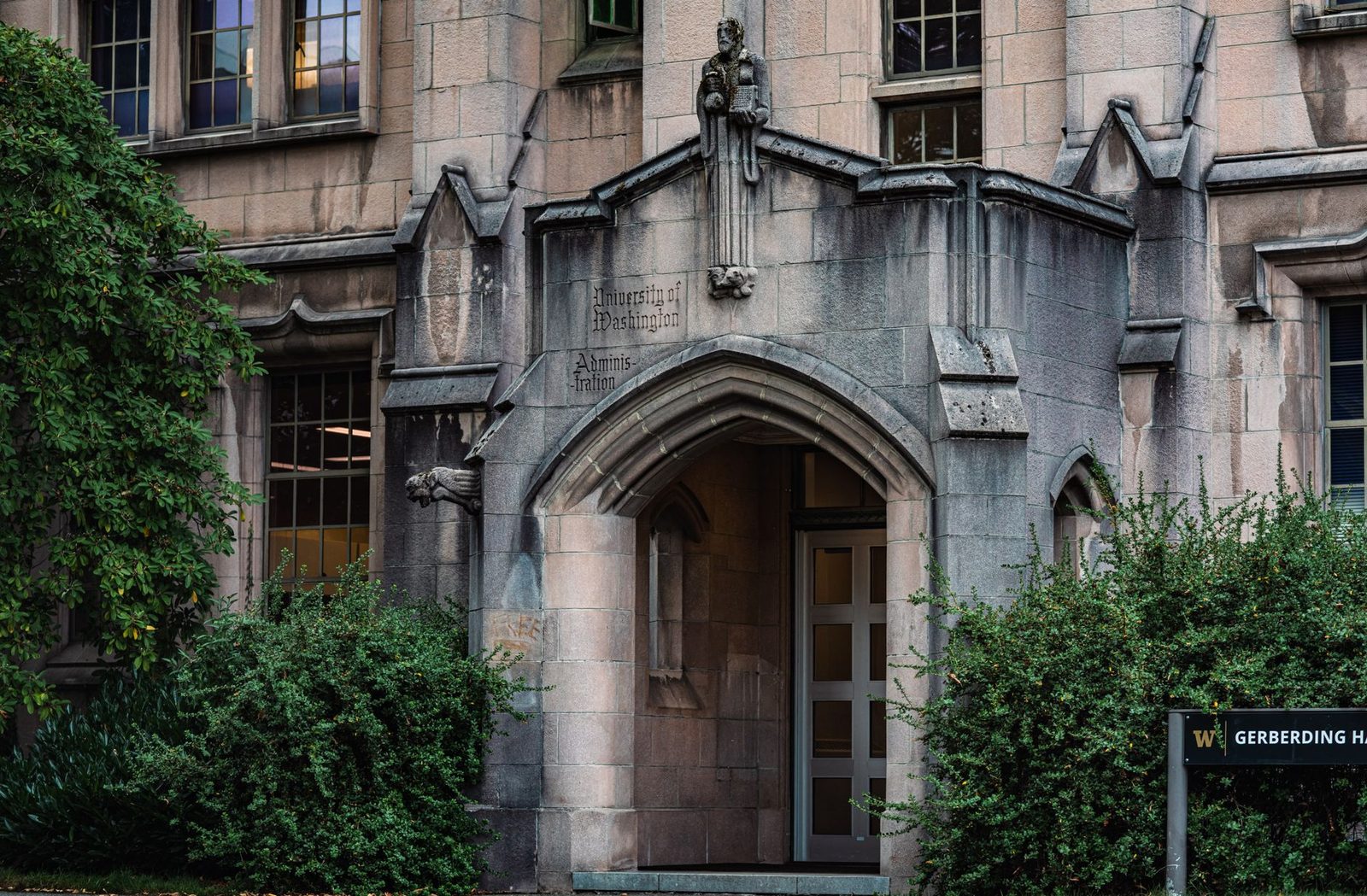
The 8 Ivy League schools are Brown, Columbia, Cornell, Dartmouth, Harvard, the University of Pennsylvania, Princeton, and Yale, all private universities clustered across seven northeastern states. Every one competes in NCAA Division I athletics, which is where the group name actually comes from.
An athletic conference first. The Ivy League began as a formal sports agreement signed in 1954 among these 8 schools. The name predates the deal, referring to the ivy-covered buildings of old northeastern campuses, per Britannica. Academic prestige attached itself later, and the membership never grew past eight.
Here is the full list with location, founding year, and 2026-27 test policy.
| School | City, State | Founded | 2026-27 Test Policy |
| Harvard University | Cambridge, MA | 1636 | Test-required |
| Yale University | New Haven, CT | 1701 | Test-optional |
| University of Pennsylvania | Philadelphia, PA | 1740 | Test-required |
| Princeton University | Princeton, NJ | 1746 | Test-required |
| Columbia University | New York, NY | 1754 | Test-required |
| Brown University | Providence, RI | 1764 | Test-required |
| Dartmouth College | Hanover, NH | 1769 | Test-required |
| Cornell University | Ithaca, NY | 1865 | Test-required |
Test policy is only one signal. Beyond the score, course rigor carries real weight, and you can see how much in our breakdown of how many AP classes for Ivy League admissions.
Are There 12 or 8 Ivy League Schools in the USA
There are exactly 8 Ivy League schools, not 12. The official Ivy League conference has eight members and has never had more. That "12" figure circulates because people confuse the Ivy League with informal groupings, chiefly Ivy Plus.
Where 12 comes from. Ivy Plus is an informal label that adds schools like MIT, Stanford, and Duke to the original 8. It carries no official standing, and lists that push the count to 12 are drawing on that grouping or on similar marketing rosters. Some publications also float a "New Ivies" tag for rising universities, but the roster shifts by outlet and year.
Three terms get tangled together. Here is what each one actually means.
| Term | Official? | Schools Included |
| Ivy League | Yes | The 8: Brown, Columbia, Cornell, Dartmouth, Harvard, Penn, Princeton, Yale |
| Ivy Plus | No | The 8 plus MIT, Stanford, Duke, and others |
| New Ivies | No | Varies by publication and year |
If a specific non-Ivy school is on your list, the admissions math still matters. For the most-searched example, check whether is Stanford Ivy League changes how you plan.
Why Stanford and MIT Are Not Ivy League Schools
Stanford and MIT are not Ivy League schools because neither signed the 1954 Ivy Group Agreement, the athletic pact that defines membership. The Ivy League is a conference, not a prestige tier, so a school can be extraordinarily selective and still sit outside it.
Once you separate conference from reputation, the two schools fall into place. Stanford sits in California and competes in a different athletic conference entirely. MIT competes in NCAA Division III, not Division I. Neither has ever joined the eight-member group, and neither is trying to. Stanford is not an Ivy League school, but its SAT score expectations and holistic review process closely mirror those of Harvard and Princeton.
| School | Ivy League? | Athletic Division | 2026-27 Test Policy |
| Stanford | No | Division I (non-Ivy) | Test-required |
| MIT | No | Division III | Test-required |
| Harvard | Yes | Division I (Ivy) | Test-required |
| Princeton | Yes | Division I (Ivy) | Test-required |
Both Stanford and MIT require the SAT or ACT for 2026-27, which puts them on the same prep timeline as the six test-required Ivies. If MIT is a target, its exact benchmarks sit in our guide to MIT SAT requirements. And because the whole application, not the score alone, decides these cases, families building a school list often start with college admissions counseling to sequence testing, essays, and course choices together.
Ivy League SAT and ACT Score Ranges for 2026-27 Applicants
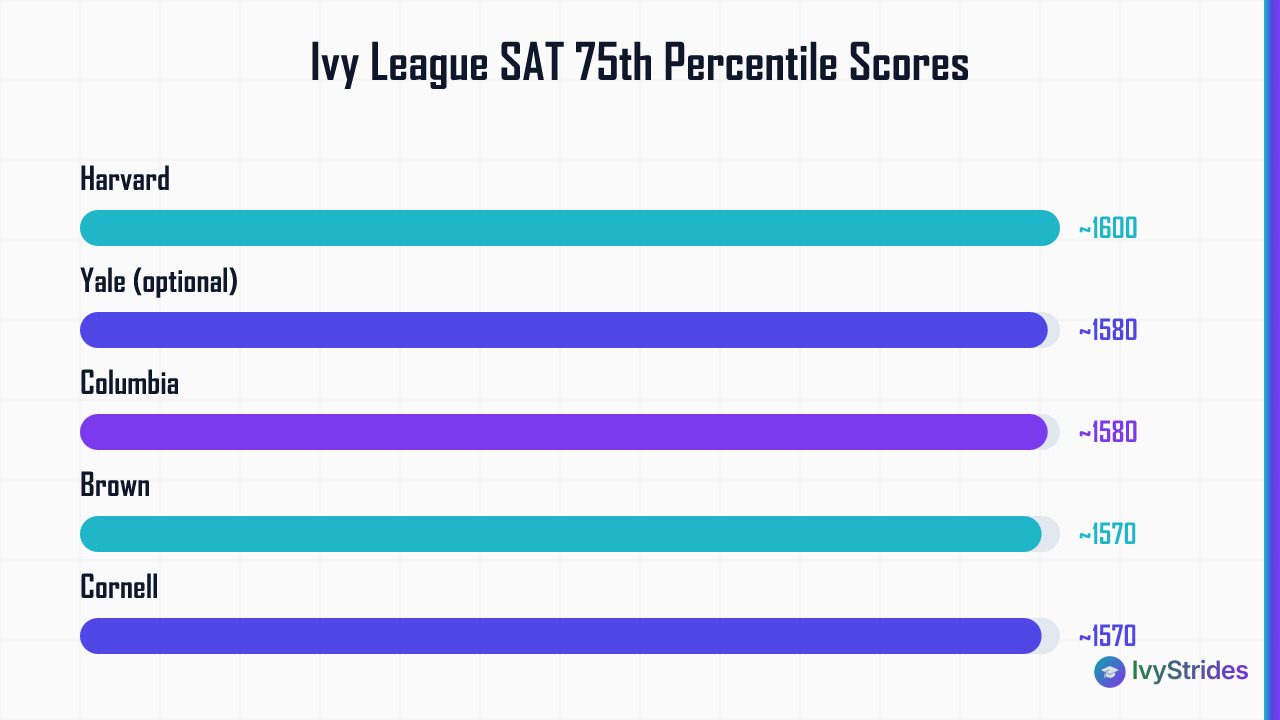
Six Ivy League schools require the SAT or ACT for 2026-27: Brown, Columbia, Cornell, Dartmouth, Harvard, Penn, and Princeton, while Yale stays test-optional. Competitive SAT scores run roughly 1500 at the 25th percentile to 1580 at the 75th, with ACT composites clustering at 34 to 36. All figures below come from each school's Common Data Set.
A 1500 SAT score sits at or near the 25th percentile at most Ivy League schools that require testing, which means it is the floor, not the target. Most admitted students land at or above the 75th-percentile line. Across the six test-requiring Ivies, the average 75th-percentile SAT is about 1575 (IvyStrides averaged the Common Data Set figures; College Board publishes no cross-school average).
| School | Test Policy | SAT 25th-75th | ACT 25th-75th | Acceptance Rate |
| Brown | Required | ~1510-1570 | 34-36 | ~5% |
| Columbia | Required | ~1510-1580 | 34-36 | ~3.9% |
| Cornell | Required | ~1500-1570 | 33-35 | ~7.6% |
| Dartmouth | Required | ~1510-1570 | 33-35 | ~5.3% |
| Harvard | Required | ~1580-1600 | 34-36 | ~3.6% |
| Penn | Required | ~1510-1570 | 34-36 | ~5.9% |
| Princeton | Required | ~1510-1570 | 34-36 | ~4.7% |
| Yale | Optional | ~1500-1580 | 33-35 | ~3.7% |
Test-optional is not test-blind. Yale remains test-optional for 2026-27, but a strong submitted score still helps, and that policy is subject to annual review. Verify it on Yale's admissions page before you apply. International applicants face the same bands; no separate Ivy scale exists for them.
Beyond test scores, most admitted Ivy League students complete 8 to 12 AP courses, making course rigor as important as the score itself. The number on your score report and the rigor on your transcript get read together, not in isolation.
In our coaching with students targeting Ivy League schools, the gap between a diagnostic score and the 25th-percentile benchmark at the target school is the single most useful number to establish before building a prep plan. That gap tells you the size of the climb before you spend a dollar on tutoring.
A student who arrives with a 1400 diagnostic and a Harvard target typically needs roughly 12 to 16 weeks of focused work to reach the 1500 floor, and longer to reach the 75th percentile. Whether a specific score clears the bar is its own question, answered in is 1500 a good SAT score for Ivy League admission.
School-specific policy detail matters too. Penn applicants, for instance, should read UPenn SAT requirements 2026 before locking a target. Once you know your gap, 1-on-1 SAT prep starts from a diagnostic and targets the exact sections holding your score down.
Acceptance rates shift year to year, and the figures above draw on the most recent available Common Data Set. Admission depends on the full application, so treat every band as context, not a cutoff.
FAQ: Ivy League Schools and Test Requirements
Are there 12 or 8 Ivy League schools in the USA?
There are exactly 8 Ivy League schools. The number 12 appears online because people confuse the official Ivy League athletic conference with informal groupings like Ivy Plus, which adds schools such as MIT, Stanford, and Duke. The official eight are Brown, Columbia, Cornell, Dartmouth, Harvard, Penn, Princeton, and Yale.
Which Ivy League school is the most prestigious?
Harvard and Princeton consistently rank at or near the top nationally, and both carry the lowest acceptance rates among the eight, at roughly 3.6% and 4.7% respectively per their Common Data Set filings. Prestige is subjective and varies by field: Cornell leads in engineering, Columbia in journalism, and Penn in business through Wharton.
Why is Stanford not an Ivy League school?
The Ivy League is a specific athletic conference formed in 1954 by eight northeastern universities. Stanford was not a founding member and has never joined; it competes in a different conference entirely. Stanford's selectivity and SAT expectations rival Harvard and Princeton, but conference membership is separate from academic prestige.
Is a 3.7 GPA competitive for Ivy League admissions?
A 3.7 unweighted GPA sits below the median for most Ivy League admitted students, whose unweighted GPAs typically cluster above 3.9. Colleges recalculate GPA with their own formulas, though, and course rigor counts heavily. A 3.7 in the hardest available courses reads differently than a 3.7 in a lighter schedule. Admissions depend on the full application, not GPA alone.
Your Next Step With the Ivy League List
You now have the definitive eight, the six that require a score for 2026-27, and the bands that make an application competitive. Turn that into a plan.
- Pull your most recent SAT or ACT score and compare it to the 25th-75th band at each target school.
- Confirm each school's current test policy on its own admissions page, since Yale's optional status is reviewed annually.
- Map the gap between your score and the 75th-percentile line, then set a test date that leaves room to prep.
- Weigh your AP course load alongside the score, since admissions read both together.

Award-winning author (South Asian Book Award) and graduate of BITS Pilani and UCLA Luskin School of Public Affairs. Brings a published writer's eye to Common App essays and grammatical precision to SAT and ACT R&W instruction.