
Why Princeton's Supplemental Essays Ask About Service, and How to Answer
On this page
- What Princeton's Supplemental Essay Prompts Ask in 2026-27
- Why Princeton Requires a Service Essay (and What It Is Really Asking)
- How to Answer Princeton's Academic Interest and Service Prompts
- Princeton's Deadlines, the Graded Written Paper, and What Else the Checklist Requires
- FAQ: Princeton Supplemental Essays and Requirements
- Does Princeton require supplemental essays?
- How many supplemental essays does Princeton require?
- Can you provide some examples of Princeton supplemental essays?
- Should I submit a 34 ACT to Princeton?
- Your Next Step on Princeton's Supplements
Princeton requires six supplemental prompts for 2026-27: one academic interest essay (250 words, A.B. or B.S.E. track), one community and lived-experience essay (400-500 words), one service and civic engagement essay (250 words), and three 50-word short answers. All first-year applicants also submit a graded written paper.
Princeton's supplemental essays are the Princeton-specific questions you answer on the Common App, in addition to the personal statement, with every prompt cited to Princeton's official application pages below. The harder question is not what they ask. It's why the service essay is required, and what a genuine answer looks like with the November 1 and January 1 deadlines approaching.
What Princeton's Supplemental Essay Prompts Ask in 2026-27
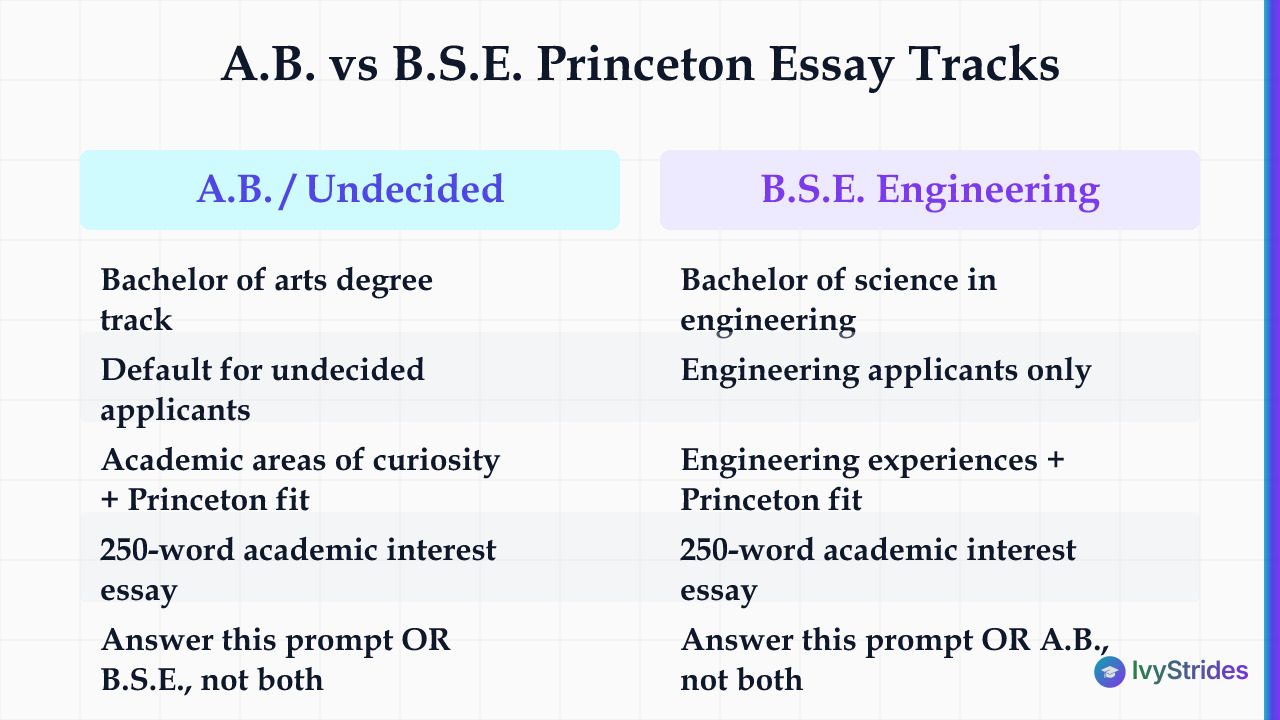
Princeton's supplemental essay prompts for 2026-27 total six Princeton-specific questions, and the word limits vary sharply. The academic interest essay runs 250 words or fewer, the community and lived-experience essay runs 400 to 500 words, the service essay runs 250 words, and each short answer caps at 50 words, per Princeton Admission.
The academic prompt splits by degree track. You answer either the A.B. track version (bachelor of arts, the default for undecided applicants) or the B.S.E. track version (bachelor of science in engineering), never both. A.B. and undecided applicants explain which academic areas pique their curiosity and how Princeton's programs fit. B.S.E. applicants write about engineering experiences and specific Princeton engineering fit.
The three short answers ask what new skill you would like to learn in college, what brings you joy, and what song represents the soundtrack of your life. Fifty words each, and they reward specificity, not polish.
| Prompt | Word Limit | Track / Applicant |
| Academic interest (A.B./undecided) (answer one of rows 1-2, not both) | 250 words | A.B. and undecided |
| Academic interest (B.S.E.) (answer one of rows 1-2, not both) | 250 words | Engineering applicants |
| Community and lived experience | 400-500 words | All |
| Service and civic engagement | 250 words | All |
| Skill to learn in college | 50 words | All |
| Source of joy | 50 words | All |
| Song on your soundtrack | 50 words | All |
Note: The A.B. and B.S.E. academic interest prompts are mutually exclusive. Every applicant answers one of them, not both, so each individual writes six prompts total.
The full load is real. IvyStrides' analysis of Princeton's six Princeton-specific prompt word limits, using the 500-word ceiling for the community essay, puts the upper bound at 1,150 words across the six prompts, before the Common App personal statement. With that load, knowing how many supplemental essays you will write across your full list helps you protect time for your other schools.
Submit through the Common App. It's the standard platform; QuestBridge serves eligible students. Princeton remains test-optional for the 2026-27 cycle: applicants for fall 2027 entry may apply without SAT or ACT scores and will not be at a disadvantage. Princeton will return to requiring the SAT or ACT beginning with the 2027-28 admission cycle, for students enrolling in fall 2028.
Why Princeton Requires a Service Essay (and What It Is Really Asking)
Princeton's service essay is one of the Princeton-specific questions every applicant must submit, and it asks how your own story intersects with Princeton's commitment to service. That 250-word prompt is not a formality. Princeton rates the application essay among nine factors it calls Very Important in its Common Data Set: rigor of secondary school record, class rank, academic GPA, standardized test scores, application essay, recommendations, extracurricular activities, talent/ability, and character/personal qualities. Princeton is test-optional for the 2026-27 cycle, so sending scores is your choice.
Princeton looks for students who make a difference in their schools and communities, and wants to know what you care about and what you've done about it. The question is not whether you volunteered. It's whether you acted on something you cared about, and what came of it.
The weakest versions list hours. The service prompt is often the one applicants draft last and revise least, which is the opposite of what its weight warrants. "I kept coming back after the holiday rush ended, because that's when the shelves emptied and no one else showed up" tells Princeton who you are.
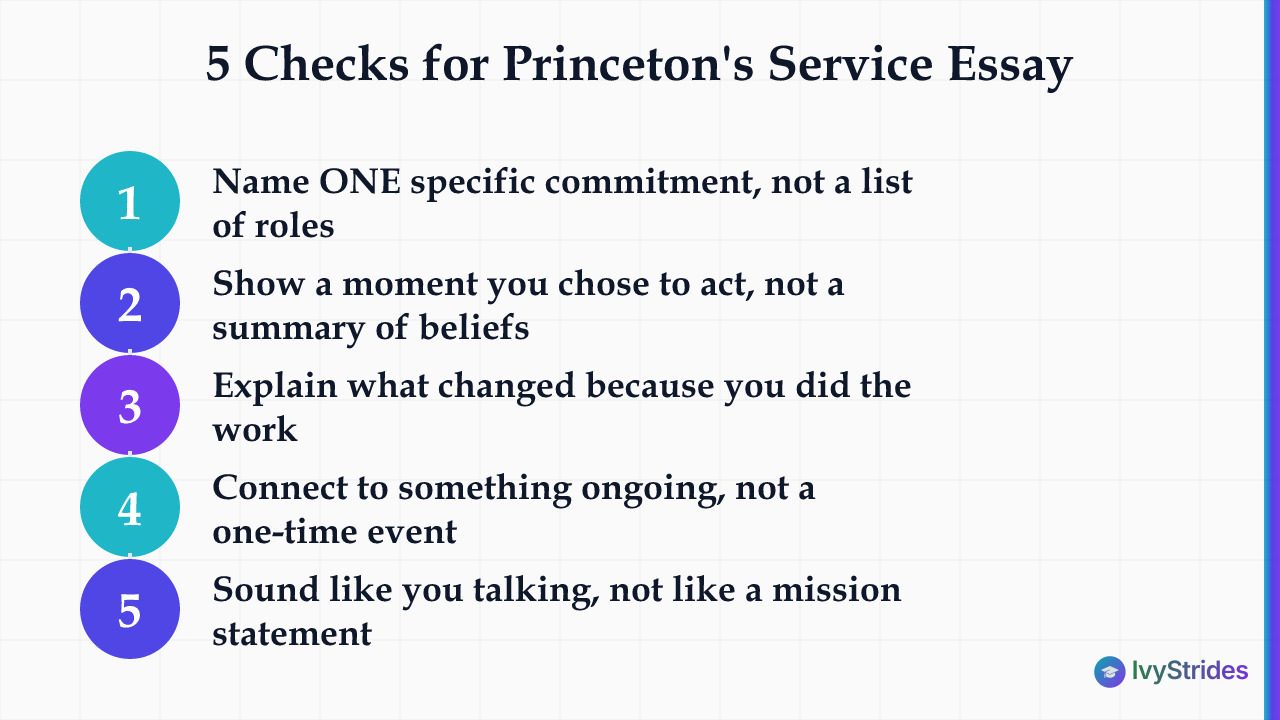
Does your service essay answer Princeton's actual question? Check it against these five:
- It names ONE specific commitment, not a list of roles.
- It shows a moment when you chose to act, not a summary of what you believe.
- It explains what changed because you did the work.
- It connects to something you'll keep doing, not a one-time event.
- It sounds like you talking, not like a mission statement.
Students who find this essay hardest are often those whose service has been genuine but undocumented. On the Princeton supplemental essays, IvyStrides' coaches review your service and community essay drafts and point out where each answer is still too general. If that's you, essay coaching that covers every Princeton-specific prompt can help surface the story that connects to Princeton's own language.
How to Answer Princeton's Academic Interest and Service Prompts
Princeton's 250-word academic interest essay and its 400-500 word community essay both reward a single specific thread over a broad survey. The same specificity that saves a service essay saves these two. Princeton seeks students with intellectual curiosity who have achieved academic excellence, and generic enthusiasm reads as neither.
Start with the academic prompt. The A.B. version asks which academic areas pique your curiosity and how Princeton's programs fit. It follows the same logic as connecting your intellectual history to a specific program: you need one intellectual thread, not a list of courses you liked. Name a real question you can't stop thinking about, trace where it came from, then name the specific Princeton course, certificate, or lab that would let you chase it further.
The B.S.E. version wants engineering experiences and specific Princeton engineering fit. If you're applying B.S.E., Princeton recommends four years of math including calculus and lab science including physics and chemistry, so your essay should reflect genuine depth, not a late pivot.
The community essay is where most drafts go wrong. A common pattern in early drafts is that students describe their identity in the abstract rather than opening with a specific scene; the revision almost always starts by finding that scene. Princeton values respectful conversations that expand perspectives and asks how your lived experience will shape conversations on campus. Your 400-500 word budget is enough to open with showing rather than telling in a college essay before you explain what the moment means.
The strongest service essays name one specific commitment and trace it to a moment when the writer chose to act, rather than listing every volunteer role. The same habit builds the community essay.
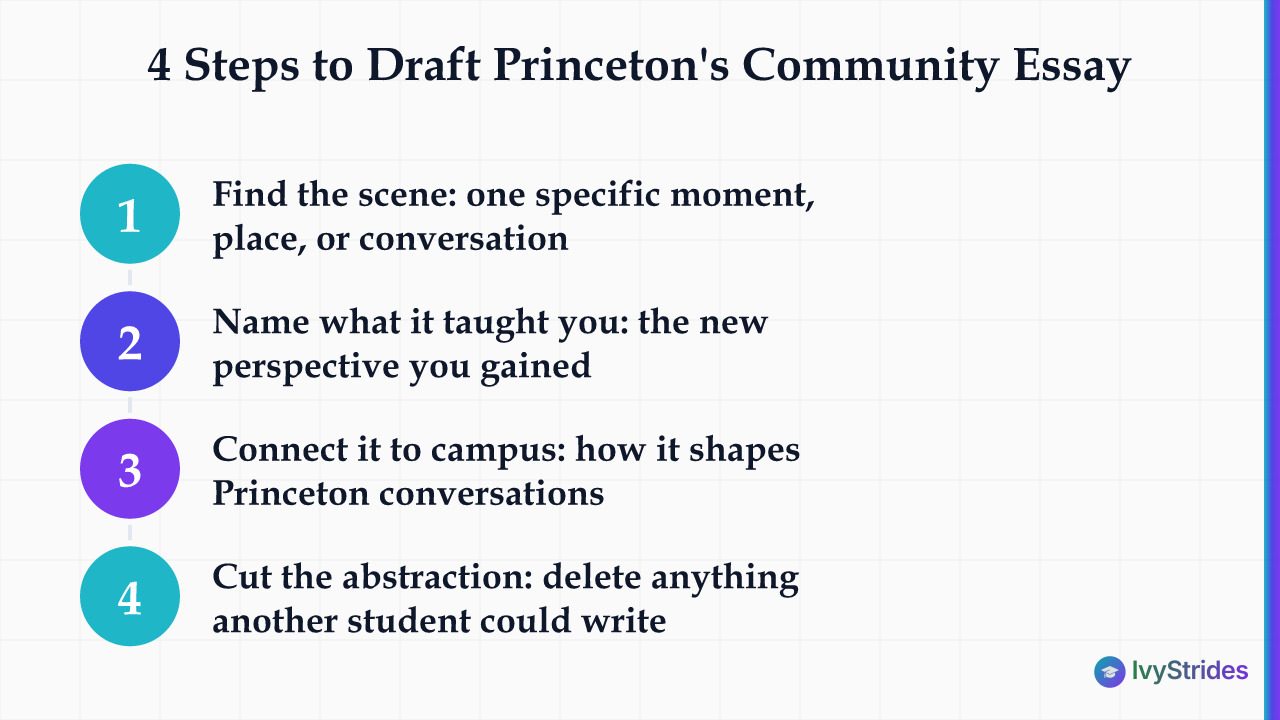
Drafting the 400-500 word community essay, a four-step approach:
-
Find the scene. Write the one moment, place, or conversation that captures your lived experience. Specific people, specific words.
-
Name what it taught you. What perspective do you hold now that you didn't before?
-
Connect it to campus. How will that perspective shape a conversation in a Princeton seminar, dorm, or dining hall?
-
Cut the abstraction. Delete every sentence that could appear in another student's essay. Keep only what's yours.
Princeton's Deadlines, the Graded Written Paper, and What Else the Checklist Requires
Princeton's two deadlines are November 1 for Single-Choice Early Action (SCEA) and January 1 for Regular Decision, with SCEA decisions in mid-December and RD decisions in late March, per Princeton Admission. The same specificity your essays need matters here too, because SCEA carries a restriction that affects your whole list. Map Princeton's dates against your other college application deadlines for fall 2027 early.
SCEA is restrictive. If you apply SCEA to Princeton, you may not apply early to any other private U.S. college or university. That makes committing to the November 1 round a strategic call about your entire list, not just one school. SCEA is non-binding: if admitted, you have until May 1 to decide.
The graded written paper is unique. All first-year applicants must submit a graded paper from an English, social studies, or history course, written in the last three years of high school. It should be at least one page and include the entire paper, the prompt, the grade you received and any available comments. Start hunting for it now; retrieving a marked-up paper from a sophomore-year class takes longer than students expect.
| Component | SCEA Deadline | RD Deadline | Notes |
| Common App + Princeton questions | November 1 | January 1 | Six prompts plus personal statement |
| Graded written paper | November 1 | January 1 | English, social studies, or history course |
| Recommendations and reports | November 1 | January 1 | Two teachers, different academic areas |
| Arts Supplement (optional) | November 6 | January 8 | Digital materials |
| Alumni interview (optional) | By invitation | By invitation | 30-45 min; no disadvantage if skipped |
| Decisions released | Mid-December | Late March | SCEA is non-binding |
Princeton also requires a School Report, a counselor recommendation, two teacher recommendations from different academic areas, a transcript, and a Midyear School Report, per the application checklist. The alumni interview is optional; applicants who don't opt out may be invited to a 30-45 minute conversation with a Princeton Alumni Schools Committee member.
Managing six prompts, a graded paper, two recommendations, and the SCEA restriction at once is a sequencing problem, not just a writing one. Students juggling all of it benefit most from a counselor who can order the full checklist against the November 1 date.
FAQ: Princeton Supplemental Essays and Requirements
Does Princeton require supplemental essays?
Yes. Princeton requires six Princeton-specific prompts for 2026-27: one academic interest essay (250 words), one community and lived-experience essay (400-500 words), one service essay (250 words), and three 50-word short answers. Every first-year applicant also submits a graded written paper. None is optional.
How many supplemental essays does Princeton require?
Six Princeton-specific prompts sit on top of the Common App personal statement. They are one academic interest essay, one community essay, one service essay, and three 50-word short answers on a skill to learn in college, a source of joy, and a song.
Can you provide some examples of Princeton supplemental essays?
Princeton's prompt page offers no sample answers, and Princeton asks you to certify that your essays are your own work. Strong answers share one trait: a single concrete detail, whether a specific project, a named moment, or a real commitment. Generic activity summaries rarely land in 250 words.
Should I submit a 34 ACT to Princeton?
Princeton is test-optional for fall 2027 entry, so submitting is your choice. In Princeton's 2025-26 Common Data Set, the middle 50% ACT composite for fall 2025 enrollees who submitted the ACT was 34 to 35, so a 34 sits at the 25th percentile of enrolled students who sent an ACT score.
Your Next Step on Princeton's Supplements
Princeton's prompts reward honesty and specificity over polish, and no single essay decides your outcome; admission depends on your full application. Start where the work is hardest and the stakes are highest.
- Draft the 400-500 word community essay first, opening with one specific scene.
- Write the 250-word service essay around one real commitment, not a list.
- Pin down one intellectual thread for the academic prompt, A.B. or B.S.E.
- Locate your graded written paper now, with the grade and teacher comments intact.
- Decide SCEA or Regular Decision before you lock your full college list.

Rajesh is a technology leader, entrepreneur, and angel investor with 28+ years in Business & Technology Leadership and Product & Solution Engineering. He is passionate about education, mentoring, and driving digital transformation.