
When Should You Bring In a College Essay Coach? What Can Still Change
On this page
- What a College Essay Coach Actually Does, Stage by Stage
- When in the Application Timeline a College Essay Coach Makes the Biggest Difference
- Is Using a College Essay Coach Ethical? Where Help Ends
- How to Choose a College Essay Coach: Four Questions to Ask First
- FAQ: College Essay Coaching
- Can a college essay coach write or edit my essay for me?
- Can I hire someone to write my college essay?
- Who can help me write my college essay?
- How is a college essay coach different from a tutor or mentor?
- Your Next Step on Essay Coaching
A college essay coach is a specialist who guides a student through brainstorming, structuring, drafting, and revising the Common App personal statement and supplemental essays without writing the essay for them. In our view, the summer before 12th grade is the best time to bring one in.
That timing isn't a hard rule. A coach who joins after a first draft exists can still change a lot before an Early Decision deadline. What matters is matching the kind of help to the gap in front of you, and knowing where legitimate coaching ends.

What a College Essay Coach Actually Does, Stage by Stage
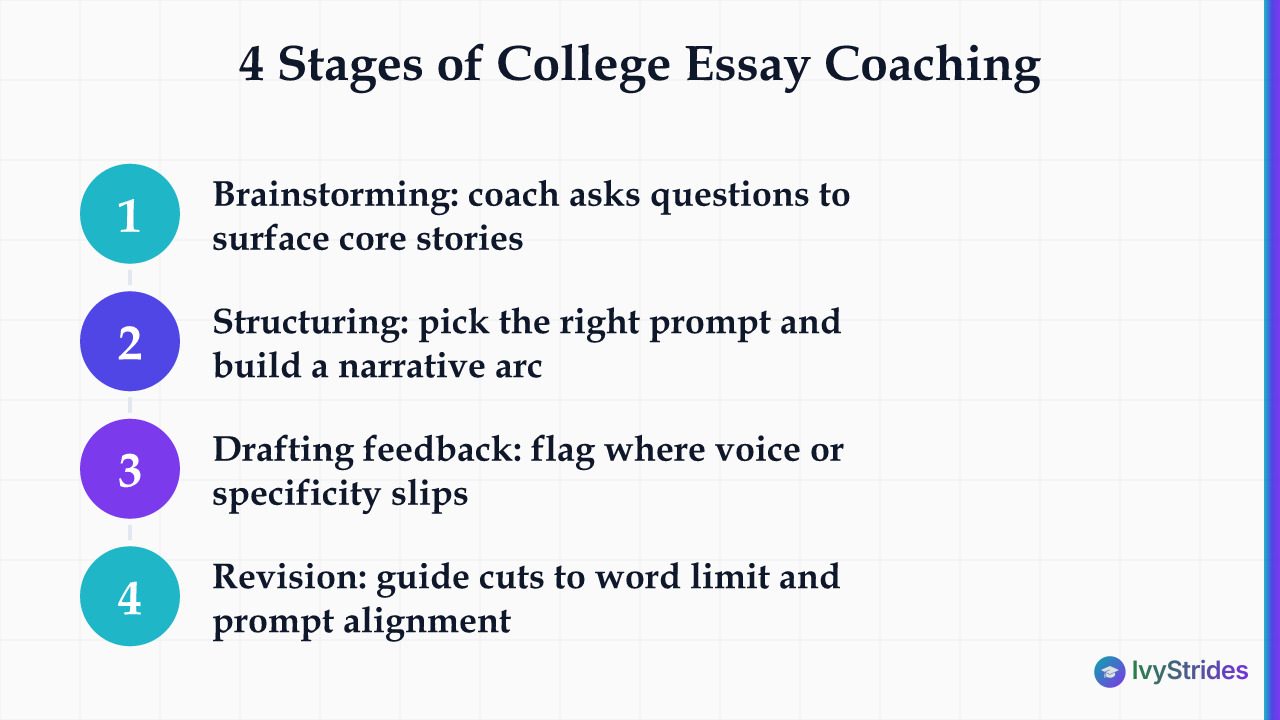
A college essay coach works across four stages: brainstorming, structuring, drafting feedback, and revision. In each stage the coach asks questions, reacts to your writing, and points to what a reader will find flat, while the words stay yours. That last part is the line no good coach crosses.
The Common App personal essay answers one of seven prompts, unchanged for 2026-27. A coach's first job is often helping you pick the right prompt for your strongest story, then building a structure that fits the word limit. The seventh prompt lets you write on any topic, which is where many students quietly default when they should be choosing on purpose.
Before a coach, most students try peer or teacher review. Those help. A coach goes further by diagnosing why a draft is not working and guiding you to fix it yourself. If you want lighter input first, read about getting feedback on your college essay from readers you already have.
In our essay coaching, a common first-session finding is that a student's strongest story sits in paragraph three, not leading the essay. The fix is usually structural. One frequent intervention is replacing summary statements with specific scenes, the show, don't tell technique that turns a generic draft into a memorable one.
Then come the supplementals. Supplemental essays are the shorter pieces individual colleges require beyond the personal statement, with word limits and prompts set by each college. A college's writing supplement can only be submitted after you submit the main application to that college.
A list of eight or more schools can mean many supplemental essays on top of the personal statement, and a coach who knows each college's supplemental prompts can help you sequence and adapt drafts. In our coaching, the "Why This College" prompt is often the one written most generically, naming rankings rather than specific programs or faculty.
| Stage | What the coach does | What the student brings |
| Brainstorming | Asks questions to surface core stories and values | Honest answers, a rough topic list |
| Structuring | Helps pick a prompt and build a narrative arc | A chosen direction, raw material |
| Drafting feedback | Flags where voice, clarity, or specificity slips | A complete first draft |
| Revision | Guides cuts to word limit, flow, prompt alignment | The willingness to rewrite |
When in the Application Timeline a College Essay Coach Makes the Biggest Difference

Photo by RDNE Stock project on Pexels
In our view, a college essay coach adds the most value in the summer before 12th grade, before the Common App's August pressure arrives. The supplemental essays mapped above get written faster when the personal statement is already settled, so the earlier you have a working draft, the more room a coach has to push on quality rather than triage.
The Common App opens for a new season on August 1 each year; the 2026-2027 application opened August 1, 2026. Starting to brainstorm in June before 12th grade leaves room for more revision rounds before an ED deadline than starting in September.
Early Decision is binding, and a student may apply ED to only one college; if admitted, you withdraw your other applications. Most ED deadlines fall in November, so drafts must be complete weeks before. Early Action is non-binding, and admitted students have until May 1 to consider the offer and confirm enrollment. If you miss the first ED window, some colleges offer an Early Decision II round with a later deadline; the Common App's requirements grid lists each college's dates.
It is rarely too late to improve. You are allowed unlimited edits to the personal essay after your first submission, so a draft sent to one school in November can be sharpened before a January deadline at another. Keep in view that essays are one component; admissions outcomes depend on the full application.
Essay coaching is one piece of a broader strategy. Students who also need help with college list building, early decision timing, or extracurricular positioning may want a counselor who covers the full application. To build your deadline calendar, check the college application deadlines.
| When you start | Application round | What a coach can still change |
| Summer before grade 12 | Any round | Topic, structure, voice, all supplementals |
| Early fall | ED / EA (Nov) | Draft rescue, tightening, prompt fit |
| Late fall | Regular Decision | Revision, supplemental sequencing |
| After a first draft exists | Any remaining deadline | Diagnosis, restructure, final polish |
Is Using a College Essay Coach Ethical? Where Help Ends
Using a college essay coach is ethical as long as the writing stays the student's own. The Common App requires you to certify that all writing you submit is your own work, and that is the line a good coach honors. Coaching means questions, feedback, and revision guidance; ghostwriting means someone else produces the sentences.
The same own-work standard covers AI tools. A chatbot that drafts a paragraph for you has produced writing that isn't yours, which puts the certification at risk and tends to read as generic to an admissions reader.
| An ethical coach will | An ethical coach will not |
| Ask questions to surface your story | Write or rewrite your sentences |
| React to a draft you wrote | Draft a paragraph for you to paste in |
| Flag unclear structure or weak openings | Invent experiences you did not have |
| Help you plan around deadlines | Promise or imply admission |
| Preserve your authentic voice | Run your essay through an AI generator |
A quick gut check before you hand your essay to anyone: would you be comfortable telling the admissions office exactly how this draft was produced? If the honest answer is no, the help went too far. The weeks before an ED deadline are when students feel most tempted to let someone else "just fix it," and that is exactly when the risk is highest.
How to Choose a College Essay Coach: Four Questions to Ask First
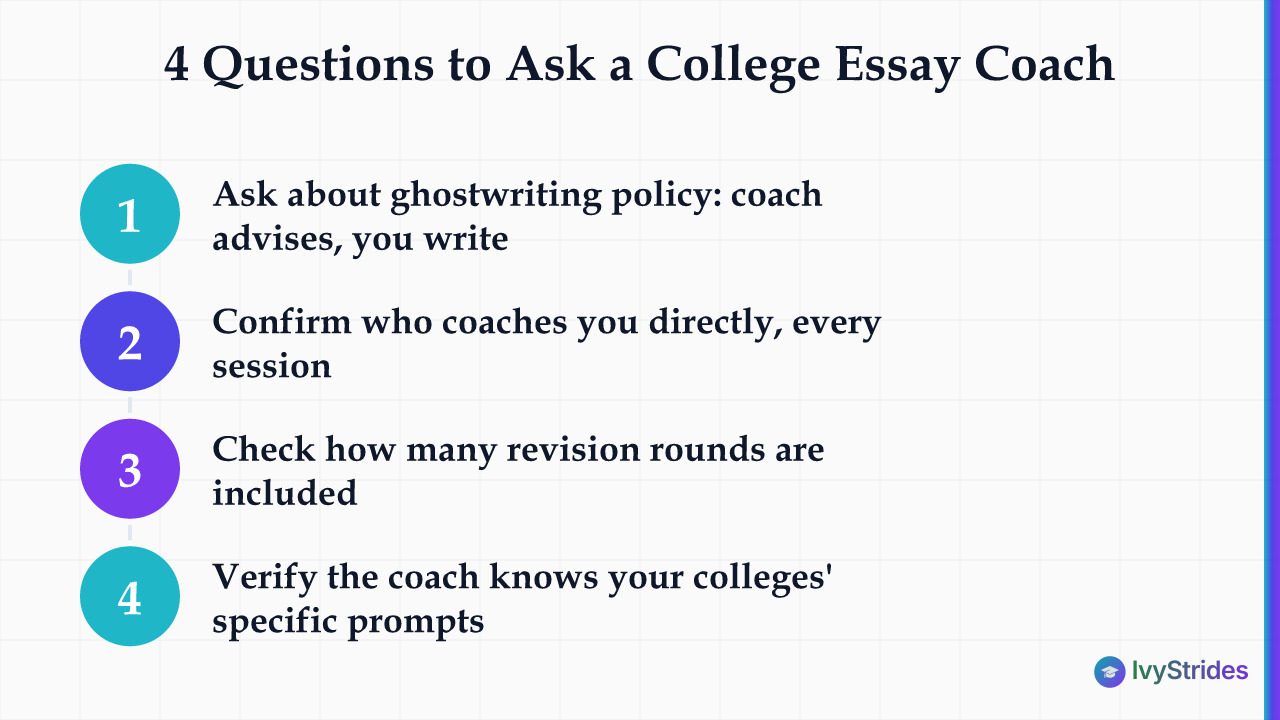
Choosing a college essay coach comes down to four questions: ghostwriting policy, who actually coaches you, how many revision rounds are included, and whether they know your colleges' prompts.
Those four separate a college essay consultant who adds value from one who just reads your draft.
Ghostwriting policy first. A strong answer is plain: the coach advises and edits, you write. If a college essay writing coach offers to produce a draft "to save time," that ends the conversation.
Who actually coaches you. Some services hand you to an associate after the sales call. Ask whether the person assessing your draft is the person who will work with you week to week. A college essay mentor who knows your voice across several sessions catches drift a one-time reviewer never will.
Revision rounds. A single pass rarely moves a flat draft to a sharp one. Ask how many rounds a package includes and what happens when you need one more before a deadline.
Prompt knowledge. Each college decides whether the personal essay is required or optional, and every supplement can only be submitted after you submit that college's application.
A coach who already knows your schools' prompts and word limits saves you the research, and good advice respects each college's actual prompts, never a generic template. If you need the foundation first, start with how to structure a Common App essay. Still mapping the basics? Read what the college application essay is.
| Question to ask | What a strong answer looks like |
| What is your ghostwriting policy? | "I advise and edit; the words stay yours." |
| Will I work with you directly? | "Yes, every session, start to finish." |
| How many revision rounds are included? | A clear number, plus flexibility near deadlines |
| Do you know my colleges' prompts? | Familiarity with your specific supplemental list |
IvyStrides essay coaching works directly with the student and holds a clear policy against ghostwriting, which is how we'd answer all four questions above. That is the standard to hold any coach to, ours included.
FAQ: College Essay Coaching
Can a college essay coach write or edit my essay for me?
No. A coach can ask questions, react to drafts, and flag unclear structure, but the words must be yours. The Common App requires you to certify that the writing you submit is your own work. The same standard applies to AI tools that generate text.
Can I hire someone to write my college essay?
Hiring someone to write your essay is ghostwriting, which breaks the Common App's requirement that you certify the writing as your own. Legitimate coaching means a professional guides your brainstorming, reacts to your drafts, and helps you revise, while the writing stays yours.
Who can help me write my college essay?
Teachers, school counselors, parents, and peers can all give feedback, and many students start there. A professional college essay coach or college essay consultant adds structured brainstorming and admissions context. The right choice depends on how much guidance you need and how much time remains before your deadline.
How is a college essay coach different from a tutor or mentor?
The terms are often used interchangeably. In practice, a college essay tutor tends to focus on mechanics and grammar, a college essay mentor may advise broadly across the application, and a coach typically combines brainstorming, structural feedback, and revision guidance. What matters most is whether the person knows admissions context.
Your Next Step on Essay Coaching
A coach is worth hiring when your gap is real: a draft that reads flat, a supplemental list you haven't sequenced, or a deadline closing faster than your revisions. Match the help to the gap, hold the own-work line, and start as early in the application cycle as you can.
- Pick which one of the seven Common App prompts fits your strongest story.
- List every target college's supplemental prompts and word limits now.
- Mark your nearest binding deadline, then work backward to a revision schedule.
- Decide whether peer and teacher feedback is enough, or whether a coach's structured guidance fits your timeline.

Award-winning author (South Asian Book Award) and graduate of BITS Pilani and UCLA Luskin School of Public Affairs. Brings a published writer's eye to Common App essays and grammatical precision to SAT and ACT R&W instruction.