
Should You Retake the SAT? What to Weigh for 2026-27
On this page
- When Retaking the SAT Is Worth It: A Score-Band Breakdown
- How Superscoring Changes the SAT Retake Math
- When You Can Skip the SAT Retake
- How to Time Your SAT Retake Before Application Deadlines
- FAQ: SAT Retake Decisions in 2026
- Is it worth retaking the SAT?
- Should I retake the SAT if I got a 1500?
- Can you retake the SAT as a senior?
- How many times can you retake the SAT?
Retake the SAT if your current score sits below the middle-50% range of your target colleges and you have time to prepare before your application deadlines. The Digital SAT is a 2-hour-14-minute exam scored 400 to 1600 across two sections, Reading and Writing and Math, each split into two modules with an adaptive second module.
Skip it if you already sit at or above the 75th percentile of every target school, if you've sat the test several times with no change in how you prepared, or if your colleges are test-optional and you don't plan to send a score.

When Retaking the SAT Is Worth It: A Score-Band Breakdown
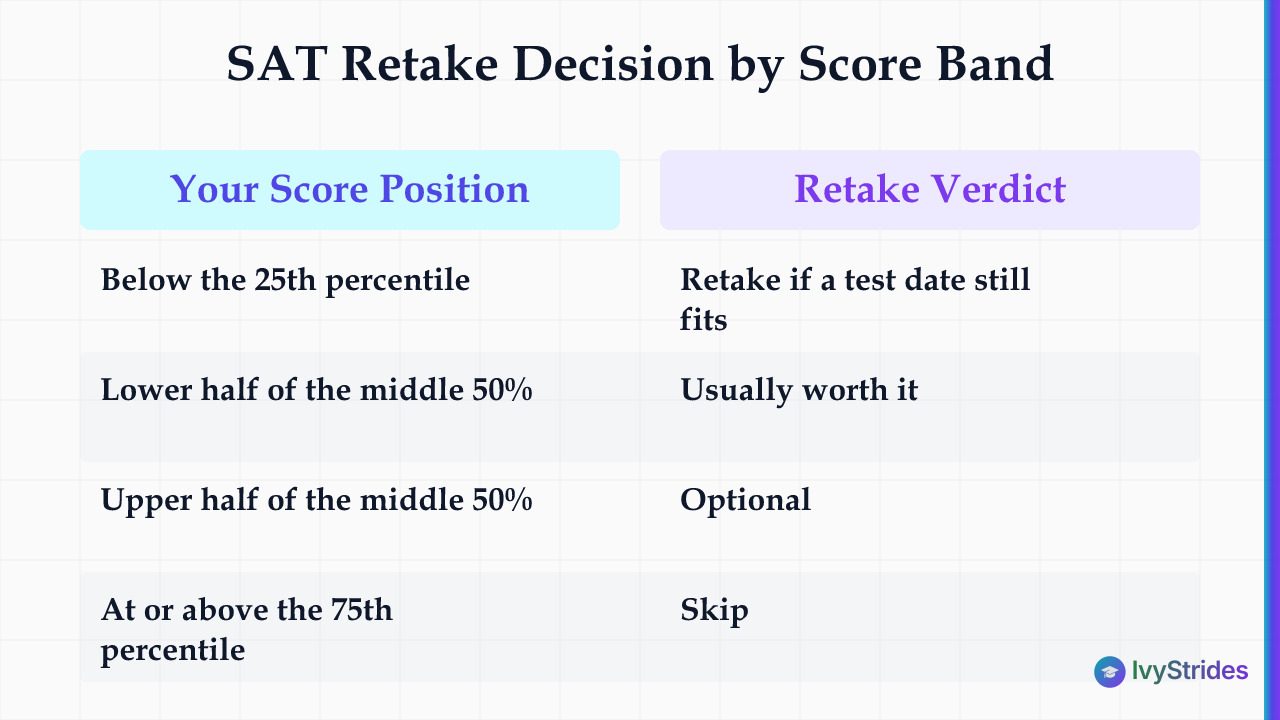
A retake is worth it when the gap between your score and a target college's published range is one another sitting could realistically close before your deadline. The benchmark is not a national average or a general sense of what counts as a good SAT score. It's the middle-50% range a college reports in its annual Common Data Set: the 25th-to-75th percentile band of enrolled first-year students who submitted SAT scores.
Find your gap first. Look up the Common Data Set for each target school, note its 25th and 75th percentile SAT scores (item C9), and see where your current total falls between them, school by school. Ranges shift from year to year, so use each school's most recent Common Data Set rather than a figure quoted secondhand.
Here is how the decision reads at each band, one target college at a time.
| Your Score at a Target College | Retake Verdict | What Can Change It |
| Below the 25th percentile | Retake, if a test date with time to prepare still fits | No remaining test date that college will accept for your round |
| Lower half of the middle 50% | Usually worth it | Superscoring, or one section well below the other, strengthens the case |
| Upper half of the middle 50% | Optional | A merit scholarship cutoff just above your score can tip it toward a retake |
| At or above the 75th percentile | Skip | Little, unless a scholarship cutoff still sits above your score |
College Board itself recommends taking the SAT at least twice, in the spring of junior year and the fall of senior year, and says most students get a higher score the second time. That is a general pattern, not a forecast for your score.
Merit scholarships change the math. Some universities publish automatic merit scholarship cutoffs tied to SAT scores, and if one sits just above your score, crossing it can matter more than the admissions bump.
And remember Score Choice: College Board lets you decide which test dates' scores to send, so a weaker sitting need not follow you to a college that doesn't require all scores. No score guarantees admission, and colleges that consider scores weigh them alongside the rest of your application.
How Superscoring Changes the SAT Retake Math
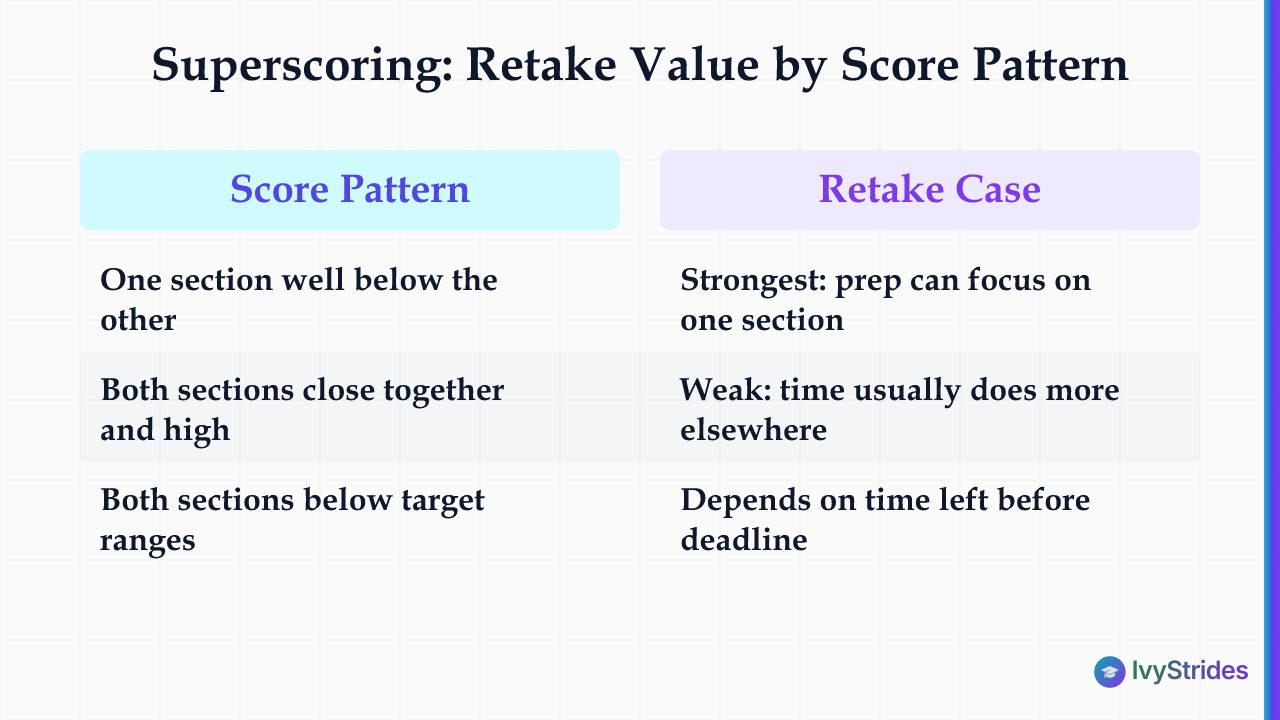
Superscoring is when a college takes your highest Reading and Writing score and your highest Math score, even from different test dates, and combines them into one total. The Digital SAT reports two section scores, each on a 200-to-800 scale, that sum to your 400-1600 total. College Board notes that many schools superscore, and at those schools a gain on just one section can raise your superscore even if the other section stays flat or slips. That changes how to read the score gap you calculated above: to raise a superscore, you don't need to beat your old total outright, only your best score in one section.
IvyStrides' analysis of College Board's superscoring definition, applied to a hypothetical pair of sittings, shows how a retake can lift the superscore above both totals. Say your first sitting gives 700 in Reading and Writing and 650 in Math, a 1350 total, and your second gives 680 and 710, a 1390 total. If your colleges superscore, they take 700 from the first date and 710 from the second, so your superscore is 700 + 710 = 1410, higher than either total even though Reading and Writing slipped the second time.
| Score Pattern | What Superscoring Does | Retake Case |
| One section well below the other | A gain on the weaker section lifts the superscore while the stronger section stays on record | Strongest: prep can focus on one section |
| Both sections close together and high in your target ranges | Little room to raise either section | Weak: the time usually does more elsewhere |
| Both sections below your target ranges | Both sections need to rise | Depends on the time left before your deadline |
Section imbalance is the strongest signal. When one section trails the other by a wide margin, a second SAT sitting aimed at that section is worth weighing even if your total already sits near a college's range, because your stronger section is already on record.
When a student asks IvyStrides whether to retake the SAT, our coaches start with the two section scores on the report, set each one against the target colleges' published ranges, and only then plan one-on-one SAT prep around the weaker section and a test date whose scores those colleges will consider.
When You Can Skip the SAT Retake
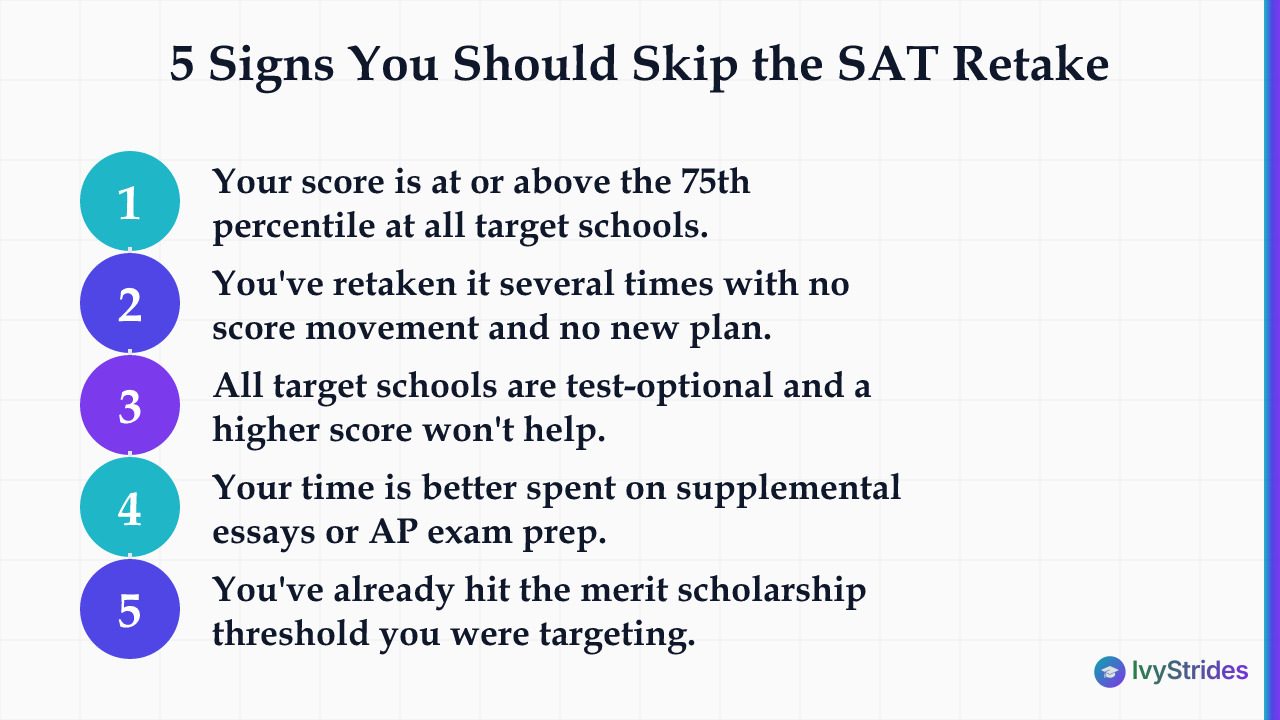
Skip the SAT retake when your score already clears the 75th percentile at every target school, because at that point another sitting adds little to your application for the time it takes. The same holds when both sections already sit high in your target ranges: there's little room left to gain.
Watch for diminishing returns. College Board sets no cap on attempts, so the stopping point is yours to judge, and deciding how many SAT sittings are enough comes down to whether the next one has a weaker section to target and a changed prep plan behind it.
College admissions insights on LinkedIn: follow IvyStrides for application guidance and counseling updates.
Five signs a retake is not worth it:
-
Your score sits at or above the 75th percentile of all your target schools.
-
You've taken the SAT several times, your scores have barely moved, and you have no new prep plan.
-
Every target school is test-optional and a higher score wouldn't strengthen your file.
-
Your remaining time is better spent on supplemental essays or AP exam prep.
-
You've hit the merit scholarship threshold you were chasing.
Test-optional needs care. Test-optional policies vary by school and year, and FairTest's college test-policy list tells applicants to confirm requirements directly with each school, so check each college's policy for your entry year. A test-optional college still considers the scores applicants choose to send, unlike a test-blind one, so the real question there is whether to submit your SAT score at all. A retake earns its time only if you would send the new score.
How to Time Your SAT Retake Before Application Deadlines
Time your SAT retake so the scores arrive before each college's cutoff for your application round, with enough weeks before test day to prepare. The table below follows College Board's published test dates and deadlines and its score release schedule. Registration for every 2026-27 SAT date closes 15 days before test day, with a late registration deadline four days after that.
| Test Date | Registration Deadline | Late Registration | Scores Released | Best For |
| October 3, 2026 | September 18 | September 22 | October 16 | Past; these may be the scores you're weighing now |
| November 7, 2026 | October 23 | October 27 | November 20 | Registration closed; seniors already registered whose colleges accept November scores |
| December 5, 2026 | November 20 | November 24 | December 18 | Seniors whose colleges accept December scores |
| March 6, 2027 | February 19 | February 23 | March 19 | Juniors taking a first sitting |
| May 1, 2027 | April 16 | April 20 | May 14 | Juniors taking a first or second sitting |
| June 5, 2027 | May 21 | May 25 | June 21 | Juniors who want a score in hand before senior fall |
Juniors have room. College Board's recommended pattern, spring of junior year and fall of senior year, leaves the summer to prepare between sittings, so use that runway rather than compressing everything into senior fall.
Seniors run tight. November 7 scores are scheduled for November 20 and December 5 scores for December 18, both after an early deadline such as MIT's November 1 Early Action date. That does not rule them out, because each college sets the latest test date it will consider for each round: MIT asks applicants to test before November 30 for Early Action and before December 31 for Regular Action. Find that rule on each target college's testing page before you register.
Daily SAT and ACT prep on YouTube: short strategy videos from IvyStrides. Subscribe to IvyStrides on YouTube.
Put the whole decision together in this order:
- Note where your score sits between each target school's 25th and 75th percentile SAT scores.
- Check whether one weaker section, under superscoring, could close the gap.
- Match the next open SAT date and its score release to each college's latest accepted test date.
- If the gap is real and the timeline fits, register and spend the weeks before test day on raising your SAT score section by section, weaker section first.
FAQ: SAT Retake Decisions in 2026
Is it worth retaking the SAT?
Yes, if your score falls below the 25th percentile of your target colleges and you have time for targeted prep before the next date. If you've already met your target range or sat the test several times without changing how you prepare, another attempt is unlikely to be worth the time.
Should I retake the SAT if I got a 1500?
It depends on your target schools. Where a 1500 already sits inside or above a college's middle 50%, a retake adds little. At the most selective colleges it can fall below the range: MIT's 2025-26 Common Data Set puts its 25th percentile at 1520. There, a retake aimed at your weaker section is worth weighing.
Can you retake the SAT as a senior?
Yes. Seniors can still sit the December 5, 2026 SAT (registration deadline November 20, scores December 18), and seniors who registered for November 7 by the October 27 late deadline get scores on November 20. Whether they count depends on each college's latest accepted test date for your round.
How many times can you retake the SAT?
College Board sets no limit: students can take the SAT as many times as they want. Sit again only when you have a section to target and a changed prep plan, and remember that some colleges ask for every score; MIT, for example, asks applicants to self-report all the exams they have taken.

Rajesh is a technology leader, entrepreneur, and angel investor with 28+ years in Business & Technology Leadership and Product & Solution Engineering. He is passionate about education, mentoring, and driving digital transformation.