
Columbia's Last Test-Optional Year: You Can Add Scores Until Jan. 15
On this page
- Columbia Is Test-Optional for 2026-27: What the Policy Actually Says
- The Score-Submission Deadline You Cannot Miss at Columbia
- What Columbia Actually Weighs When You Go Test-Optional
- Should You Submit a Borderline SAT or ACT Score to Columbia?
- FAQ: Columbia's Test-Optional Policy and Score Submission
- Is the Columbia test optional for 2027?
- Should I go test optional for Columbia with a 1490 SAT?
- Do I submit a 33 ACT to Columbia?
- Will Columbia be test optional in 2027?
- Your Next Step on Columbia's Test-Optional Decision
Columbia University (Columbia College and Columbia Engineering) is test-optional for the 2026-27 cycle, meaning fall 2027 entry. Submitting the SAT or ACT is your choice. Columbia will require scores for fall 2028 entry.
Applied without scores? You can still add them until January 15 for Regular Decision. Every Columbia policy fact below comes from Columbia's own pages, starting with its testing policy page. The harder question, and the one this page settles, is whether adding a borderline score to a holistic review actually helps you or quietly works against you.

Columbia Is Test-Optional for 2026-27: What the Policy Actually Says
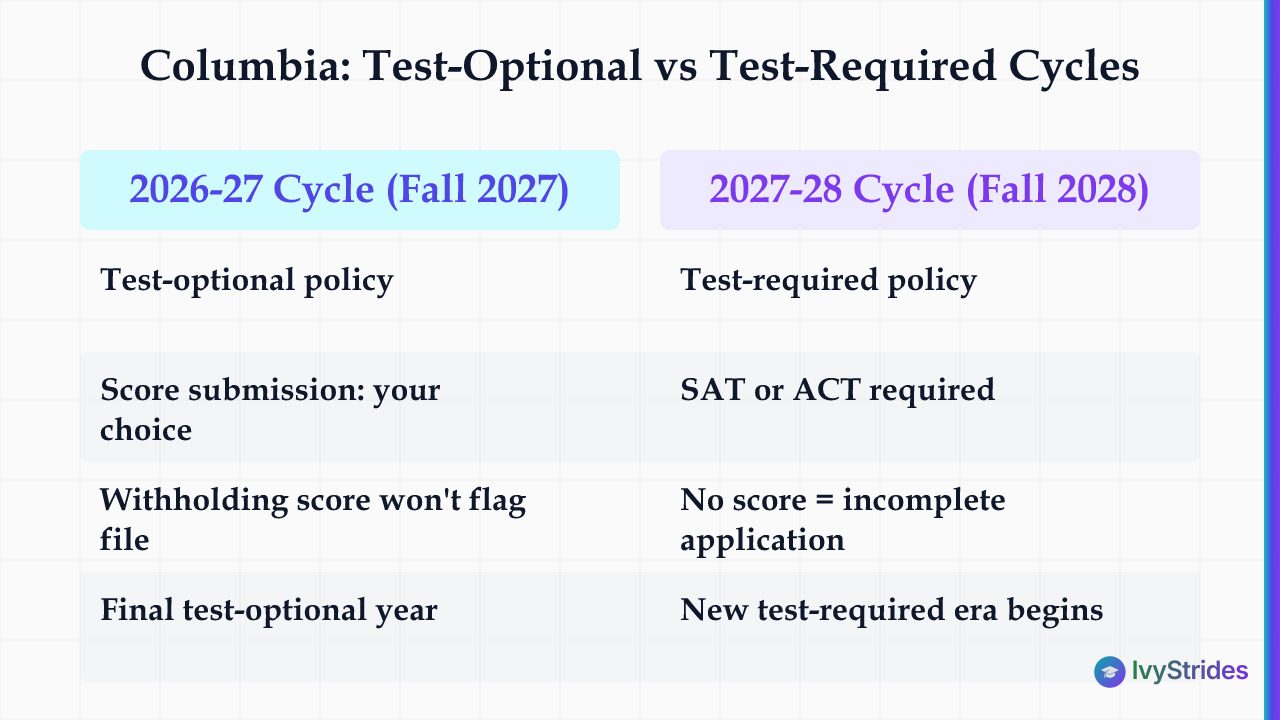
Columbia College and Columbia Engineering (SEAS) accept applications without SAT or ACT scores for fall 2027 entry. Test-optional means you decide whether Columbia considers a score you already hold; no score is required to apply, and withholding one does not flag your file. This is the final test-optional year.
For fall 2028 entry, that changes. Columbia has announced it will require standardized testing for fall 2028 entry, which governs the 2027-28 cycle. So the current cycle and the next one are two separate decisions. If you are applying now, the future test-required rule does not touch you.
| Application Cycle | Entry Term | Policy | Score Requirement |
| 2026-27 | Fall 2027 | Test-optional | Your choice |
| 2027-28 | Fall 2028 | Test-required | SAT or ACT required |
Columbia is not alone this cycle. Princeton faces the same one-cycle window before scores become required, so if both schools sit on your list, the timing is the same at both: optional for fall 2027 entry, required for fall 2028. Other elite schools run on different clocks: NYU stays test-optional through 2027-28, one cycle longer than Columbia's, which shifts your timeline if NYU is on your list too.
One caveat worth stating plainly: test-optional policies move year to year and school by school. Confirm each college's current rule on its own admissions site before you finalize anything.
The Score-Submission Deadline You Cannot Miss at Columbia
The Columbia supplement asks one binary question: should Columbia consider your scores, yes or no? This score-consideration toggle is the single most time-sensitive thing in your Columbia application, because once you submit, you cannot change or withdraw a yes answer. A no answer, though, you can still upgrade.
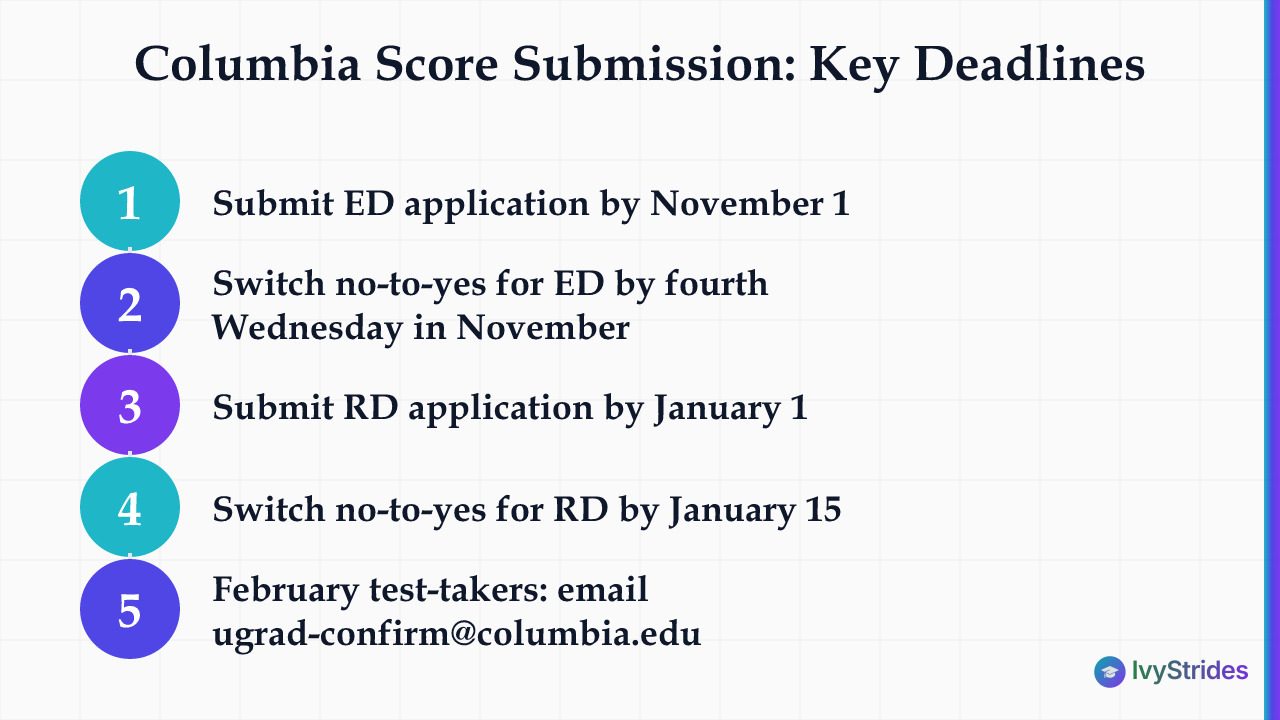
Because that toggle runs one direction only, the timing matters. You can switch a no to yes by the fourth Wednesday in November for Early Decision, or by January 15 for Regular Decision, per Columbia's testing policy page. February test-takers who want scores considered email ugrad-confirm@columbia.edu.
The deadlines track the application plans. Early Decision closes November 1 with decisions typically in mid-December; Regular Decision closes January 1 with decisions typically in late March. Those release dates are typical and may shift in a given year.
| Action | Deadline |
| Submit ED application | November 1 |
| Switch no to yes (ED) | Fourth Wednesday in November |
| Submit RD application | January 1 |
| Switch no to yes (RD) | January 15 |
| February test-taker, add scores | Email ugrad-confirm@columbia.edu |
The volume here is real. Columbia's 2025-26 Common Data Set records 5,868 Early Decision applications for the fall 2025 entering class, and Columbia admitted 819 of them. That works out to an Early Decision admit rate of roughly 14% (819 of 5,868) for the fall 2025 entering class.
If you decide to add scores before the deadline, Columbia takes them through your applicant status portal, where self-reported scores are accepted; for an official report, use the institutional code and score-release timing for sending your SAT scores to Columbia, since College Board typically sends standard reports for the weekend SAT within 5–10 business days of the order.
What Columbia Actually Weighs When You Go Test-Optional

Photo by https://kaboompics.com/ on Pexels
Columbia reads seven factors as Very Important, and none of them is a test score. Section C7 of Columbia's 2025-26 Common Data Set rests the file on rigor of secondary school record, class rank, academic GPA, application essay, recommendation, extracurricular activities, and character and personal qualities. Omitting scores does not weaken these; it simply lets them carry the full weight.
Because the application essay sits among those Very Important factors, your writing matters as much as any score you submit or withhold. Columbia's writing supplement, including the 100-word reading list and its short-answer questions, is where reviewers hear your individual voice. Columbia runs a holistic, contextual, committee-based review with no formula and no cut-off GPA or score, per its how-we-review page. Columbia admits no candidate without discussion by multiple officers.
| Factor | CDS Rating |
| Rigor of secondary school record | Very Important |
| Class rank | Very Important |
| Academic GPA | Very Important |
| Application essay | Very Important |
| Recommendation | Very Important |
| Extracurricular activities | Very Important |
| Character / personal qualities | Very Important |
| Interview | Not Considered |
| Level of applicant's interest | Not Considered |
| State residency | Not Considered |
No interviews, no demonstrated interest. Columbia removed interviews from the process in May 2023, and the CDS rates both Interview and Level of applicant's interest as Not Considered. State residency and religious affiliation also carry no weight. So you cannot nudge the file by signaling enthusiasm; the writing and the record do that work.
Columbia also names what it looks for in applicants: academic preparation across subjects, intellectual curiosity, engagement with others, an authentic individual voice, and genuine knowledge of Columbia, including the Core Curriculum and its New York City setting. Columbia expects Engineering applicants to have physics and calculus. It accepts every curriculum, AP, IB, A Levels, or a national system, with no preference.
One note on scope: students applying with a gap of more than a year or seeking part-time study apply to the School of General Studies instead, which runs a separate process outside this policy.
If you go test-optional at Columbia, let your supplements and extracurricular record carry the file: Columbia says applicants who choose not to submit scores will not be disadvantaged, and its Common Data Set rates both the application essay and extracurricular activities Very Important. If your draft of Columbia's reading-list and short-answer supplement is not yet pulling its weight, revising it, on your own or with essay coaching for supplement drafts, is the lever to pull before a deadline, not a last-minute score.
Should You Submit a Borderline SAT or ACT Score to Columbia?
Submit the score if it sits at or above the middle 50% of Columbia's enrolled students; withhold it if it is your weakest element. Columbia publishes no cut-off score and says there is no formula for reviewing applications, so the decision is file-specific. A score is one signal among many in a holistic review, not a gate.
Because Columbia weighs those seven Very Important factors regardless of whether you submit, the question is simply whether the number adds a positive data point or drags on an otherwise strong file. Check Columbia's current enrolled-student range on Columbia's Common Data Set (available on Columbia's OPIR page) before you decide, and read the middle 50% correctly: it describes enrolled students who sent a score, not everyone admitted. Ranges shift slightly each cycle.
IvyStrides' review of Columbia's test-optional policy and its 2025-26 Common Data Set shows two facts that frame this choice: Columbia sets no minimum test score, and the enrolled first-years who sent scores had a middle 50% of 1510–1560 on the SAT and 34–35 on the ACT.
| Your Score vs. Middle 50% | Likely Signal to Reviewer | Recommended Action |
| Above the 75th percentile | Reinforces a strong file | Submit |
| Inside the middle 50% | Neutral to mildly positive | Usually submit |
| Just below the 25th percentile | Risks pulling focus | Weigh against file strength |
| Well below, with strong GPA and essays | Distracts from your case | Withhold |
Make the score-submission decision at Columbia by placing the number inside the full file context: course rigor, essay strength, and the specific factors Columbia rates Very Important. Before you click yes or no, a counselor who places your score against Columbia's enrolled-student range and the rest of your record reads the file as a reviewer would.
If you are weighing Early Decision with a score below the middle 50%, whether a borderline score belongs in a binding ED application is a different risk calculus from Regular Decision, because ED commits you. And remember: admissions outcomes depend on the full application, not test scores alone. No score, submitted or withheld, decides this on its own.
FAQ: Columbia's Test-Optional Policy and Score Submission
Is the Columbia test optional for 2027?
Yes. For students applying in the 2026-27 cycle for fall 2027 entry, Columbia College and Columbia Engineering are test-optional, so submitting SAT or ACT scores is your choice. Columbia will require scores for fall 2028 entry, not the current cycle.
Should I go test optional for Columbia with a 1490 SAT?
A 1490 falls below the 25th percentile of Columbia's published middle 50% range (1510–1560 for enrolled students who submitted scores, per the 2025-26 CDS). At 20 points under, it sits just below that mark, where a score risks pulling focus, so weigh it against the rest of your file. If the score is your weakest element, withholding it lets the Very Important factors carry more weight, and Columbia says applicants who choose not to submit scores will not be disadvantaged. There is no universal answer; the decision is file-specific.
Do I submit a 33 ACT to Columbia?
A 33 ACT falls one point below the 25th percentile of Columbia's published ACT range (34–35 for enrolled students who submitted the ACT, per the 2025-26 CDS), so treat it like a 1490 SAT: weigh it against the rest of your file rather than submitting by default. Confirm the current enrolled-student range for students who submitted scores on Columbia's Common Data Set first, since ranges move slightly each cycle.
Will Columbia be test optional in 2027?
For fall 2027 entry, yes: the current 2026-27 cycle is test-optional, and it is the last test-optional year for Columbia College and Columbia Engineering. Starting in August 2027, for the 2027-28 cycle and fall 2028 entry, Columbia will require the SAT or ACT from first-year and transfer applicants, and applicants who face challenges in meeting the requirement may request a waiver.
Your Next Step on Columbia's Test-Optional Decision
You now know the policy, the deadline, and what Columbia weighs. The work left is matching your own file to it before the clock runs out.
- Check whether you answered the score-consideration toggle, and note your deadline: fourth Wednesday in November for ED, January 15 for RD.
- Pull Columbia's current enrolled-student range from Columbia's Common Data Set and place your score against it honestly.
- If your score is below the middle 50%, strengthen the Very Important factors you control: the essay and the supplement.
- Confirm Columbia's policy on its official admissions site, since test-optional rules change each year.

Hemant is a seasoned entrepreneur, investor, and growth strategist with deep ground in education and technology-driven learning. His core training is in Mathematics and Physics — he authored Physics for IB Diploma: Ultimate Revision Guide, recognized as a top student resource.