
Is the ACT Worth Taking in a Test-optional Era? Here Is What You Need to Know in 2026
On this page
- Is the ACT Worth Taking in a Test-Optional Era? When Scores Still Count
- Is the ACT Test Optional at the Colleges on Your List?
- Is Taking the ACT Worth the Time and Fees in 2026-27?
- Is Taking the Science ACT Worth It?
- Is the ACT Worth It on Your Timeline? Choosing a 2027 Test Date
- Is Retaking the ACT Worth It?
- Frequently Asked Questions: Is the ACT Worth Taking in a Test-optional Era
- What is the best ACT score possible?
- Do most colleges prefer the SAT or ACT?
- Is the ACT writing worth it?
- Is taking SAT or ACT worth it after applying test-optional?
- Your Next Step on Whether the ACT Is Worth Taking
Yes, the ACT is worth taking for most college-bound students. The ACT is a national admissions test scored 1 to 36, and test optional only means a college won't require it. College Board lists 42 public and 21 private colleges that currently or soon will require SAT or ACT scores.
Those counts come from College Board's list of colleges that require the SAT or ACT, which warns that it changes frequently. Scholarships, course placement and some majors also ask for a score.

Is the ACT Worth Taking in a Test-Optional Era? When Scores Still Count
An ACT score still counts in five situations, even at test-optional colleges. ACT defines a test-optional college as one that does not require ACT or SAT scores to be admitted, which is not the same as ignoring them. The ACT's guide to test-optional admissions names the uses below.
| Situation | What the ACT score does | Official source |
| Merit-based scholarships | Often required even at test-optional colleges | ACT test-optional page |
| Course placement | Places students in classes at the right level | ACT test-optional page |
| Nursing and engineering programs | Often required by the program itself | ACT test-optional page |
| Automatic admission | A sufficient score can secure it at some schools | ACT test-optional page |
| Test-required colleges | Required now or soon at 63 listed colleges | College Board BigFuture list |
Scholarships run on separate rules. act.org notes that even test-optional colleges often require a score when awarding merit-based scholarships, so the admissions policy is only half of the picture. Scholarship rules are separate from admission rules, and ACT scores still shape merit scholarship awards at many colleges that waive the test for admission.
IvyStrides' analysis of College Board's BigFuture list, 42 public and 21 private colleges, counts 63 colleges that currently or soon will require SAT or ACT scores. So is the ACT worth taking? With one of those colleges or a merit scholarship in view, yes.
And the 2020 framing of the question doesn't describe the 2026-27 cycle; each college's own admissions page is the authority now.
Is the ACT Test Optional at the Colleges on Your List?
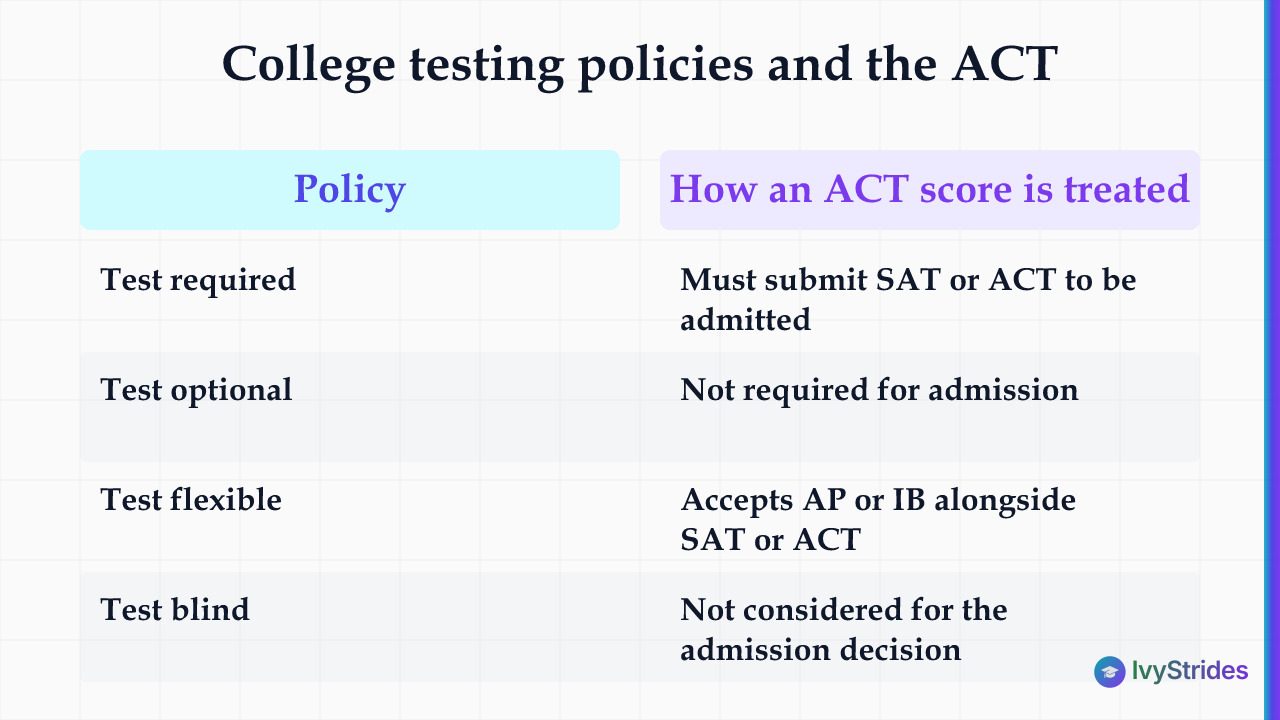
Whether you need an ACT score for admission is set by each college, not by ACT. Because colleges set the rules and the list of 63 colleges keeps moving, a policy you read two years ago may be out of date. Colleges use four policies, ACT defines three of them beyond test required, and the difference matters for a score you haven't earned yet.
| Policy | How the college treats an ACT score | What to check on the admissions page |
| Test required | Must submit SAT or ACT to be admitted | First entry year the rule applies |
| Test optional | Not required for admission | Scholarship and program score rules |
| Test flexible | Accepts AP or IB alongside SAT or ACT | Which exams count and how |
| Test blind | Not considered for the admission decision | Whether scores still set placement or aid |
Test blind isn't the end of it. ACT notes that some test blind schools still use test data for scholarships, course placement and advising. Flexible policies move too: Yale's switch from test flexible to required ACT or SAT scores means AP or IB results alone no longer meet its requirement.
Required lists change. College Board's test-required list includes Harvard College, MIT, Georgia Tech, Purdue University and the University of Texas at Austin, and it marks Auburn University's requirement as beginning for Fall 2027 entry. Some selective colleges that were test optional now appear on that list, and Cornell's return to required SAT or ACT scores shows how quickly a policy can change.
Read the Common Data Set too. Section C9 of each college's Common Data Set shows the ACT middle 50% range of enrolled students who submitted a score; set a timed practice result against it.
Taking the ACT and sending the score are two separate decisions: sit the test first, then decide college by college whether the result strengthens the file. Test optional leaves submitting an ACT score to a test-optional college with the applicant. Skip the test now, though, and that choice is gone when a scholarship deadline arrives without a score.
Is Taking the ACT Worth the Time and Fees in 2026-27?
One enhanced ACT sitting takes 125 minutes of testing for the core and costs $70. Once a scholarship deadline or score rule shows up on your list, cost is the last piece of the question. ACT's sections and structure page lists 50 English, 45 math and 36 reading questions for the core, and the ACT fee schedule sets the prices below.
| Item | Time or fee | Counts toward the Composite? |
| English | 50 questions in 35 minutes | Yes |
| Math | 45 questions in 50 minutes | Yes |
| Reading | 36 questions in 40 minutes | Yes |
| Science (optional) | 40 questions in 40 minutes; $5 add-on | No |
| Writing (optional) | One essay in 40 minutes; $25 add-on | No |
| Base registration | $70 | Covers English, Math, Reading |
| Extra score report | $20 each | Not applicable |
What the Composite measures. The ACT Composite score is the average of the English, math and reading scores, rounded to the nearest whole number, on a 1 to 36 scale, per ACT's score guide. Enhanced ACT math questions offer four answer choices instead of five, according to ACT's counselor blog.
What the fee includes. ACT's pricing covers score reports for you, your high school and up to four colleges, if you give the college codes at registration. Late registration adds $42, per the ACT fees page.
The ACT Writing test is reported on a 2 to 12 scale and doesn't affect the Composite, so add it only when a college on your list asks for it.
Is Taking the Science ACT Worth It?
Science is worth adding when the intended major is in STEM. For a student aiming at engineering or another STEM program, the $5 Science add-on is the cheapest part of the decision and the one most worth checking against the program's page. ACT's fee schedule lists $70 for the base test and $5 for Science, so a sitting that yields a Composite and a Science score costs $75 before any late or extra-report fees.
Get your Daily IV Dose on Instagram: quick study tips and test-day advice for high school students. Follow @ivy.strides.
The 125-minute core plus the 40-minute Science section comes to 165 minutes of testing. Science never changes the Composite, but ACT also reports a STEM score, the average of math and science. Deciding whether the optional ACT Science section earns its place depends on the program, not on the Composite.
Is the ACT Worth It on Your Timeline? Choosing a 2027 Test Date
The ACT is worth it on your timeline only if a sitting leaves room for one retake before your first deadline. Once a score is worth having, the useful question becomes which of the remaining national dates leaves time for preparation and one retake before the first deadline.
ACT offers seven national test dates in the 2026-27 testing year, according to ACT's test dates page. The December 12, 2026 sitting is still reachable through late registration until November 29, with the $42 late fee. The dates after it are below.
| Test date | Regular registration deadline | Late deadline |
| February 27, 2027 | January 22, 2027 | February 9, 2027 |
| April 10, 2027 | March 5, 2027 | March 23, 2027 |
| June 12, 2027 | May 7, 2027 | May 25, 2027 |
| July 10, 2027 | June 4, 2027 | June 22, 2027 |
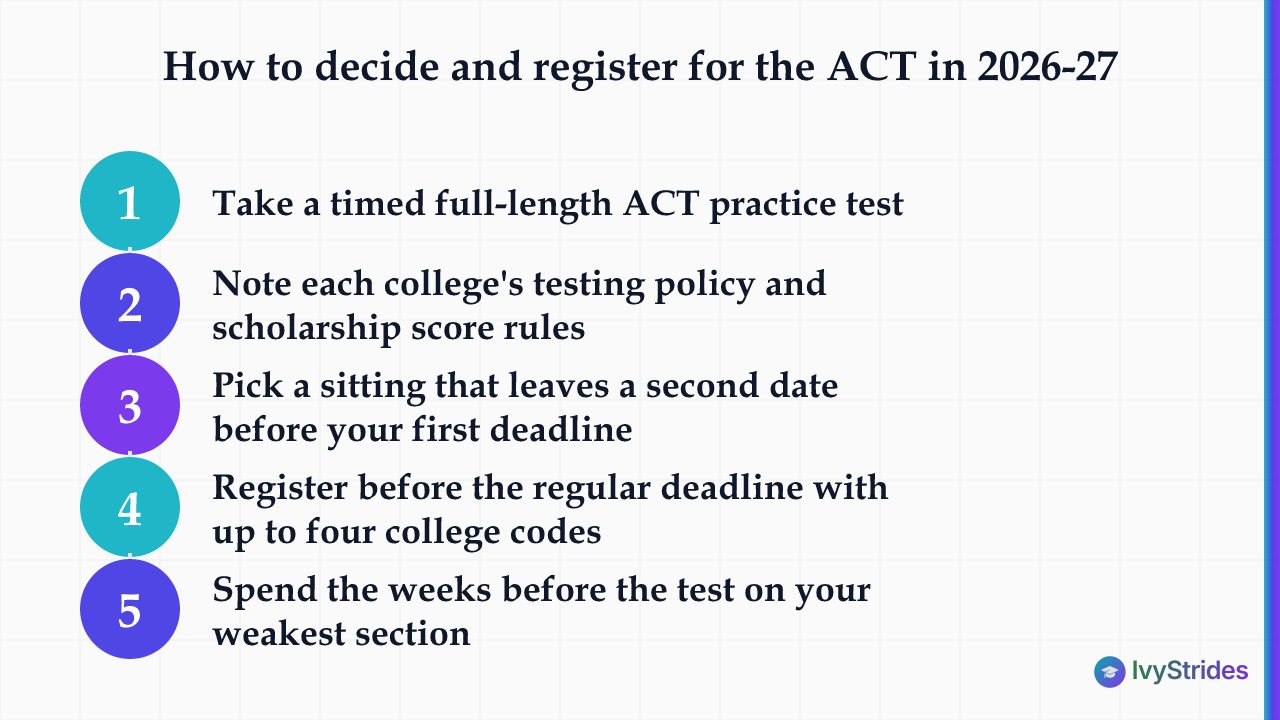
How to decide and register for the ACT in 2026-27:
-
Take a timed run through one of the full-length ACT practice tests for a timed diagnostic, so the result shows whether a score is likely to help before money goes on registration.
-
Note each target college's testing policy, scholarship score rules and program requirements.
-
Pick the sitting that leaves a second date before your earliest deadline, using the registration deadlines for each 2026-27 ACT sitting.
-
Register before the regular deadline and enter up to four college codes so the included reports go out.
-
Spend the weeks before the test on the section the practice test showed to be weakest.
Preparation that starts from the result. For a student facing the February or April deadline, IvyStrides' one-on-one ACT prep shaped around the weakest section starts with a diagnostic test and a custom ACT study roadmap. Live 1-on-1 sessions with an expert instructor run over a flexible 12 to 16 weeks, and each full-length practice test in the enhanced ACT format is followed by a detailed performance review.
Is Retaking the ACT Worth It?
Retaking is worth planning, because one weak sitting isn't final. ACT creates a superscore from your highest English, math and reading scores across test dates, and many colleges accept superscores, according to ACT's score guide. Whether a given college uses ACT superscore rules for combining section scores is that college's decision, so check its page.
Here's the part most students miss: a retake only helps if there's a date left after the first one. Book the first sitting too late, and a disappointing result can leave no second date before an early deadline. Admission still depends on the full application, never on the score alone.
Frequently Asked Questions: Is the ACT Worth Taking in a Test-optional Era
What is the best ACT score possible?
The highest possible ACT score is 36, which is the top of the scale for the Composite and for each section. The Composite averages English, math and reading only. Science and Writing are reported separately and can't raise or lower it.
Do most colleges prefer the SAT or ACT?
Neither, as a rule. College Board's list counts colleges that require SAT or ACT scores, so either test meets that kind of requirement. Pick the test your timed practice results favor.
Is the ACT writing worth it?
Only when a college on your list requires or recommends it. Writing costs a $25 add-on and earns a separate 2 to 12 score that leaves the Composite untouched.
Is taking SAT or ACT worth it after applying test-optional?
Sometimes. It helps only if the college accepts scores after you apply, for example after a deferral, or a scholarship still needs one. Find the college's deadline for adding scores before you register.
Your Next Step on Whether the ACT Is Worth Taking
Test optional removes the requirement, not the value of a score. For most families, that means one planned sitting with room for a retake.
- Take one timed full-length ACT practice test this month.
- Register for February 27 or April 10 before the regular deadline.
- Keep a later date free for a retake.
Watch the method, then try it: IvyStrides explains SAT and ACT question types on YouTube.

Hemant is a seasoned entrepreneur, investor, and growth strategist with deep ground in education and technology-driven learning. His core training is in Mathematics and Physics — he authored Physics for IB Diploma: Ultimate Revision Guide, recognized as a top student resource.