
Is a 1400 SAT Worth Submitting? How to Decide at Test-Optional Colleges
On this page
- Should I Submit a 1400 SAT Score? The Middle 50% Rule
- Is an SAT Score of 1400 Good? What the 93rd User-Group Percentile Means
- Should I Submit a 1400 SAT to UW-Madison, Michigan, USC or Duke?
- Should I Submit SAT Scores? A Checklist for Each College on Your List
- FAQ: Submitting a 1400 SAT Score
- Should I submit a 1350 SAT score?
- Do I have to submit all of my SAT scores?
- Is it bad to not submit SAT scores?
- What ACT score is comparable to a 1400 SAT?
- Your Next Step With a 1400 SAT Score
Submit a 1400 SAT where it reaches the median of a college's Common Data Set range, weigh it between the 25th percentile and median, and usually withhold it below the 25th at test-optional colleges. A 1400 is a Digital SAT total at the 93rd user-group percentile, yet it falls below USC's and Duke's 25th percentiles.
College Board publishes that percentile for the 400 to 1600 scale; each college publishes its own range and fall 2027 testing rules, so you make the call school by school.

Should I Submit a 1400 SAT Score? The Middle 50% Rule
The answer to "should I submit my 1400 SAT score" is yes where it reaches a college's median (50th percentile), and usually no below that college's 25th percentile at a test-optional school. The middle 50% is the band between the 25th and 75th percentile scores, and the same 1400 lands in a different spot at every college.
Where the range lives. The submit test lives in one table, section C9 of a college's Common Data Set, which lists the 25th, 50th and 75th percentile scores of enrolled first-years who sent them. In the University of Michigan's Common Data Set 2025-26, C9 covers first-time, first-year students enrolled in fall 2025 who submitted scores, not admitted students.
Percent submitting SAT scores. C9 also shows how many enrolled first-years sent each test. In fall 2025, 11.8% of UW-Madison's enrolled first-years sent an SAT, per its Common Data Set 2025-26, against 78% at Georgia Tech, per Georgia Tech's 2025-26 edition. A range built from a small, self-selected group says little about the students who withheld.
Three policies, three decisions. A test-optional college lets you choose, a test-required college needs a score to consider the application, and a college like UCLA won't consider SAT or ACT scores for admission at all. USC's Test Optional FAQ says applicants "will not be penalized or put at a disadvantage" without scores. That's what makes test-optional review without SAT scores a real choice below the 25th percentile rather than a gap.
| Where 1400 sits in the college's C9 range | What it tells a reader | Usual call |
| At or above the median (50th percentile) | Top half of enrolled senders | Send |
| Between the 25th percentile and median | Second quarter of enrolled senders | Weigh with the transcript |
| Exactly at the 25th percentile | Edge of the bottom quarter | Weigh; lean withhold |
| Below the 25th percentile | Bottom quarter of enrolled senders | Usually withhold |
| Any position, test-required college | Policy decides, not range | Send |
| Any position, college that won't consider scores | Scores play no part in admission | Not needed for admission |
No college publishes this rule; use it on one school's C9 numbers at a time, and only where the testing policy leaves you the choice.
Is an SAT Score of 1400 Good? What the 93rd User-Group Percentile Means
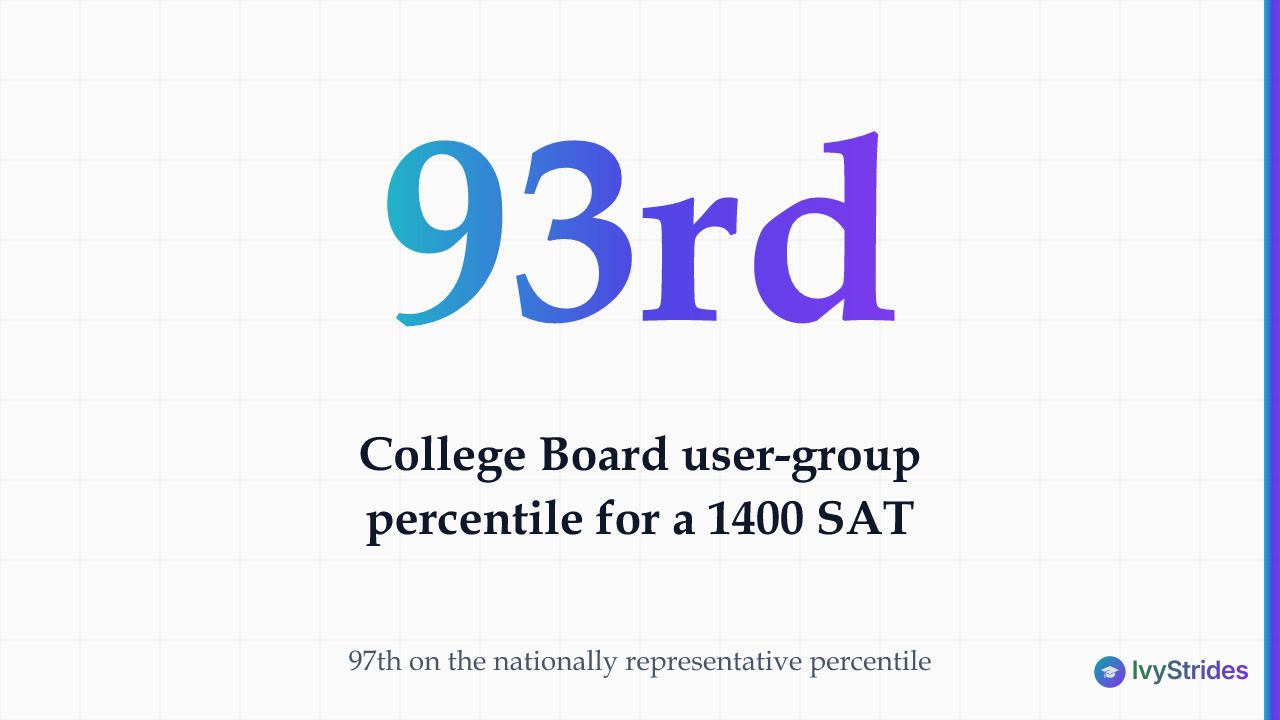
An SAT score of 1400 is good by national standards: College Board's percentile tables place it at the 93rd user-group percentile and the 97th nationally representative percentile. Even so, a strong national standing doesn't tell you where a 1400 lands in one school's C9 numbers.
Two kinds of percentile. User-group percentiles use the actual scores of students who graduated in the past three school years; nationally representative ones come from a weighted study of U.S. students in 11th and 12th grade.
| SAT total score | College Board user-group percentile | Nationally representative percentile | Points above the class of 2025 mean (1029) |
| 1200 | 75th | 81st | 171 |
| 1350 | 89th | 94th | 321 |
| 1400 | 93rd | 97th | 371 |
| 1440 | 95th | 98th | 411 |
| 1450 | 95th | 99th | 421 |
| 1500 | 97th | 99th | 471 |
Sources: College Board percentile tables and its 2025 SAT Suite Annual Report, whose class of 2025 mean of 1029 uses each student's most recent score; the last column subtracts 1029 from each total.
Why a 1400 can look low. At a test-optional college, the C9 SAT range covers only enrolled students who chose to send an SAT: 33% of USC's fall 2025 enrolled first-years, per USC's Common Data Set 2025-26. Against that opt-in group, a 1400 can sit low while still outranking most recent test takers.
A 1400 rates as strong against good SAT score benchmarks across percentile bands, but standing is a different question from whether one college's range makes the score worth sending.
Should I Submit a 1400 SAT to UW-Madison, Michigan, USC or Duke?
A 1400 SAT gets four different calls across six colleges: weigh it at UW-Madison and Michigan, send it to Georgia Tech, usually withhold it at USC and Duke, and skip it for admission at UCLA. Each college's own range and policy make that score worth sending or not, so the answer to "should I submit a 1400 SAT to USC" isn't Michigan's answer.
The 25th percentile test. IvyStrides' analysis of five 2025-26 Common Data Sets puts a 1400 at or above the 25th percentile at UW-Madison, Michigan and Georgia Tech, and 70 and 110 points below it at USC and Duke.
| College | Testing policy for fall 2027 entry | SAT middle 50% (CDS 2025-26, fall 2025 enrolled who sent an SAT) | Where a 1400 lands | Usual call |
| UW-Madison | Test-optional for fall 2027; top composite only, no superscore | 1400 to 1490, median 1450 | At the 25th, 50 under median | Weigh; lean withhold |
| Michigan | Test-optional for the 2027 application cycle | 1370 to 1530, median 1470 | 30 above the 25th, 70 under median | Weigh |
| Georgia Tech | Test-required: at least one SAT or ACT | 1370 to 1530, median 1460 | 30 above the 25th, 60 under median | Send (required) |
| USC | Test-optional for 2027-28 first-year applicants | 1470 to 1540, median 1510 | 70 under the 25th | Usually withhold |
| Duke | Test-optional for the 2026-27 cycle | 1510 to 1570, median 1550 | 110 under the 25th | Usually withhold |
| UCLA | Will not consider SAT or ACT scores for admission | Not applicable | No effect on admission review | Not needed for admission |
Get your Daily IV Dose on Instagram: quick study tips and test-day advice for high school students. Follow @ivy.strides.
Sources: section C9 of each college's Common Data Set 2025-26, including Duke's. Policies: Georgia Tech, USC, Duke and UCLA admissions pages. Point gaps are the difference between 1400 and each published figure.
UW-Madison. UW-Madison's test-optional FAQ covers spring 2027, fall 2027 and spring 2028 applicants, but the Board of Regents hasn't decided on fall 2028 and beyond, so juniors shouldn't assume the waiver carries over.
Michigan. U-M is test optional for the 2027 application cycle, and its early-round score date, Nov. 1, has passed. A Regular Decision applicant who wants the 1400 read follows Michigan's test-optional self-reporting rules and gets the score in by Feb. 1.
One score, six decisions. A list that mixes test-required and test-optional colleges with one that won't consider scores needs one send-or-withhold decision per school. IvyStrides' grades 11 and 12 college counseling with a per-school submission audit also delivers a written testing recommendation alongside the college list.
Each college on the list gets its own send-or-withhold call. Get one wrong and a college reads a 1400 you meant to withhold, or never sees one that would have helped.
Should I Submit SAT Scores? A Checklist for Each College on Your List

Photo by Julio Lopez on Pexels
Should I submit SAT scores to every college on my list? Seven checks per school answer that, so no college reads a 1400 you meant to withhold or misses one you needed it to see.
-
Testing policy. Open the college's fall 2027 testing page first. Georgia Tech needs a score; UCLA won't consider one for admission.
-
Section C9 range. Place 1400 against the 25th percentile, median and 75th percentile in the newest Common Data Set, and give less weight to a range few students sent scores for.
-
How the college combines scores. UW-Madison reads only the top composite and skips superscoring, while Duke takes the highest score on each SAT section across test dates. Those superscore and top-composite rules can turn the same two sittings into two different numbers.
-
Score Choice and all-scores rules. Score Choice lets you pick test dates and colleges can't opt out of it, but some require all SAT scores. With no stated policy, College Board recommends sending all scores.
-
An ACT, if you hold one. Place both scores in the same college's range and send the one that sits higher.
-
Scholarship rules. A college that awards automatic merit scholarships tied to test scores can make sending worthwhile even when a 1400 sits low in its admission range.
-
Self-report window. Confirm when each college needs self-reported or official scores, because a missed date leaves a helpful 1400 unread.
The retake branch. When a 1400 sits below the 25th percentile at the colleges that matter most and a later sitting still counts, the question moves from whether to send the score to how far a retake can move it. College Board's 2026-27 SAT dates put the next sitting on December 5, 2026, with late registration open until November 24, and the one after it on March 6, 2027, a date juniors can plan around.
IvyStrides' 1-on-1 SAT prep for a retake starts from a diagnostic test and a custom roadmap, and it includes 10 Bluebook-style adaptive mocks, each followed by a tutor review session.
FAQ: Submitting a 1400 SAT Score
Should I submit a 1350 SAT score?
A 1350 is the 89th user-group percentile in College Board's tables. It sits 20 points under Michigan's 25th percentile and 50 under UW-Madison's, so both lean toward withholding, while test-required Georgia Tech still needs an SAT or ACT result.
Do I have to submit all of my SAT scores?
Usually not. Score Choice lets you decide which test dates a college sees, though some colleges require every SAT score you've taken. When a college states no policy, College Board's advice is to send everything.
Is it bad to not submit SAT scores?
Not at colleges that say so in writing: UW-Madison, Michigan, USC and Duke each state that applicants who don't send scores aren't penalized or disadvantaged. Georgia Tech differs, because it considers an application only with a score.
What ACT score is comparable to a 1400 SAT?
ACT's concordance tables pair an ACT composite of 31 with SAT totals of 1390 to 1410. The tables date from 2018, before the enhanced ACT launched, and ACT says they don't equate scores, so send whichever score sits higher in each college's range.
Your Next Step With a 1400 SAT Score
A 1400 doesn't carry one verdict across a list, so make every call before the first Regular Decision form goes in.
- Mark each college send, weigh, withhold or required.
- Check each school's all-scores rule before picking test dates.
- Note every score deadline before it passes.
Daily SAT and ACT prep on YouTube: short strategy videos from IvyStrides. Subscribe to IvyStrides on YouTube.

Rajesh is a technology leader, entrepreneur, and angel investor with 28+ years in Business & Technology Leadership and Product & Solution Engineering. He is passionate about education, mentoring, and driving digital transformation.