
How to Review your SAT Practice Test Mistakes: The Complete 2026 Playbook for a Top Score
On this page
- The Direct Answer: What Reviewing SAT Practice Test Mistakes Actually Means
- Step 1: Access Your Bluebook and My Practice Scores Before You Do Anything Else
- Why Most Students Review Practice Tests the Wrong Way (And What to Do Instead)
- Still Seeing the Same Mistakes on Every Practice Test?
- Step 2: Build Your SAT Error Log (What to Track and How)
- Step 3: Categorize Every Error by Root Cause
- Content gap
- Careless error
- Timing error
- Test-strategy error
- Step 4: Turn Your Error Log Into Next Week's Study Plan
- Score Benchmarks: What Your Practice Test Score Actually Means
- What the 3-to-1 Rule on the SAT Actually Tells You (And Its Real Limits)
- When to Get a Coach Involved in Your SAT Review Process
- FAQ
- Can you see exactly which questions you got wrong on the Digital SAT practice test?
- Why is my SAT practice test score not showing up in My Practice?
- How many questions can I miss and still get a 1400 on the SAT?
- What's the difference between reviewing a careless error and a content gap on the SAT?
- Is a 1350 a bad SAT score?
- Should I review questions I guessed correctly on the SAT practice test?
- Ready to Turn Your Error Log Into a Real Score Gain?
To review your SAT practice test mistakes effectively, follow four steps: log every missed question in an error log immediately after the test, categorize each error by root cause (content gap, careless mistake, timing issue, or test-strategy error), re-solve each problem from scratch without looking at the answer, and use the pattern across your log to build your next study session. Access your question-level results by signing into College Board My Practice at mypractice.collegeboard.org after completing a full-length test inside the Bluebook app. Reading the answer explanation alone isn't enough, and it's the single most common reason practice scores stop improving.
The portal URL and the sign-in requirement come directly from the College Board's My Practice 101 guidance. The rest of this article turns that framework into a system you can run, section by section, for the Digital SAT format current as of March 2024.
The Direct Answer: What Reviewing SAT Practice Test Mistakes Actually Means
Reviewing SAT practice test mistakes isn't the same thing as reading the answer explanation. It's a four-step process:
-
Log every missed question with question number, section, module, and question type.
-
Categorize each error by root cause: content gap, careless error, timing error, or test-strategy error.
-
Re-solve each missed question from scratch, without looking at the correct answer or the explanation.
-
Plan your next study session using the pattern that shows up in your log.
The Digital SAT is scored on a 400 to 1600 scale, with two section scores of 200 to 800 each for Reading and Writing and Math. Each section has two adaptive modules; your performance in Module 1 determines whether Module 2 routes you to the easier or harder question bank, which changes the scoring ceiling. That adaptive structure is why raw review, just counting wrong answers, is a weak signal. What matters is which questions you missed and why.
Yes, you can see exactly which questions you got wrong. After completing a full-length practice test in the Bluebook app while signed into your College Board student account, results appear in My Practice with question-level right and wrong detail plus a skill-category breakdown by section. That data is the raw material for the four-step system. Before you push through another test, though, know that quantity is often the wrong lever. Related reading: how many SAT practice tests should you take.
Step 1: Access Your Bluebook and My Practice Scores Before You Do Anything Else
Here's the exact navigation path, because most of the "why is my SAT practice test score not showing" panic starts here.
-
Open the Bluebook app on the same laptop, iPad, or school-issued device you'll use on test day.
-
Sign into your College Board student account before you start the test. This is the step students miss. If you take the test without being signed in, the score doesn't sync.
-
Complete the full-length adaptive test in one sitting.
-
Wait for the "Your practice test is complete" screen, then close Bluebook.
-
Go to mypractice.collegeboard.org in a browser, sign in with the same College Board account, and open the completed test.
You'll see a section score for Reading and Writing, a section score for Math, a total on the 400-1600 scale, and a skill-category breakdown showing how you performed on each Digital SAT R&W question category (Information and Ideas, Craft and Structure, Expression of Ideas, Standard English Conventions) and each Math domain (Algebra, Advanced Math, Problem-Solving and Data Analysis, Geometry and Trigonometry).
If your score isn't appearing, one of three things is almost always true. First, you weren't signed into your College Board account inside Bluebook during the test. That can't be retroactively fixed for that sitting. Second, you used a third-party practice test platform. Those scores don't sync to My Practice. Third, you finished the test in the last few minutes and the portal needs time to process; wait around 15 to 30 minutes and refresh.
The quality of your review matters more than the number of tests you take; in our coaching, students who review two tests deeply outperform students who rush through five tests without a structured error analysis. If you want the full library of official practice-test resources organized by score band, start with our official SAT practice tests page. If you're chasing a big score jump, read how to raise your SAT score 200 points next.
Why Most Students Review Practice Tests the Wrong Way (And What to Do Instead)
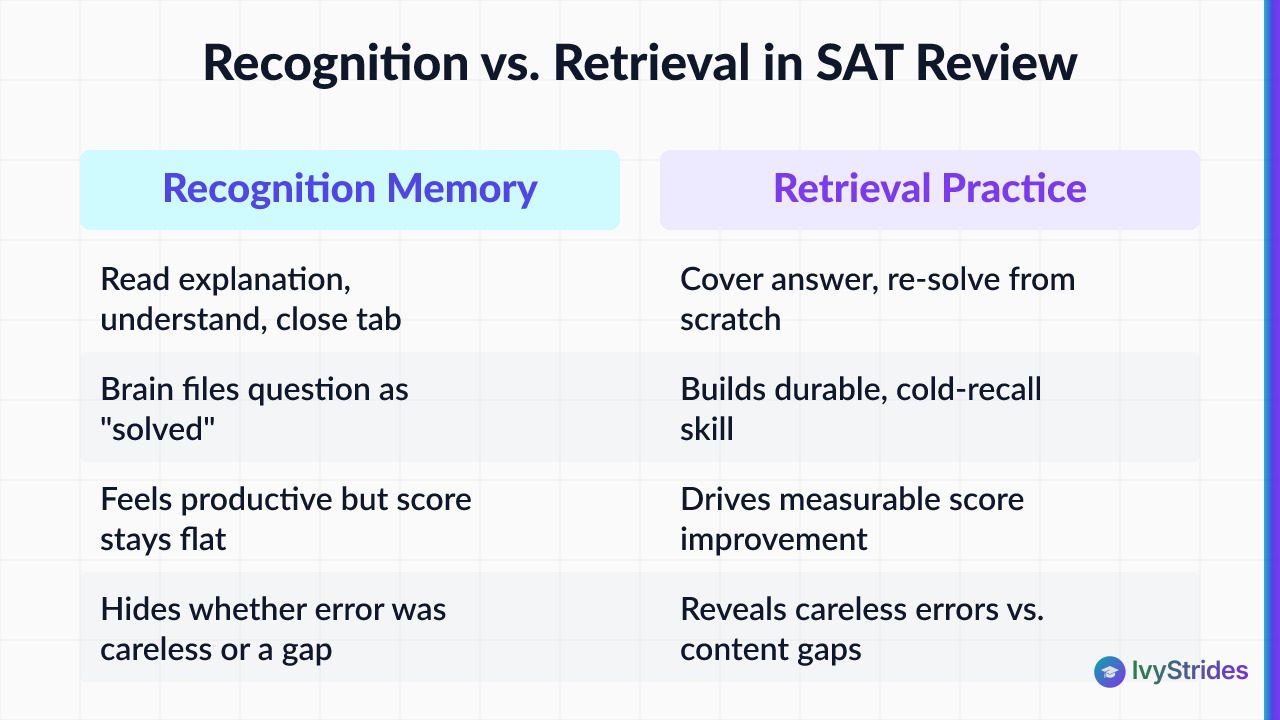
Here's the part most students miss. You finish a practice test, open My Practice, read the answer explanation for each question you missed, nod along, and close the tab. You feel productive. Your next practice test scores the same, sometimes lower.
Reading an explanation triggers recognition memory. You see the right answer, you understand why it's right, and your brain files it under "solved". But on the next test, you're not being asked to recognize the solution. You're being asked to retrieve it, cold, under time pressure, from a slightly different question stem. Recognition and retrieval are different skills, and only retrieval builds a durable score.
The fix is the re-solve technique. For every question you missed, cover the answer explanation, cover the correct answer, and re-solve the problem from scratch. If you get it right on the re-solve, that's a careless error. If you get it wrong or can't get started, that's a content gap or a test-strategy error. That distinction is the entire ballgame, and it's invisible if you skip straight to the explanation.
One more piece that gets skipped: guessed-correct questions. A right answer for the wrong reason is a future wrong answer. If you eliminated three choices and guessed between two, or you picked (B) because it "felt right", flag those in your log too. Not every one needs a full re-solve, but you should be able to articulate why the right answer is right and why each wrong choice is wrong before you move on. As the College Board's My Practice guidance puts it directly, understanding why each answer choice is correct or incorrect helps you prepare for similar questions.
Students who reach the 200-point improvement milestone in our coaching almost always share one habit: they treat every wrong answer as a data point, not a disappointment. If your score has been flat across two tests, the most likely cause isn't talent or effort; it's review method. For deeper reading on this exact plateau, see why is my SAT score not improving. For a full weekly structure, our SAT study plan walks it through.
Still Seeing the Same Mistakes on Every Practice Test?
In a free 15-minute call, an IvyStrides section-specialist coach will review your current score band, identify your highest-leverage error category, and give you a concrete next step. Students and parents both welcome. No commitment required.
Step 2: Build Your SAT Error Log (What to Track and How)
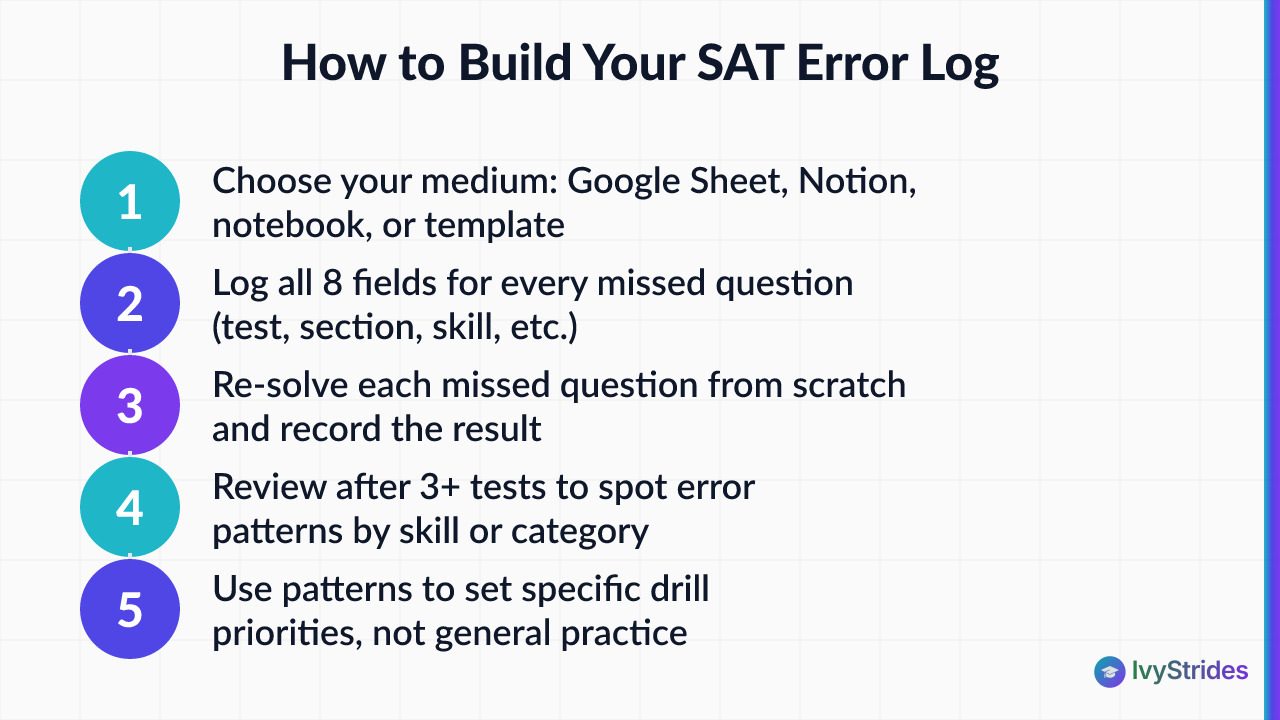
An error log is a table. It can live in a Google Sheet, a Notion database, a paper notebook, or a printed template. The medium doesn't matter. The fields do.
At minimum, log the following for every missed question:
- Test number (Practice Test 1, 2, 3, 4, 5, 6, or the custom Bluebook test)
- Section: R&W or Math
- Module: 1 or 2
- Question number within that module
- Question type or skill tag: for R&W, one of Information and Ideas, Craft and Structure, Expression of Ideas, Standard English Conventions; for Math, one of Algebra, Advanced Math, Problem-Solving and Data Analysis, Geometry and Trigonometry
- Error category: content gap, careless error, timing error, or test-strategy error (Step 3 explains each)
- Re-solve result: correct or incorrect when attempted from scratch
- Date reviewed
That's eight columns. It takes about 90 seconds per question to fill out honestly.
The value isn't in one test. It's in the pattern that emerges after logging three or more. If roughly 60 percent of your Math errors cluster in Advanced Math (nonlinear functions, quadratics, exponential relationships), that's your drill priority for the next two weeks, not "more Math practice" in general. If most of your R&W misses are Standard English Conventions items involving punctuation with subordinate clauses, you've found a specific rule to study, not a section to fear.
If you want a starting template rather than building one from scratch, our sat mistake tracker is free to download from the resources page. Additional free SAT resources sit at our free SAT resources hub.
Step 3: Categorize Every Error by Root Cause
This is where most self-study systems collapse. Students write "silly mistake" or "didn't know it" for every wrong answer, and the log becomes useless. The four categories below are mutually exclusive and each has a different fix.
Content gap
You didn't know the rule, formula, or concept. On the re-solve, you still can't get started, or you use the wrong method.
Fix: targeted skill instruction, not more practice tests. Watch a lesson on the specific concept (say, function transformations, or the rules for parallel structure), work roughly 15 to 20 problems that isolate that skill, then come back to the missed question. Taking another full-length test before closing the content gap is wasted time.
Careless error
You knew the method. On the re-solve, you get it right cold, in under two minutes. The original miss was a sign error, an arithmetic slip, a misread word, a skipped step, or a bubbled answer for the wrong question.
Fix: execution habits. Annotate the question stem before solving. Write out steps rather than doing them mentally. On any two-step Math problem, plug your answer back into the original equation before moving on. In our coaching, careless errors account for roughly 30 to 40 percent of missed questions for students in the 1200 to 1350 score band, which is why they're the highest-use fix at that level.
On the Math side, careless errors in algebra and geometry often look like content gaps until you re-solve the problem cold and realize you knew the method but skipped a step under time pressure. Related reading: SAT algebra questions.
Timing error
You left questions blank at the end of a module, or you rushed the last three questions and missed them because of pace, not concept. On the re-solve untimed, you get them right.
Fix: pacing drills. Time yourself on 10-question sets within a single module, aiming for the average per-question pace the Digital SAT allows (roughly 71 seconds per R&W question in a 27-question module, about 95 seconds per Math question in a 22-question module). Use a two-pass strategy: answer the questions you can solve in under about 90 seconds on pass one, flag the rest, come back on pass two.
Test-strategy error
You knew the content. On the re-solve you got it right. But the original miss came from misreading the question stem, eliminating the correct answer, or falling for a distractor College Board specifically designed to trap students who read too quickly.
Fix: question-stem annotation and distractor pattern recognition. Circle the exact task the question is asking ("which choice best supports the claim…", "which choice completes the text so that it conforms to the conventions of Standard English…"). Before selecting an answer, articulate in one sentence what the right answer needs to do.
For Reading and Writing errors specifically, note which passage type tripped you up, whether that is a rhetoric question, a vocabulary-in-context item, or a transition question, because each requires a different fix. Missing a transition question because you didn't read the full paragraph context is a test-strategy error, not a content gap; treating it as content will send you drilling transitions when the real fix is reading habits. See SAT main idea questions for how to break down R&W passage tasks in more depth.
Step 4: Turn Your Error Log Into Next Week's Study Plan
After reviewing a single practice test, you should walk away with three to five specific skill targets for the next study week. Not "study more Math". Something like: "Drill Advanced Math nonlinear functions for 45 minutes on Monday and Wednesday, run a 27-question timed R&W module focusing on Standard English Conventions on Tuesday, and re-review the six careless Math errors from Test 3 on Thursday."
Prioritize in this order:
-
Content gaps first. They take the most hours to close and carry the highest point value per hour once closed. A student who doesn't know how to interpret a scatterplot line of best fit will miss every question that tests it until the concept is learned.
-
Careless errors second. These are the quick wins. Around 15 minutes of "check-your-work" habit-building can save you roughly five to eight questions across a full test.
-
Timing errors third. Pacing improves with deliberate module-timed drills. You can't fix pace by hoping; you fix it by drilling 27-question and 22-question modules against the clock.
-
Test-strategy errors woven throughout. Question-stem annotation habits get baked in every time you practice.
Then, spaced retesting. Don't take the next full-length practice test the day after your review. Give yourself roughly two to three weeks of targeted drilling on the priorities your log surfaced. In our coaching, students who follow a diagnostic-driven plan with spaced retesting typically see measurable score movement within about four to six weeks, and the gap between tests is what allows the drilling to actually take.
Once your error log shows a clear pattern across two or three practice tests, that pattern becomes the input for your SAT prep plan, telling you exactly which skills to drill in the weeks before your test date. If you'd rather have a coach build that plan around your specific log rather than DIY it, see how our 1-on-1 SAT prep structures the diagnostic-to-drill cycle.
Score Benchmarks: What Your Practice Test Score Actually Means
Before you spend another twelve hours reviewing, calibrate. Where is your practice score on the 400 to 1600 scale, and what does it actually represent?
The following are approximate percentile benchmarks based on College Board score distributions. Exact percentiles shift year to year and by test form, so treat these as calibration ranges, not commitments:
- 1200: around the 74th percentile
- 1300: around the 87th percentile
- 1350: around the 91st percentile
- 1400: around the 94th percentile
- 1420: around the 95th percentile
- 1480: around the 98th percentile
- 1500: roughly the 98th to 99th percentile
- 1600: 99th+ percentile
On wrong-answer counts, a 1300 typically corresponds to roughly 20 to 25 questions missed across both sections, and a 1400 to roughly 12 to 16 questions missed, but these are approximations. Because the Digital SAT is adaptive, a student routed to the harder Module 2 can miss the same number of questions as a student routed to the easier Module 2 and score higher, because the harder module has a higher scoring ceiling. Use section-level My Practice data, not a fixed wrong-answer count, to track progress.
A 1350 isn't a bad score. It sits around the 91st percentile and is competitive at many strong universities. For highly selective schools with median admitted SAT scores above 1500, though, a 1350 falls below the typical admitted range, and whether to retake depends on your target school list and timeline.
Even at test-optional schools, a strong SAT score can strengthen a borderline application, which is why investing time in proper practice test review pays off beyond just the test itself. Test-optional policies vary by school and year; check FairTest for the current school-by-school status, and remember that college admissions decisions depend on the full application, not test scores alone.
For deeper score-band context, see is 1300 a good SAT score. For a broader framing, read what is a good SAT score 2026. For elite-school targets, see is a 1500 a good SAT score for Ivy League.
What the 3-to-1 Rule on the SAT Actually Tells You (And Its Real Limits)
The 3-to-1 rule is a heuristic that shows up in student forums: if three of the four answer choices share a structural or stylistic pattern and one choice is the odd one out, the odd one is often the correct answer. It applies most visibly to Standard English Conventions questions, where three choices might use a semicolon and one uses a period, or three use "which" and one uses "that".
Here's the honest version. The rule works as a tiebreaker when you're genuinely stuck between two remaining choices. It's not a primary strategy, and it fails on higher-difficulty Module 2 questions where College Board deliberately designs all four choices to look structurally similar so no odd-one-out pattern jumps out.
The more reliable approach: identify the specific grammatical or rhetorical rule being tested, eliminate the choices that violate it, and use the 3-to-1 observation only as a final sanity check on your reasoning. Students who rely on the rule as a primary strategy plateau around the 1200 to 1250 band in our coaching because the rule doesn't build the underlying skill; it just provides a coin flip that happens to be slightly better than 50-50.
For a fuller take on when guessing is worth it, see should you guess on the SAT.
When to Get a Coach Involved in Your SAT Review Process
Self-directed review works up to a point. There are three signals that you've hit its ceiling:
-
Your score hasn't moved after three or more reviewed practice tests.
-
The same error categories keep appearing despite targeted drilling.
-
You can't identify why a re-solved answer is still wrong even after re-attempting.
Any one of those means the diagnostic step is failing, not the effort step. A section-specialist coach (an R&W specialist for R&W errors, a Math specialist for Math errors, rather than one generalist tutor across both) can spot the specific sub-skill gap that a student's self-diagnosis misses. That's why the IvyStrides methodology starts every plan from a full diagnostic practice test, not a placement quiz.
For students completing the full IvyStrides 1-on-1 SAT program, typical score improvement is 200+ points, though outcomes depend on starting score band, hours invested, and consistency of weekly practice. We don't guarantee score outcomes; anyone who does isn't being honest with you.
If your test date is within the next few months, the SAT winter batch enrollment is structured for that timeline. For students juggling APs, athletics, or school leadership, our online SAT prep for busy students post walks through how the scheduling actually works. On test day itself, know what tools you can use: our digital SAT calculator page covers the built-in Desmos calculator and how to practice with it before the exam.
FAQ
Can you see exactly which questions you got wrong on the Digital SAT practice test?
Yes. After completing a full-length practice test in the Bluebook app while signed into a College Board student account, your results appear at mypractice.collegeboard.org. The portal shows which questions you answered correctly and incorrectly, the skill category for each question, and the correct answer. You can't re-open the full question text after the test session closes, so taking notes during your review session is important. Screenshot or transcribe anything you want to re-solve later before you close the results view.
Why is my SAT practice test score not showing up in My Practice?
The most common reason is that the test was completed without being signed into a College Board student account in Bluebook. Scores only save when you're logged in before starting the test, and that state can't be fixed after the fact. A second common reason is using a third-party practice platform instead of the official Bluebook app; those scores never sync to My Practice. If you were signed in and the score still isn't visible, wait roughly 15 to 30 minutes and refresh, because processing can take a short time after test completion.
How many questions can I miss and still get a 1400 on the SAT?
On the Digital SAT, scoring around 1400 typically means missing roughly 12 to 16 questions across both sections, though the adaptive scoring model complicates any exact count. A student routed to the harder Module 2 who misses 14 questions may score higher than a student routed to the easier Module 2 who misses the same number, because Module 2 questions are weighted by their difficulty tier. Use the section-level score reports in My Practice to track progress, not a fixed wrong-answer count.
What's the difference between reviewing a careless error and a content gap on the SAT?
A careless error is one where you re-solve the problem cold and get it right. The fix is execution habits: annotating the question stem, writing out steps, and checking your answer before moving on. A content gap is one where you re-solve the problem and still can't arrive at the right answer, or you use the wrong method. The fix is skill instruction: learning the underlying rule, formula, or concept before drilling more practice questions. Treating a content gap as a careless error is one of the most common reasons SAT scores plateau.
Is a 1350 a bad SAT score?
A 1350 isn't a bad score. It places a student at around the 91st percentile, meaning they scored higher than roughly 91 out of 100 test-takers, and it's competitive at many strong universities. For highly selective schools with median admitted SAT scores above 1500, however, a 1350 falls below the typical admitted range. Whether to retake depends on your target school list, current test-optional policies (which vary by school and year), and how much score improvement is realistically achievable given your timeline.
Should I review questions I guessed correctly on the SAT practice test?
Yes. A question you guessed correctly is a future wrong answer waiting to happen. If you can't explain why the correct answer is right and why each wrong answer is wrong, you don't own that question type yet. In our coaching we flag guessed-correct questions with a separate marker in the error log and treat them as a lower-priority review item after confirmed wrong answers, but they should never be skipped entirely.
Open your most recent practice test, pull up My Practice, and log every miss into a fresh spreadsheet before you read a single explanation. That one habit change, done consistently across the next two tests, is what turns practice hours into scaled score points.
Ready to Turn Your Error Log Into a Real Score Gain?
Book a free 15-minute SAT strategy call. We'll look at your practice test results, pinpoint your root-cause error pattern, and map out a personalized plan. Students and parents both welcome.

Two decades teaching quantitative and verbal aptitude on standardized tests. Rare dual expertise across Math and Verbal — particularly effective for students with gaps on both sides. Senior AP Mentor for our Calculus and English tracks.