
Is the ACT Digital or Paper Now? Both, and How to Choose
On this page
- What the Enhanced ACT Format Looks Like in 2026, on Paper and Screen
- What the Digital ACT Experience Looks Like at a Test Center
- Paper or Digital ACT: How to Choose the Right Format for Your Next Test Date
- How the ACT Composite Is Calculated on Paper and Digital
- FAQ: ACT Digital and Paper Format
- Is the ACT on paper or online?
- Can you combine scores from different ACT tests?
- Is the ACT easier online or on paper?
- Is the digital ACT adaptive?
- Your Next Step on the ACT Format Decision
The ACT is available in both paper and digital formats in 2026. It is a college-admissions test, now in its enhanced form: 131 questions across English, Math, and Reading in 125 minutes, with Science and Writing optional. For a national test date, you pick your format when you register, and you cannot take either version at home.
One caveat up front: not every test center offers the online option, and outside the U.S. the ACT is online only. If you test at school through a state or district program, your school or district chooses the format.

What the Enhanced ACT Format Looks Like in 2026, on Paper and Screen
The enhanced ACT is the version both paper and digital testers sit. Its core runs three sections, English, Math, and Reading, and their counts and times on ACT, Inc.'s official format page add up to 131 questions in 125 minutes. State and district testing moved to the enhanced ACT in spring 2026, so school-day testers now sit this version too.
Scored versus total questions. Each section mixes scored questions with unlabeled field-test items that do not count. You cannot tell them apart while testing, so answer every question as if it counts. The table below shows each section's split, which comes to 108 scored questions out of the core 131.
The enhanced ACT Math questions offer four answer choices instead of five, per ACT's counselor blog. That matters for guessing: ACT says "There is no penalty for incorrect answers," and a random guess on a Math question now has a one-in-four chance, not one-in-five.
Science and Writing are both optional, and neither counts toward the Composite.
| Section | Total Questions | Scored Questions | Time | Counts Toward Composite? |
| English | 50 | 40 | 35 min | Yes |
| Math | 45 | 41 | 50 min | Yes |
| Reading | 36 | 27 | 40 min | Yes |
| Science (optional) | 40 | 34 | 40 min | No |
| Writing (optional) | 1 essay | n/a | 40 min | No |
ACT's K-12 webinar FAQ says section times "are the same whether you take the test on paper or online," so you can plan your pacing from this table in either format. The question types inside each enhanced ACT section are the next thing to learn.
What the Digital ACT Experience Looks Like at a Test Center

Photo by Mikhail Nilov on Pexels
The digital ACT is the enhanced test delivered on a computer at an ACT-authorized test center, and it does not adapt to your answers. ACT's design report on the enhancements says it plainly: "While the ACT can be taken online, it is not a computer-adaptive test." The Digital SAT, by contrast, routes you to an easier or harder second module.
It is not a remote exam. ACT requires you to take the online test at your chosen test center, per ACT's online testing page. You select Computer during registration, then find a center offering the online format and choose between bringing your own device or using a center device.
If you bring your own device, ACT does not support personal Chromebooks, Windows S Mode, iPads, or tablets, and the center need not provide a backup. Show up without your device and you cannot test.
On-screen tools. The digital format gives every student a line reader, text highlighting, answer masking, an option eliminator, a mark-for-review flag, a time-remaining indicator, magnification, color-contrast options, and an online calculator. You can also bring your own permitted calculator in either format.
Scratch paper rules differ by format. For online testing, ACT does not provide scratch paper; the test site does, and all of it is collected at the end. On paper, ACT does not permit scratch paper, and every annotation goes in the test booklet.
| Feature | Paper ACT | Digital ACT |
| Delivery | Test booklet and answer document | On screen, on your device or a center device |
| Annotation | Mark directly in the booklet | Highlight, mask, eliminate on screen |
| Scratch paper | Not permitted | Provided by the test site |
| Calculator | Your permitted calculator | Yours, plus a built-in option |
| Adaptive? | No | No |
| At-home option | No | No |
| Test version | Enhanced ACT | Enhanced ACT |
Once you have chosen your format, you can lock in your sitting from the remaining ACT test dates and registration deadlines for 2026-27. Your prep should begin with a timed practice test in the format you will sit, because a full-length diagnostic shows which section to prioritize first.
Paper or Digital ACT: How to Choose the Right Format for Your Next Test Date
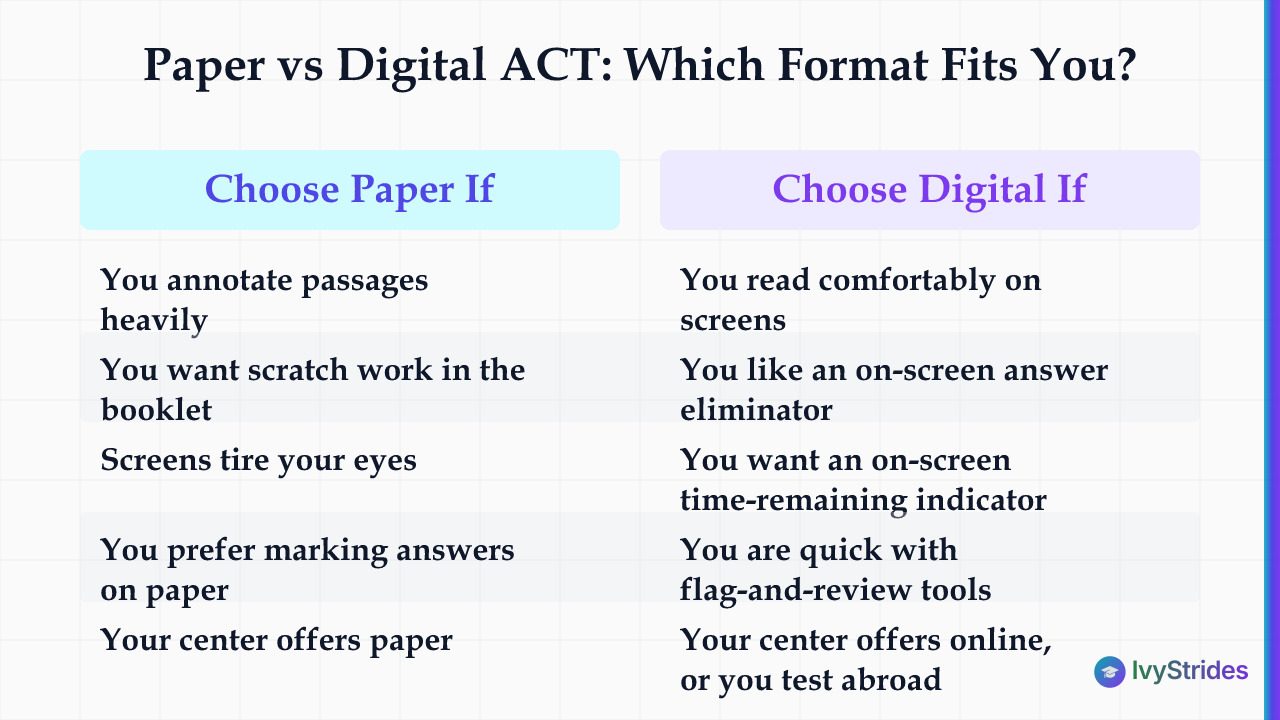
The right ACT format depends on how you work through questions. ACT converts each raw score to a scale score so results "have the same meaning across all ACT test forms, regardless of test date." Its design report adds that ACT applied equating "so that reported scores from online and paper testing were comparable."
So the decision comes down to habits. If you read a passage with a pencil in hand, underlining and bracketing, paper keeps that habit intact. If you move faster toggling an option eliminator and flagging items to revisit, the on-screen tools suit you.
Your own baseline should decide where study time goes. In IvyStrides' 1-on-1 ACT prep built around a diagnostic and a custom roadmap, the diagnostic sets the baseline and the focus areas, and an expert instructor works from them.
A few logistics decide the question before preference does:
- Availability. Not every test center offers online testing. Check what your nearest center runs when you register.
- Location. Outside the U.S., the ACT is online only.
- Changing your mind. You can change your format until the late registration deadline, for a fee, but never at the center on test day.
- Fee waivers. A fee waiver valid for paper testing also covers the online format, so a waiver does not force the choice.
| Choose Paper If | Choose Digital If |
| You annotate passages heavily | You read comfortably on screens |
| You want scratch work in the booklet | You like an on-screen answer eliminator |
| Your center offers paper | Your center offers online, or you test abroad |
| Screens tire your eyes | You want an on-screen time-remaining indicator |
| You prefer marking answers on paper | You are quick with flag-and-review tools |
Prep structure is the next decision after format, so weigh live online ACT prep against self-paced study before you commit hours.
How the ACT Composite Is Calculated on Paper and Digital
The ACT Composite is the average of your English, Math, and Reading scores, rounded to the nearest whole number, on a 1 to 36 scale, per ACT's understanding-scores page. ACT says that in September 2025 "all ACT tests (all modes of National, International, and State and District) used the updated calculation," so the averaging and rounding behind your Composite work the same on paper and on screen.
Science and Writing sit outside the Composite. Science earns its own 1 to 36 score and feeds the STEM score (the average of Math and Science). ACT reports Writing on a 2 to 12 scale, and it does not touch the Composite. ELA, if you take Writing, is the average of English, Reading, and Writing.
ACT builds a superscore from your best English, Math, and Reading scores across attempts, automatically for students who have tested more than once since September 2016, per ACT's superscore FAQ. Its educator FAQ on the enhanced test says your highest section scores "can come from ANY test event, whether it was on the legacy blueprint or the enhanced ACT." Not every college superscores the ACT, so check each school's policy.
| Score Type | Sections Included | Scale | Affects Composite? |
| Composite | English, Math, Reading | 1-36 | n/a |
| Science | Science | 1-36 | No |
| STEM | Math, Science | 1-36 | No |
| ELA | English, Reading, Writing | 1-36 | No |
| Writing | Writing essay | 2-12 | No |
| Superscore Composite | Best English, Math, Reading | 1-36 | Separate from each test's Composite |
Because the Composite is an average, one weak section can hold the whole number down, so that section is the place to start. Targeting it is what an ACT tutor does from diagnostic to a section plan. In IvyStrides' 1-on-1 ACT tutoring, the diagnostic sets the section emphasis, and your tutor tunes it weekly as data comes in.
FAQ: ACT Digital and Paper Format
Is the ACT on paper or online?
Both options exist. The enhanced ACT, which launched online in April 2025 and on paper in September 2025 for national testing, is available in both formats at ACT-authorized test centers in the U.S. For a national test date, you choose your preferred format when you register. Neither version can be taken at home.
Can you combine scores from different ACT tests?
Yes, if you have taken the ACT more than once since September 2016. The ACT superscore averages your best English, Math, and Reading scores across attempts, and ACT says those highest scores can come from any test event. Science and Writing stay out of the Superscore Composite, though ACT still reports your highest score in each.
Is the ACT easier online or on paper?
ACT's comparability study of the enhanced test found "very small differences" between the paper and online groups, with scores "slightly higher for the online group" before ACT applied equating to make reported scores comparable. Students who annotate by hand often prefer paper, and students comfortable on screens may prefer the answer eliminator and other digital tools.
Is the digital ACT adaptive?
No. ACT states that the online ACT "is not a computer-adaptive test," and its design report says adaptive testing "would make paper and online modes not equivalent." That differs from the Digital SAT, which uses a two-module adaptive structure.
Your Next Step on the ACT Format Decision
The format question comes down to comfort and availability. Both paper and digital deliver the enhanced ACT, you sit both at a test center, and both feed the same 1 to 36 Composite. Pick the one that matches how you actually work through questions, then confirm availability before you commit.
- Check whether your nearest test center offers online testing.
- Match your format to your habits: booklet annotation points to paper, on-screen tools point to digital.
- Practice in the exact format you will sit so your baseline is real.
- Remember you can switch format up to the late registration deadline, for a fee, but not on test day.

Rajesh is a technology leader, entrepreneur, and angel investor with 28+ years in Business & Technology Leadership and Product & Solution Engineering. He is passionate about education, mentoring, and driving digital transformation.