
Why Every ACT Study Plan Should Start With a Diagnostic Test
On this page
- What an ACT Diagnostic Test Actually Is (and What It Is Not)
- What a Real ACT Diagnostic Test Looks Like Under Current Format Rules
- How to Take Your ACT Diagnostic Test Under Real Conditions
- How to Read Your ACT Diagnostic Results by Section and Build a Study Plan
- FAQ: ACT Diagnostic and Practice Tests
- How many ACT practice tests should I take before test day?
- Are ACT practice tests anything like the real thing?
- How important are practice tests for ACT prep?
- Which ACT practice test should I take to see where I stand?
An ACT diagnostic test is a full-length, timed practice ACT you take before any structured studying begins. It gives you a real baseline composite and section scores across English, Math, and Reading, so you know which section to prioritize first. ACT offers four free official practice tests, and all four use the Enhanced ACT format you will sit in the 2026-27 testing year.
Those tests live on ACT's free prep page, in digital and paper versions. The harder question isn't where to find a test. It's what to do with the number once you have it.

What an ACT Diagnostic Test Actually Is (and What It Is Not)
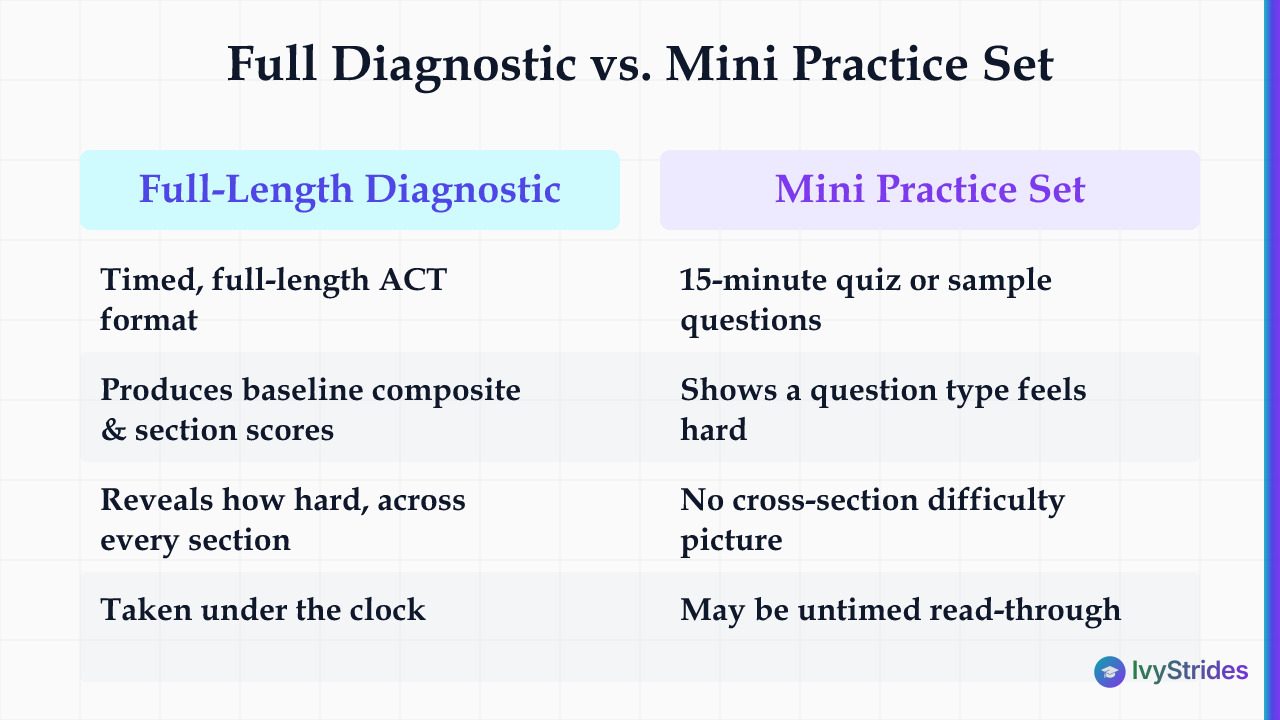
An ACT diagnostic test is the first full-length, timed practice ACT a student sits before structured prep starts, and its job is to produce a baseline composite and section scores. It is not a 15-minute quiz, not a handful of sample questions, and not an untimed read-through. A mini practice set tells you a question type feels hard. A full-length diagnostic tells you how hard, across every section, under the clock.
The diagnostic has to match the version you'll actually sit, and in the 2026-27 testing year that is the Enhanced ACT. National Saturday testing moved to it online in April 2025 and on paper in September 2025, and state and district school-day testing followed in spring 2026. Prep books from before that change describe the legacy test, which ran 215 questions in 175 minutes with its required Science section, so settle what changed in the Enhanced ACT format before you trust any score.
The composite comes from three sections, not four. ACT calculates the composite as the average of English, Math, and Reading only, rounded to the nearest whole number. Science is optional and scored separately. So a student who panics over Science passages may be worrying about a score that never touches the composite.
The national mean composite is 19.1 on the 2026-27 ranks, and a composite of 30 sits at the 94th percentile, meaning 94 percent of test takers earned that score or lower.
| Section | Questions | Time | Feeds Composite? |
| English | 50 | 35 min | Yes |
| Math | 45 | 50 min | Yes |
| Reading | 36 | 40 min | Yes |
| Core total | 131 | 125 min | Yes |
| Science (optional) | 40 | 40 min | No (separate) |
What a Real ACT Diagnostic Test Looks Like Under Current Format Rules
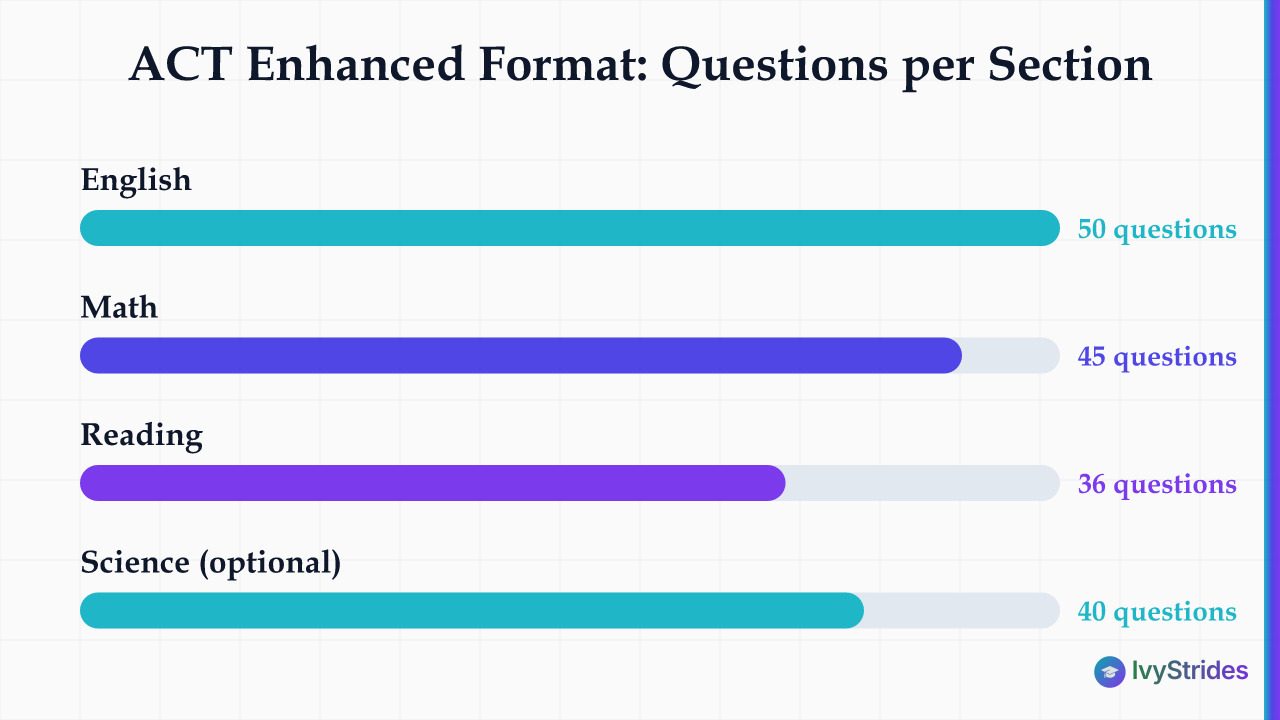
A real ACT diagnostic test uses an official full-length ACT built to current specifications, and ACT's four free full-length practice tests come in both digital and paper form. All four are Enhanced ACT forms, with the question counts and time limits in the table above. Because pacing depends on exact section timing, a test that still lists the legacy counts gives you a baseline you can't trust.
Official beats third-party for one reason. ACT's practice tests include retired questions from earlier test dates, so you practice on real ACT material under the Enhanced time limits. An ACT practice test PDF from an older source may run English at 75 questions in 45 minutes, which is the legacy format. Not every third-party test reflects the Enhanced version, so work out which ACT practice test is most accurate for the current format before you sit down.
The optional Science section adds 40 questions in 40 minutes, scored separately and feeding a STEM score rather than the composite. Some colleges require or accept ACT Science scores, so add it to your diagnostic if one on your list does or if you want a STEM score. Otherwise, skip it to keep the first sitting focused on the three sections that build your composite.
On a school-day ACT, your state or district decides whether Science is given, so ask your counselor before you plan around it. The optional Writing test doesn't touch your composite, so it can wait.
Before you start, run a fast format check:
- The core sections add up to 131 questions in 125 minutes, not the legacy 215 in 175
- English runs 50 questions in 35 minutes
- Math runs 45 questions in 50 minutes, with four answer choices per question, not five
- Reading runs 36 questions in 40 minutes
- Science, if you include it, runs 40 questions in 40 minutes
- The test includes an answer key or score conversion chart
Get your Daily IV Dose on Instagram: quick study tips and test-day advice for high school students. Follow @ivy.strides.
How to Take Your ACT Diagnostic Test Under Real Conditions
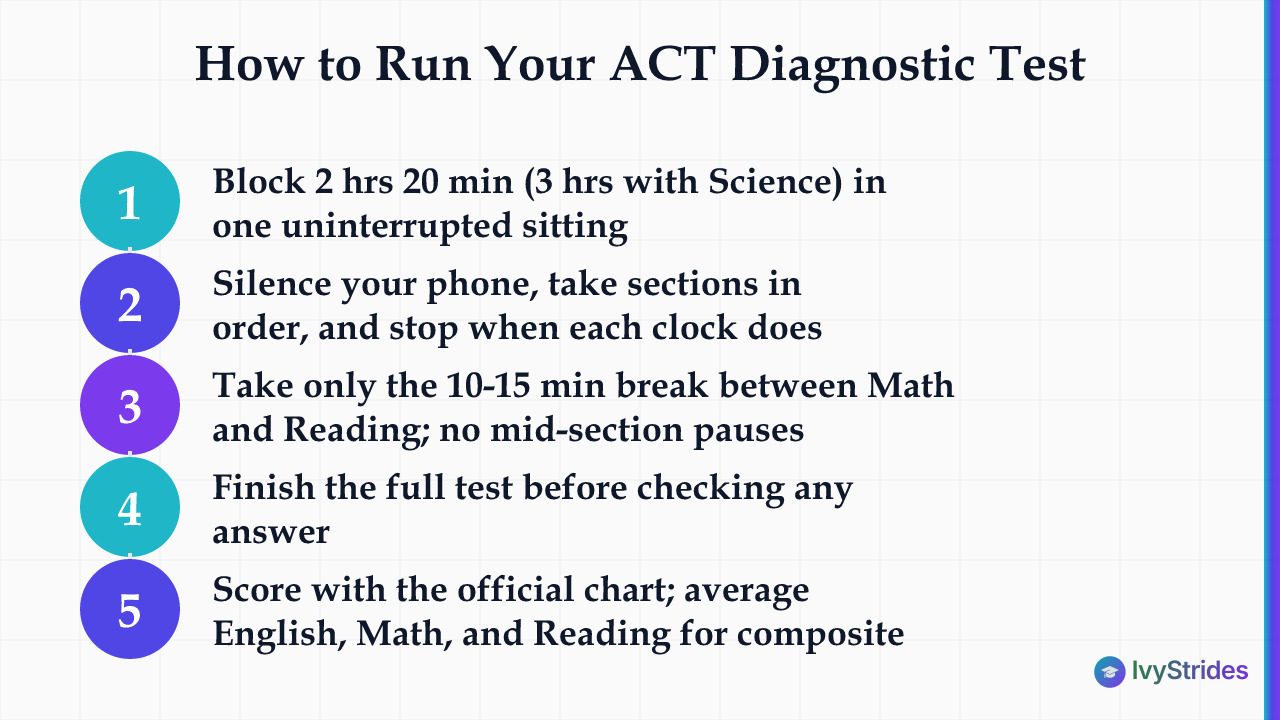
Taking the diagnostic under real conditions means one sitting, full timing per section, and no interruptions, because a baseline built from a paused, phone-checked test can over-report your real level. ACT's practice booklet sets the one pause, a 10- to 15-minute break between Math and Reading, and puts the core sitting at 2 hours 20 minutes and a sitting with Science at 3 hours. If you take the digital version, finish each section once you open it, because closing the page erases your responses.
ACT's test specifications put the core test, 131 questions in 125 minutes, at about 57 seconds per question. That average hides a split: the same specifications allow 42 seconds per English question and 67 each for Math and Reading, so judge each section against its own clock. If you ran out of time on Reading, that's data, not failure.
Score it the same day. Use the official scoring key and conversion chart that come with the test. Your raw score counts only scored questions, because each section includes field-test items the key tells you to skip: the highest raw score is 40 in English, 41 in Math, 27 in Reading, and 34 in Science. Convert each raw score to a scaled score from 1 to 36, then average English, Math, and Reading for your composite. Score any Science section on its own; it never enters that average.
Run the diagnostic before any content review, so your first weeks don't go to drilling sections already at or above target. Then go back through each low section to tell whether the score reflects a content gap, a pacing problem, or both, since the fix differs.
Run your diagnostic like this:
-
Block 2 hours 20 minutes (3 hours with Science), break included, in one sitting
-
Silence your phone and put it in another room
-
Take the sections in order, time each one separately, and stop when the clock does
-
Take only the 10- to 15-minute break between Math and Reading; do not pause mid-section
-
Finish the whole test before you check a single answer
-
Score each section with the official conversion chart
-
Average English, Math, and Reading for your baseline composite
How to Read Your ACT Diagnostic Results by Section and Build a Study Plan
Reading your ACT diagnostic results means comparing each section score against national percentiles, then finding the one section with the largest gap to your target composite. That gap, not your overall feeling about the test, sets your study order. A section where you ran short of time is a pacing fix, while a section where you had time but missed questions is a content fix.
Start by setting a target composite. A composite of 24 sits at the 80th percentile and 28 at the 91st on the 2026-27 ACT national ranks; knowing which composite scores unlock merit scholarship thresholds makes that target concrete rather than arbitrary. ACT ranks each section too, and this sample shows where a diagnostic score stands.
| Score | English Percentile | Math Percentile | Reading Percentile | Composite Percentile |
| 20 | 64 | 68 | 56 | 63 |
| 24 | 81 | 81 | 75 | 80 |
| 28 | 90 | 93 | 85 | 91 |
| 30 | 93 | 95 | 89 | 94 |
| 32 | 95 | 97 | 93 | 97 |
Prioritize the largest gap. If your diagnostic reads English 27, Math 21, Reading 26, your Math section drags the composite down hardest, so Math leads your study order. Each priority section rewards different tactics, and the question types and pacing rules that move each ACT section are where that targeted work happens.
Superscore changes how many sittings you plan for. Since 2025, ACT's Superscore has averaged your best English, Math, and Reading across test dates, so you can sit the test twice and target different sections each time. Many colleges accept Superscores, so check the policy of each college on your list. A student strong in English and Reading but weak in Math might aim prep for the second sitting almost entirely at Math.
If your test date is about eight weeks out, a two-month ACT prep plan built around your section scores turns the priority order into dated assignments. Once you know your gaps, let them decide how to study for the ACT week by week. A strong ACT score stays strategically useful even where colleges are test-optional, though those policies vary by school and year.
See how planning your week in advance by locking in days and topics removes decision fatigue and keeps your prep consistent.
More videos like this one: follow IvyStrides on YouTube for daily SAT and ACT preparation tips.
The baseline composite tells you where you stand; the section scores tell you where to start. Your next steps:
- Sit an official full-length ACT from act.org, timed, with no phone and no answer-checking
- Score it the same day with the official conversion chart
- Set a target composite, then study the section with the largest gap first
At IvyStrides, ACT coaching starts from a diagnostic, and a 1-on-1 tutor then works the one or two areas the scores flag as the composite ceiling. A student who wants that plan built alongside a coach can start with 1-on-1 ACT coaching matched to your diagnostic results.
FAQ: ACT Diagnostic and Practice Tests
How many ACT practice tests should I take before test day?
ACT's four free official tests can cover the whole plan: one diagnostic at the start, one or two mid-prep to measure progress, and one in the final two weeks. Score and review each one section by section before attempting the next, so every practice test feeds a decision.
Are ACT practice tests anything like the real thing?
ACT's free practice tests from act.org include retired questions from earlier test dates and use the Enhanced section limits, so they show you real ACT questions under the current clock. Third-party tests vary, and some still don't reflect the Enhanced format that launched in 2025 and reached school-day testing in spring 2026. Check the section limits before using any test as your diagnostic.
How important are practice tests for ACT prep?
Practice tests matter because they show which sections and question types actually limit your composite. Without a timed full-length test, a study plan is guesswork. The diagnostic supplies the data, and every prep session afterward should trace back to a gap it identified.
Which ACT practice test should I take to see where I stand?
ACT offers four free full-length tests at act.org, all with Enhanced ACT question counts and time limits, so start with one of those. Take the full core in one sitting, with the 10- to 15-minute break between Math and Reading. Add the optional Science section if you want a STEM score or a college on your list requires or accepts Science scores.

Rajesh is a technology leader, entrepreneur, and angel investor with 28+ years in Business & Technology Leadership and Product & Solution Engineering. He is passionate about education, mentoring, and driving digital transformation.