
How to Turn Test Scores Into Scholarship Money: The Merit Aid Playbook
On this page
- Automatic Institutional Merit Scholarships: How Score Thresholds Trigger Real Dollars
- What Score Do You Actually Need to Qualify for Scholarship Money
- Know Your Score Gap. Find Out If a Retake Is Worth It.
- How the PSAT/NMSQT Opens the National Merit Scholarship Door
- Private and External Scholarships That Reward High SAT and ACT Scores
- Score Mapped. Scholarship Tiers Clear. What Comes Next?
- FAQ: SAT, ACT, and PSAT Scholarship Thresholds
- Can I get scholarships based on my SAT score?
- What SAT score will get you a full scholarship?
- What GPA will get you a full ride scholarship?
- Is it possible to receive a scholarship from an SAT score alone?
- Your Next Step on Turning a Score Into Scholarship Money
Yes, SAT, ACT, and PSAT scores unlock scholarship money through three channels: automatic institutional merit awards triggered by a college's published score threshold, the National Merit Scholarship pathway via the PSAT/NMSQT Selection Index, and private external scholarships that need a separate application. A merit scholarship is aid awarded for academic achievement, not financial need.
No single score guarantees a full ride. But specific thresholds trigger specific dollar amounts, and knowing which tier your score sits in tells you what your prep investment is worth. The rest of this playbook maps score bands to awards.

Automatic Institutional Merit Scholarships: How Score Thresholds Trigger Real Dollars
An automatic institutional merit scholarship is an award a college grants to any admitted student whose SAT or ACT score meets a published threshold, usually with no separate application. Hit the number on the grid, get the money. Most colleges publish these as a matrix combining a score band with a minimum GPA.
The grid, not a committee. An institutional merit grid is a fixed table: a 1350 SAT and a 3.7 GPA lands in one award box, a 1450 and a 3.9 in a higher one. Many colleges award merit this way, combining GPA and test-score thresholds (Leland). The ACT composite runs 1 to 36 and averages English, Math, and Reading only; Science and Writing are optional and excluded (ACT, Inc.).
Here is how the bands typically break at public flagships and private colleges.
| Score Tier | SAT Range | ACT Range | Typical Award per Year | Application Required? |
| Entry | 1200-1300 | 27-30 | $1,000-$5,000 | No |
| Mid | 1350-1450 | 31-33 | $10,000-$20,000 | No |
| Top | 1500+ | 34+ | Up to full tuition | Sometimes |
| Below grid | Under 1200 | Under 27 | Often none | N/A |
Top-tier awards sometimes ask for a supplemental application (Curvebreakers). For academic scholarships, colleges may require students to show achievement through a minimum GPA and standardized test score (NCES). Most awards are renewable: you keep the money each year if you hold a stated GPA, often 3.0 to 3.5.
Test-optional is not scholarship-optional. Many test-optional colleges still require a submitted score to qualify for their merit grid, even when the score is optional for admission (FairTest). If your target colleges are test-optional, a strong score can still unlock merit dollars; here is what does test optional mean in practice. Always verify the exact cutoff on each college's Common Data Set or merit aid page, because thresholds change annually.
For how specific ACT composite scores map to award tiers at named universities, see our breakdown of how ACT scores affect merit scholarships.
What Score Do You Actually Need to Qualify for Scholarship Money
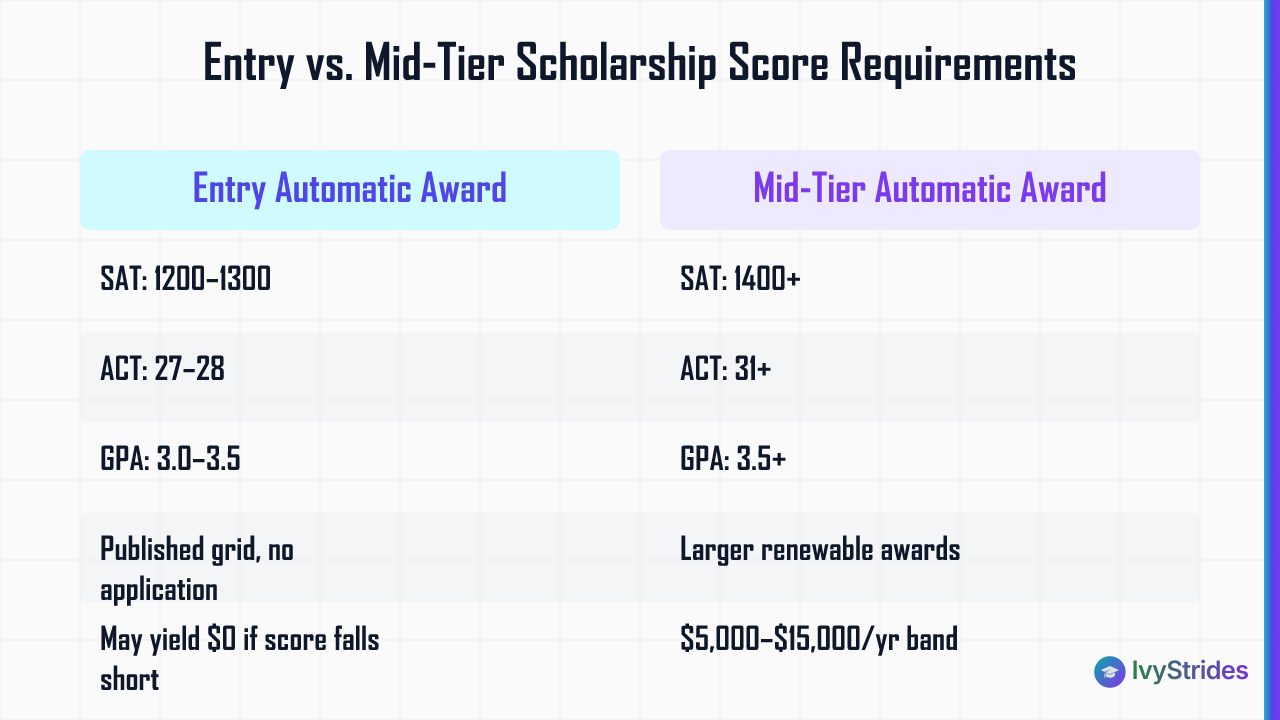
The floor for scholarship money starts around 1200-1300 SAT or 27-28 ACT for entry-level automatic awards at many public flagships. Competitive private scholarships usually want 1400 SAT or 30 ACT. Each channel has a different entry gate, so your first move is finding which one your score already clears.
The Digital SAT scores on a 400 to 1600 scale, split into Reading and Writing (200-800) and Math (200-800), across two adaptive modules per section (College Board). That total is the number nearly every institutional grid reads.
| Scholarship Category | Minimum SAT | Minimum ACT | GPA Also Required | Notes |
| Entry automatic award | 1200-1300 | 27-28 | 3.0-3.5 | Published grid, no application |
| Mid-tier automatic | 1400+ | 31+ | 3.5+ | Larger renewable awards |
| Competitive private | 1400+ | 30+ | Varies | Separate application |
| National Merit entry | via PSAT/NMSQT | N/A | Not the gate | Selection Index screens entrants |
GPA is a co-factor, not a substitute. On most grids, a strong score with a weak GPA drops you a tier, and the reverse holds too. A 1500 with a 2.9 rarely triggers the top award. Treat the two numbers as one combined key.
Here is the part that makes prep worth it. Moving from a 1250 to a 1350 SAT, or from a 27 to a 30 ACT, can shift a student from no award into the $5,000 to $15,000 per year band at many institutions. That 100-point SAT gain or 3-point ACT gain buys real tuition dollars.
In our coaching with students at the 1180-1300 SAT band, a typical gain of 100 to 200 points across a focused plan has moved students into higher scholarship tiers; students completing our 1-on-1 ACT program typically gain 4 or more composite points. If your score sits just below a threshold, a focused plan can close that gap in roughly 8 to 12 weeks. Here is how to raise your SAT score 200 points. The parallel plan for how to raise your ACT score 4 points.
Diagnostic work matters here, because a student who knows their gap relative to one college's threshold has a concrete target. That is where our 1-on-1 SAT prep earns the fee: closing the exact 80 to 150 Reading and Writing points, or the specific Math module, holding you under the line.
Know Your Score Gap. Find Out If a Retake Is Worth It.
Your student has a score, a college list, and a scholarship tier to reach. A free 15-minute call maps current section scores against the thresholds that matter, tells your family whether the gap is closable before the next application deadline, and gives you a concrete first step.
How the PSAT/NMSQT Opens the National Merit Scholarship Door
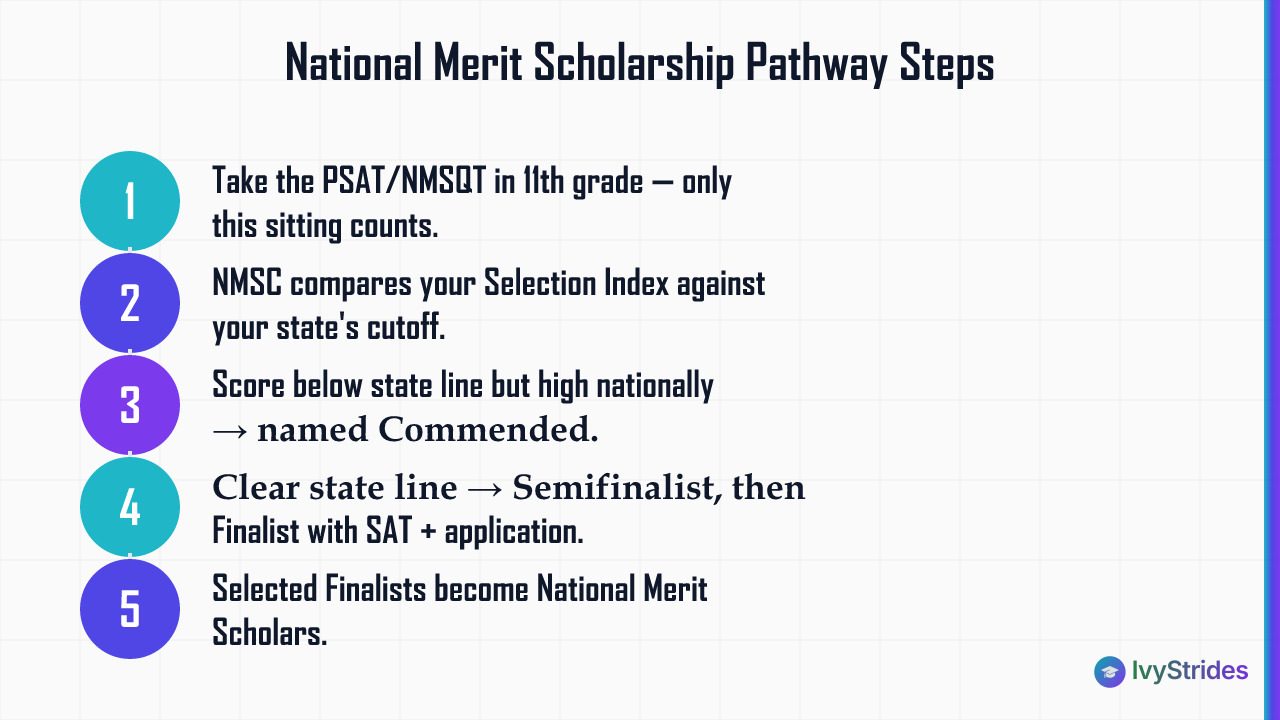
The PSAT/NMSQT is the qualifying test for the National Merit Scholarship, and only the junior-year sitting counts. Once your SAT and ACT gap is mapped, the PSAT adds a second, higher-value route: the National Merit Scholarship Corporation screens entrants using the Selection Index off that one October junior-year test.
Here is the formula. The NMSC Selection Index doubles your Reading and Writing section score, adds your Math section score, then divides by 10 (College Board). Section scores run 160 to 760, so the index runs 48 to 228. College Board publishes the section ranges and formula; IvyStrides applies it to the minimum and maximum inputs to confirm the 48-to-228 scale. The PSAT/NMSQT total runs 320 to 1520.
The pathway moves in stages:
-
Take the PSAT/NMSQT in 11th grade. No other PSAT counts for National Merit.
-
NMSC compares your Selection Index against your state's cutoff. Cutoffs are set per state, per year, by NMSC, and College Board does not publish them (NMSC).
-
Score below the state line but high nationally, and you are named Commended.
-
Clear the state line, and you become a Semifinalist, then advance to Finalist with a confirming SAT score and application.
-
Selected Finalists become National Merit Scholars.
The National Merit Scholar award is a one-time $2,500 from NMSC. The bigger money sits elsewhere: college-sponsored National Merit awards run from about $1,000 per year to full tuition at participating institutions.
That is why a strong junior-year PSAT is worth serious prep. Because NMSC alone sets the cutoffs, never trust a published "National Merit score" figure. The state-by-state cutoffs and the Semifinalist-to-Finalist steps sit in our National Merit Scholarship PSAT cutoffs and Selection Index guide. The full award tiers in our breakdown of National Merit scholarship benefits.
Private and External Scholarships That Reward High SAT and ACT Scores
Private and external scholarships come from foundations, corporations, and nonprofits that use SAT or ACT scores as an eligibility filter, and they need a separate application. Where automatic institutional awards and National Merit flow from a single score, this third channel asks you to apply, usually with an essay and an official score report. Competitive pools typically open at 1400 SAT or 30 ACT.
Private organizations fund scholarships specifically for students with high standardized test scores (Leland). Award amounts range from a few hundred dollars to several thousand per year, and eligibility rules change annually, so verify each program's current requirements directly.
Where to find them. The Federal Student Aid scholarship finder is a free government tool that searches external scholarships by eligibility criteria, including test scores (studentaid.gov). International students can find score-based scholarships too, but each program sets its own rules on citizenship and residency, so read the fine print first.
Use this checklist before you apply:
- Confirm your SAT or ACT score clears the program's stated minimum.
- Request an official score report sent to the sponsor.
- Draft the scholarship essay, distinct from your Common App personal statement.
- Gather any GPA transcript or recommendation the program requires.
- Note the deadline, often earlier than college application dates.
- Verify the award amount and renewal terms in writing.
In our coaching, students with SAT scores above 1400 or ACT composites above 30 have accessed meaningful private scholarship pools when they also submitted a strong essay. The score gets you eligible; the essay decides the award. Once your score qualifies you, our guide on how to write a scholarship essay walks through the structure step by step.
Score Mapped. Scholarship Tiers Clear. What Comes Next?
Students and parents now have the three scholarship categories, the score thresholds, and the checklist. Turning that into a plan tied to actual section scores, specific target colleges, and the weeks before the next test date takes a focused conversation. A free 15-minute call builds that plan.
FAQ: SAT, ACT, and PSAT Scholarship Thresholds
Can I get scholarships based on my SAT score?
Yes. Many colleges award automatic merit scholarships when an admitted student's SAT score meets a published threshold, typically starting around 1200 to 1300 at public universities. Private external scholarships also use SAT scores as eligibility filters. GPA is usually a co-factor, and test-optional admission does not always mean scholarship-optional.
What SAT score will get you a full scholarship?
There is no single cutoff. Full-tuition automatic awards at public flagships often require SAT scores of roughly 1400 to 1500 combined with a 3.5 to 4.0 GPA, but thresholds vary by school. The National Merit pathway, which starts with the PSAT/NMSQT, can also lead to full-ride packages. Check each school's merit aid page for exact figures.
What GPA will get you a full ride scholarship?
Most full-ride institutional merit awards require a 3.7 to 4.0 GPA alongside a high test score, though some set the floor at 3.5. GPA alone rarely triggers a full ride; the combination of GPA and SAT or ACT score is what most grids evaluate. Requirements vary, so verify with each school's financial aid office.
Is it possible to receive a scholarship from an SAT score alone?
A few private external scholarships reward test-score merit with minimal GPA requirements, but most institutional awards combine score and GPA. Submitting a strong SAT score at a test-optional school can still unlock merit dollars even when the score is not required for admission. Always check each program's eligibility criteria.
Your Next Step on Turning a Score Into Scholarship Money
You now know which score bands trigger which awards, how the PSAT feeds the National Merit pipeline, and where private scholarships set their floors. The move is to place your current score in the right tier and decide whether the next tier is worth a retake.
- Pull each target college's merit grid from its Common Data Set and mark where your score lands.
- Check whether your junior-year PSAT/NMSQT put you near your state's Selection Index range.
- List private scholarships whose minimum you already clear, and note their deadlines.
- Decide, honestly, whether a 100-point SAT or 3-point ACT gain moves you into a higher award box before your next deadline.

Hemant is a seasoned entrepreneur, investor, and growth strategist with deep ground in education and technology-driven learning. His core training is in Mathematics and Physics — he authored Physics for IB Diploma: Ultimate Revision Guide, recognized as a top student resource.