
How to Prep for the SAT from Abroad in 2026: A Step-by-Step Guide That Actually Works

On this page
- What the Digital SAT Actually Is (and Why It Is the Same Test Everywhere)
- How to Register for the SAT from Outside the United States
- Step 1: Take a Diagnostic Practice Test Before You Study Anything Else
- The Biggest Challenge International Students Face When Prepping for the SAT (And How to Solve It)
- Build Your Study Plan: A 12-to-16-Week Framework That Works from Any Time Zone
- Phase 1 (Weeks 1 to 2): Diagnostic and Target-Score Setting
- Phase 2 (Weeks 3 to 8): Targeted Weakness Work
- Phase 3 (Weeks 9 to 12): Full-Length Timed Practice
- Phase 4 (Weeks 13 to 16): Simulation and Test-Day Logistics
- What SAT Score Should International Students Actually Target?
- Three Tactical Moves That Separate High-Scoring International Students from the Rest
- What to Bring and What to Expect on SAT Test Day at an International Center
- When Self-Study Is Not Enough: How to Know You Need a Coach
- FAQ
- Is the international SAT harder than the SAT taken in the United States?
- What is a good SAT score for an international student applying to US universities?
- Can you prepare for the SAT on your own as an international student?
- What is the 3-to-1 rule on the SAT?
- Should I take the SAT even if the colleges I am applying to are test-optional?
- What are the SAT test dates available for international students in 2026?
- Your Next Step
To prep for the SAT from abroad in 2026: download the free Bluebook app from College Board and take a full-length diagnostic practice test first. Then register at an international test center in your country at satsuite.collegeboard.org. Available international dates include March, May, August, October, and December. Build a 12-to-16-week study plan with roughly 8 to 10 hours per week, using official adaptive practice tied to your diagnostic. The Digital SAT is identical in content and difficulty for international and US students. A score of 1350 or above sits at roughly the 90th percentile.
Those numbers come from College Board's official Digital SAT documentation, cited throughout the sections below. The harder question is how to sequence prep so the hours you put in from Mumbai, Lagos, Seoul, or São Paulo translate into the score band your target US universities actually want.
What the Digital SAT Actually Is (and Why It Is the Same Test Everywhere)
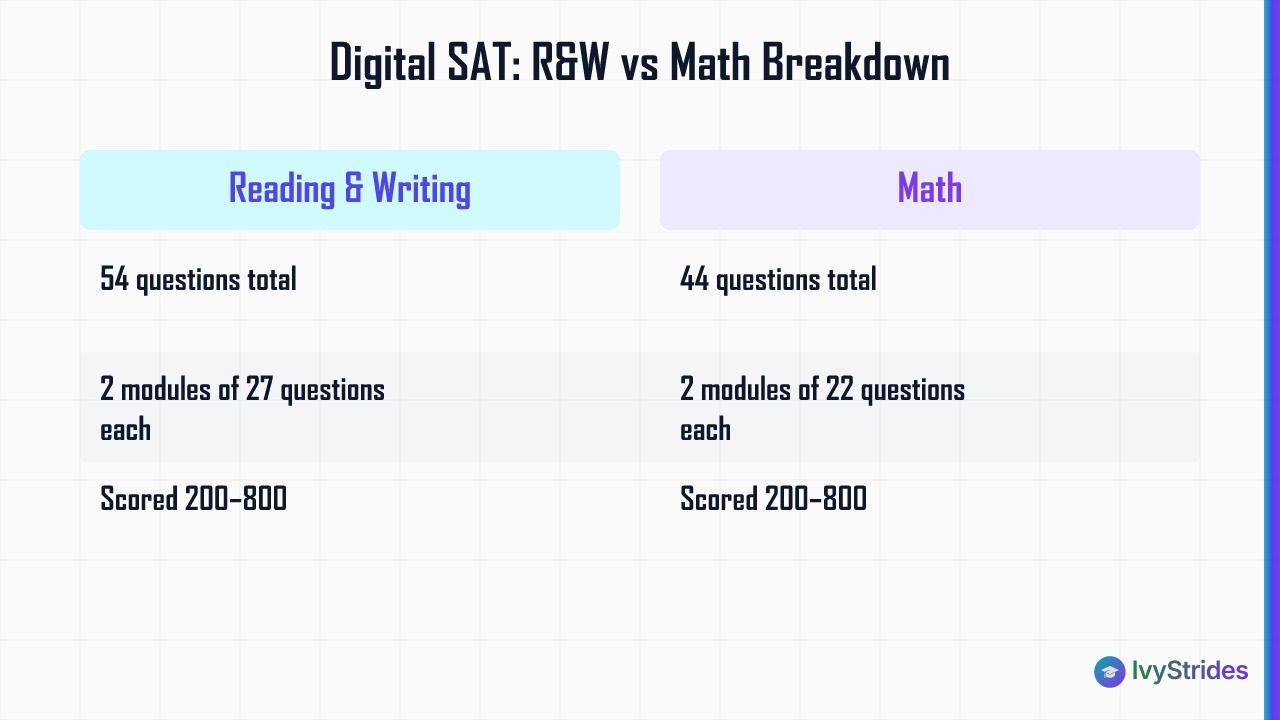
The Digital SAT is a two-section adaptive exam scored on the 400 to 1600 scale, delivered on your own device through College Board's Bluebook app. Total test time is 2 hours and 14 minutes, shorter than the old paper SAT, and every international student takes the same test as students in a New Jersey high school gymnasium.
Here's how it breaks down. Reading and Writing (R&W) contains 54 questions split across two modules of 27 questions each. SAT Math contains 44 questions split across two modules of 22 questions each. Each section is scored from 200 to 800, and the two combine to your total.
The word "adaptive" matters more than most first-time test-takers realize. Module 1 in each section is a mixed-difficulty set, and how you perform on it determines whether Module 2 routes you to an easier or harder question set. The harder Module 2 carries a higher score ceiling; the easier one caps your maximum possible section score. Module 1 accuracy is disproportionately valuable.
College Board has stated directly that content and difficulty do not vary between the international and US editions. If you've heard the "international SAT is harder," that rumor traces to security-related form differences on the old paper SAT and no longer applies. For more on timing, see how long is the SAT. For the routing mechanic, see SAT adaptive testing explained.
How to Register for the SAT from Outside the United States
Registration happens at satsuite.collegeboard.org. Create an account, choose a test date, and select an international center from the finder tool. Centers operate in more than 170 countries.
For 2026, international administrations are scheduled for March, May, August, October, and December. Registration typically opens roughly 8 to 10 weeks before each date, and deadlines fall roughly 4 to 5 weeks before test day. Test-date choice matters more for international students than US ones, because seats at international centers fill faster. If your closest center is in a major city, register the day the window opens.
International registration fees are higher than US fees and vary by country, so check the current SAT fees for international students before budgeting. We don't quote a fixed figure here because College Board updates pricing annually.
Two other logistics points worth locking in early. First, College Board recommends testing at least twice: once in the second-to-last year of secondary school and once at the start of your final year, giving you a baseline and an improvement window before applications are due. Second, Bluebook must be downloaded and set up on your testing device before you arrive. For the current calendar, see our SAT test dates 2026 reference.
Step 1: Take a Diagnostic Practice Test Before You Study Anything Else
Full-length official practice tests, taken under timed conditions in Bluebook, are the most accurate predictor of your real score and the foundation of every prep plan we build. Skip this step and you'll waste weeks reviewing content you already know while missing the two or three question types actually costing you points.
Download Bluebook. Sit one full-length adaptive practice test in a single sitting, ideally on a Saturday morning at the time your real test will run, on the device you plan to bring. Score it, then look at the subscore breakdown.
R&W subscores cover four skill areas: Information and Ideas, Craft and Structure, Expression of Ideas, and Standard English Conventions. Math subscores cover Algebra, Advanced Math, Problem-Solving and Data Analysis, and Geometry and Trigonometry. The report tells you which of the eight buckets is bleeding points. That's your prep plan's first target.
A diagnostic gap of roughly 100 to 150 points is typical for students starting prep 12 to 16 weeks out. If the gap is 250 or more, you likely need a longer runway or denser weekly hours. In our coaching, students who skip the diagnostic and go straight to content review typically waste 3 to 4 weeks on material they already know.
For a deeper walkthrough of how to interpret your report, work through our official SAT practice tests library. To turn each wrong answer into a learning event rather than a data point, follow the process in how to review your SAT practice test mistakes.
The Biggest Challenge International Students Face When Prepping for the SAT (And How to Solve It)
Ask a student in Dubai or Bangkok what makes SAT prep hard from abroad and you'll hear the same four things. Local prep books cover the old paper format. No classroom or peer group holds them accountable. R&W passages assume idiomatic English fluency their curriculum didn't build. And live coaching often runs on New York time, landing sessions at 2 a.m. local.
The Digital SAT launched globally in March 2024, so any prep book printed before then covers a test that no longer exists. Paper-format practice doesn't reflect the adaptive module structure, doesn't train you for on-screen tools like the built-in Desmos calculator, and doesn't build the pacing instinct Module 1 accuracy requires. If your book still references the "Evidence-Based Reading and Writing" section or 3-hour timing, close it.
The isolation problem is real but solvable. Structured accountability, whether from a coach, a study group, or a documented weekly plan you track, is what moves scores. In our coaching, students who log weekly hours with someone else typically improve faster than students studying the same book alone.
The R&W context gap is the most technical of the four. International students frequently lose roughly 20 to 40 points on Craft and Structure questions, which test rhetorical purpose and vocabulary in context, because they read for content rather than authorial intent. A coach who works only on R&W catches this in the first session, having seen the pattern across hundreds of students. A generalist often misses it.
Time zones are a scheduling problem, not a quality problem. IvyStrides coaches work across time zones and schedule sessions to fit each student's local calendar. See our 1-on-1 SAT prep approach for how we match coach to student. If you're juggling school and activities, online SAT prep for busy students shows how the weekly structure works when afternoons are packed.
Build Your Study Plan: A 12-to-16-Week Framework That Works from Any Time Zone
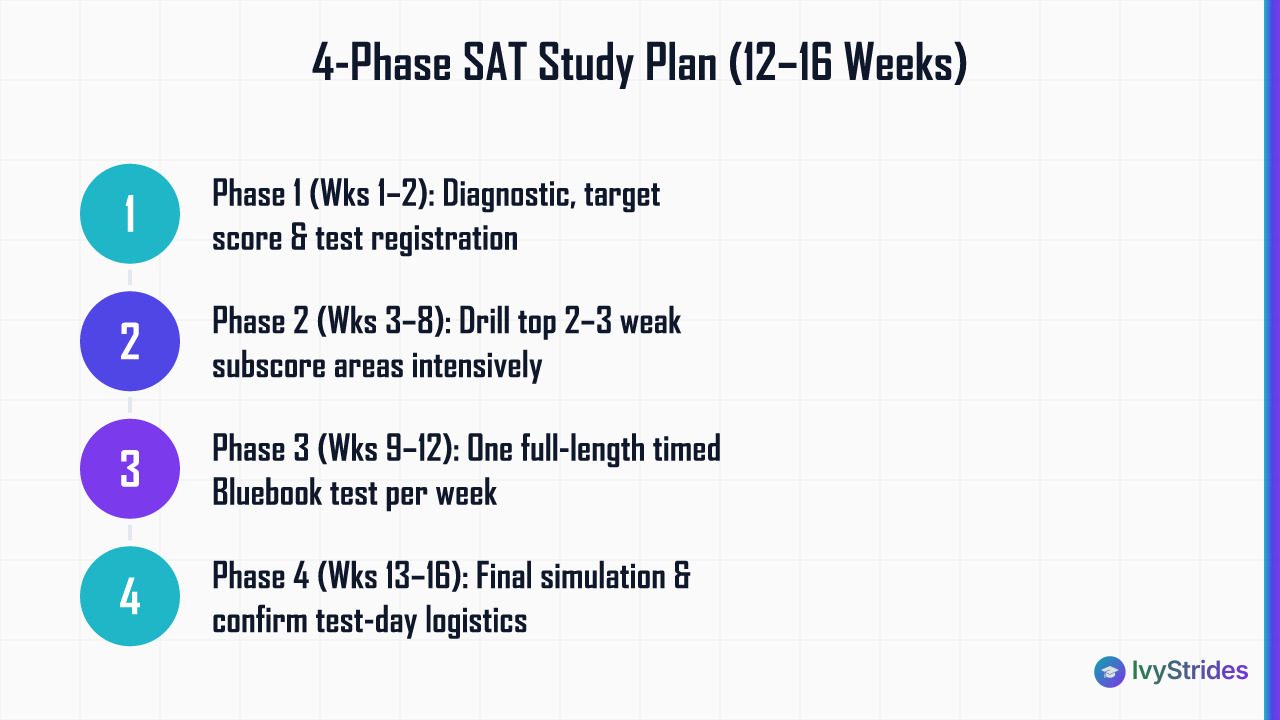
Once you have your diagnostic score, a structured study plan maps which weeks to drill R&W grammar rules versus SAT Math topics like linear equations and data analysis. Below is the four-phase framework we use with international students, calibrated to roughly 8 to 10 hours per week over 12 to 16 weeks, or about 96 to 160 total prep hours.
Phase 1 (Weeks 1 to 2): Diagnostic and Target-Score Setting
Take your Bluebook diagnostic. Review every wrong answer. Set a specific target score based on your target universities' middle-50% ranges, not a round number pulled from the air. Choose your test date and register.
Phase 2 (Weeks 3 to 8): Targeted Weakness Work
Six weeks of focused drilling on the two or three subscore areas that lost you the most points. If the diagnostic showed weakness in Standard English Conventions and Advanced Math, then punctuation, transitions, sentence boundaries, quadratics, and exponential functions take roughly 60 to 70 percent of your prep hours. Use free official College Board practice, which personalizes drills to your results. Don't add new content areas until the targeted ones move.
R&W skill areas to know by name: grammar conventions (punctuation, subject-verb agreement, pronoun reference), rhetorical synthesis, vocabulary in context, and central idea and details. SAT Math topics to know by name: linear equations, systems of equations, quadratics, exponential functions, data analysis, geometry, and trigonometry. Our SAT math topics breakdown maps each to Module 1 versus Module 2 frequency.
Phase 3 (Weeks 9 to 12): Full-Length Timed Practice
Four weeks of full-length timed practice in Bluebook, one per week, followed by roughly 3 to 4 hours of error review each. Spaced retesting is the key methodology: a full-length test every 3 to 4 weeks during Phase 2, then weekly in Phase 3. In our coaching, students who complete at least 4 full-length timed tests before their real exam typically score around 80 to 120 points higher than those doing only section drills.
Phase 4 (Weeks 13 to 16): Simulation and Test-Day Logistics
Final tune-up. One more full-length test at your real test's start time. Confirm your ID (passport for international students), center location, transportation, and Bluebook setup. International students often face extra exam-day pressure from unfamiliar testing environments, so a consistent pacing routine built during practice reduces test-day anxiety.
For the weekly template we hand students, see our SAT study plan framework. To track error patterns across weeks, download the SAT mistake tracker from our free resources library.
What SAT Score Should International Students Actually Target?
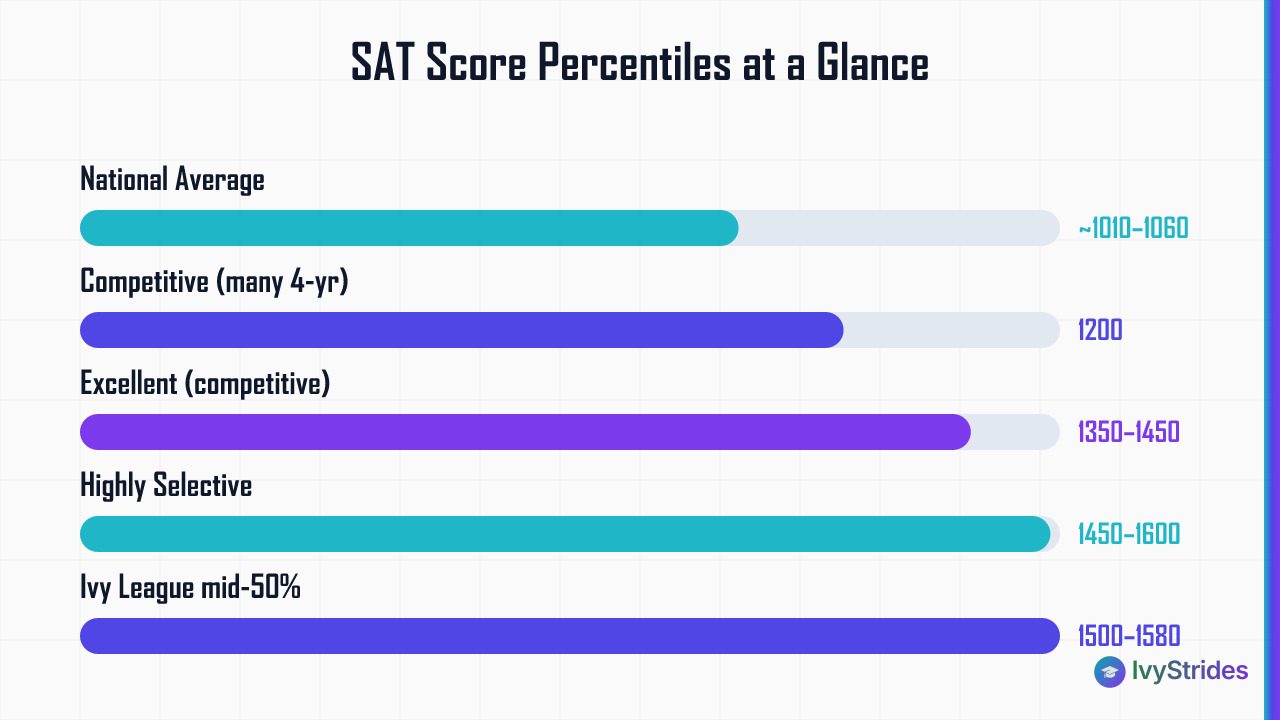
Set your target based on the middle-50% range at your target schools, not on a round number. Here's the percentile map on the 400 to 1600 scale.
A 1200 sits above the national average of roughly 1010 to 1060 and is competitive at many four-year colleges. A 1350 to 1450 falls in roughly the 90th to 96th percentile and is often considered excellent for competitive universities. A 1450 to 1600 sits in roughly the 96th to 99th percentile, competitive at highly selective schools. A 1500 places you at approximately the 99th percentile.
Ivy League middle-50% SAT ranges typically fall between 1500 and 1580. UPenn's has recently sat around 1510 to 1570, per its Common Data Set. Always verify the current Common Data Set for each target school, because these ranges shift year to year. For deeper analysis of the 1500 band, read is 1500 a good SAT score for Ivy League.
Two policy points international students frequently get wrong. First, superscore. Most selective US universities superscore the SAT, taking your highest R&W score and highest Math score across sittings, which makes testing twice strategically valuable rather than redundant. Second, test-optional. Policies vary by school and by year, so check FairTest.org for current status. Even at test-optional schools, a score above roughly the 75th percentile can strengthen an international applicant's file. A score well below the 25th percentile is generally better withheld. Test-optional is not test-blind; test-blind schools won't consider scores at all.
International applicants are not evaluated on a separate scoring curve; you compete in the same applicant pool as US students at most universities. A strong score works best alongside AP course rigor and a compelling admissions essay. For a broader benchmark discussion, see our good SAT score 2026 guide. To plot section-score scenarios, use the digital SAT calculator.
Three Tactical Moves That Separate High-Scoring International Students from the Rest
Here's the part most students miss. These three moves are typically worth 100 to 200 points combined for students already in the 1200 to 1400 range.
Tactic 1: Nail Module 1 accuracy before you chase Module 2 speed. Adaptive routing is unforgiving. A strong Module 1 routes you to the harder Module 2 and its higher score ceiling; a weak one routes you to the easier Module 2, capping your section score no matter how many questions you get right there. Practice Module 1 accuracy drills separately from Module 2 speed drills. In our coaching, students who train these separately typically gain around 40 to 60 more Math points than students who only do mixed practice.
Tactic 2: Use the 3-to-1 answer pattern as an elimination tool on R&W Craft and Structure questions. When three answer choices share a similar structural pattern and one stands out, the outlier is frequently correct. SAT distractors are engineered to look plausible in groups, which is what makes the structurally distinct option easier to spot. It's a heuristic, not a rule: apply it only after eliminating clearly wrong answers, and lean on it hardest for questions about authorial purpose or vocabulary in context.
Tactic 3: Build a roughly 2.5-minute cap on Math Module 2 questions. Module 2 (hard) contains more advanced algebra, quadratics, and data analysis. Students who spend more than about 2.5 minutes on a single question routinely run out of time on the final 4 to 5, which is exactly where the hardest and highest-use questions sit. If a question is eating time, mark it, guess your best elimination, and come back if the clock allows.
For more moves to run in the final two weeks before test day, see our SAT last-minute tips. If Reading is your weaker section, walk through how to improve SAT reading score.
What to Bring and What to Expect on SAT Test Day at an International Center
Bring your passport. At international centers, a valid passport is the standard photo ID; a school ID is not sufficient at most locations. Verify your center's specific ID policy on your admission ticket before test day.
Bring the device you registered with Bluebook installed and tested. Accepted devices for the Digital SAT include Windows laptops, Mac laptops, and iPads. Chromebook and Android tablet support has shifted over recent administrations, so verify current device compatibility against College Board's documentation before you commit to a specific device. Run Bluebook's exam setup at least 48 hours before test day so any technical issues surface with time to fix them.
Bring a charger, a backup charger, and water and a small snack for the break. Arrive at least 30 minutes before your scheduled start. If your device fails mid-test, don't leave the room; notify a proctor. Center staff have a protocol to provide a loaner or reschedule.
For a printable version of everything to pack, see our SAT test day checklist. For the short list of non-negotiables, see what to bring to the SAT.
When Self-Study Is Not Enough: How to Know You Need a Coach
Self-study works. Many students score well on their own. But it plateaus at a predictable point, and knowing where that point is saves you months.
Here's the signal. In our coaching, students who plateau at the same score across two consecutive full-length practice tests typically have a systematic error pattern in one section that self-review can't catch. The most common Math plateau: students solve familiar problem types but lose roughly 30 to 50 points on unfamiliar Module 2 setups, particularly advanced algebra and nonlinear functions. The most common R&W plateau: losing around 20 to 40 points on Craft and Structure questions by reading for content rather than rhetorical intent.
A section-specialist R&W coach can identify the Craft and Structure pattern in one session and assign targeted drills the same week. A Math specialist can distinguish a topic gap from a pacing gap, which have completely different fixes, often within 30 minutes. A generalist tutor often misses these distinctions, because pattern recognition at this level requires seeing hundreds of students in the same section.
Coaching ROI is typically highest for students targeting 1350+ from a 1150 to 1250 baseline, roughly a 100 to 200 point gap fought for at the subscore level. For students completing the IvyStrides 1-on-1 SAT program, a 200+ point improvement from diagnostic baseline is typical, though never guaranteed and always dependent on hours actually put in.
You can read more about the full approach on our SAT prep overview page. If you want a structured cohort start with a fixed timeline, see SAT winter batch enrollment.
FAQ
Is the international SAT harder than the SAT taken in the United States?
No. The Digital SAT is the same test worldwide: identical content, identical difficulty, identical scoring scale of 400 to 1600. The only differences are logistical, meaning test dates, test center locations, registration fees, and ID requirements at international centers. College Board has confirmed that the content tested and the level of difficulty do not differ between international and US editions.
What is a good SAT score for an international student applying to US universities?
It depends on the university tier. For competitive universities, a score of 1350 to 1450 (roughly 90th to 96th percentile) is generally considered strong. For highly selective schools, 1450 to 1600 (roughly 96th to 99th percentile) is the target range. Ivy League middle-50% ranges typically fall between 1500 and 1580. International applicants aren't scored on a separate curve; they compete in the same pool as US applicants at most universities. Always check the current Common Data Set for each target school.
Can you prepare for the SAT on your own as an international student?
Yes. Self-study is possible and many students start that way. The Bluebook app provides free full-length adaptive practice tests, and College Board offers free personalized practice tied to your diagnostic. It works well for disciplined students who can identify their own error patterns and have roughly 12 to 16 weeks available. It tends to plateau above 1350, where section-specific error patterns require expert identification.
What is the 3-to-1 rule on the SAT?
The 3-to-1 pattern is a heuristic used in SAT Reading and Writing. When three answer choices share a similar structure or approach and one stands out as different, the outlier is often the correct answer. This works because SAT distractors are engineered to look plausible in groups, making the structurally distinct option easier to spot. It's an elimination tool, not a replacement for reading the question carefully, and it's most reliable on Craft and Structure question types.
Should I take the SAT even if the colleges I am applying to are test-optional?
Test-optional policies vary by school and change year to year; check FairTest.org for current status. Even at test-optional schools, submitting a score above roughly the school's 75th percentile can strengthen an international applicant's file. A score below the 25th percentile is generally better withheld. If you're unsure, a strategy call can help you decide based on your score and target list.
What are the SAT test dates available for international students in 2026?
International students can take the Digital SAT in March, May, August, October, and December 2026. Registration deadlines typically fall roughly 4 to 5 weeks before each test date, and seats at popular international centers fill quickly. Check the current schedule and register early at satsuite.collegeboard.org. College Board recommends taking the SAT at least twice: once in the second-to-last year of secondary school and once at the start of the final year.
Your Next Step
The only question left is which of the four phases you belong in this week: diagnostic, targeted work, full-length simulation, or final tune-up. A call will answer that and give you a specific action list you can start Monday.

Award-winning author (South Asian Book Award) and graduate of BITS Pilani and UCLA Luskin School of Public Affairs. Brings a published writer's eye to Common App essays and grammatical precision to SAT and ACT R&W instruction.