
How to Improve ACT Pacing by Section: The Complete 2026 Guide
On this page
- ACT Pacing by Section: Exact Time Targets for the 2026 Enhanced Format
- ACT Math Pacing: How to Bank Time Early and Protect It Late
- ACT Reading Pacing: How to Finish All Four Passages Without Guessing
- ACT Science Pacing: The 60-Second Rule and the Conflicting Viewpoints Exception
- How to Build ACT Pacing Through Timed Section Drills
- FAQ: ACT Pacing by Section
- How to do better on the reading section of the ACT?
- How rare is a 36 on ACT reading?
- How can I raise my ACT score from a 29 to a 33?
- How to improve my time management for the ACT Reading section?
- Your Next Step on ACT Pacing
ACT pacing by section means applying a different time-per-question target to each part of the test: about 42 seconds in English, 67 in Math, 67 in Reading, and 60 in Science. Set a checkpoint at each section's halfway mark, and skip anything over budget. IvyStrides derives this figure from the inputs cited above.
Those four budgets come from ACT, Inc.'s published question counts and time limits, cited below. The number most students miss is the asymmetry: English gives you the least time per question but the easiest decisions, while Reading gives you more time and eats it anyway.
ACT Pacing by Section: Exact Time Targets for the 2026 Enhanced Format
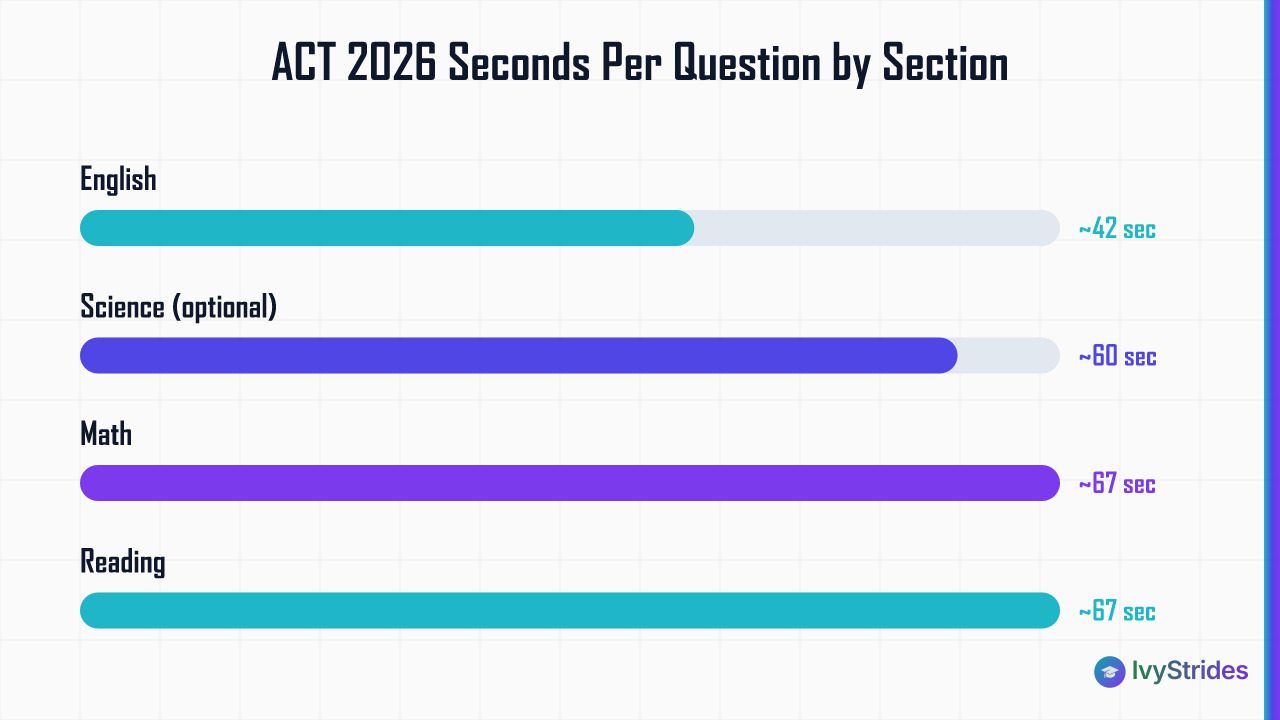
The enhanced ACT is a 131-question core exam scored in 125 minutes, and each section carries its own time-per-question budget. IvyStrides calculates this from the published figures cited above. Before applying section-specific rules, confirm you are working from the current format: 50 English questions in 35 minutes, 45 Math in 50, and 36 Reading in 40, for a 131-question core in 125 minutes total. Science stays optional at 40 questions in 40 minutes, and its score does not count toward your composite.
Why the old numbers fail you. The legacy ACT ran 215 questions in 2 hours 55 minutes. The enhanced format cut 70 minutes and 44 questions, which changed the per-question budget for every section (ACT, Inc.). Any pacing advice built on 75 English questions or 60 Math questions is now wrong. The enhanced ACT gives you slightly more time per question than the legacy version did, a shift one section-by-section analysis attributes to the restructured counts (Test Ninjas).
Your composite is the average of English, Math, and Reading only. ACT, Inc. publishes each section's question count and time limit; IvyStrides divides seconds by questions to get the per-question budget below.
| Section | Questions | Time (min) | Seconds/Question | Toward Composite |
| English | 50 | 35 | ~42 (IvyStrides) | Yes |
| Math | 45 | 50 | ~67 (IvyStrides) | Yes |
| Reading | 36 | 40 | ~67 (IvyStrides) | Yes |
| Science (optional) | 40 | 40 | ~60 (IvyStrides) | No |
| Core total | 131 | 125 | ~57 (IvyStrides) | Eng + Math + Read |
For the full structure behind these numbers, see our breakdown of the enhanced ACT format and sections.
ACT Math Pacing: How to Bank Time Early and Protect It Late
ACT Math gives you about 67 seconds per question, but you should not spend them evenly. That average hides a difficulty curve: questions climb from easy to hard, so a flat pace leaves you rushed exactly where the points are hardest to recover.
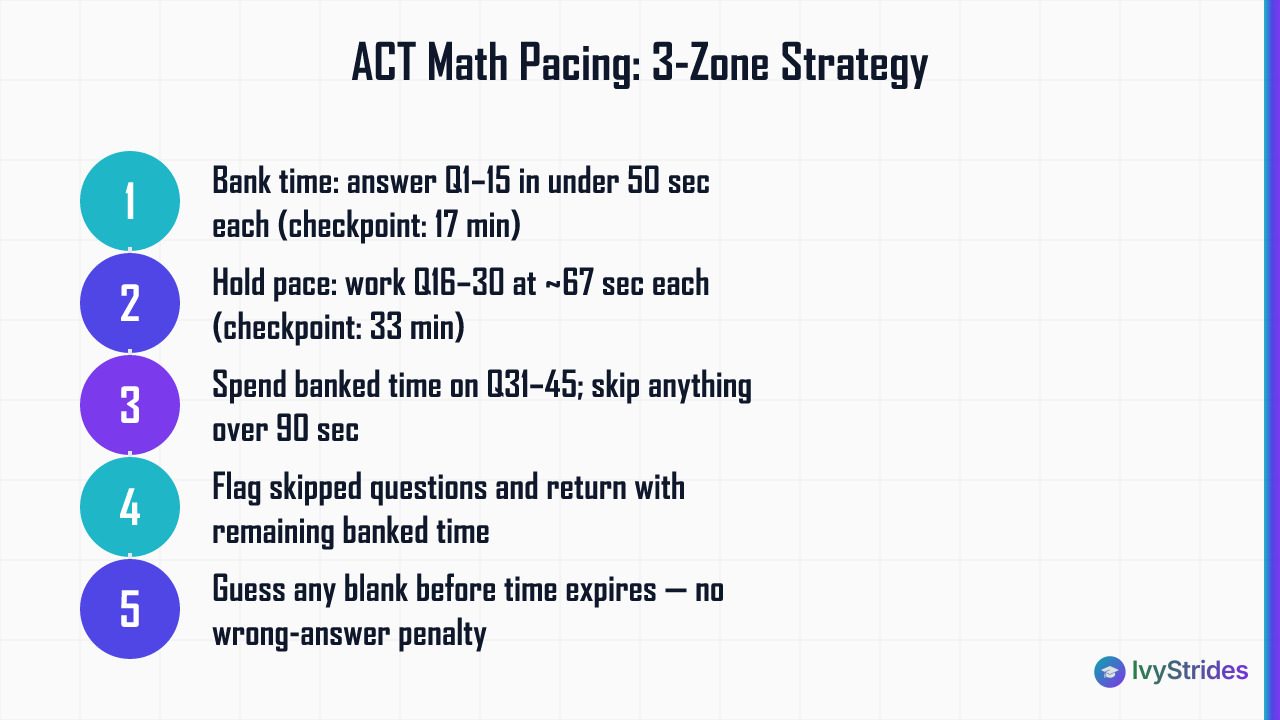
Split the 45 questions into three zones. Move through questions 1 to 15 fast, under 50 seconds each, and you bank roughly three minutes for the hard zone. Your first checkpoint is question 15 at 17 minutes elapsed; your second is question 30 at 33 minutes. Hit those marks and the final 15 questions get the extra time they need.
The skip rule. On your first pass, flag any question that crosses 90 seconds and move on immediately. Come back in the final minutes with your banked time. In our coaching with students in the 24-28 composite band, Math pacing errors, meaning 3+ minutes sunk into one hard question, account for an average of 2-3 missed questions per test. That's a clock problem, not a content problem.
Use the built-in Desmos calculator for complex graphing and systems of equations, not for arithmetic you can do faster in your head. Never leave a question blank; guess before time expires, since there's no wrong-answer penalty.
| Zone | Questions | Target/Question | Checkpoint | If Behind |
| Bank | 1-15 | Under 50 sec | Q15 at 17 min | Speed up, skip stragglers |
| Hold | 16-30 | ~67 sec | Q30 at 33 min | Skip anything over 90 sec |
| Spend | 31-45 | Use banked time | Finish by 50 min | Guess remaining, flag review |
For the content work underneath this plan, our guide on how to study for ACT Math covers the question types that slow students down.
ACT Reading Pacing: How to Finish All Four Passages Without Guessing
ACT Reading gives you four passages of nine questions each in 40 minutes, a 10-minute-per-passage target. Reading pacing is the section where most students lose the most time; the passage-ordering and question-sequencing tactics below address the patterns we see most often in coaching. This is also where knowing the content and still scoring low is most common, because time, not skill, runs out first.
The 14-minute trap. In our coaching with students scoring 22-26 on Reading, the most common error is spending 14 to 15 minutes on the first passage, then guessing the last nine questions blind. That single mistake can cost 4 to 9 raw points. Your checkpoint fixes it: finish passage 2 by the 20-minute mark. If you are behind at 20 minutes, skip the broad theme questions on passage 3 and return to them.
Two tactics recover the time. First, order the passages: start with the one you find most accessible, the shortest questions or the most familiar topic, rather than working straight through. Students who begin with their strongest passage type recover an average of 1 to 2 minutes per test in our coaching observations. Second, sequence the questions inside each passage: answer line-reference and detail questions first, save broad main-idea questions for last.
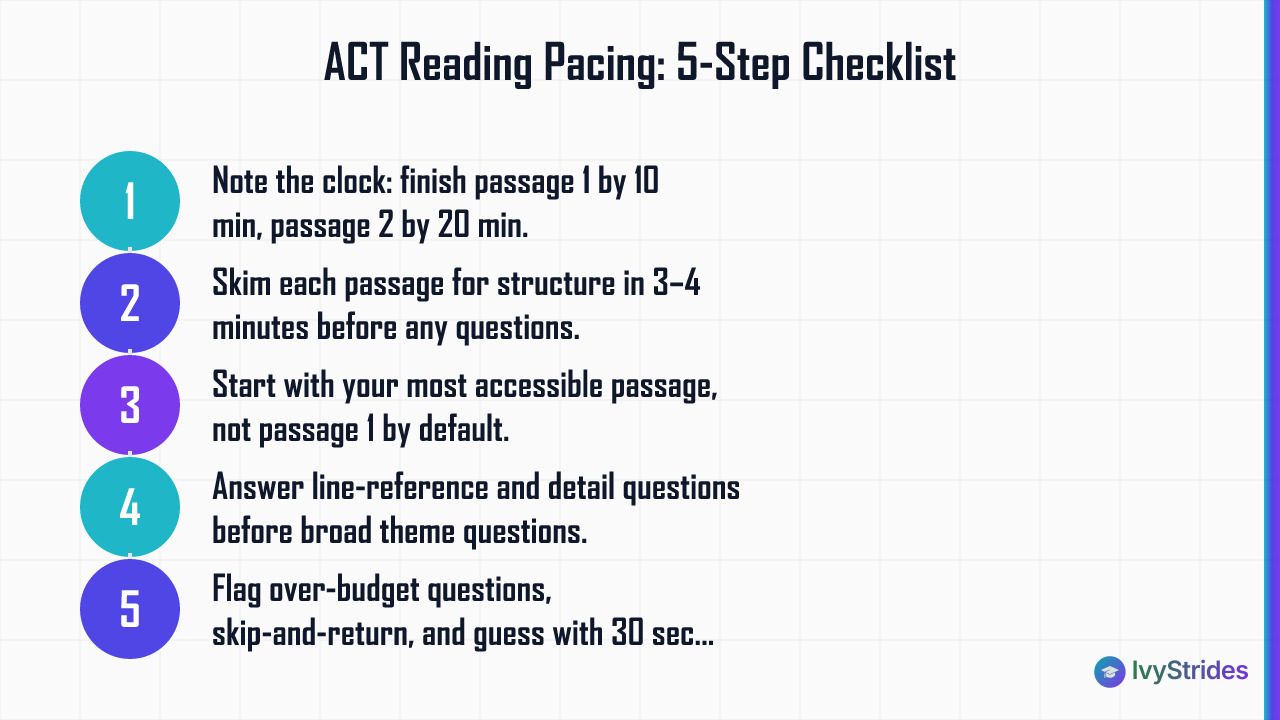
ACT Reading Pacing Checklist: before you start each passage
-
Note the clock. Passage 1 ends by 10 minutes, passage 2 by 20.
-
Skim for structure in 3 to 4 minutes before touching a question.
-
Attempt your most accessible passage first, not passage 1 by default.
-
Answer line-reference and detail questions before broad theme questions.
-
Flag any question over budget and skip-and-return in the final minutes.
-
Never leave a bubble blank; guess with 30 seconds left.
If you fix Reading pacing and the score still sits flat, our guide on how to break an ACT score plateau covers the error-pattern layer. Students chasing a top result will also want how to score 34+ on the ACT.
ACT Science Pacing: The 60-Second Rule and the Conflicting Viewpoints Exception
ACT Science gives you about 60 seconds per question across 40 questions in 40 minutes, spread over six or seven passages. The section is optional and scored separately, so it never touches your composite, but the pacing demands are real if you register. If you have not decided whether to add the optional Science section, those demands are one factor worth weighing before registration.
Read figures first. Most Science questions on Data Representation and Research Summaries passages point straight at a graph or table. Read the figure before the passage text and you answer most questions without full reading. Your checkpoint is passage 4 at 24 minutes, which leaves room for the slower passages at the end.
The one exception is Conflicting Viewpoints. That passage type gives you two or more competing hypotheses in dense prose, and skimming figures does not work because there usually are none. Budget extra reading time there and pull it from the figure-heavy passages where you move fast.
How to Build ACT Pacing Through Timed Section Drills
A timed section drill is one ACT section, run at its full time limit with no interruptions, and it's the fastest way to convert these targets into habit. Because pacing is a clock habit, drilling one section in isolation builds the muscle faster than full-length tests alone. Skipping time-consuming questions and tracking planned checkpoints is the recommended core approach across all four sections (Mentomind).
Review pacing, not just accuracy. After each drill, mark which questions ran over their per-question budget, not only which ones you got wrong. A question you answered correctly in 2 minutes is a pacing error that cost you points elsewhere. Pause at the halfway checkpoint during the drill and note whether you're on pace.
Pacing gains compound with content work: in our coaching with students in the 26-30 composite band, fixing one section's pacing typically recovers 1 to 2 composite points before any new content is taught. Students who run timed section drills three times a week for three weeks before a full-length test show more consistent improvement than students who only take full-length tests, in our coaching observations.
| Week | Drill Type | Goal |
| 1 | Single sections, timed | Hit each section's halfway checkpoint |
| 2 | Single sections + review log | Cut over-budget questions in half |
| 3 | Two-section blocks | Hold pace across fatigue |
| 4 | Full-length test | Confirm pacing under real conditions |
Here's the distinction that decides whether drills are enough: if your errors trace to time habits, drills fix them. If they trace to content gaps that slow you on specific question types, you need a coach to read your error log and separate the two. That's where ACT 1-on-1 prep fits, with a section-specialist coach who reads the log with you.
FAQ: ACT Pacing by Section
How to do better on the reading section of the ACT?
Target 10 minutes per passage and start with the passage you find most accessible, not passage 1 by default. Answer line-reference and detail questions before broad main-idea questions. If you finish a passage with more than 30 seconds to spare, bank that time for the hardest passage.
How rare is a 36 on ACT reading?
A 36 on ACT Reading sits in the 99th percentile, and fewer than roughly 1 in 200 test-takers reach it. Perfect pacing, finishing all four passages with time to review, is a prerequisite, but it also demands near-zero content errors. The path there starts with consistent 10-minute passage pacing.
How can I raise my ACT score from a 29 to a 33?
A 4-point composite gain typically means fixing pacing in at least one section and closing content gaps in one or two others. In our coaching with students in this band, the most common lever is Reading pacing combined with targeted Math work on the hard-question zone. Plan on roughly 8 to 12 weeks of structured prep.
How to improve my time management for the ACT Reading section?
Set a hard checkpoint at the end of passage 2: you should be at 20 minutes elapsed. If you're behind, skip the broad theme questions in passage 3 and return to them. Practice timed single-passage drills, 10 minutes each, three times a week before attempting full Reading sections.
Your Next Step on ACT Pacing
Pacing is the most recoverable source of lost ACT points. A student who knows the content but runs out of time is leaving a higher composite on the table, and the fix is a plan you can test this week.
- Run one timed Reading drill using the 10-minute-per-passage checkpoint and the passage-ordering tactic.
- Log which questions ran over budget, not only which ones you missed.
- Apply the three-zone plan on your next Math section and hit question 15 by 17 minutes.
- Repeat single-section drills three times before your next full-length test.

Award-winning author (South Asian Book Award) and graduate of BITS Pilani and UCLA Luskin School of Public Affairs. Brings a published writer's eye to Common App essays and grammatical precision to SAT and ACT R&W instruction.