
What Is the Enhanced ACT? The Complete 2026 Guide to the New Format
On this page
- What Is the Enhanced ACT? A Clear Definition
- What Changed from the Legacy ACT to the Enhanced ACT
- Is the Enhanced ACT Easier Than the Legacy Test? An Honest Answer
- How Long Is the Enhanced ACT? Section-by-Section Timing
- The Optional Science Section: Should You Take It?
- What Math Is on the Enhanced ACT? Topics and Calculator Policy
- Enhanced ACT vs. Digital SAT: The Key Structural Differences
- How to Prepare for the Enhanced ACT: A Format-Aware Strategy
- FAQ
- Is the Enhanced ACT available on paper, or is it digital only?
- Does the Enhanced ACT affect superscoring?
- When did the Enhanced ACT start, and which test dates use the new format?
- How does the Enhanced ACT score compare to legacy ACT scores? Will colleges understand the difference?
- Is the Enhanced ACT harder than the legacy ACT?
- Can I still take the ACT with Writing on the Enhanced format?
- Where to Go From Here
The Enhanced ACT is a redesigned version of the ACT that launched nationally in September 2025. It has 131 core questions across three required sections (English, Math, Reading), down from 215 questions across four required sections on the legacy test. Total testing time for the three core sections runs roughly 2 hours 5 minutes, or about 2 hours 45 minutes if you add the now-optional Science section. The composite scale is unchanged at 1–36, and the test is available in both paper and digital formats.
These figures come from ACT, Inc.'s official documentation, which is worth checking for your specific test date. The harder question, the one this article actually answers, is whether the new format changes what a smart prep plan looks like. Short answer: yes, in three specific ways the next sections walk through.

What Is the Enhanced ACT? A Clear Definition
The Enhanced ACT is ACT, Inc.'s redesigned test format that debuted digitally in April 2025 and rolled out nationally in both paper and digital formats in September 2025. It keeps the 1–36 composite score scale that colleges have used for decades, but restructures how you get there.
Here's what's fixed about the new format:
- 131 core questions across three required sections (English, Math, Reading), down from 215 on the legacy ACT.
- Three required sections, not four. Science moved to optional status.
- Roughly 2 hours 5 minutes of testing time for the three core sections. Add about 40 minutes if you sit for optional Science, bringing the total to around 2 hours 45 minutes.
- 1–36 composite scale unchanged. A 32 on the Enhanced ACT reads the same to admissions offices as a 32 on the legacy test.
- Paper and digital formats both available, with availability varying by test center and date.
For a closer look at every policy and scoring change ACT, Inc. announced alongside the format update, see our companion article on Enhanced ACT changes for 2026.
What Changed from the Legacy ACT to the Enhanced ACT
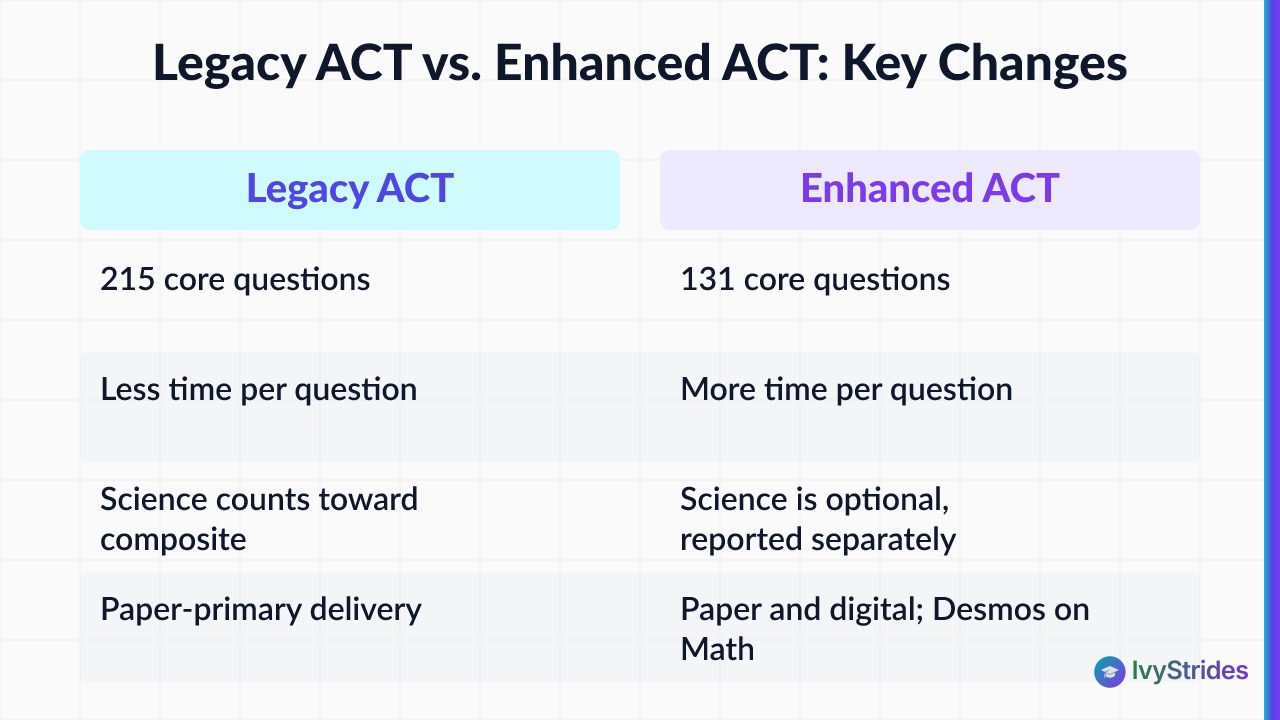
Four things changed. Everything else stayed the same.
1. Question count dropped from 215 to 131 across the core sections. Every core section (English, Math, and Reading) has fewer questions than the legacy version. The content standards are the same college-readiness benchmarks, but you face fewer items.
2. Time per question went up. Because the section time cuts are proportionally smaller than the question cuts, you now get more seconds per item on every core section. For students who lost points to pacing on the legacy test, this is the single biggest structural change.
3. Science became optional. On the legacy ACT, all four sections fed into the composite. On the Enhanced ACT, only English, Math, and Reading count toward the 1–36 composite. Science is reported separately when taken.
4. Digital delivery became a real option. Legacy ACT was paper-primary. The Enhanced ACT was designed for both paper and digital administration from the start, with the digital version offering a built-in Desmos graphing calculator on Math.
What did not change: the score scale (1–36), the content domains within each section (English still tests grammar and rhetorical skills, Math still spans pre-algebra through trigonometry, Reading still tests comprehension, inference, and vocabulary in context), and the optional Writing section for students whose colleges request it.
Here's the side-by-side, with per-section legacy figures from ACT, Inc.:
| Section | Legacy Questions | Legacy Time | Enhanced Status |
| English | 75 | 45 min | Fewer questions, more time per question |
| Math | 60 | 60 min | Fewer questions, more time per question |
| Reading | 40 | 35 min | Fewer questions, more time per question |
| Science | 40 | 35 min | Optional, roughly 40 min if taken |
| Total (core) | 215 | ~2h 55m | 131 questions, ~2h 5m |
Verify exact per-section question counts against act.org before your test date, since ACT, Inc. can adjust these figures. If you're still weighing your test choice, our breakdown of ACT vs. SAT difficulty can help before you commit. If you want a starting point for structured practice, our ACT prep overview walks through what a diagnostic-driven plan looks like.
Is the Enhanced ACT Easier Than the Legacy Test? An Honest Answer
Shorter is not the same as easier. Here's the honest version.
The Enhanced ACT wasn't designed to be a lower bar. ACT, Inc. has stated the redesign maintains the validity and reliability of the composite as a college-readiness measurement. The content standards on English, Math, and Reading match the legacy standards. A 30 still means a 30.
What did get easier is pacing. In our coaching, the number-one point-losing pattern on the legacy test for students in the 24–28 composite band was running out of time on Reading and Science, not misunderstanding the content. The Enhanced format gives more seconds per question on every core section, and it removes the Science-pacing pressure entirely for students who choose to skip it.
Here's the part most students miss. Same content rigor, better pacing conditions, one section you can drop. That combination benefits students who were losing points to fatigue and the clock. It does not benefit students who were losing points to weak content mastery. Fewer questions actually raises the stakes on the questions you do see, because each item is a larger percentage of your section score.
Whether a strong Enhanced ACT score still moves the needle at test-optional schools is a question we answer in our guide on does the ACT matter for college admission. Before choosing your prep approach, it's also worth reading our honest assessment of whether is free ACT prep enough to close a meaningful score gap.
How Long Is the Enhanced ACT? Section-by-Section Timing
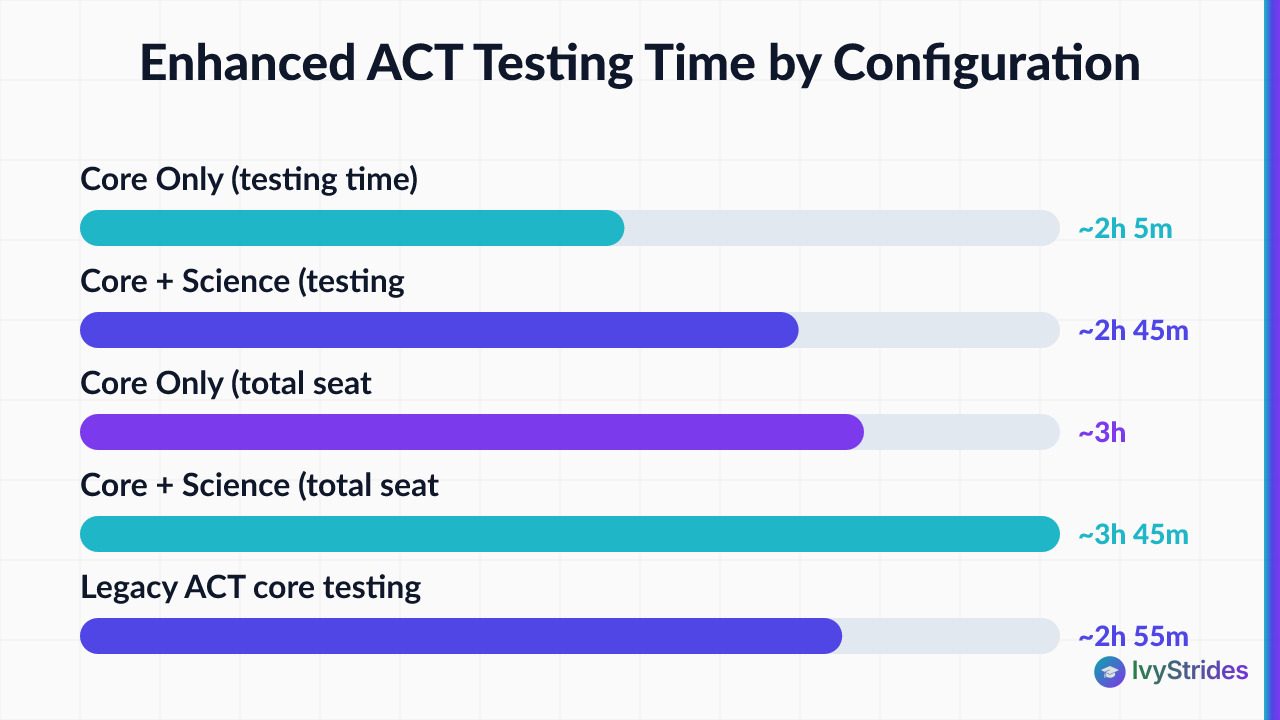
Total testing time depends on whether you sit for optional Science, optional Writing, or both.
- Core only (English, Math, Reading): roughly 2 hours 5 minutes.
- Core plus optional Science: roughly 2 hours 45 minutes.
- Core plus Science plus optional Writing: longer still, with Writing adding a timed essay at the end.
Those figures cover section testing time only. Add roughly 30 to 45 minutes for check-in, instructions, ID verification, and the scheduled break between sections. Plan for a total seat time of around 3 hours if you're taking only the core, and closer to 3 hours 45 minutes if you add Science. Verify current break structure and reporting-time expectations at act.org for your specific test date.
Compared to the legacy ACT's roughly 2 hours 55 minutes of core testing time, the Enhanced format saves you about 50 minutes in the seat. That matters more than it sounds. Test fatigue was a real drag on legacy ACT Science scores, since Science sat at the end of an already long test. Removing about 50 minutes of cognitive load before the final section is one of the quieter wins of the redesign.
For full-length practice under real timing conditions, our ACT practice test online library simulates the Enhanced format section timing.
The Optional Science Section: Should You Take It?
Yes, the Enhanced ACT still has Science. It's just optional now, and it doesn't count toward your 1–36 composite unless a specific college asks for it.
The Science section tests data interpretation and experimental reasoning: reading charts, evaluating experimental design, comparing conflicting viewpoints. It does not test memorized biology, chemistry, or physics facts. If you're strong at pulling information from graphs and tables under time pressure, Science is a place to demonstrate that skill. If data interpretation has been a struggle in your science classes, skipping it removes a roughly 40-minute liability from your test day.
Take the optional Science section if:
- You're applying to STEM-heavy programs (engineering, computer science, pre-med tracks) where a strong Science subscore signals quantitative reasoning.
- One or more of your target colleges specifically requests the Science subscore. Check each school's admissions page or Common Data Set to confirm.
- You've scored consistently well on data-interpretation practice under timed conditions.
Skip the optional Science section if:
- Your target schools don't consider the Science subscore (many liberal arts and humanities-focused programs do not).
- You need the roughly 40 minutes of reduced fatigue to protect your Reading score, which does count toward the composite.
- Data interpretation has been a persistent weak spot despite targeted practice.
Caveat: Science score reporting policies vary by college and change year to year. Confirm with each school on your list before finalizing your registration.
If your target list leans STEM, look at how AP courses online can strengthen the quantitative story your application tells, since AP Chemistry, Physics, and Statistics scores carry weight admissions offices read alongside your ACT.
What Math Is on the Enhanced ACT? Topics and Calculator Policy
Enhanced ACT Math covers the same content domains as the legacy test, just across fewer questions.
The tested domains, per ACT, Inc.:
- Pre-algebra and elementary algebra: number properties, ratios, percentages, linear equations, exponents.
- Intermediate algebra: quadratics, functions, systems of equations, inequalities.
- Coordinate geometry: slope, distance, midpoint, graphs of functions.
- Plane geometry: triangles, circles, polygons, area and volume, similarity.
- Trigonometry: right-triangle trig, unit-circle basics, entry-level trig identities.
- Statistics and probability: mean, median, mode, standard deviation basics, probability calculations.
Calculator policy: permitted throughout. There is no no-calculator module on the Enhanced ACT Math section, which is a meaningful contrast with the Digital SAT. On the digital version of the Enhanced ACT, students have access to a built-in Desmos graphing calculator, which speeds up function graphing, system-of-equations solving, and geometric visualization. Verify Desmos availability against act.org for your specific administration, since embedded tool availability can be updated.
In our coaching, students preparing for the digital Enhanced ACT who spend a handful of practice sessions building Desmos fluency (graphing, sliders, regression) consistently gain a measurable pacing advantage on the harder Math items in the back half of the section. If Math is your target section for gains, 1-on-1 ACT prep with a Math specialist is the fastest path we've seen for score-band jumps.
Enhanced ACT vs. Digital SAT: The Key Structural Differences
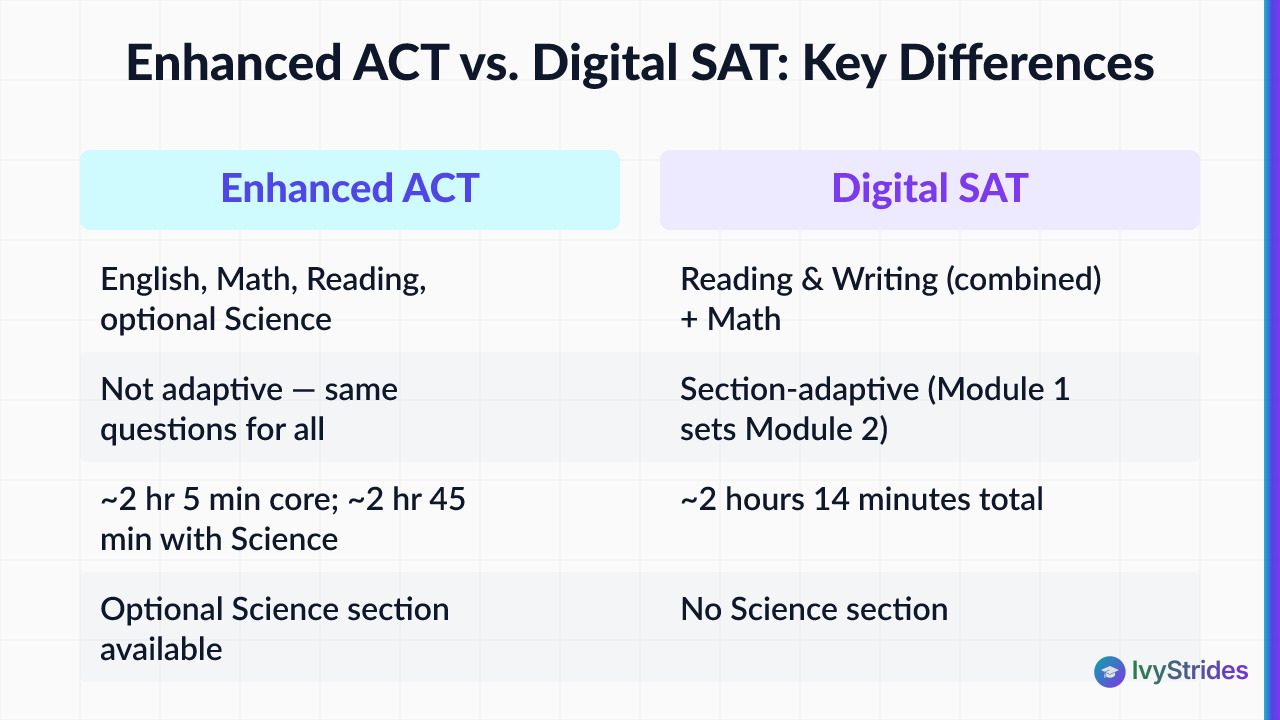
If you are still deciding between the two tests, our detailed breakdown of ACT vs SAT difficulty, format, and scoring can help you choose the right exam before you commit to a prep plan.
Structural differences that matter most when choosing:
Sections. Enhanced ACT has English, Math, Reading, and optional Science. The Digital SAT has Reading and Writing (combined) and Math. That's it. No separate Science section on the SAT at all, per College Board.
Adaptivity. The Digital SAT is section-adaptive. Your performance on Module 1 of each section determines the difficulty of Module 2. The Enhanced ACT is not adaptive. Every student sees the same questions in the same order.
Timing. Digital SAT runs roughly 2 hours 14 minutes total. Enhanced ACT runs about 2 hours 5 minutes for the core, or 2 hours 45 minutes with Science.
Calculator. Digital SAT permits calculator throughout Math (Desmos built in). Enhanced ACT permits calculator throughout Math (Desmos built in on digital). Neither has a no-calculator module in the current format.
Score scale. ACT reports on 1–36. SAT reports on 400–1600.
Science. Only the Enhanced ACT has one, and it's optional.
Choose the Enhanced ACT if you prefer a linear, non-adaptive test, want the option to show a Science score, or perform better under longer reading passages. Choose the Digital SAT if you prefer shorter passages, benefit from an adaptive structure, or want to avoid the Science-section decision entirely. For students weighing a switch between the two, our guide on ACT vs. Digital SAT transitions walks through when a mid-cycle change actually makes sense.
How to Prepare for the Enhanced ACT: A Format-Aware Strategy
Once you understand the new format, the next step is a diagnostic practice test under Enhanced ACT conditions so a section-specialist coach can build a targeted plan around your actual weak points.
A format-aware Enhanced ACT prep plan looks like this:
1. Start with a full-length Enhanced ACT diagnostic. Under real timing, all three core sections in one sitting, plus Science if your target schools care about it. Skip this step and you'll pay for it later. Students who jump straight into content review without a diagnostic often over-prepare in areas where they were already proficient, and under-prepare in the sections costing them the most points.
2. Identify your two weakest sections. Not one, two. Prep time invested in your weakest section produces bigger gains than prep time invested in a section where you're already at your target. In our coaching, students who assumed Math was their weak spot regularly discover through diagnostic data that Reading pacing was actually costing them more composite points.
3. Work with section-specialist coaches, not a generalist. ACT English and Reading demand different instructional expertise than ACT Math, and both differ from ACT Science. IvyStrides assigns a separate specialist per section rather than one tutor across all four. This structure is why we treat English/Reading, Math, and Science as distinct coaching tracks.
4. Recalibrate your pacing. More time per question on the Enhanced format changes what "aggressive pacing" and "safe pacing" look like. Practice with the actual per-section timing, not the legacy timing your older prep books are calibrated to.
5. Build Desmos fluency if you're testing digital. A handful of focused sessions is usually enough to reach working competence on the Enhanced ACT digital Math section.
6. Retest every 2 to 3 weeks on your targeted weak areas. Spaced retesting confirms whether the work is producing retention or just short-term familiarity. This is the core of our diagnostic-plus-targeted-weakness-plus-spaced-retesting methodology.
7. Plan a realistic 8 to 16 week timeline. In our 1-on-1 ACT program, a 4+ composite point gain is typical for students completing the full program. This is a typical outcome framing, not a guarantee, and it depends on consistent weekly hours and honest work between sessions.
For self-directed practice under real Enhanced ACT conditions, our digital ACT prep library gives you full-length simulations. When you're ready to move from self-study to coaching, our ACT section-specialist tutors can be matched to your specific weak-section profile.
FAQ
Is the Enhanced ACT available on paper, or is it digital only?
Both. ACT, Inc. launched the digital version in April 2025 and the paper version nationally in September 2025. You can choose the format that suits you, though specific formats may not be offered at every test center on every date. Confirm current format options at act.org before registering, especially if you have a preference tied to accommodations or comfort.
Does the Enhanced ACT affect superscoring?
ACT, Inc. continues to support superscoring on the Enhanced ACT, meaning colleges that superscore will take your highest section scores across multiple sittings. Superscoring policies vary by college. Check each school's admissions page or Common Data Set to confirm their specific policy before deciding how many times to test.
When did the Enhanced ACT start, and which test dates use the new format?
The Enhanced ACT debuted digitally in April 2025 and launched in both paper and digital formats nationally in September 2025. All ACT national test dates from September 2025 onward use the Enhanced format. Students who tested before April 2025 sat for the legacy format. Verify the current calendar at act.org.
How does the Enhanced ACT score compare to legacy ACT scores? Will colleges understand the difference?
The composite scale remains 1–36, so a 30 on the Enhanced ACT represents the same college-readiness benchmark as a 30 on the legacy ACT. ACT, Inc. has stated the redesign maintains the validity and reliability of the score for admissions purposes, and colleges are aware of the format change. As Enhanced-format score distributions accumulate through the 2025–2026 cycle, percentile tables may shift slightly. Check the most current national norms at act.org.
Is the Enhanced ACT harder than the legacy ACT?
The Enhanced ACT is not designed to be harder or easier. It's designed to be shorter and more flexible. The content standards for English, Math, and Reading match the legacy college-readiness benchmarks. In our coaching, the shorter format and additional time per question make the test feel more manageable, especially for students who lost points to pacing on the legacy version. Don't assume the content is easier. Prepare with full-length Enhanced ACT practice tests, not legacy materials.
Can I still take the ACT with Writing on the Enhanced format?
Yes. The optional Writing (Essay) section is still available on the Enhanced ACT for students whose target colleges require or recommend it. Adding Writing extends your total test time beyond the core sections. Check each college's admissions requirements to determine whether the Writing score is needed before registering. Source: ACT, Inc..
Where to Go From Here
You now know what the Enhanced ACT is, how it differs from the legacy test, and where the format changes actually change your prep. The next move is a diagnostic under Enhanced ACT conditions so you can see, with real data, where your composite is sitting today and which sections are costing you the most points.

Award-winning author (South Asian Book Award) and graduate of BITS Pilani and UCLA Luskin School of Public Affairs. Brings a published writer's eye to Common App essays and grammatical precision to SAT and ACT R&W instruction.