
How Do You Catch Up in an AP Class Before the November Exam Order?

On this page
- What AP Exam Scores Actually Mean: The 1-5 Scale and the 3 Threshold
- How to Triage Your AP Class Gap Without Starting Over
- What the November AP Exam Order Deadline Means for Your Recovery Plan
- A Realistic AP Catch-Up Timeline From Now to May
- FAQ: Catching Up in an AP Class
- Is 70% a 5 on AP?
- Is a C+ good in an AP class?
- Is a 3 a bad AP score?
- Is it hard to get an A in AP classes?
- Your Next Step on Catching Up in an AP Class
To catch up in an AP class, stop restarting from Unit 1. Stay current with today's lessons, then use AP Classroom progress checks to find which past units carry the most exam weight and close those first. An AP class is a college-level course whose separate May exam is scored 1 to 5.
Order your exam by November 13, 2026 to avoid the $40 late order fee that applies through March 12, 2027. Everything below counts backward from the first 2027 exam day, May 3, so the plan reaches the finish line with review time to spare.
What AP Exam Scores Actually Mean: The 1-5 Scale and the 3 Threshold
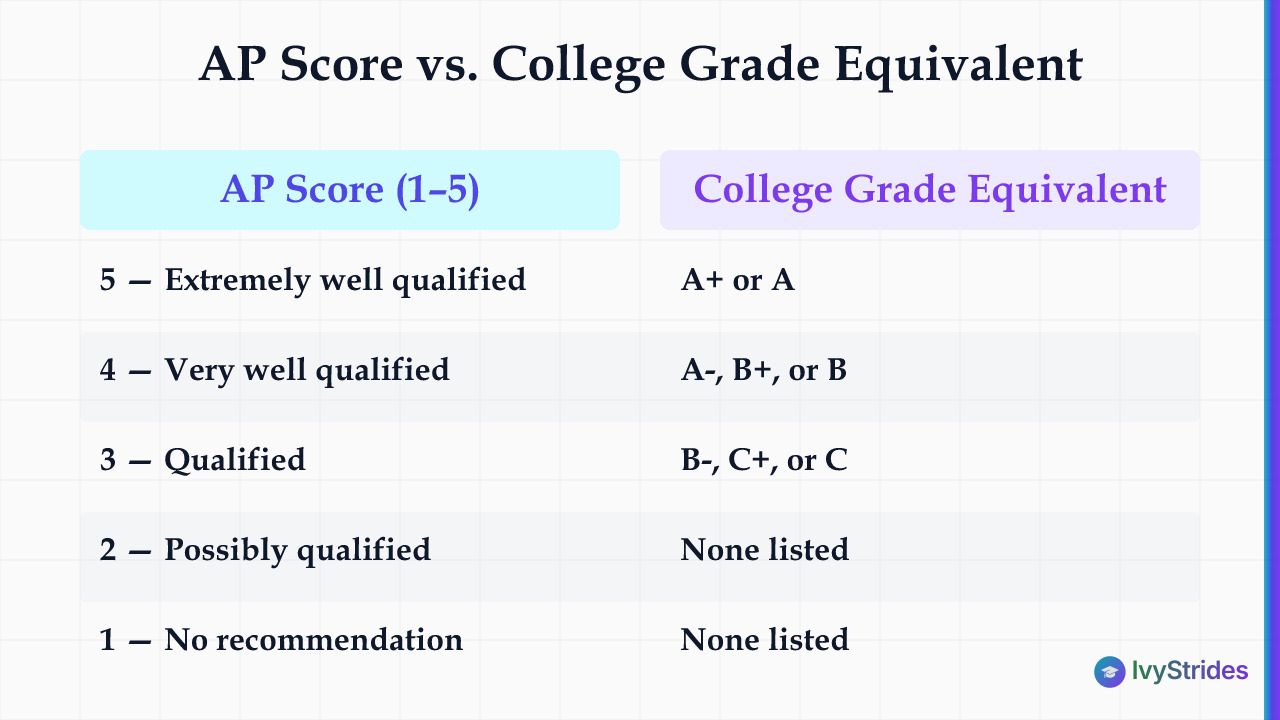
Your target is an exam score of 3 or higher, not an A on your report card. Every AP exam is scored 1 to 5, separately from your course grade. College Board labels a 3 "qualified," the lowest score it pairs with a college grade equivalent on its AP score scale table.
Course grade versus exam score. Your teacher sets the course grade from homework, quizzes and tests all year. College Board sets the exam score from one May administration. A student sitting on a C+ in class can still reach a 3 by prioritizing the highest-weight units, so plan the two numbers separately.
Here is what each score signals, in College Board's own words.
| AP Score | College Board Recommendation | College Grade Equivalent |
| 5 | Extremely well qualified | A+ or A |
| 4 | Very well qualified | A-, B+, or B |
| 3 | Qualified | B-, C+, or C |
| 2 | Possibly qualified | None listed |
| 1 | No recommendation | None listed |
The scale is fixed; credit policy isn't. A 3 earns credit at one university and only placement at another, and policies change by year. Each college publishes its own table, and reading how a college awards AP credit takes the guesswork out of it.
How to Triage Your AP Class Gap Without Starting Over
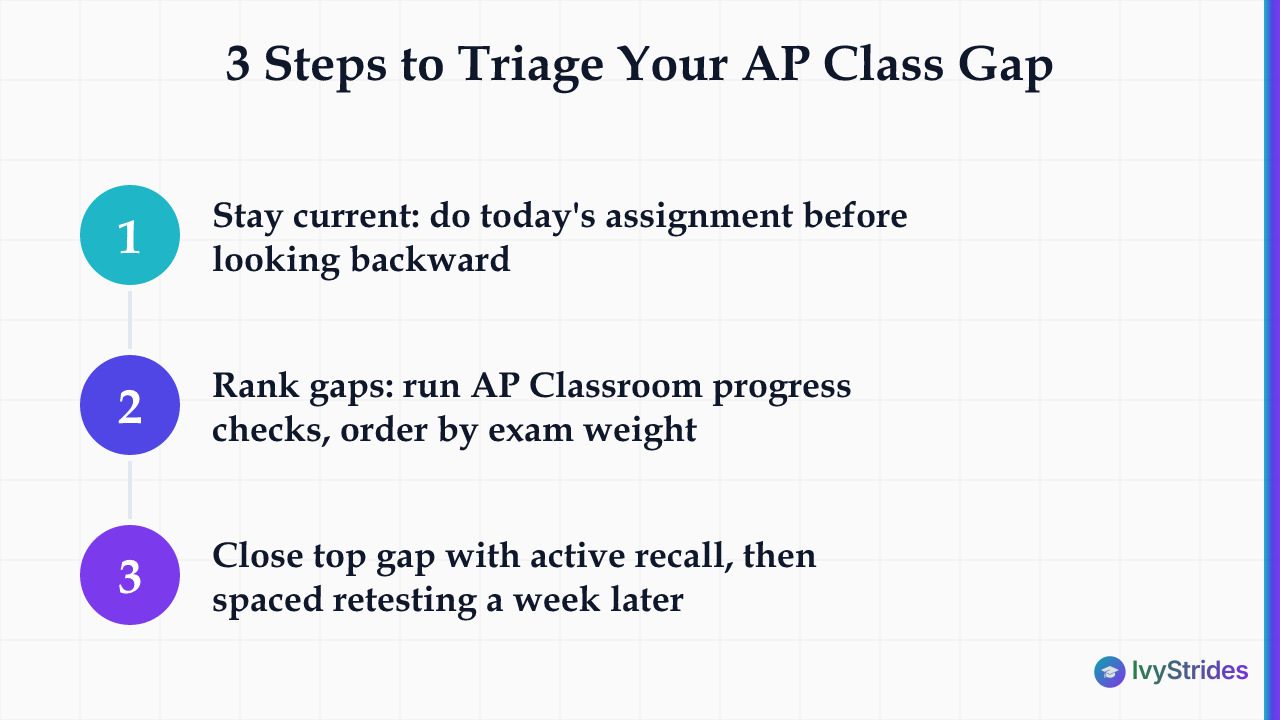
Stay current with today's lessons first, then close past-unit gaps ranked by exam weight, not in chronological order. AP Classroom is the official College Board platform, with topic questions and progress checks written to exam difficulty, and it's free to every enrolled student. It's your diagnostic tool for finding exactly where the gaps sit.
A common pattern in AP Classroom diagnostic results: students score well on early units but have large gaps in the units covered during the weeks they fell behind.
Why triage beats restarting. The exam score sets your target, and time is the constraint, so unit prioritization matters more than coverage. In our coaching, students who try to restart from Unit 1 usually run out of time before reaching the high-weight units that appear most often on the exam. Ranking gaps by weight spends your limited hours where the exam spends its points.
Run the process in three steps.
-
Stay current. Attend every class and do today's assignment first. New gaps cost more to close than old ones, so stop the bleed before you look backward.
-
Rank the gaps. Run an AP Classroom progress check on each unit you missed. Check your course's exam weighting in the AP Classroom course guide, then order the gaps highest weight first.
-
Close the top gap with active recall. Self-test, redo missed questions, and explain the concept aloud; retrieval tends to stick better than re-reading notes. Confirm it holds a week later with spaced retesting: a second progress check on the same unit.
When self-study stalls. If the gap is larger than two units or the subject involves heavy calculation (AP Calculus, AP Chemistry, AP Physics), a per-subject specialist can compress the timeline. Weigh whether AP tutoring is worth paying for against the size of your gap. If it is, AP courses that pair one teacher with each subject put someone who knows that exam's weighting on your unit map.
What the November AP Exam Order Deadline Means for Your Recovery Plan
The AP exam order deadline is November 13, 2026, for full-year and first-semester courses, and it is the first hard date in your recovery. Order from November 14, 2026 through March 12, 2027 at 11:59 p.m. ET, and College Board charges a $40 late order fee per exam on top of the $99 base fee in the U.S. and Canada.
Unused exams cost too. An exam you cancel after November 13, or leave unused, carries its own $40 fee, so order only the exams you intend to sit.
Unlike the unit-weight ranking above, that $40 penalty is a cost you control today with one order. A committed date also sharpens motivation: "someday in May" becomes a fixed target. Ordering your exam before November 13 avoids the $40 late fee, and the full AP exam registration walkthrough shows what your school's coordinator will ask you to do.
The 2027 exams run over two weeks in May. Count backward from your first date to size the plan.
| Event | Date | Fee or Note |
| Exam order deadline | Nov 13, 2026 | $99 base fee, no penalty |
| Late order period | Nov 14, 2026 to Mar 12, 2027 | +$40 per exam |
| Exam week 1 | May 3 to 7, 2027 | 8 a.m. and 12 p.m. local |
| Exam week 2 | May 10 to 14, 2027 | Same start times |
| Late testing | After week 2 | For students who can't test in the first two weeks |
| Canceled or unused exam | After Nov 13 | $40 per exam |
Fees and dates: College Board's 2026-27 AP exam fees and 2027 AP exam dates pages.
IvyStrides calculates approximately 24 weeks between the November 13, 2026 exam order deadline and the May 3, 2027 first exam day, and roughly 31 weeks from late September. Morning exams begin at 8 a.m. local time and afternoon exams at 12 p.m. at most schools, so check which slot your subject takes before exam week.
A Realistic AP Catch-Up Timeline From Now to May

Photo by RDNE Stock project on Pexels
Split your runway into four phases, each with one job. AP exams run as fully digital or hybrid digital exams in Bluebook, so practice in the tool you'll test in once your course opens it.
Anchored to that May 3 start date, here is the phase map.
| Phase | Dates | Primary Focus | Key Tool |
| 1 | Now to Nov 13 | Triage top gaps, order the exam | AP Classroom progress checks |
| 2 | Nov to Feb | Systematic unit gap closure | AP Classroom topic questions |
| 3 | Mar to Apr | Full-exam practice, retest weak units | Bluebook |
| 4 | Exam week | Light recall, confidence drills | Your own notes |
Phase 1 is triage and commitment. Rank your gaps, close the single highest-weight one, and order the exam before November 13.
Phase 2 is the grind. Work through ranked unit gaps with active recall, one unit at a time, while staying current in class. In our coaching, students who begin unit-gap work before December have more time for full-exam practice in March and April.
Phase 3 shifts from units to whole exams. Sit timed sections in Bluebook, then retest the units that come back weak. Once you have closed the most critical unit gaps, the full AP exam study method gives you the structured review plan to carry through to May. For where each course concentrates its weight, AP exam prep broken down by subject sequences the units to hit first.
Phase 4 is exam week, and less is more. Light recall, a full night's sleep, and no new unit the night before. One note for after the exam: you can send scores free to one recipient each year until June 20, 2027 at 11:59 p.m. ET, and additional reports cost $15 each.
FAQ: Catching Up in an AP Class
Is 70% a 5 on AP?
Not necessarily. College Board sets score cutoffs after each exam administration, so the raw percentage needed for a 5 changes by subject and by year. No fixed percentage guarantees a 5. Use the released scoring guidelines for your subject to judge how close your practice results are.
Is a C+ good in an AP class?
A C+ is a passing course grade, but it doesn't predict your AP exam score. The exam is scored separately on the 1 to 5 scale, and College Board describes a 3 as "qualified," equivalent to a college grade of B-, C+, or C. A student earning a C+ in class can still reach a 3 or higher with focused work on the highest-weight units.
Is a 3 a bad AP score?
No. College Board labels a 3 "qualified," and whether a college awards credit for it depends on that college's own policy. Earning a score of 3 or higher also counts toward AP Scholar recognition, which requires qualifying scores on three or more AP exams, per College Board's AP Scholar Award page.
Is it hard to get an A in AP classes?
AP classes move faster and cover more than standard courses, so an A takes consistent weekly effort rather than last-minute cramming. The course grade and the exam score are separate. A student can earn a B or C in class and still reach a 4 or 5 on the exam by prioritizing the units that carry the most exam weight.
Your Next Step on Catching Up in an AP Class
You don't need to relearn the whole course. You need to stop losing ground, then close the gaps the exam rewards, in the order that gets you to a 3 or higher by May.
- Open AP Classroom today and run a progress check on the unit you're furthest behind on.
- Block two focused study sessions this week on that highest-weight gap.
- Order your exam by November 13, 2026 to avoid the $40 late fee.
- Confirm your subject's May date, then count backward through the four phases.

Two decades teaching quantitative and verbal aptitude on standardized tests. Rare dual expertise across Math and Verbal — particularly effective for students with gaps on both sides. Senior AP Mentor for our Calculus and English tracks.