
Do You Report AP Scores on College Applications? Here Is What the College Board Actually Says
On this page
- Do You Have to Report AP Scores on College Applications?
- Which AP Scores Should You Report on College Applications?
- How to Send AP Scores to Colleges: Self-Report vs. Official Report
- Can You Hide Your AP Scores From Colleges, and What Happens If You Do?
- FAQ: Reporting AP Scores on College Applications
- Do I have to self report all AP scores?
- Can you hide your AP scores from colleges?
- Is 4 a bad AP score?
- Should I send AP scores to colleges when applying?
- Your Next Step on AP Score Reporting
Reporting AP scores on college applications is optional at most schools. You self-report by typing scores into the application form, and College Board does not send them automatically. A 4 or 5 generally helps, a 3 is neutral, and a 1 or 2 is best left off.
A small set of selective schools, including Stanford and MIT, ask you to report every AP score if you report any, so verify each target school's policy before you submit. Those rules come from the College Board AP Program and each college's admissions page, cited below.
Do You Have to Report AP Scores on College Applications?
No. AP score reporting is a student-controlled, optional step on most applications. An AP score report is the College Board document that lists your exam results, and the college sees your scores only if you provide them, either by self-reporting or by ordering an official send. College Board does not push your scores to schools on its own.
Self-reporting means you type each score into an optional section of the application yourself. The Common App includes exactly this kind of optional AP scores field, and filling it in is not mandatory.
Not on the transcript. AP scores do not appear on most high school transcripts. The transcript carries your AP course grade, not your exam result, so a school has no back channel to your scores unless you or College Board hand them over. In our coaching, the most common mistake we see is students assuming colleges already know their AP scores through the transcript. They typically do not.
An official AP score report is a separate action. When you order one through the AP student score reporting portal, College Board sends your full AP score history, every exam from every year, and you cannot exclude an individual score from that official send.
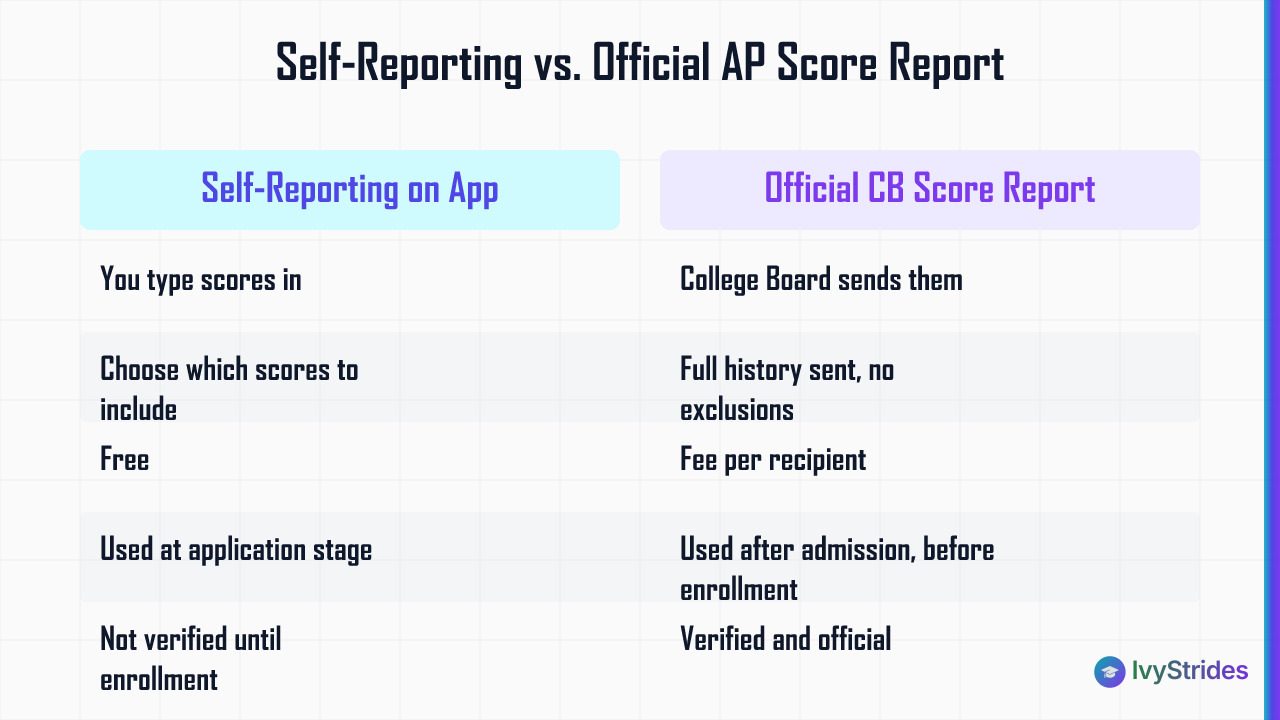
| Feature | Self-Reporting on Application | Official College Board Score Report |
| Who enters the scores | You type them in | College Board sends them |
| Choose which scores | Yes, per score | No, full history goes |
| Cost | Free | Fee per recipient |
| Usually needed | At application stage | After admission, before enrollment |
| Verified | Not until enrollment | Yes, official |
If you are an international student weighing whether future AP exams are worth taking, our guide to ap classes online covers how students worldwide access the courses.
Which AP Scores Should You Report on College Applications?
Report your 4s and 5s, treat a 3 as neutral, and omit most 1s and 2s. The AP exam score scale runs 1 to 5. Per the College Board AP Program, a 3 is "qualified," a 4 is "well qualified," and a 5 is "extremely well qualified." That definition is the backbone of the reporting decision.
Because those bands carry different signals, the score you report tells an admissions officer something specific. A 5 in AP Chemistry for a prospective engineer reads as subject mastery. A lone 2 in an unrelated subject reads as noise, so leaving it off costs you nothing on a school without an all-scores rule.
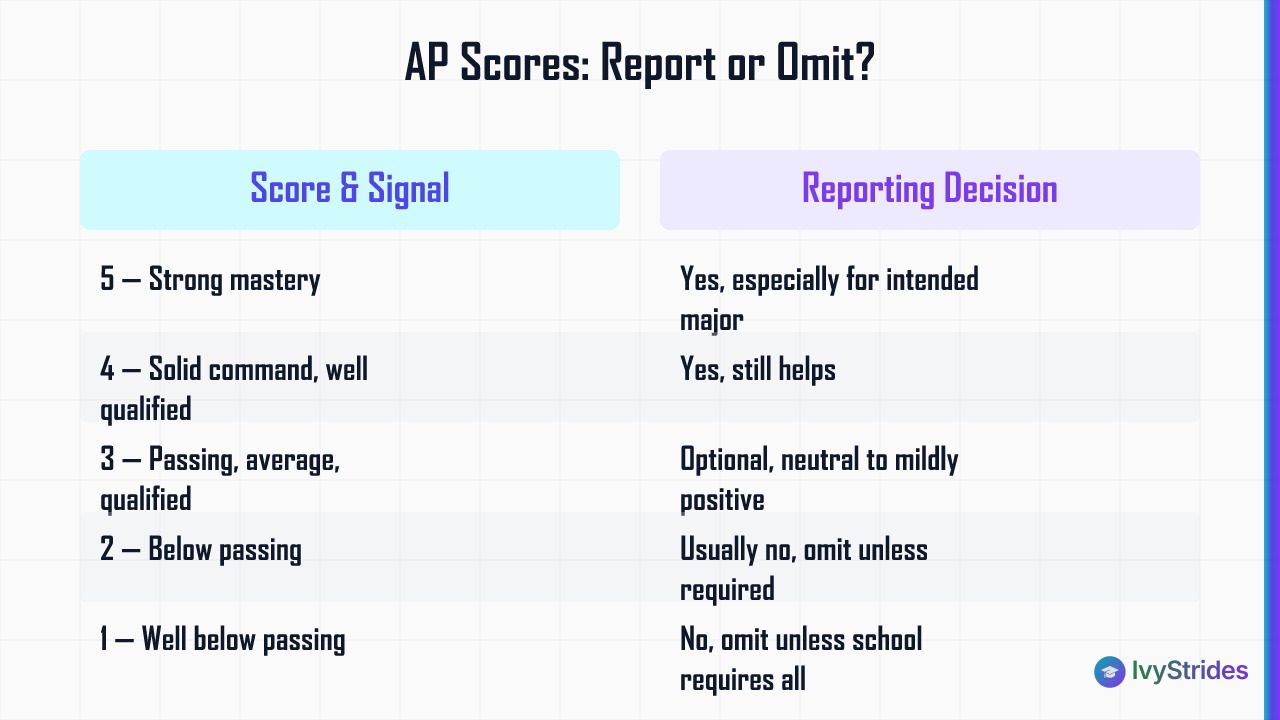
| AP Score | What It Signals | Report on Most Applications? | Note |
| 5 | Strong mastery | Yes | Especially in your intended major |
| 4 | Solid command | Yes | Well qualified, still helps |
| 3 | Passing, average | Optional | Neutral to mildly positive |
| 2 | Below passing | Usually no | Omit unless school requires all |
| 1 | Well below passing | No | Omit unless school requires all |
In our coaching with students applying to selective schools, a 4 or 5 in a subject tied to the intended major consistently adds positive signal, while a 2 in an unrelated subject adds nothing and is best left off. This is a data point inside a holistic review, not the deciding factor.
The all-or-nothing exception. A few selective schools apply an all-scores reporting policy. Stanford asks applicants to self-report every AP score if they report any, and MIT asks for all AP scores. Both policies must be verified against each school's current admissions page every application cycle, because these rules change.
Whether a college then grants credit for a reported score is a separate question from whether to report it; see our guide to do colleges accept AP credit for the full breakdown. And remember that admissions officers weigh the AP course grade on your transcript more heavily than the exam score itself, a distinction our guide on does AP help with college admission covers in detail.
How to Send AP Scores to Colleges: Self-Report vs. Official Report
Self-report now, send officially later. For most applications, you self-report scores on the form at the application stage and pay nothing. Colleges usually require an official AP score report only after admission and before enrollment, not while they read your file. So the expensive step waits until you have an offer in hand.
That timing matters because AP scores release in July, while most application deadlines fall in November for early rounds and January for regular decision. Before you decide what to report, confirm your scores are final in your College Board account; our walkthrough on how to check your AP scores shows the portal step by step.
When a college does require the official document, you order it through the AP student score reporting portal. College Board sends your full score history for a fee per recipient, and each additional recipient carries its own fee. Official AP score reports also take time to process, so factor the send date into your college application deadlines for fall 2026 calendar.
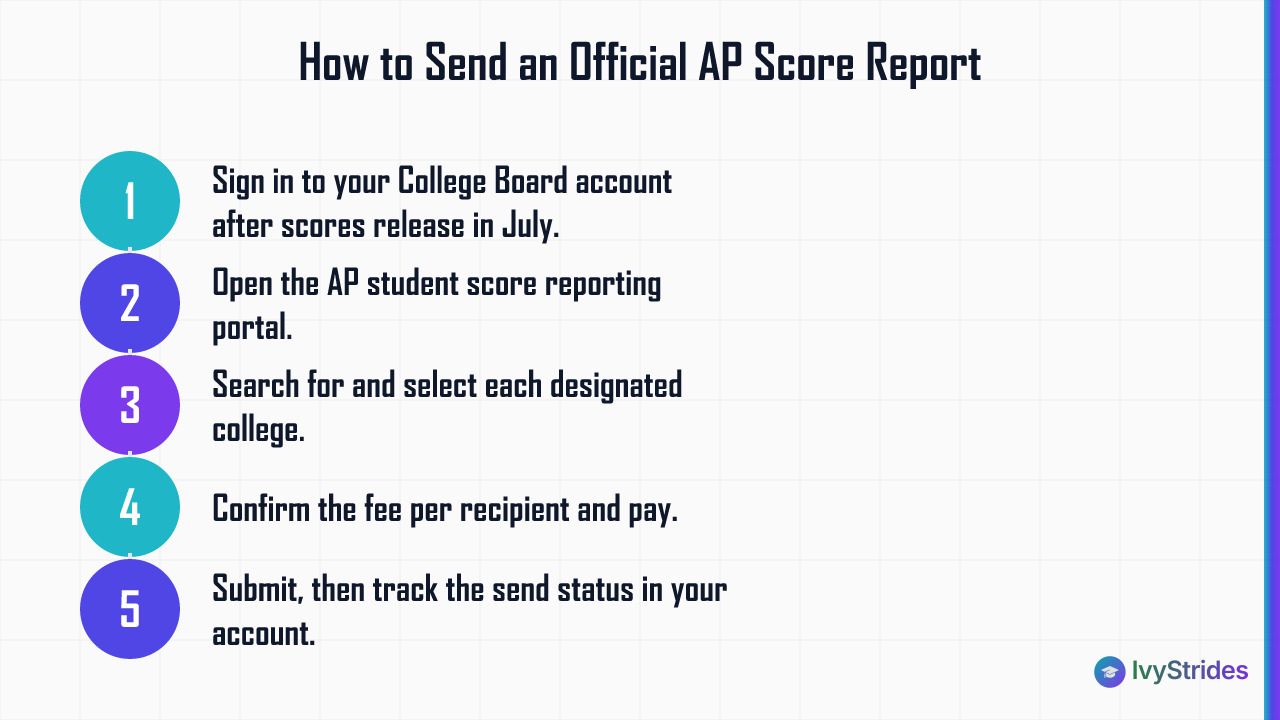
How to send an official report:
-
Sign in to your College Board account after scores release in July.
-
Open the AP student score reporting portal.
-
Search for and select each designated college.
-
Confirm the fee per recipient and pay.
-
Submit, then track the send status in your account.
One more lever exists before scores are even released. College Board lets you withhold a score from a specific college for a fee, but only before the June 15 deadline. Miss that date and an official send carries your full history, no exceptions.
Can You Hide Your AP Scores From Colleges, and What Happens If You Do?
Yes, within limits, and omitting a score is not the same as hiding it. On most applications you simply do not list a score in the optional self-report section, which is entirely permitted. For official reports, College Board lets you withhold a score before the June 15 deadline for a fee. After that date, an official send includes your full AP score history.
Because the self-report field is voluntary, not listing a score is not misrepresentation on most applications, per Common App policy. IvyStrides derives this figure from the inputs cited above. A student with a 4 in AP Chemistry and a 2 in AP World History can report only the 4, since the two scores are self-reported independently. Neither College Board nor Common App states this per-score flexibility as a single rule, but combining their policies is what tells you it is your call.
The exception that changes the math. At a school with an all-scores policy, such as Stanford or MIT, omitting a score when you self-report would violate the school's stated rule. That is not a gray area. Verify each target school's current policy before you submit, because these requirements shift by cycle.
Students who feel a weak AP score dents their profile often ask whether the rest of the application can carry more weight. It usually can, and a sharper narrative is where college essay coaching helps most. A single low score in an unrelated subject rarely moves an admissions decision at schools without an all-scores rule.
Before you submit:
- Confirm every score is final in your College Board account.
- Decide which scores to self-report using the 4-5 / 3 / 1-2 framework.
- Check whether each target school has an all-scores policy.
- Remember AP scores are not on your transcript, so the college sees only what you provide.
- Plan the official send for after admission unless a school states otherwise.
- Note the June 15 deadline if you want to withhold a score.
FAQ: Reporting AP Scores on College Applications
Do I have to self report all AP scores?
No. On most applications self-reporting is optional and you choose which scores to include. The exception is a small number of selective schools, including Stanford and MIT, that require you to report all AP scores if you report any. Always check each school's specific policy before submitting.
Can you hide your AP scores from colleges?
Yes, within limits. You can simply not list a score when self-reporting on most applications. For official College Board score reports, you can withhold a score before the June 15 deadline for a fee. After that deadline, an official send includes your full score history and you cannot exclude individual scores.
Is 4 a bad AP score?
A 4 is a strong score. College Board defines it as "well qualified," and most colleges that grant AP credit accept a 4. At highly selective schools, a 4 in a relevant subject is a positive signal. It is not a score to hide, so report it.
Should I send AP scores to colleges when applying?
For most applications, self-reporting strong scores of 4 or 5 during the application stage is worthwhile. You typically do not need to pay for an official College Board score report until after admission, when some colleges require it before enrollment. Confirm the policy with each school.
Your Next Step on AP Score Reporting
You now have the framework: reporting is optional at most schools, you control what goes on the form, and only a handful of selective schools require every score. Turn that into three concrete moves.
- Confirm your scores are final, then sort them into the 4-5 / 3 / 1-2 bands.
- Check each target school's admissions page for an all-scores policy this cycle.
- Hold the official College Board send until a college requests it, usually after you are admitted.

Two decades teaching quantitative and verbal aptitude on standardized tests. Rare dual expertise across Math and Verbal — particularly effective for students with gaps on both sides. Senior AP Mentor for our Calculus and English tracks.