
Do College Interviews Matter? The Honest, Data-Backed Answer for 2026
On this page
- How Much Weight Do College Interviews Actually Carry
- Can a College Interview Actually Hurt Your Application
- Not Sure Your Interview Stories Are Specific Enough to Land?
- What Getting a College Interview Invitation Actually Means
- When a College Interview Can Actually Help Your Application
- Interview Prep Calibrated. Application Picture Still Incomplete?
- FAQ: College Interview Weight and What an Invitation Means
- What is the biggest red flag to hear when being interviewed?
- What does it mean if you get a college interview?
- Is a 20-minute college interview good or bad?
- Do all applicants get a Harvard interview?
- Your Next Step on the Interview Question
College interviews matter, but less than most students fear. A college admissions interview is a supplementary application component that ranks as the lowest-weighted factor in holistic review at nearly every school. A strong one rarely tips a borderline decision; a notably poor one can.
At highly selective schools, interviews occasionally serve as tiebreakers. Skipping an offered interview, though, is not a low-stakes move. This article maps the actual weight of the interview so you can decide how much preparation your two open weekends genuinely warrant, and where the rest of that energy should go.
How Much Weight Do College Interviews Actually Carry
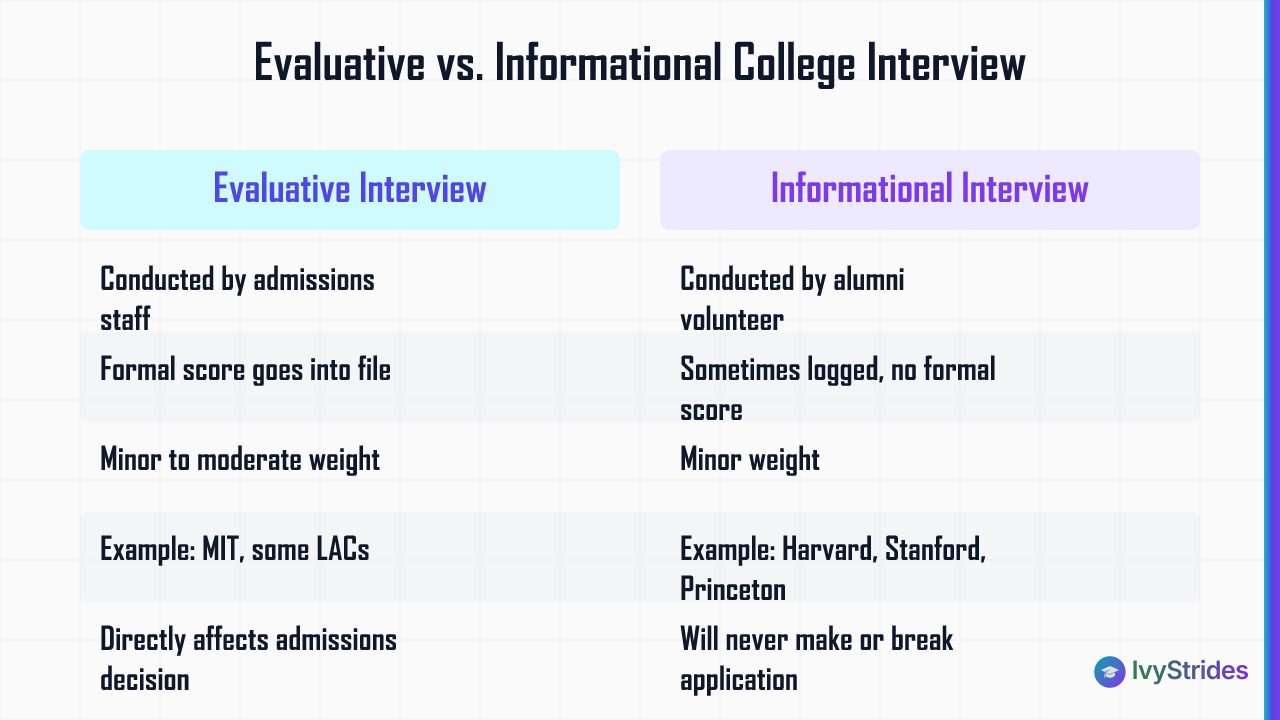
The college admissions interview carries minor weight at the vast majority of schools, and most colleges do not require one at all. Only about 2.7% of colleges require interviews, per admissions research from Alia Education. Everywhere else, the interview is optional, informational, or gone entirely.
Holistic review weighs your whole application together: GPA, course rigor, test scores, essays, recommendations, extracurriculars, and, if offered, the interview. Within that stack, the interview typically ranks last. Your transcript and essays carry the load.
Two interview types exist, and the difference decides how seriously to treat yours. An evaluative interview runs through admissions staff and produces a formal score that goes straight into your admissions file. An informational interview usually runs through an alumni volunteer, exists mostly to answer your questions and represent the school, and often carries no formal rating. Harvard's own guidance describes its alumni interviews as informational, stating the interview "will never make or break your application".
Check the Common Data Set. Each college publishes one, and Section C7 rates the "Interview" factor as Not Considered, Considered, or Important. Search "Common Data Set" plus the school name to see exactly where your target school places it.
| Interview Type | Conducted By | Goes Into File | Typical Weight | Example Schools |
| Evaluative | Admissions staff | Yes, formal score | Minor to moderate | MIT, some LACs |
| Informational (alumni) | Alumni volunteer | Sometimes, no score | Minor | Harvard, Stanford, Princeton |
| None offered | N/A | N/A | Zero | Many large publics |
Interview invitations typically arrive in October through December, which overlaps with the period when your essays and test scores are being finalized. That timing matters: the interview competes for hours you also owe your supplements.
One caveat before you calibrate anything. Interview policies vary by school and change year to year, so verify current policy on each college's admissions page rather than trusting last cycle's advice.
Can a College Interview Actually Hurt Your Application
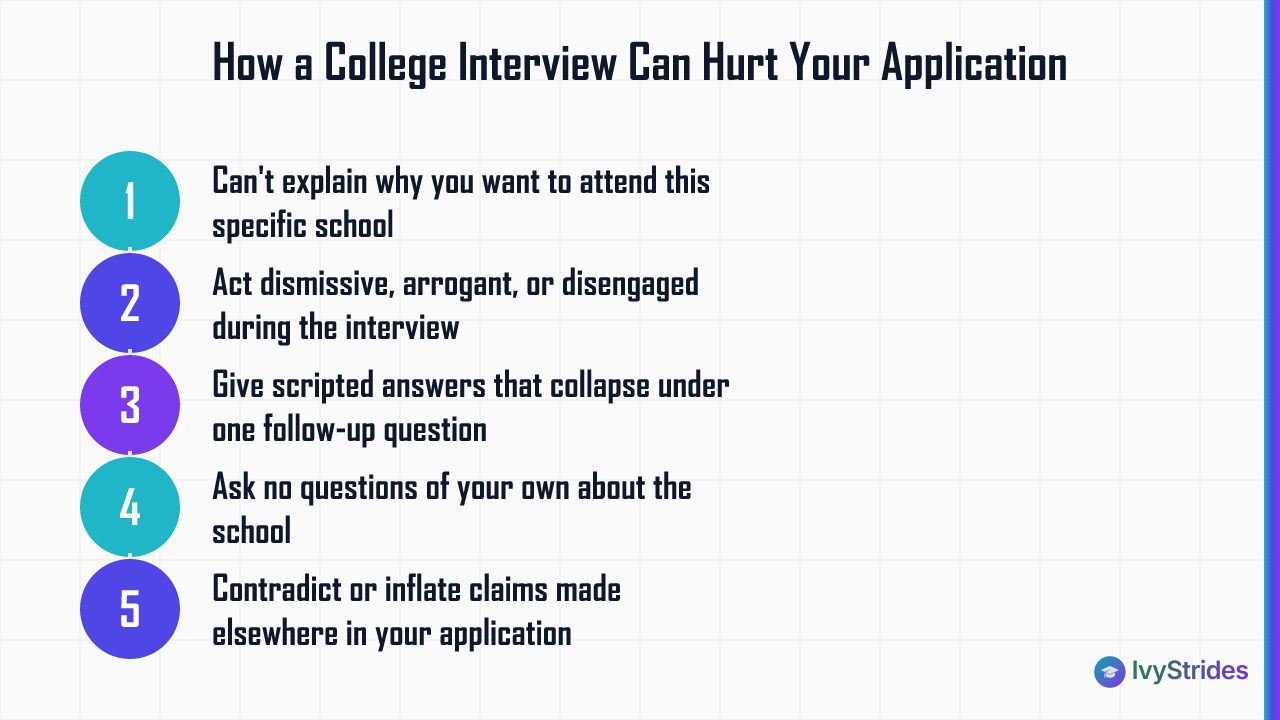
Yes, a college interview can hurt your application, but only when it goes notably wrong. The governing principle at most selective schools is do no harm: a good interview confirms what your file already shows, while a rude, disengaged, or clearly unprepared one generates a negative interview report that an admissions committee reads alongside everything else.
That same do-no-harm framing sits behind Harvard's line that the interview will never make or break your application. Read carefully, that describes a good interview. It does not promise that a dismissive or hostile one carries no cost, and interviewers do write down what they see.
The asymmetry is the whole point. A strong interview rarely lifts a borderline candidate over the line, but a poor one can pull an otherwise competitive application down, as International College Counselors frames it. You have more to lose from a bad twenty minutes than to gain from a brilliant one, which is exactly why basic preparation earns its place.
What actually lands in a negative report is rarely a wrong answer. It is attitude and preparation. Here are the red flags interviewers consistently report back to admissions offices:
- Cannot articulate a specific reason for wanting to attend this college
- Dismissive, arrogant, or rude toward the interviewer
- Visibly disengaged, distracted, or checking the time
- Rehearsed non-answers that collapse under a single follow-up question
- No questions of their own about the school
- Contradicts or inflates claims made elsewhere in the application
In our essay coaching work, students who treat the interview as a conversation about their genuine interests consistently earn stronger interviewer reports than those who memorize scripted answers. The scripted answer is the one that breaks on follow-up.
The preparation that prevents these red flags is straightforward, and we cover it step by step in our guide on how to prepare for a college interview. The short version: know why this school, and talk like a person. If that red-flag list surfaced a worry that your own answers are still too vague, our college essay coaching helps students build the specific stories that hold up in both the essay and the interview.
Not Sure Your Interview Stories Are Specific Enough to Land?
You have an invitation, a list of likely questions, and a real concern about whether your answers sound genuine or rehearsed. A free 15-minute call reads through the stories you plan to tell, pinpoints where they are too vague to survive a follow-up question, and hands you a focused revision path before the interview date.
What Getting a College Interview Invitation Actually Means
Getting a college interview invitation, at most schools, means an alumni interviewer is available in your area, not that you have been pre-selected or flagged as a top candidate. The invitation is a logistics outcome far more often than a verdict on your candidacy.
Because that invitation depends on volunteer availability rather than your file, the reverse also holds: not receiving one does not disadvantage you where interviews are not guaranteed. Harvard attempts to offer an interview to most applicants but cannot cover every student, particularly in regions with thin alumni networks, per its own admissions guidance. No interview offer, no penalty.
International applicants, take note. If you apply from a country or region with few local alumni volunteers, you may not be offered an interview at all. That gap reflects interviewer supply, not a weaker read on your application.
| School | Interview Availability | What an Invitation Signals | Not Receiving One Means |
| Harvard | Offered to most applicants | Alumni available in your area | No disadvantage |
| MIT | Offered widely, evaluative | Interviewer assigned | Contact admissions if concerned |
| Stanford | Optional, not guaranteed | Alumni available | No disadvantage |
| Princeton | Optional, alumni-conducted | Alumni available | No disadvantage |
Accepting an interview invitation is itself a demonstrated-interest signal at colleges that track enrollment likelihood, which connects the interview decision to the broader question of how colleges record your engagement. If your target school weighs demonstrated interest, declining a genuine offer sends the wrong signal. You can read how schools record and weight that signal in our guide to how colleges track demonstrated interest.
So accept the invitation. The downside of saying yes is a few hours; the downside of a no-show or a decline can be a soft negative you never see.
When a College Interview Can Actually Help Your Application
A college interview helps your application in three specific situations, and knowing them tells you where the preparation payoff actually is. First, as a tiebreaker. When two applicants present nearly identical profiles, an admissions committee can lean on the interview report to differentiate them, a pattern one college admissions platform describes as well. Because the interview differentiates rather than decides, it earns real weight only at highly selective schools where near-identical profiles are common.
Second, the interview humanizes a profile that reads like many others on paper. It is your one chance to share context a transcript and activities list cannot hold: the reason behind a dropped semester, the story behind an unusual project, the way you actually talk about what you care about.
Third, at schools that track it, the conversation reinforces demonstrated interest in a way a form submission cannot.
Here is the calibration that matters. While interviews carry minor weight at most schools, your personal statement and supplemental essays remain the highest-use written components you can still control before submission. Across students we have coached through selective college applications, the interview rarely changed an outcome that essays and scores had already set, though a dismissive or unprepared interview did generate negative reports in a small number of cases.
| Application Component | Typical Weight | Can You Still Improve It | Time Investment |
| Supplemental essays | High | Yes, before deadline | Most of your hours |
| Test scores | High | Only with a retest | Depends on open gaps |
| Personal statement | High | Yes, until submission | Substantial |
| Recommendations | Moderate | No, already requested | None |
| Interview | Minor | Yes, quick prep | 2 to 6 focused hours |
How many hours the interview actually warrants. Based on interview type and duration patterns, IvyStrides recommends roughly 2 to 4 hours of focused preparation for alumni informational interviews, which usually run 20 to 30 minutes, and about 4 to 6 hours for evaluative admissions-staff interviews, which run longer. Beyond that, you hit diminishing returns and start stealing time from higher-use work.
Put the rest of your energy where it moves the needle. If you have an open score gap or an unfinished supplement, that is the better use of the weekend. Our college application timeline for 2026-27 maps where the interview fits against your deadlines. Our breakdown of how many supplemental essays you will write helps you size the essay workload before you over-invest in interview prep.
Interview Prep Calibrated. Application Picture Still Incomplete?
You have the interview framework, the red-flag list, and a clear sense of how much prep time it warrants. A free 15-minute call reviews your full application, checks where your essays and any open score gaps stand against your target schools, and tells you where the remaining time is best spent.
FAQ: College Interview Weight and What an Invitation Means
What is the biggest red flag to hear when being interviewed?
The biggest red flag in a college interview is a dismissive or rude attitude toward the interviewer or the school. Interviewers consistently flag candidates who cannot articulate genuine interest in the college, give rehearsed non-answers, or appear disengaged. These behaviors generate negative reports that can weigh against an otherwise competitive application.
What does it mean if you get a college interview?
At most schools, an interview invitation means an alumni interviewer is available in your area, not that you have been pre-selected or flagged as a top candidate. At Harvard and similar schools, most applicants are offered interviews. Not receiving one does not disadvantage you where interviews are not guaranteed.
Is a 20-minute college interview good or bad?
A 20-minute college interview is typical for an alumni informational interview and is not a negative signal. Alumni volunteers often have limited time, and a shorter conversation does not indicate disinterest. Evaluative interviews with admissions staff tend to run longer, usually 30 to 45 minutes.
Do all applicants get a Harvard interview?
Harvard attempts to offer interviews to most applicants but cannot guarantee one for every student, particularly those in regions with limited alumni interviewer availability. Not receiving a Harvard interview invitation does not disadvantage your application. Harvard's own guidance confirms the interview is informational and will not make or break your candidacy.
Your Next Step on the Interview Question
The honest read: interviews are worth basic preparation and not worth a spiral. Accept the offer, prepare enough to clear the red flags, and spend the surplus hours where admissions weight actually lives.
- Accept the interview invitation, especially at schools that track demonstrated interest.
- Do about 2 to 4 hours of targeted prep for an alumni interview, 4 to 6 for an evaluative one.
- Focus that prep on a specific "why this school" and on stories that survive a follow-up.
- Redirect the rest of your application energy to unfinished essays and any open score gaps.
- Verify each school's current interview policy on its own admissions page before you plan.

Award-winning author (South Asian Book Award) and graduate of BITS Pilani and UCLA Luskin School of Public Affairs. Brings a published writer's eye to Common App essays and grammatical precision to SAT and ACT R&W instruction.