
How Many Questions Are on the PSAT? A Section-by-Section Count
On this page
- How Many Questions Are on the PSAT/NMSQT, Section by Section
- How the PSAT/NMSQT Question Count Compares to the SAT
- How Many Questions Can You Miss on the PSAT and Still Hit Your Score Target
- How to Use the PSAT Question Structure to Build Your Prep Plan
- FAQ: PSAT/NMSQT Question Count and Scoring
- How many questions wrong is a 1400 on the PSAT?
- Is the PSAT all multiple choice?
- How many questions are on the PSAT 8/9?
- How many questions can you miss on the PSAT for National Merit?
The PSAT/NMSQT is a 98-question digital exam that takes 2 hours and 14 minutes of testing time. It splits into two sections: Reading and Writing (54 questions, 64 minutes) and Math (44 questions, 70 minutes). Each section breaks into two equal modules.
College Board lists the same counts and timing for the PSAT 10 and the PSAT 8/9. The question count only matters once you know what it feeds: a section score, a total score, and, for juniors, the Selection Index that National Merit uses to screen entrants.

How Many Questions Are on the PSAT/NMSQT, Section by Section
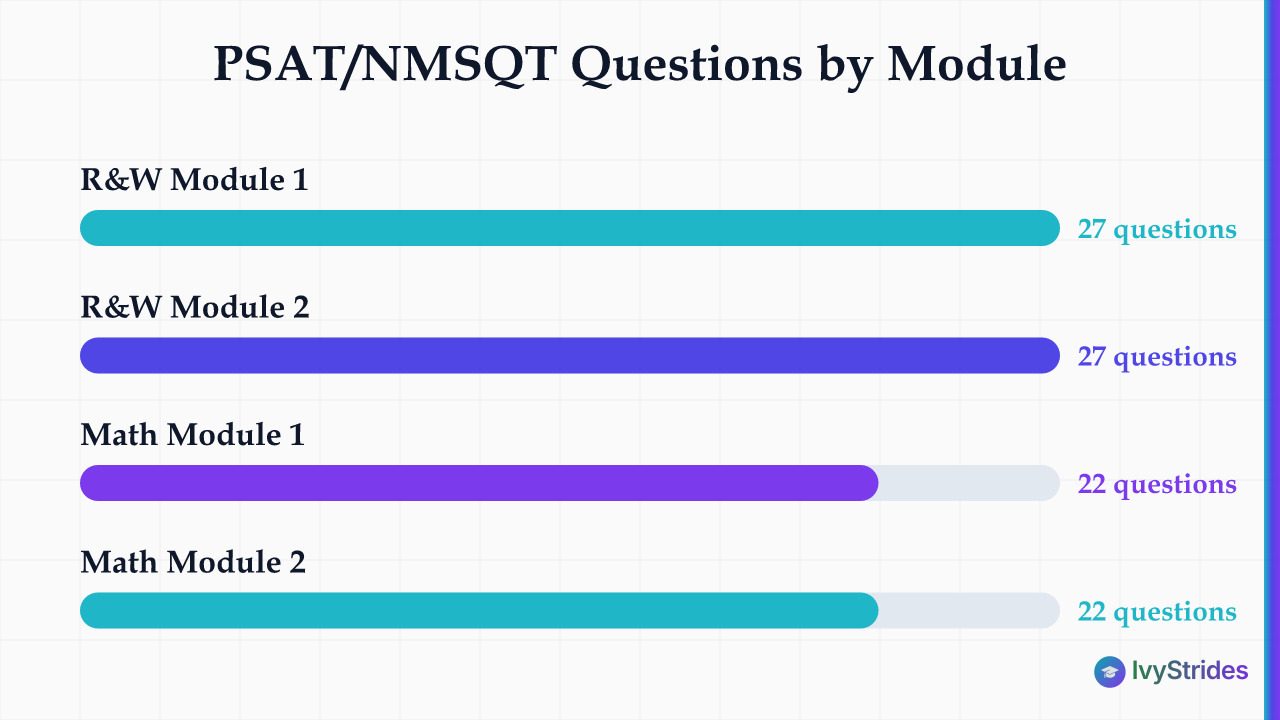
The PSAT/NMSQT carries 98 questions across two sections and four modules, delivered through College Board's Bluebook app. The Reading and Writing section holds 54 questions in 64 minutes, and the Math section holds 44 questions in 70 minutes.
That split gives you 27 questions in each Reading and Writing module and 22 questions in each Math module.
Pretest questions. Each module contains two pretest questions that do not count toward your score, per College Board. College Board embeds them to trial items for future tests. That leaves 25 scored questions in each Reading and Writing module, 20 in each Math module, and 90 across the test. You can't tell which two are pretest questions, so answer all of them as if they count.
| Section | Module | Questions | Time (min) | Approx. sec/question |
| Reading and Writing | Module 1 | 27 | 32 | about 71 |
| Reading and Writing | Module 2 | 27 | 32 | about 71 |
| Math | Module 1 | 22 | 35 | about 95 |
| Math | Module 2 | 22 | 35 | about 95 |
| Total | 4 modules | 98 | 134 | - |
IvyStrides' analysis of College Board's published timing (64 minutes for 54 Reading and Writing questions) puts the average pace at about 71 seconds per question; the Math section, at 70 minutes for 44 questions, runs about 95 seconds per question.
The adaptive piece. The PSAT/NMSQT is multistage adaptive by module. Module 2 difficulty adjusts based on your Module 1 performance: you're routed to an easier or harder set, a step central to how the PSAT is structured and timed across all four modules.
How the PSAT/NMSQT Question Count Compares to the SAT
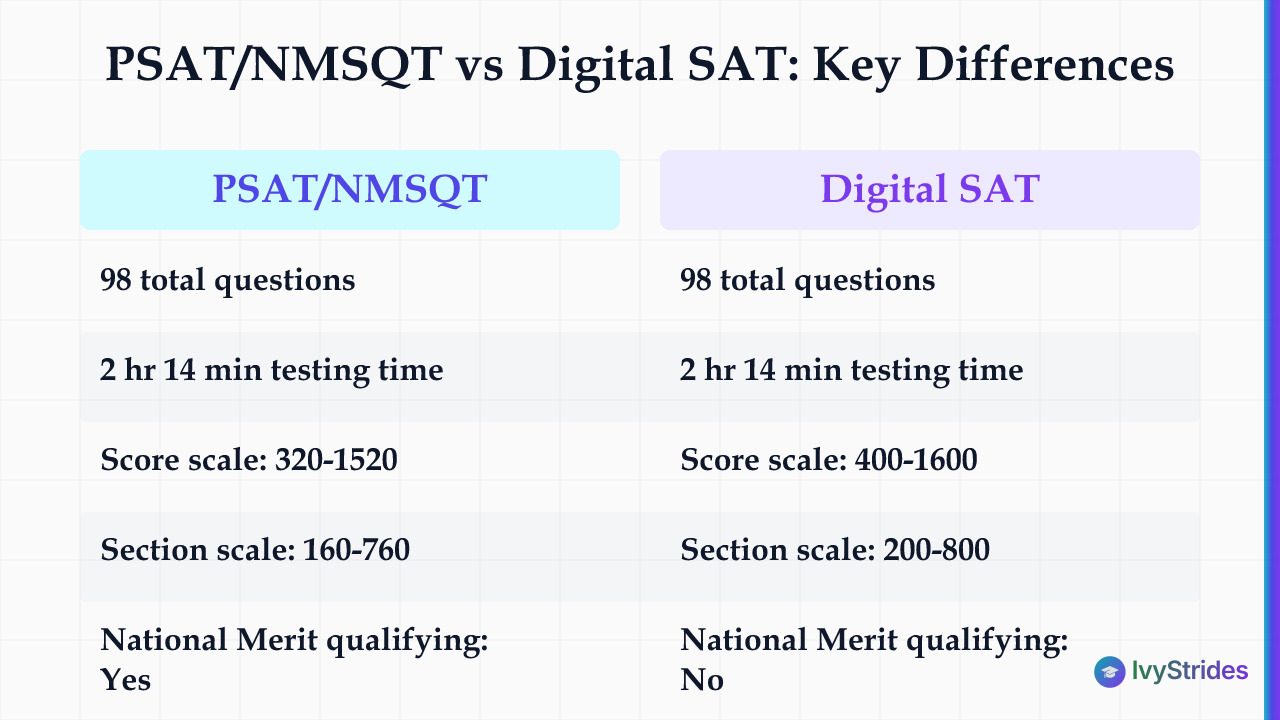
The PSAT/NMSQT uses the same two-section, four-module adaptive format as the Digital SAT, with 98 questions on each, but a lower score ceiling of 1520 rather than 1600. Both tests run 2 hours and 14 minutes of testing time.
Because the question counts match, the visible difference sits in the score scale. The PSAT/NMSQT reports a total of 320 to 1520 with each section on a 160 to 760 scale, while the SAT reports 400 to 1600 with sections of 200 to 800. College Board ties those ranges to grade-level appropriateness within a common score scale, a point at the heart of whether the PSAT is harder or easier than the SAT.
| Test | Total questions | Testing time | Score scale | National Merit qualifying |
| PSAT/NMSQT | 98 | 2 hr 14 min | 320–1520 | Yes |
| PSAT 10 | 98 | 2 hr 14 min | 320–1520 | No |
| Digital SAT | 98 | 2 hr 14 min | 400–1600 | No |
| PSAT 8/9 | 98 | 2 hr 14 min | 240–1440 | No |
No conversion step is needed. The SAT Suite, from the PSAT 8/9 through the SAT, uses a common score scale. A student with a 500 Math section score on the PSAT/NMSQT would be expected to get a 500 on the SAT on that same day, because a 500 represents the same level of academic achievement on all four tests. So your score needs no conversion and no fixed number of added points. A higher SAT score later shows growth, which College Board says likely comes from hard work in and out of school.
The PSAT 10 and the PSAT 8/9 match those counts and times. The PSAT 8/9 reports on a 240 to 1440 scale, though, one of several distinctions across the differences between PSAT 8/9, PSAT 10, and PSAT/NMSQT.
How Many Questions Can You Miss on the PSAT and Still Hit Your Score Target
No fixed number of missed questions maps to a given PSAT/NMSQT score, and College Board doesn't publish a raw-score chart for the adaptive test. Its scoring model weighs whether you answered each question right or wrong, the difficulty of those questions, and whether your pattern of answers suggests guessing. So two students with the same number of correct answers in a section can earn different section scores, and any chart tying a score to a set number of misses is an estimate.
A harder Module 2 isn't a bonus on its own: College Board says students aren't advantaged just for seeing harder questions, and a range of section scores is possible from either module. For most students, it's better to guess than leave a question blank.
Get your Daily IV Dose on Instagram: quick study tips and test-day advice for high school students. Follow @ivy.strides.
Every scored question feeds your section scores, and those feed the Selection Index that NMSC uses to identify 50,000 high scorers. The Selection Index doubles your Reading and Writing section score, adds your Math section score, and divides by 10.
| Reading and Writing | Math | Total score | Selection Index | What the row shows |
| 160 | 160 | 320 | 48 | Floor of the scale |
| 700 | 700 | 1400 | 210 | Even split at a 1400 |
| 720 | 680 | 1400 | 212 | Same 1400, more in Reading and Writing |
| 680 | 720 | 1400 | 208 | Same 1400, more in Math |
| 760 | 760 | 1520 | 228 | Ceiling of the scale |
These rows are worked examples of the formula, not score targets or cutoffs; the same total can come from different section splits, and the split changes the index. IvyStrides' analysis of the published formula and the 160 to 760 section range confirms the Selection Index runs from 48, which is (2×160+160)÷10, to 228, which is (2×760+760)÷10.
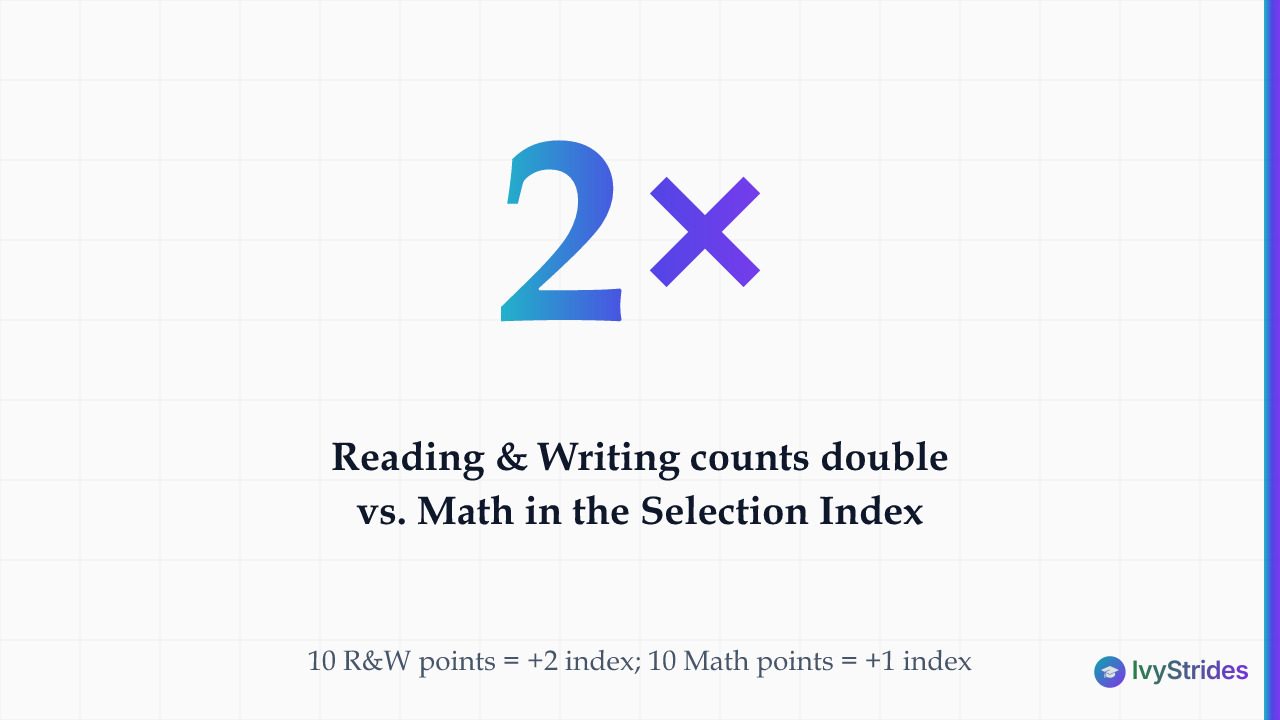
Reading and Writing counts double in the index. Because the formula doubles your Reading and Writing score before adding Math, 10 section points in Reading and Writing add 2 to the Selection Index, while 10 section points in Math add 1. Of the 50,000 high scorers NMSC identifies, about 34,000, more than two-thirds, become Commended Students.
NMSC names Commended Students on a national qualifying score that may vary from year to year, while Semifinalist qualifying scores vary from state to state and from year to year. Any cutoff you see before NMSC announces it is an estimate. Your report's percentiles add context too, since what a good PSAT score looks like by grade and percentile depends on the test takers you're compared with.
How to Use the PSAT Question Structure to Build Your Prep Plan
The PSAT/NMSQT score report tracks eight content domains, four in each section, and that's where a prep plan starts. Reading and Writing covers Information and Ideas, Craft and Structure, Expression of Ideas, and Standard English Conventions. Math covers Algebra, Advanced Math, Problem-Solving and Data Analysis, and Geometry and Trigonometry.
Once you know those eight domains, the next step is a timed diagnostic. In our coaching, every PSAT plan starts with one that maps which of the eight domain progress bars needs the most work before the student's next test.
The reason is practical: reading those eight bars before you start prep lets you aim at the one or two domains pulling hardest instead of spreading effort evenly across all 98 questions. IvyStrides' coaches start from that same read, with a diagnostic test and a custom study roadmap, through PSAT prep built around your domain progress bars.
The fall 2026 in-school testing window ran October 1 to October 30, 2026, and College Board's release schedule lists student scores on October 22, November 5 or November 12, 2026, depending on when you submitted your answers; state testing programs can differ. The next in-school window, for the PSAT 10 and PSAT 8/9, runs March 1 to April 30, 2027. The eight domain areas are the starting point for deciding how long to study for the PSAT and what a realistic schedule looks like before your next test.
Your school handles registration, so ask there about what the PSAT costs and whether your school covers the fee. The 2026-27 list price for the PSAT/NMSQT and PSAT 10 is $18 per student, and some districts and schools cover all or part of it.
Daily SAT and ACT prep on YouTube: short strategy videos from IvyStrides. Subscribe to IvyStrides on YouTube.
Your next step depends on where you stand after the fall 2026 window:
- Juniors who tested: NMSC considers your 2026 Selection Index for the 2028 competition, and high scorers hear through their schools in September 2027. Your section scores also give you an SAT starting point, with test dates on December 5, 2026, and March 6, May 1 and June 5, 2027.
- Juniors who missed the test: if illness, an emergency or another extenuating circumstance kept you out, write to NMSC by April 1, 2027, to request another route of entry.
- Sophomores: on the usual four-year path, the PSAT/NMSQT you take in 2027 as a junior is the one that enters you in National Merit.
- Students testing in spring: ask whether your school offers the PSAT 10 or PSAT 8/9, then sit a timed, full-length practice test at about 71 seconds per Reading and Writing question and about 95 per Math question.
FAQ: PSAT/NMSQT Question Count and Scoring
How many questions wrong is a 1400 on the PSAT?
There's no fixed wrong-answer count for a 1400, because the PSAT/NMSQT is adaptive and your score depends on the difficulty of the questions you answered, not a simple tally. College Board doesn't publish a chart that ties a 1400 to a set number of misses.
Is the PSAT all multiple choice?
Most PSAT/NMSQT questions are four-option multiple choice, but about 25% of the Math section is student-produced response questions, where you enter your own answer instead of selecting a choice. Every Reading and Writing question is multiple choice, and the PSAT/NMSQT has no essay.
How many questions are on the PSAT 8/9?
The PSAT 8/9 takes 2 hours and 14 minutes and has 98 questions, 54 in Reading and Writing and 44 in Math, the same as the PSAT/NMSQT. Its score scale runs 240 to 1440 rather than 320 to 1520, with section scores from 120 to 720. The PSAT 8/9 doesn't qualify for the National Merit Scholarship Program; only the PSAT/NMSQT does.
How many questions can you miss on the PSAT for National Merit?
No official number of misses exists for National Merit, and NMSC's qualifying scores can change each year, with Semifinalist scores also varying by state. Because the Selection Index doubles the Reading and Writing section score before adding Math, 10 section points in Reading and Writing add twice as much as 10 in Math.

Rajesh is a technology leader, entrepreneur, and angel investor with 28+ years in Business & Technology Leadership and Product & Solution Engineering. He is passionate about education, mentoring, and driving digital transformation.